






Label-Free Shotgun Proteomics as a Strategy for Global Protein Quantification
Label-free shotgun proteomics is a global relative quantification strategy that digests complex protein mixtures into peptides, acquires each unlabeled sample as an independent liquid chromatography-tandem mass spectrometry (LC-MS/MS) run, identifies peptides by database search, and compares the same proteins across samples from intensity features or related metrics. Shotgun means bottom-up, open discovery without a predefined peptide panel. Label-free means no isotopic or chemical tags such as tandem mass tags (TMT) or SILAC. Acquisition may be data-dependent (DDA) or data-independent (DIA); both sit inside the same unlabeled shotgun strategy. The valid claim is same-protein relative change inside one coherent plan, not absolute concentration and not cross-protein molar ranking (Cox et al. 2014).
Researchers who already have unlabeled samples or a defined discovery cohort can also review the MtoZ Biolabs Label-Free Quantitative Proteomics Service for project-specific feasibility and analysis planning.
What the Strategy Combines
Label-free shotgun is best understood as three decisions held together.
|
Strategy layer |
What it specifies |
What it does not specify |
|---|---|---|
|
Shotgun / bottom-up |
Digest proteins; identify peptides; infer proteins |
Targeted MRM/PRM closed panels |
|
Label-free |
No isotopic or isobaric labeling chemistry |
Whether acquisition is DDA or DIA |
|
Global quantification |
Open relative discovery across the measurable proteome |
Absolute units without standards |
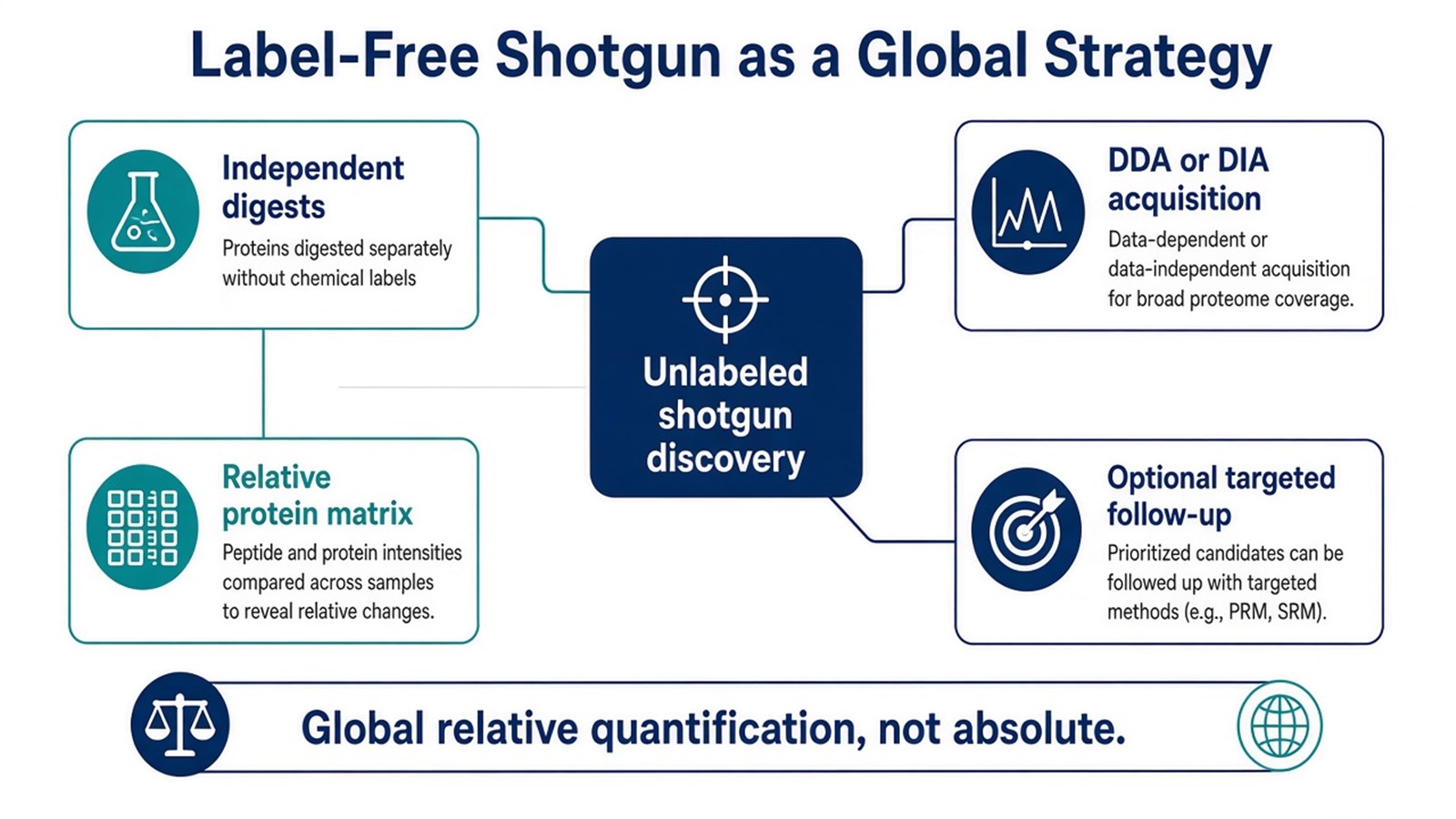
Figure 1. Label-free shotgun is a global relative strategy: open unlabeled discovery first, with optional targeted follow-up after the shortlist is closed.
Global here means open discovery scope, not a guarantee that every protein in the proteome is measured cleanly.
How the Strategy Is Executed
1. Prepare independent unlabeled digests
Extract, digest, and clean up samples under one protocol. Matched loading and digestion quality bound later ratios. Labeling failures are avoided by design; run-to-run technical risk is accepted instead.
2. Acquire shotgun LC-MS/MS
Separate peptides by liquid chromatography and collect MS/MS evidence. DDA selects intense precursors in real time and commonly feeds MaxLFQ-style MS1 quantification. DIA fragments scheduled windows and recovers fragment chromatograms, including SWATH-style library routes (Gillet et al. 2012). Choose acquisition from missing-value and interference trade-offs, not from the shotgun label alone.
3. Search, quantify, and summarize globally
Identify peptides against a protein database, align features across runs, normalize under a declared rule, and summarize to a protein-level relative matrix. Peak-area or intensity-based LFQ is the default for discovery statistics. Spectral counting is coarser. Intensity-based absolute proxies such as iBAQ answer within-sample ranking questions and should not be substituted for cross-sample LFQ contrasts without stating the change in claim.
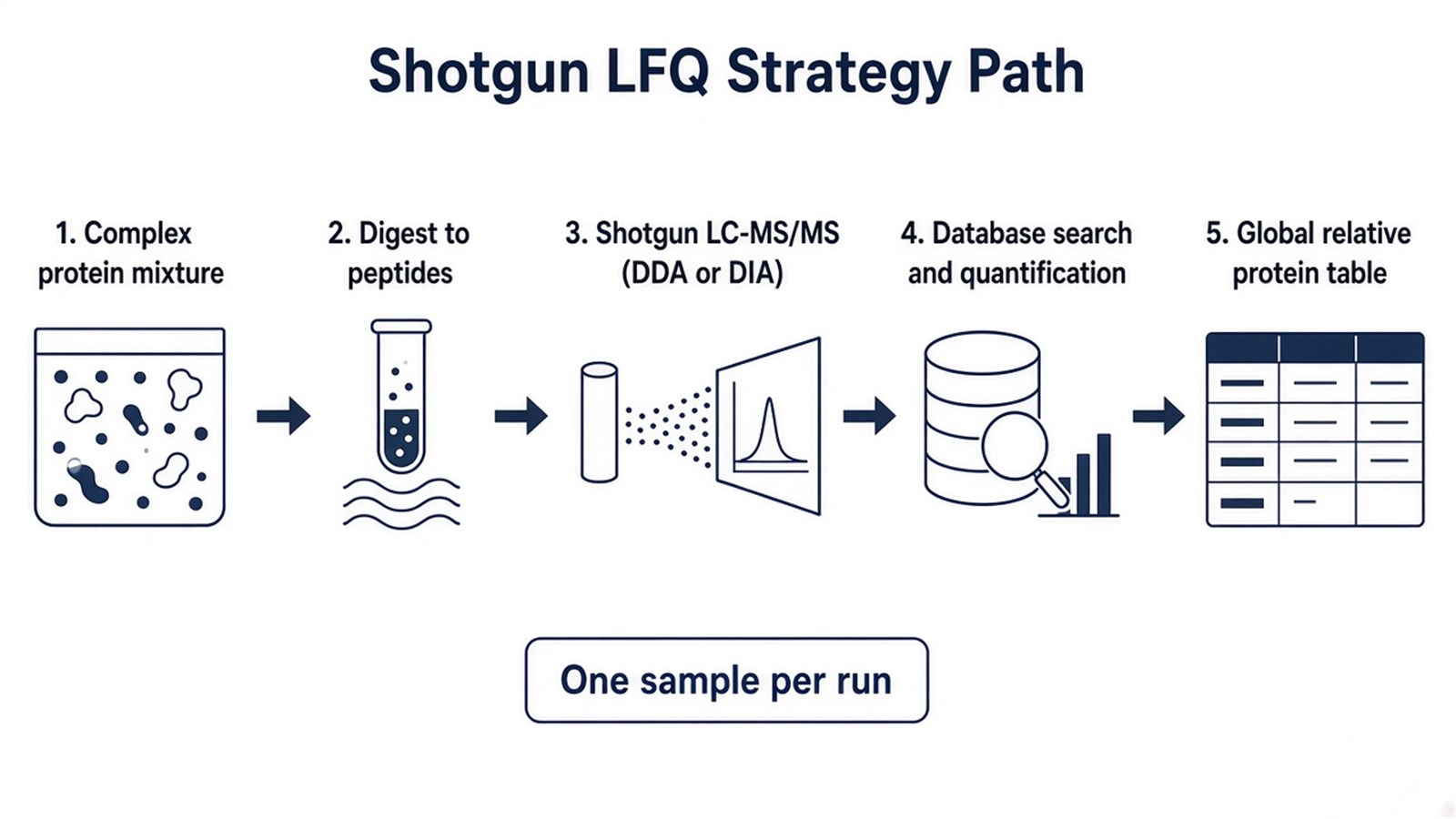
Figure 2. The shotgun LFQ path keeps one sample per run and builds a global relative protein table after search, alignment, and normalization.
For operational step detail, researchers can refer to What Is Label-Free Analysis? LFQ Principles, Workflow, Advantages, and Limitations. For definition-level LFQ framing, see What Is Label-Free Quantification in Proteomics?.
Judgment Criteria: When Label-Free Shotgun Fits
|
Study need |
Strategy often fits |
Reassess before committing |
|---|---|---|
|
Scope |
Global relative discovery without predefined targets |
Closed peptide panel already decided |
|
Chemistry |
Samples should stay unlabeled and independent |
Closed TMT plex and amine labeling are preferred |
|
Claim |
Same-protein fold changes across a coherent cohort |
Absolute concentration or diagnostic cutoff |
|
Acquisition support |
DDA-LFQ or unlabeled DIA tooling available |
No stable chromatography or batch plan |
|
Follow-up |
Shortlist can later enter PRM/MRM if needed |
Expect shotgun alone to deliver clinical cutoffs |
Prefer label-free shotgun when the scientific question still needs an open protein inventory and relative ranking across independent samples. Prefer TMT when a frozen multiplex kit and same-run comparison fit better. Prefer MRM or PRM, with stable isotope-labeled standards when absolute units are required, after targets are closed.
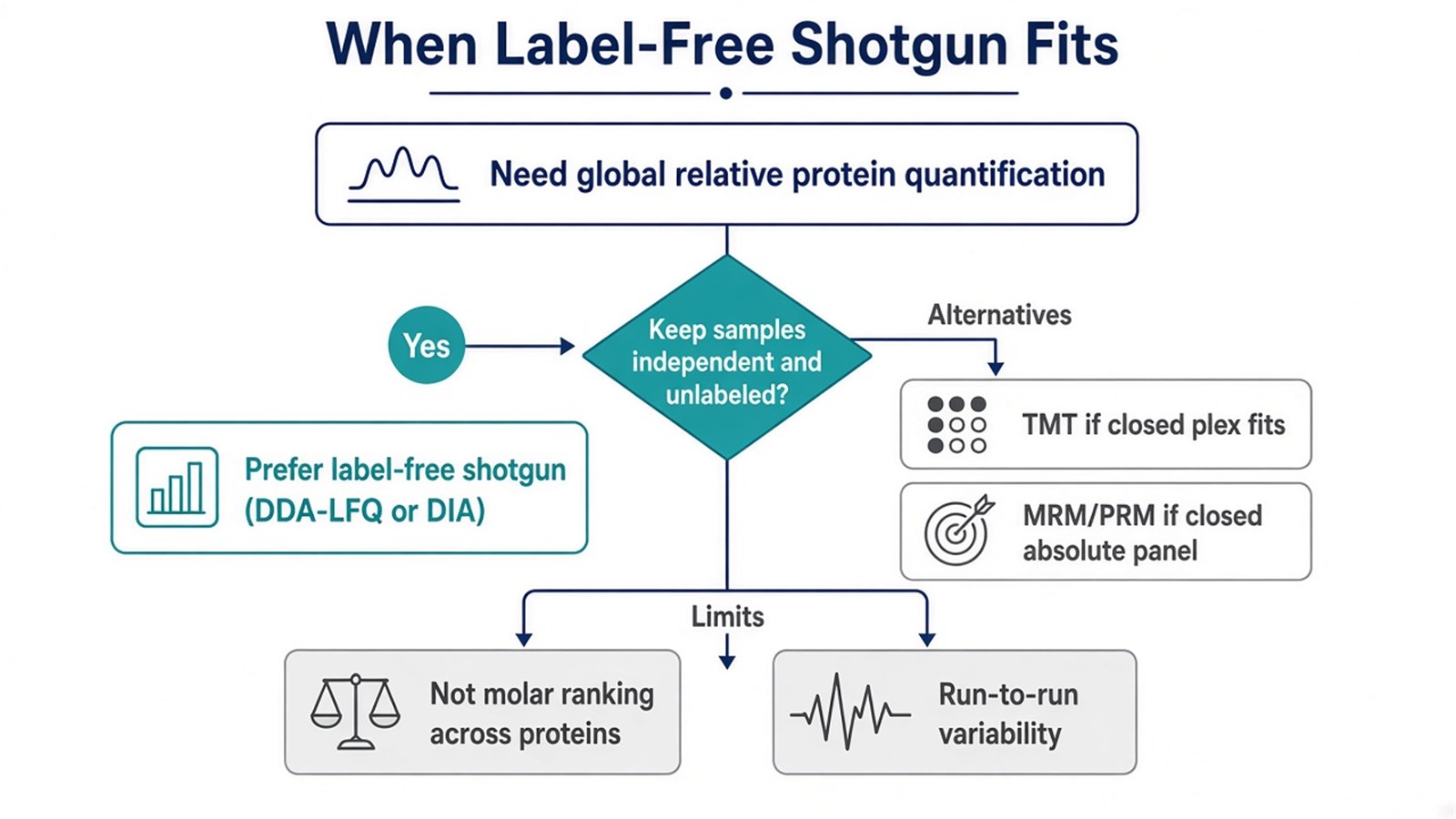
Figure 3. Use label-free shotgun for global relative quantification with independent unlabeled samples; change strategy when the claim requires a closed plex or absolute panel.
Limits and Application Boundaries
Independent injections make chromatography, ion-source stability, and run order part of the quantitative risk. Low-abundance proteins may remain sparse. Missing values are common in DDA shotgun matrices; DIA reduces stochastic gaps but adds window interference. Ordinary LFQ intensities do not report tissue concentration or rank protein A against protein B by molar amount. Pathway enrichment on a candidate list reflects overrepresentation relative to a quantified background. It does not prove pathway activity.
Typical applications are disease-mechanism screens, drug-response discovery cohorts, tissue-state comparisons, and biofluid biomarker candidate discovery that stay at relative claims. Diagnostic cutoffs sit outside ordinary shotgun LFQ reporting unless a separately validated assay framework is in place.
Once sample chemistry, acquisition mode, normalization plan, and the global relative claim are defined, the project can be evaluated as a label-free shotgun study. Researchers can review the MtoZ Biolabs Label-Free Quantitative Proteomics Service for sample evaluation, feasibility assessment, and workflow planning. For unlabeled DIA options inside the same strategy, see Label-Free DIA Quantitative Proteomics. For design-level trade-offs, see Advantages and Disadvantages of Label-Free Quantitative Proteomics.
Frequently Asked Questions
1. Is label-free shotgun the same as DIA?
No. Shotgun and label-free name discovery scope and labeling chemistry. DIA is one acquisition mode that can be used inside that strategy; DDA is the other common mode.
2. Does global quantification mean the whole proteome is absolute?
No. Global means open discovery scope. Quantities remain relative unless standards and calibration are added.
3. How does this strategy differ from targeted proteomics?
Targeted methods measure a closed peptide list. Shotgun discovers and quantifies without requiring that list up front.
4. Can iBAQ replace LFQ in this strategy?
Not for cross-sample relative contrasts. iBAQ-style proxies address within-sample abundance ranking under model assumptions.
5. When should a shotgun LFQ study add PRM or MRM?
When a shortlist needs fragment-level confirmation or absolute units that the discovery matrix cannot defend.
Reference
- J. Cox, M.Y. Hein, C.A. Luber, I. Paron, N. Nagaraj, M. Mann (2014). Accurate proteome-wide label-free quantification by delayed normalization and maximal peptide ratio extraction, termed MaxLFQ. Mol. Cell. Proteomics, 13, 2513-2526. https://doi.org/10.1074/mcp.M113.031591
- L.C. Gillet, P. Navarro, S. Tate, H. Rost, N. Selevsek, L. Reiter, R. Bonner, R. Aebersold (2012). Targeted data extraction of the MS/MS spectra generated by data-independent acquisition: a new concept for consistent and accurate proteome analysis. Mol. Cell. Proteomics, 11, O111.016717. https://doi.org/10.1074/mcp.O111.016717
How to order?




