






In Which Biological Samples Can Acylation Proteomics Be Applied?
Acylation proteomics, an important branch of epigenetics and protein post-translational modification (PTM) research, has rapidly advanced with the development of mass spectrometry technologies. It enables the systematic characterization of diverse acyl modifications on proteins, including acetylation, propionylation, butyrylation, and succinylation. Investigation of these modifications provides critical insights into cellular metabolic states, signaling pathway regulation, and disease mechanisms. However, the low abundance and dynamic nature of acylation modifications mean that sample type and processing strategies profoundly influence experimental outcomes. Various biological samples can be utilized for acylation proteomics, and common sample types are summarized below according to research objectives and availability.
Common Sample Types for Acylation Proteomics
1. Cell Samples
Cell lines are the most widely used model systems in acylation studies due to their experimental flexibility, scalability, and precise control of variables.
-
Common cell lines: HEK293, HeLa, A549, RAW264.7
-
Primary cells: hepatocytes, neurons, and immune cells derived from human or animal sources
(1) Applications
-
Comparative analysis of acylation changes before and after drug treatment
-
Knockout or overexpression-based regulatory studies
-
Stable isotope labeling (SILAC)-based quantitative analysis
(2) Considerations
- Deacylase inhibitors (e.g., TSA, NAM) must be added during cell lysis to prevent loss of modifications. In addition, all procedures should be performed under cold-chain conditions to preserve protein integrity and modification status
2. Animal Tissue Samples
Animal tissues exhibit higher physiological relevance and are well suited for investigating the regulatory roles of acylation in specific organs or disease models.
-
Common tissues: liver, brain, heart, kidney, skeletal muscle, and small intestine
-
Model organisms: mice, rats, zebrafish
(1) Applications
-
Profiling acylation in liver metabolic disease models
-
Investigating protein modification changes in brain tissues of neurodegenerative diseases
-
Integrative multi-omics analyses in combination with transcriptomics and metabolomics
(2) Considerations
- Tissues should be snap-frozen in liquid nitrogen immediately after collection. Low-temperature homogenization is recommended for total protein extraction, combined with highly denaturing lysis buffers to minimize interference from enzymatic activities affecting modifications
3. Clinical Samples
Clinical samples are essential for translating basic research into practical applications, particularly for the discovery and validation of acylation-based biomarkers.
-
Tumor tissues: breast, lung, liver, and gastric cancers
-
Biofluids: plasma, serum, urine, cerebrospinal fluid, and saliva
-
Peripheral blood mononuclear cells (PBMCs): offering both convenient accessibility and immunological relevance
(1) Applications
-
Comparative analysis of acylation profiles between cancer patients and healthy controls
-
Integrated multi-omics approaches to identify potential diagnostic and prognostic biomarkers
-
High-sensitivity analysis of low-volume samples (e.g., enrichment of acylated peptides from serum)
(2) Considerations
- Due to substantial sample heterogeneity, standardized preprocessing workflows are essential. Baitai Biotech provides customized small-batch enrichment and analytical services for clinical samples, particularly suited for exploratory studies
4. Model Organism Samples
Genetically engineered animals or model organisms enable in-depth investigation of dynamic changes in specific modifications across developmental stages, tissues, or stress conditions.
-
Gene knockout mouse models (e.g., Sirt3-KO mice for studying mitochondrial deacetylation)
-
Drosophila and nematodes for high-throughput screening
-
Zebrafish for investigating protein modification dynamics during early development
(1) Applications
-
Functional validation of enzymes (e.g., deacylases and acyltransferases)
-
Studies on the association between metabolic states (e.g., fasting or high-fat diet) and acylation modifications
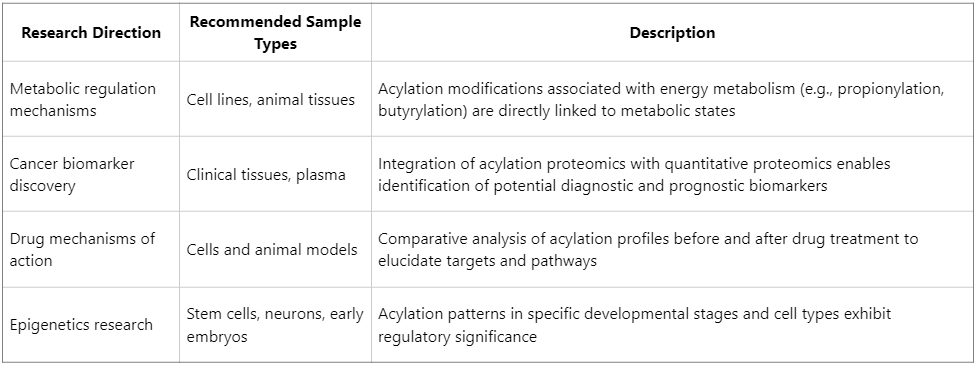
Sample Selection Recommendations
The choice of sample type should be tailored to specific research objectives:
MtoZ Biolabs: One-Stop Acylation Proteomics Solutions
In acylation research, each step from sample selection and preprocessing to mass spectrometry analysis critically determines data depth and accuracy. By leveraging proprietary high-efficiency enrichment platforms and advanced mass spectrometry systems, MtoZ Biolabs offers the following services:
1. Broad Sample Compatibility
-
Supports acylation proteomics analysis of cells, tissues, biofluids, and clinical samples
-
Provides customized preprocessing and enrichment strategies suitable for low-input samples
2. Multiplex Modification Detection
-
Enables parallel detection of multiple acyl modifications, including acetylation, propionylation, butyrylation, and succinylation
-
Integrates quantitative strategies such as TMT, iTRAQ, and SILAC to enhance data interpretability
3. Comprehensive Bioinformatics Analysis
-
Identification of differentially modified proteins, GO/KEGG functional annotation, and pathway enrichment analysis
-
Visualization of acylation site distribution, along with heatmaps and volcano plots
4. Multi-Omics Integration
- Integration with proteomics, metabolomics, and transcriptomics to improve the systematic nature of research
Whether for mechanistic studies or clinical translation, appropriate sample selection represents the first critical step in successful acylation proteomics. By aligning research objectives, sample availability, and technical requirements, and implementing standardized workflows, researchers can ensure high-quality data acquisition and robust downstream bioinformatics analyses. MtoZ Biolabs provides tailored acylation proteomics solutions to facilitate the elucidation of molecular mechanisms underlying protein modifications in health and disease. For specific sample preparation or project design needs, consultation with the professional technical team is recommended.
MtoZ Biolabs, an integrated chromatography and mass spectrometry (MS) services provider.
Related Services
How to order?




