






How to Select a Plant Proteomics Workflow Based on the Research Question
A drought-response study and a hormone-signaling study may use the same plant species and tissue, yet they do not require the same proteomics workflow. One is primarily concerned with changes in protein abundance. The other may depend on phosphorylation events that occur before total protein levels begin to shift.
This distinction is easy to overlook when workflow planning starts with a platform choice such as DIA, TMT, or label-free analysis. These methods define how proteins are measured, but they do not define what the experiment needs to measure.
A more useful starting point is the biological question: Does the study require information about protein abundance, post-translational regulation, protein interactions, or a defined set of candidate proteins?
Key Takeaways
- Use quantitative proteomics to compare broad changes in protein abundance.
- Use PTM proteomics when regulation may occur without a change in total protein level.
- Use interaction proteomics to identify proteins associated with a target protein or complex.
- Move to targeted proteomics when the candidate list has already been narrowed.
- Select DIA, label-free DDA, or TMT only after the sample structure and comparisons are defined.
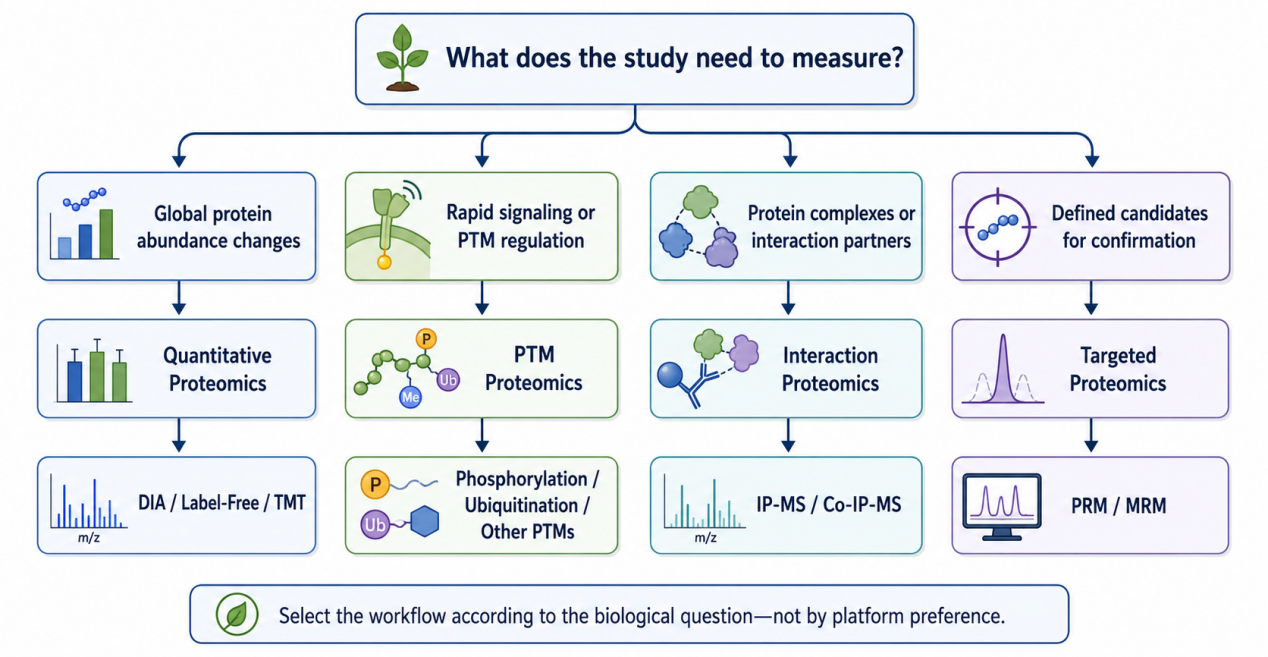
Figure 1. Plant proteomics workflow selection based on the research question
Start with the Biological Question
Different proteomics workflows generate different types of evidence. A change in protein abundance is not equivalent to pathway activation. Co-expression does not establish a protein interaction, and enrichment in an IP-MS experiment does not by itself demonstrate direct binding.
The expected conclusion should therefore be defined before the analytical route is selected.
| Recommended Workflow | Primary Measurement | Critical Design Issue | |
|---|---|---|---|
| Compare plants across treatments, genotypes, tissues, or developmental stages | Quantitative proteomics | Relative protein abundance | Biological replication and matched comparisons |
| Investigate rapid signaling or modification-dependent regulation | PTM proteomics | Modified peptides and sites | Sampling time, modification stability, and enrichment |
| Identify proteins associated with a target protein | Interaction proteomics | Co-enriched proteins | Enrichment specificity, controls, and replication |
| Confirm selected candidates in additional samples | Targeted proteomics | Defined peptides or proteins | Peptide specificity and analytical reproducibility |
| Improve detection of low-abundance regulators | Fractionation, enrichment, or targeted analysis | Lower-abundance proteins or peptides |
The table provides a first decision point, but the final workflow must also account for the plant material, sample number, treatment design, and expected biological timescale.
Choose the Protein Layer to Measure
1. Global Protein Abundance
Quantitative proteomics is the logical starting point when the study asks which proteins differ between defined biological groups.
This applies to comparisons involving drought, salinity, temperature, pathogen exposure, cultivar resistance, developmental stages, gene mutation, or external treatment. The typical output is a set of proteins with relative abundance differences that can be examined through pathway analysis, clustering, functional annotation, and integration with phenotype data.
The value of this workflow depends on the comparison being biologically interpretable. A large differential protein list cannot correct for inconsistent tissue collection, unmatched controls, or insufficient biological replication.
Quantitative proteomics also has a clear boundary. It mainly describes how much protein is detected. It does not directly reveal whether a protein has been activated through phosphorylation, destabilized through ubiquitination, or recruited into a new complex.
2. Post-Translational Regulation
Plant responses to hormones, pathogens, light, temperature, and osmotic stress often begin through modification of existing proteins rather than immediate synthesis of new ones. Phosphorylation is particularly important in plant signaling, while ubiquitination, acetylation, methylation, and other modifications can affect protein activity, stability, and interactions.
PTM proteomics is therefore more appropriate when the research question concerns:
- Early signaling events;
- Kinase or phosphatase activity;
- Modification-dependent protein regulation;
- Protein turnover;
- Regulatory changes that occur without a corresponding shift in total protein abundance.
Timing becomes part of the analytical workflow. A phosphorylation event may appear shortly after stimulation and decline before a visible phenotype develops. Collecting only late samples can capture downstream abundance changes while missing the signaling event that initiated them.
PTM results also need protein-level context. An increase in a phosphopeptide may reflect greater phosphorylation, an increase in the corresponding protein, or both. Parallel analysis of the total proteome can help distinguish these possibilities.
Large-scale plant phosphoproteomics remains technically demanding because modified peptides are often present at relatively low abundance and require enrichment before LC-MS/MS analysis. Sample handling, enrichment performance, and modification preservation can therefore influence the biological picture obtained.
3. Protein Interactions
Quantitative proteomics can show that two proteins respond to the same condition, but it cannot determine whether they occur in the same protein complex.
IP-MS, Co-IP-MS, and affinity purification-MS are more appropriate when the objective is to identify proteins associated with a target protein, determine whether complex composition changes after treatment, or evaluate how a mutation affects candidate interactions.
The analytical challenge is separating specific enrichment from background binding. Proteins may bind nonspecifically to antibodies, beads, affinity tags, or other abundant components in the plant extract.
Suitable controls depend on the experimental system and may include IgG, tag-only, empty-vector, mock-enrichment, or target-deficient controls. Replicates and quantitative comparison with controls are more informative than simply removing proteins from a generic contaminant list. Plant AP-MS protocols likewise emphasize bait expression, complex stability, enrichment efficiency, and data quality control.
The final output should be treated as a prioritized list of candidate associations. Co-enrichment does not prove direct binding, and follow-up biochemical, genetic, or functional evidence may still be required.
4. Targeted Candidate Measurement
Once discovery proteomics has reduced the problem to a defined set of proteins, repeating another broad discovery experiment may add little value.
PRM or MRM can provide a more focused route for measuring selected candidates across additional plant samples. This is useful for following proteins across cultivars, treatments, developmental stages, or larger sample sets.
Peptide selection is especially important in plants because large gene families often contain highly homologous proteins. A peptide shared by several family members may generate a reliable signal but fail to identify which protein has changed.
Target peptides should therefore be evaluated for uniqueness, detectability, chromatographic behavior, interference, and reproducibility. Plant-specific targeted proteomics studies have shown that signature peptide selection and method optimization are central to assay performance.
Match Quantification to the Study Design
DIA, label-free DDA, and TMT are not separate biological workflows. They are alternative strategies for quantitative measurement within a broader experimental design.
DIA is often useful for larger sample sets, time-course studies, and projects that may expand. Systematic acquisition can improve quantitative consistency and reduce missing data, although performance still depends on stable chromatography, quality control, and data processing.
Label-free DDA offers flexible sample arrangement and avoids a labeling step. It can work well for exploratory studies or relatively simple comparisons, but stochastic precursor selection can contribute to missing values and between-run variation.
TMT enables multiplexed analysis of several samples in the same experiment and can reduce missingness within a multiplex. The design must account for the available channel capacity, cross-batch bridging, and ratio compression caused by co-isolated peptide signals.
The choice should follow the sample design rather than determine it. First define the biological groups, replication, time points, and primary comparisons. Then select the quantitative strategy that can support those comparisons.
Account for Plant-Specific Sample Challenges
Plant tissues are not interchangeable proteomics matrices. Leaves, fruits, seeds, roots, and lignified materials differ in structural properties and chemical composition.
Depending on the material, extracts may contain pigments, polyphenols, polysaccharides, lipids, organic acids, proteases, oxidative enzymes, and highly abundant storage or photosynthetic proteins. These components can interfere with protein recovery, digestion, chromatographic separation, and ionization.
A method that produces a high apparent protein yield is not necessarily suitable for LC-MS/MS. Residual detergent, salts, phenolics, pigments, or carbohydrates may reduce digestion efficiency or suppress peptide signals.
Sample preparation should therefore be evaluated by several criteria:
- Reproducibility across biological samples;
- Protein integrity and recovery;
- Removal of interfering compounds;
- Compatibility with enzymatic digestion;
- Suitability for downstream enrichment or quantification.
The sampling procedure is equally important. Plant protein expression can vary with genotype, developmental stage, tissue position, light exposure, water availability, temperature, and circadian timing.
Biological replicates should represent independently grown or treated biological units. Pooling several plants may provide enough material for analysis, but the pooled material remains one biological replicate.
Time-course studies also require matched controls. Without a control at each relevant time point, treatment effects may be difficult to distinguish from normal development or circadian variation.
Plan the Path from Discovery to Validation
A plant proteomics workflow should not end with the production of a long protein list.
Before the experiment begins, it is useful to consider how candidates will be prioritized and what evidence will be required next. Depending on the research question, follow-up may involve targeted proteomics, immunological assays, biochemical analysis, genetic materials, or functional experiments.
This planning also helps prevent unnecessary workflow expansion. A project does not automatically become stronger by combining global proteomics, phosphoproteomics, interaction proteomics, and metabolomics. Each additional layer should address a defined gap in the biological argument.
The most useful workflow is the one that:
- Measures the protein layer relevant to the question;
- Fits the biological timescale;
- Accounts for the properties of the plant material;
- Supports the required comparisons;
- Produces candidates that can be interpreted and followed up.
For plant proteomics projects involving quantitative strategy selection, PTM analysis, protein interaction research, or candidate validation, researchers can discuss the plant species, tissue type, treatment conditions, experimental groups, and research objectives with MtoZ Biolabs to evaluate an appropriate workflow.
MtoZ Biolabs, an integrated chromatography and mass spectrometry (MS) services provider.
Related Services
How to order?




