






How to Optimize Sample Preparation and Digestion in Shotgun Proteomics?
In shotgun proteomics, while mass spectrometer performance is essential, upstream sample preparation and proteolytic digestion strategies are often the primary determinants of overall experimental quality. This is particularly critical when handling complex and highly heterogeneous biological samples (e.g., tissues, biofluids, and clinical specimens), where appropriate pretreatment directly impacts protein extraction efficiency, peptide coverage, and the total number of protein identifications.
Sample Pretreatment
1. Sample Lysis: Maximizing Total Protein Recovery
Lysis conditions vary substantially depending on sample type in shotgun proteomics:
-
Cell samples: Typically lysed using buffers containing SDS or urea, combined with ultrasonication or mechanical homogenization
-
Tissue samples: Require cryogenic grinding prior to lysis, followed by treatment with strong lysis buffers (e.g., RIPA or 8 M urea) to ensure efficient disruption of cellular structures
-
Serum/plasma: Due to the presence of high-abundance proteins, depletion or enrichment steps (e.g., albumin/globulin removal) are recommended to reduce interference
Optimization recommendations
-
Perform all procedures at low temperature to minimize protein degradation.
-
Incorporate protease and phosphatase inhibitors to preserve post-translational modifications (PTMs)
-
Employ filter-aided sample preparation (FASP) or magnetic bead-based methods (e.g., SP3) to enhance lysis efficiency and downstream compatibility.
2. Protein Quantification: Ensuring Accurate Input and Batch Consistency
-
The BCA assay is recommended for protein quantification due to its broad compatibility with common lysis buffer components.
-
A protein input of 50-100 μg per sample is generally recommended to ensure optimal digestion efficiency and reproducibility.
Optimization of Digestion Strategies
1. Selection of Proteases and Digestion Approaches
Trypsin is the most widely used protease in shotgun proteomics, cleaving at lysine (K) and arginine (R) residues (except when followed by proline), with the following advantages:
-
High cleavage specificity
-
Generation of peptides well-suited for MS analysis (500-3000 Da)
To improve proteome coverage, combined digestion strategies can be applied:
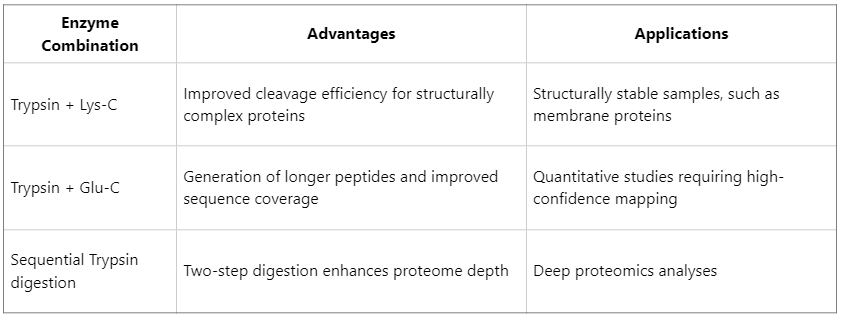
2. Control of Digestion Parameters: Balancing Time, Temperature, and Enzyme Ratio
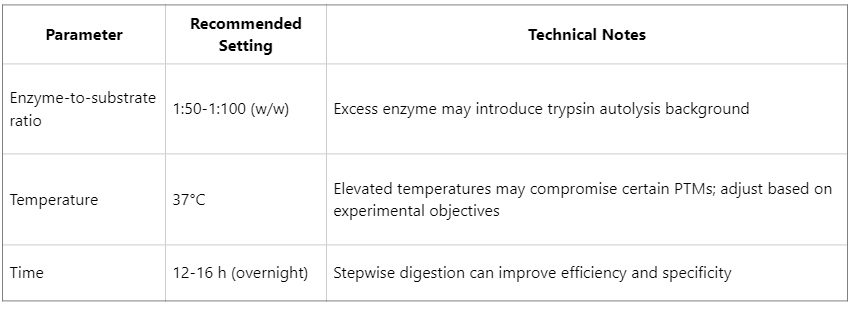
Note:
-
Use MS-grade, high-purity trypsin to minimize nonspecific cleavage.
-
Digestion is typically performed in ammonium bicarbonate (AmBic) buffer to ensure MS compatibility.
Peptide Purification and Desalting
1. Following Digestion, The Following Contaminants Should Be Removed
-
Salts (Na⁺, Cl⁻)
-
Detergents and chaotropes (e.g., SDS, urea)
-
Small-molecule metabolites and buffer components
2. Common Approaches
-
C18 reversed-phase solid-phase extraction (SPE) for peptide retention and salt removal
-
StageTips or OMIX tips for efficient desalting of low-input samples
-
Magnetic bead-based enrichment (e.g., SP3), offering strong compatibility with automated and high-throughput workflows
-
Recommended peptide concentration after desalting: 0.5-1 μg/μL, suitable for nanoLC-MS injection
MtoZ Biolabs Shotgun Proteomics Sample Processing Solutions
MtoZ Biolabs has established modular sample preparation workflows tailored to diverse sample types (e.g., tissues, cells, serum, and exosomes), ensuring maximal protein recovery and consistent digestion efficiency, with the following quality control features:
-
Automated lysis platform compatible with 96-well formats, enabling high-throughput processing
-
Use of MS-grade proteases and dual-enzyme digestion strategies, improving coverage by >15%
-
Standardized digestion QC metrics, including peptide length distribution and digestion efficiency assessment
-
Full compatibility with Label-Free, TMT, and DIA quantitative workflows
-
Integrated end-to-end services from sample preparation to MS analysis, minimizing cross-platform variability and improving data consistency.
The success of shotgun proteomics depends not only on mass spectrometry performance but also on the rational design and rigorous execution of sample preparation and digestion strategies. Optimization of lysis protocols, precise control of digestion parameters, and effective removal of contaminants can substantially enhance protein identification, data reproducibility, and the reliability of downstream bioinformatics analyses. MtoZ Biolabs is committed to delivering robust, reproducible, and quantitatively reliable shotgun proteomics solutions. For project evaluation, workflow optimization, or standard operating procedures, please contact us for expert support.
MtoZ Biolabs, an integrated chromatography and mass spectrometry (MS) services provider.
Related Services
How to order?




