






How to Identify Lactylation Sites on Histones?
Histone Lactylation: A New Perspective on Metabolism-Epigenetics Crosstalk
Histones are core components of chromatin and are subject to diverse post-translational modifications on lysine residues, including acetylation, methylation, and ubiquitination. Lactylation is a recently identified modification that primarily occurs on lysine (K) residues, forming ε-N-L-lactyllysine. Emerging evidence indicates that histone lactylation is closely associated with cellular metabolic states, showing significant upregulation under hypoxic conditions and enhanced glycolysis. This modification contributes to the regulation of gene expression and is involved in a variety of physiological and pathological processes, including inflammation, immune activation, and tumor metabolism.
How to Accurately Identify Histone Lactylation Modification Sites?
1. Sample Preparation
To ensure efficient identification of modification sites, high-purity histones must first be extracted:
(1) Common Method: Strong acid extraction (e.g., 0.2 M H₂SO₄), which effectively separates histones from non-histone proteins.
(2) Protein Quantification and Quality Control: Protein concentration and quality are recommended to be assessed using SDS-PAGE or BCA assays.
2. Enzymatic Digestion Strategy of Histones
Due to the high abundance of basic amino acids in histones, trypsin cleavage sites (K/R) occur frequently, generating excessively short peptides that are difficult to analyze by mass spectrometry.
Recommended digestion strategies include:
(1) Glu-C or Asp-N: Avoid cleavage at lysine residues, thereby preserving lactylation modification information.
(2) Multi-Enzyme Digestion: Such as Trypsin + Lys-C, to improve sequence coverage.
3. Enrichment of Lactylated Peptides
As lactylated peptides constitute only a small fraction of the total peptide pool, targeted enrichment is a critical step prior to mass spectrometry analysis.
(1) Anti-Lactyl-Lysine Antibody Enrichment: Commercially available antibodies (e.g., PTM Biolabs) can be used for immunoprecipitation-based enrichment of lactylated peptides.
(2) Immunoaffinity Chromatography Combined with Mass Spectrometry: Significantly enhances the enrichment efficiency and specificity of modified peptides.
4. LC-MS/MS Analysis
(1) Instrumentation: High-resolution mass spectrometers are recommended (e.g., Orbitrap Fusion Lumos, timsTOF Pro).
(2) Parameter Optimization
-
MS1 resolution ≥ 60,000
-
HCD fragmentation mode to retain characteristic neutral loss signals of lactylation
-
Enable variable modification settings (+72.0211 Da for lactylation)
(3) Software Analysis
-
Use PTM-compatible software such as MaxQuant, PEAKS, or Byonic
-
Define the lactylation mass shift to ensure high-confidence site localization (site localization probability > 0.75)
Coexistence Analysis of Histone Lactylation with Other Modifications
Histone lactylation frequently coexists with other modifications, such as acetylation and methylation, at the same lysine residues (e.g., H3K18), potentially exhibiting synergistic or competitive interactions in epigenetic regulation. Studies suggest that lactylation may act in concert with acetylation to promote chromatin accessibility, or dynamically replace other modifications in response to metabolic changes. Mass spectrometry approaches incorporating tandem immunoenrichment and multi-PTM search strategies enable the identification of peptides bearing multiple coexisting modifications. Elucidating the interplay between lactylation and other PTMs will facilitate a deeper understanding of their coordinated roles in transcriptional regulation and inflammatory responses.
Common Problems and Optimization Suggestions
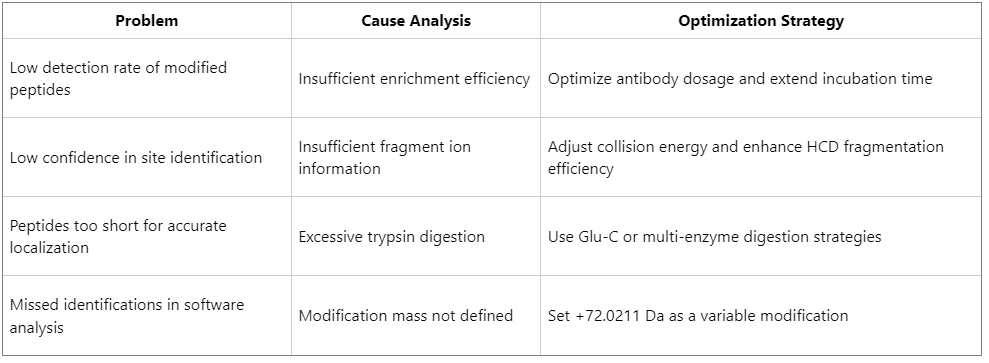
Histone lactylation serves as a critical link between metabolic regulation and epigenetic control and is emerging as a key focus in cutting-edge research areas such as tumor immunity and inflammation. Accurate site identification relies on the integration of high-quality sample preparation, specific enrichment strategies, and high-resolution mass spectrometry platforms. Given challenges such as low modification abundance and structural complexity, the establishment of standardized and systematic analytical workflows is essential. MtoZ Biolabs integrates advanced high-resolution mass spectrometry platforms (e.g., Orbitrap Exploris 480), proprietary lactylation enrichment method libraries, and customized data analysis pipelines to provide comprehensive, one-stop histone lactylation omics solutions, thereby facilitating in-depth investigation of metabolism-epigenetics regulatory mechanisms.
MtoZ Biolabs, an integrated chromatography and mass spectrometry (MS) services provider.
Related Services
How to order?




