






How to Detect Histone Malonylation Modifications?
Histones, as fundamental components of chromatin, play a central role in the regulation of gene expression and cell fate determination through a variety of post-translational modifications. In addition to classical modifications such as acetylation, methylation, and phosphorylation, histone malonylation has emerged in recent years as an important focus in epigenetic research. This modification involves the covalent attachment of a malonyl group to lysine residues, thereby influencing chromatin accessibility, regulating transcriptional activity, and being closely associated with cellular metabolism as well as the molecular mechanisms underlying various diseases. Although histone malonylation is generally present at low abundance, it plays a critical role in epigenetic regulatory networks. Therefore, accurate detection of this modification is essential for both fundamental research and precision medicine applications.
Introduction to Histone Malonylation Modification
Histone malonylation is a lysine post-translational modification generated through the utilization of malonyl-CoA as a donor substrate and catalyzed by enzymes such as histone acetyltransferases (HATs). Its key features include:
-
Functional diversity: It alters chromatin accessibility, thereby modulating transcriptional activity.
-
Metabolic association: Malonylation levels are regulated by cellular metabolic status and reflect energy and lipid metabolic conditions.
-
Disease relevance: Although low in abundance, this highly dynamic modification may participate in epigenetic regulation in cancer, metabolic disorders, and other diseases.
Given its low abundance and dynamic nature, the development of sensitive and specific detection strategies is essential for its study.
Common Methods for Detecting Histone Malonylation
1. Antibody-Based Detection (Western Blot / ELISA)
Antibody-based approaches are widely used for preliminary assessment of histone malonylation. Using antibodies specific to malonyl-lysine, the presence and relative changes of this modification can be evaluated at the protein level.
-
Advantages: Simple and rapid, suitable for screening samples under different experimental conditions.
-
Limitations: Susceptible to antibody cross-reactivity, with limited sensitivity for low-abundance modifications.
2. Mass Spectrometry (MS)
Mass spectrometry is regarded as the gold standard for histone malonylation analysis due to its high sensitivity, high resolution, and precise site localization capability.
(1) Sample Preparation
Histones are extracted under acidic conditions and subsequently digested, commonly using trypsin or Lys-C. Immunoenrichment or chemical derivatization is then applied to improve detection sensitivity for malonylated peptides.
(2) Enrichment Strategies
-
Immunoenrichment: Utilizes specific anti-malonyl-lysine antibodies to capture modified peptides, enhancing detection of low-abundance species.
-
Chemical derivatization: Chemically labels malonylated peptides to facilitate mass spectrometric identification.
(3) Mass Spectrometry Analysis
Common platforms include Orbitrap, Q-TOF, and timsTOF systems. High-resolution MS/MS enables precise localization and quantitative analysis of modification sites.
3. Chromatin Immunoprecipitation Sequencing (ChIP-seq)
To investigate the genome-wide distribution of histone malonylation, ChIP-seq is commonly employed. Chromatin fragments are immunoprecipitated using specific antibodies and subsequently sequenced, enabling comprehensive mapping of malonylation across the genome and facilitating mechanistic studies of its regulatory roles.
4. Isotopic and Metabolic Labeling Strategies
Stable isotope labeling approaches, such as SILAC or 13C-labeled malonyl-CoA, can be used to track dynamic changes in malonylation. When combined with mass spectrometry, these strategies enable quantitative comparison and provide insights into the interplay between metabolism and epigenetic regulation.
Technical Selection Recommendations
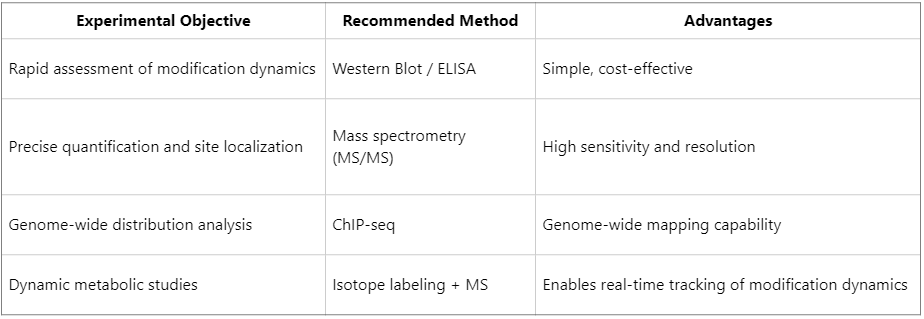
Mass spectrometry combined with immunoenrichment is widely considered the most reliable strategy for histone malonylation analysis, particularly for low-abundance or complex biological samples.
Research Prospects and Application Value
Histone malonylation plays a distinctive role in regulating chromatin architecture and gene expression. Its dynamic changes reflect cellular metabolic states and epigenetic regulatory networks. With advances in high-resolution mass spectrometry and the development of high-specificity antibodies, the sensitivity and accuracy of malonylation detection have been significantly improved. These technological developments provide powerful tools for systematically elucidating epigenetic mechanisms. Moreover, they offer a robust foundation for epigenetic therapy research, precision medicine, and disease mechanism studies, thereby advancing life science research toward greater precision and system-level understanding.
Advantages of MtoZ Biolabs in Histone Malonylation Detection
In the field of histone modification analysis, MtoZ Biolabs integrates advanced mass spectrometry platforms with optimized sample preparation workflows to provide high-coverage and high-sensitivity histone malonylation detection services. Key features include:
-
Full workflow mass spectrometry analysis: Covering histone extraction, enzymatic digestion, immunoenrichment, and MS/MS analysis, ensuring high reproducibility and data reliability.
-
Multidimensional data interpretation: Including quantification, site localization, and functional association analyses to support in-depth understanding of epigenetic regulation mechanisms.
-
Customized services: Offering either single-modification detection or comprehensive histone modification profiling tailored to research needs, supporting both high-throughput and low-input sample studies.
Through collaboration with MtoZ Biolabs, research teams can rapidly obtain high-quality datasets for histone malonylation and other emerging histone modifications, thereby accelerating scientific discovery.
How to order?




