






How to Design a Metabolomics Study for Group Comparison
A metabolomics study design for group comparison stands or falls on four decisions made before any sample is collected: how you define the groups, which control you compare against, how many biological replicates each group needs, and when and how samples are taken.
The guiding principle is that the biological contrast of interest should not be systematically confounded with other variables. Collection time, handling, and other controllable factors should be matched across groups, while unavoidable variables should be balanced or recorded for downstream analysis. This makes observed metabolic differences more interpretable in relation to the intended biological contrast.
In short, a sound group comparison is built on:
-
Clear groups defined around the intended biological contrast.
-
A matched control that isolates the effect you are studying.
-
Enough biological replicates to separate signal from natural variation.
-
Consistent sampling time and collection applied identically to every group.
Get these right and the analysis has something real to find. Get them wrong and no amount of downstream statistics can rescue the study.
Start From the Comparison, Not the Samples
The most common planning mistake is to collect samples first and design the comparison afterward. A strong metabolomics study design works in the opposite order: define the contrast, then let it dictate the groups.
Ask what single biological difference you want the data to reflect. It might be treated versus untreated, disease versus healthy, or one genotype versus another. That difference becomes the axis of the whole study, and every group should be positioned along it deliberately.
Once the contrast is explicit, the groups almost design themselves. Where possible, groups should be matched for factors unrelated to the biological question. Variables such as age, sex, diet, housing, or growth conditions should be controlled, balanced, or recorded so they do not systematically track with group assignment. The cleaner that match, the more confidently a group comparison can attribute differences to biology rather than background.
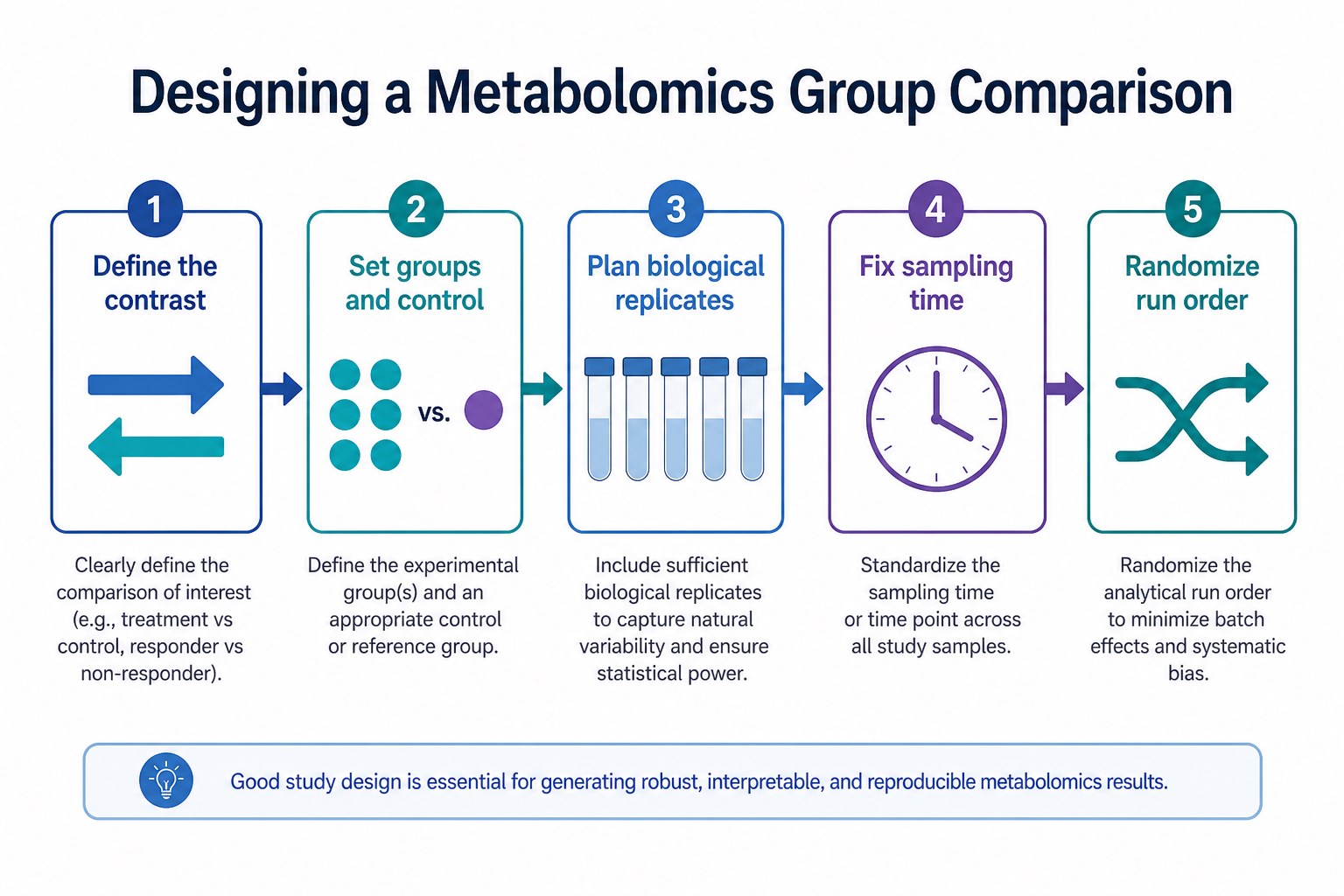
Figure 1. A group comparison is planned from the contrast outward: define the difference, set groups and controls, plan replicates, then fix sampling time and handling.
Choose a Control That Isolates the Effect
A useful control should isolate the biological contrast as clearly as the study design allows. Other relevant variables should be matched or balanced where possible so they do not confound interpretation.
Different questions call for different controls:
-
Untreated or vehicle controls show what the system looks like without the intervention, and a vehicle control matters whenever a solvent or carrier could itself shift the metabolome.
-
Baseline or pre-treatment samples let each subject act partly as its own reference in longitudinal designs.
-
Healthy or wild-type controls anchor disease or genotype comparisons.
The test to apply is simple: if the control differs from the treatment group in more than the intended variable, any difference you find is ambiguous. Spending time on control choice early is far cheaper than discovering a confounded design after the data is in.
Biological Replicates: The Backbone of the Comparison
Replication is what turns an observation into a defensible group comparison, so it deserves real attention in any metabolomics study design.
The key distinction is between biological and technical replicates. Biological replicates are independent biological or experimental units and capture variation within a group. Technical or analytical replicates repeat sample preparation or measurement and mainly assess non-biological variation. Biological replication is therefore the key basis for drawing group-level conclusions rather than conclusions from individual samples.
The appropriate number of biological replicates depends on expected effect size, within-group variability, study design, and statistical power. Broad untargeted studies may also need to account for multiple testing. Very small groups make it harder to distinguish biological differences from natural variation, so replicate planning should reflect the specific study rather than a number copied from an unrelated paper. It is therefore useful to discuss replicate planning with MtoZ Biolabs before sample collection begins.
Sampling Time and Collection Consistency
Timing is an underrated part of a group comparison. The metabolome shifts over hours, with feeding, and with circadian rhythm, so when you sample can matter as much as what you sample.
Two rules keep timing from becoming a confounder. First, decide whether you need a single timepoint or a time course. A single point suits a stable state comparison, while a time course is needed when the response itself unfolds over time. Second, whatever you choose, apply it identically across groups. If the treated group is sampled in the morning and the control in the afternoon, time of day is now tangled with treatment.
Collection and storage should be standardized just as tightly. Because metabolite levels can continue to change after sampling, collection, metabolic quenching or stabilization, processing delay, storage conditions, and freeze-thaw history should be controlled consistently across groups. Fasting state and sample input should also be matched where relevant to the biological matrix.
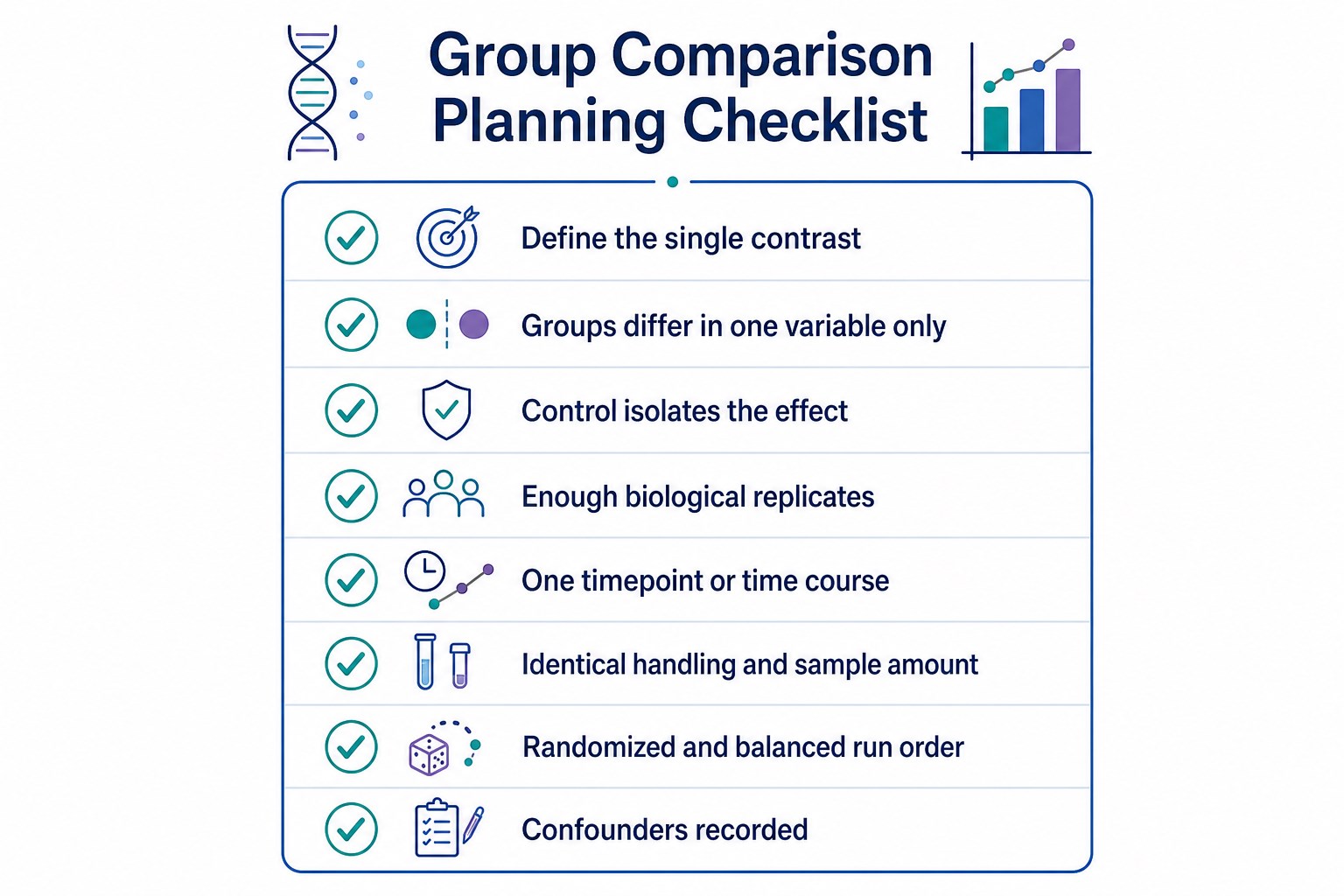
Figure 2. A practical checklist covering groups, controls, replicates, sampling time, run order, confounders, and sample amount.
Control Technical Variation During the Run
Even a well-planned comparison can be undermined by how samples are processed and measured. A few habits protect the biology.
-
Randomize run order so groups are spread across the sequence rather than run in blocks. Running all controls first and all treated samples last confounds biology with instrument drift.
-
Balance any batches. If samples must be split across preparation days or plates, each batch should contain a mix of groups rather than one group per batch.
-
For many LC-MS-based untargeted workflows, pooled QC samples prepared from representative study samples can be analyzed periodically to monitor analytical consistency across the sequence. QC design should be matched to the analytical workflow rather than applied identically to every metabolomics study.
None of these steps change the biology; they simply stop technical structure from being mistaken for it.
A Planning Checklist for Group Comparisons
The table below turns the design principles into concrete planning decisions.
|
Design element |
Question to settle |
Why it matters |
|---|---|---|
|
Contrast |
What single difference am I testing? |
Defines the axis of the whole study |
|
Groups |
Are other relevant variables matched, balanced, or recorded? |
Reduces confounding between group assignment and background variables |
|
Control |
Which control isolates the effect? |
Makes differences interpretable |
|
Biological replicates |
How many independent samples per group? |
Separates signal from natural variation |
|
Sampling time |
One timepoint or a time course? |
Stops timing from becoming a confounder |
|
Collection |
Are collection, processing, storage, and sample input standardized? |
Keeps the contrast biological |
|
Run design |
Are order and batches randomized and balanced? |
Avoids technical artifacts |
|
Confounders |
Which variables are recorded? |
Enables adjustment during analysis |
Read it as a pre-flight check. Every row that stays ambiguous is a place where technical variation can later be confused with a real result.
Common Design Mistakes to Avoid
A handful of errors account for most disappointing comparisons.
-
Confounded controls, where the control differs from the treatment group in more than the intended way.
-
Too few biological replicates, which leaves the study underpowered before it starts.
-
Inconsistent sampling time, so time of day or feeding state tracks with group.
-
Batch-aligned groups, where each preparation batch holds a single group and batch effects mimic biology.
-
Incomplete metadata recording, which limits the ability to account for relevant biological or pre-analytical variables during analysis.
Each of these is far easier to prevent at the design stage than to correct once the data exists.
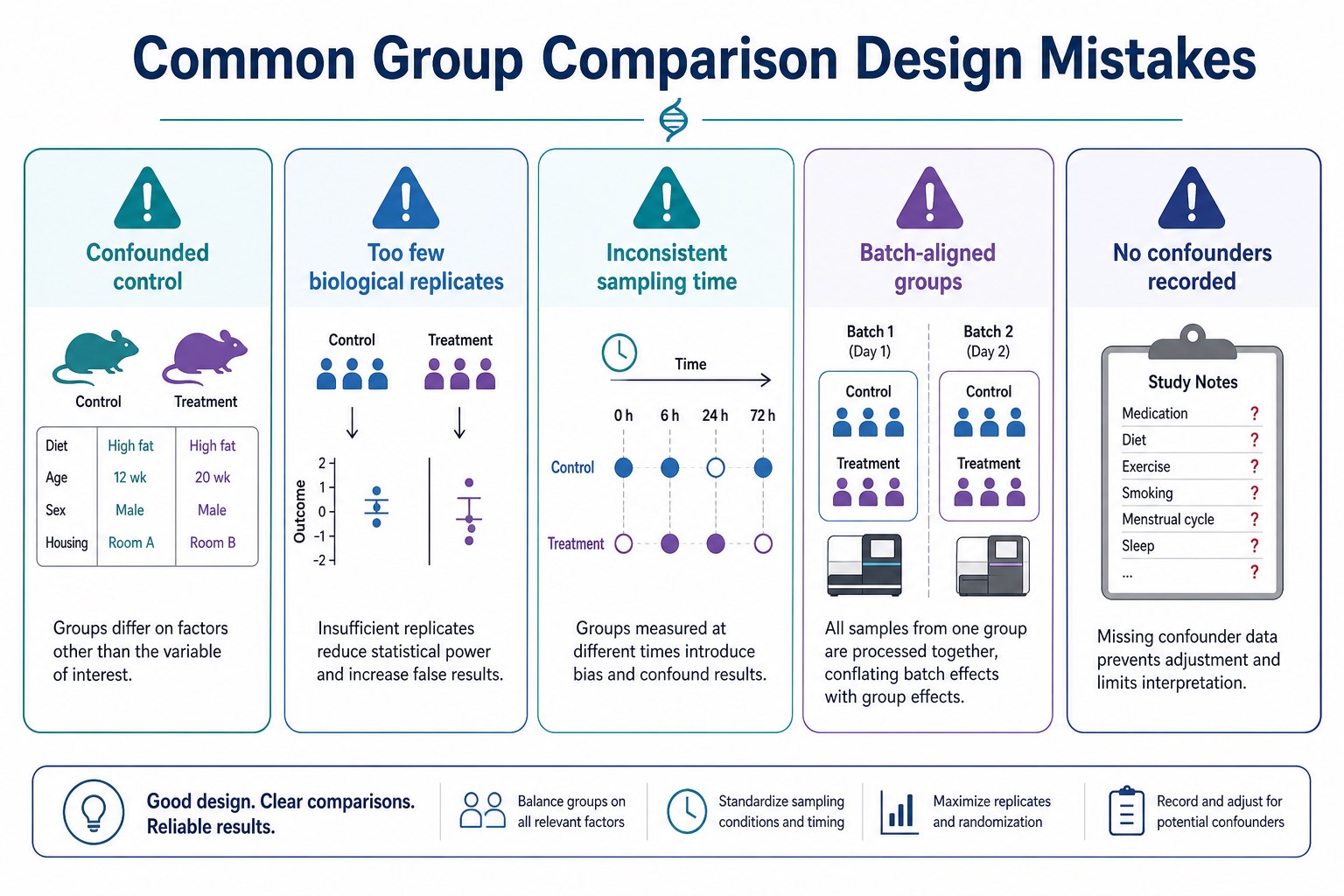
Figure 3. The most frequent design mistakes let technical variation imitate a biological difference.
Related Services
Metabolomics and Lipidomics Analysis Services
Untargeted Metabolomics Service
Targeted Metabolomics Analysis Service
Frequently Asked Questions
1. What makes a good metabolomics study design for group comparison?
Clear groups defined around the intended biological contrast, an appropriate control, enough biological replicates, and consistent sampling time and handling across groups. The biological contrast should not be systematically confounded with other variables.
2. How many biological replicates do I need?
The appropriate number depends on expected effect size, within-group variability, study design, and statistical power. Broad untargeted studies may also need to account for multiple testing, so replicate numbers should be planned for the specific project rather than copied from another study.
3. What is the difference between biological and technical replicates?
Biological replicates are independent biological or experimental units and capture variation within a group. Technical or analytical replicates repeat preparation or measurement and mainly assess non-biological variation.
4. Should I use untargeted or targeted metabolomics for a group comparison?
Untargeted metabolomics is generally appropriate for broad comparison when no predefined metabolite list exists. Targeted metabolomics is more suitable when specific metabolites or predefined targets have already been selected. The choice depends on the research objective and target scope.
5. What information should be recorded before sample collection?
Record group assignment, biological replicate information, sampling time, relevant biological variables, collection and processing conditions, storage history, and other factors that could differ systematically between groups. The exact metadata required depends on the sample type and study design.
Conclusion
A metabolomics study design for group comparison is mostly decided before the instrument is ever involved. Define the contrast, minimize or document potential confounding variables, choose an appropriate control, plan sufficient biological replication, and standardize sampling and handling across groups.
Those choices, together with randomized run order and recorded confounders, make metabolic differences easier to interpret in relation to the intended biological comparison. Teams shaping a group comparison can talk the plan through with MtoZ Biolabs to align groups, controls, replicates, and sampling before collection begins.
How to order?




