






How to Choose the Right Platform for Histone Propionylation Analysis?
Histone propionylation is a crucial epigenetic modification that regulates gene expression, chromatin architecture, and cell fate decisions. Advances in proteomics and mass spectrometry have enabled researchers to detect and quantify histone propionylation using a variety of analytical platforms. These platforms differ markedly in sensitivity, coverage, data analysis capability, and cost, necessitating careful selection to match specific research requirements.
Overview of Histone Propionylation Detection Platforms
Currently, the commonly employed platforms for histone propionylation analysis include:
1. Mass Spectrometry-Based Proteomics (LC-MS/MS)
-
Principle: Separation of peptides by liquid chromatography followed by high-resolution mass spectrometry detection of propionylated peptides.
-
Characteristics: High sensitivity, precise quantification, and the ability to resolve multiple modification sites.
2. Antibody-Based Detection (Western Blot / ELISA / Dot Blot)
-
Principle: Target modifications are recognized using specific anti-propionylation antibodies.
-
Characteristics: Simple operation and low cost, but limited coverage of all histone modification sites.
3. Immunoprecipitation Combined with Mass Spectrometry (IP-MS)
-
Principle: Propionylated proteins or peptides are enriched with antibodies prior to mass spectrometry analysis.
-
Characteristics: Enhances detection of low-abundance modifications while supporting both quantification and site-specific resolution.
4. Chemical Labeling Combined with Mass Spectrometry (Chemical Labeling-MS)
-
Principle: Chemical labeling of propionylated peptides to enhance mass spectrometry signals.
-
Characteristics: Suitable for detecting extremely low-abundance modifications with improved signal-to-noise ratio.
Key Considerations for Platform Selection
When selecting a histone propionylation analysis platform, the following factors should be considered:
1. Detection Sensitivity and Modification Abundance
-
Low-abundance propionylation: IP-MS or Chemical Labeling-MS are recommended to maximize signal capture.
-
High-abundance propionylation: Western Blot or ELISA can provide rapid validation.
2. Coverage of Modification Sites
-
Global analysis of histone propionylation: LC-MS/MS or chemical labeling combined with mass spectrometry is most suitable, providing coverage of multiple sites across samples.
-
Targeted site analysis: Antibody-based platforms combined with immunoprecipitation allow quantitative evaluation of specific key sites.
3. Sample Type and Quantity
-
Abundant cell lines or tissue samples: High-resolution mass spectrometry for comprehensive histone analysis is preferred.
-
Rare or limited samples: High-sensitivity enrichment platforms such as IP-MS or Chemical Labeling-MS should be employed.
4. Data Quantification and Analysis Requirements
-
For precise quantification and cross-experiment comparisons: TMT/iTRAQ-labeled mass spectrometry or LFQ quantification platforms are most appropriate.
-
For qualitative verification only: Western Blot or Dot Blot is sufficient.
Recommended Platform Matching for Research Contexts
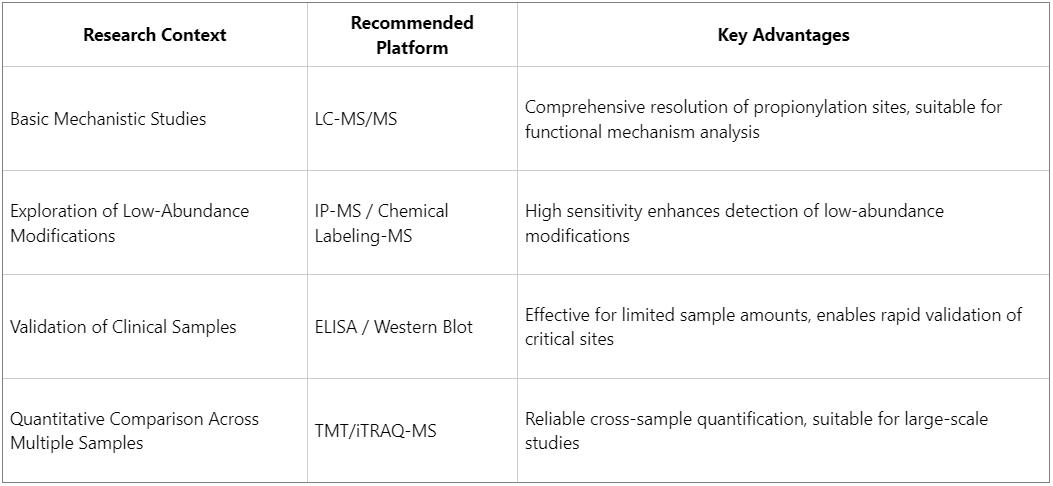
By aligning research objectives with platform capabilities, researchers can enhance experimental efficiency and data quality, thereby maximizing research outcomes.
Selecting the appropriate histone propionylation analysis platform is critical not only for experimental success but also for ensuring the reliability and depth of scientific findings. Researchers should consider modification abundance, site coverage, sample type, quantification requirements, and cost-effectiveness to identify the most suitable technology. MtoZ Biolabs offers comprehensive mass spectrometry platforms and tailored services, providing solutions that span from low-abundance detection to global quantitative analysis, thereby supporting efficient epigenetic research and facilitating the translation of scientific discoveries.
MtoZ Biolabs, an integrated chromatography and mass spectrometry (MS) services provider.
Related Services
How to order?




