






How to Analyze Protein–Protein Interactions: Key Experimental Approaches
-
Stable interactions: Long-lasting protein complexes, such as ribosomes or proteasomes.
-
Transient interactions: Typically occur following signaling pathway activation, e.g., kinase-substrate or receptor-ligand interactions.
-
Exploration of unknown interaction networks
-
Mapping interaction domains
-
Construction of initial PPI networks
-
Domain mapping
-
Validation of drug targets
-
Quantitative comparison of binding capabilities among mutants
-
FRET: Measures energy transfer between fluorophores to infer spatial proximity.
-
BiFC: Reconstitution of non-fluorescent fragments through protein interaction generates a detectable fluorescent signal.
-
Provides spatial structural information
-
Facilitates 3D modeling of protein complexes
-
Complements techniques such as cryo-EM and AlphaFold
-
Initial screening using Y2H or AP-MS
-
Verification by Co-IP or pull-down assays
-
Observation of intracellular dynamics using FRET/BiFC
-
Accurate affinity measurement with SPR/BLI
Protein–protein interactions (PPIs) constitute the foundation of nearly all cellular life processes. They regulate molecular network stability and dynamics, influencing signal transduction, transcriptional regulation, protein degradation, immune responses, and tumorigenesis. In recent years, rapid advances in structural biology, mass spectrometry, and high-throughput screening have transformed PPI research from conventional validation experiments to systematic, network-level, and precision-oriented studies. This review systematically summarizes current mainstream PPI research methods, considering research objectives and covering low-throughput validation, high-throughput screening, and quantitative kinetic analysis.
Protein–Protein Interactions: Connectors of Cellular Networks
Within cells, proteins function cooperatively, forming dimers, oligomers, or complexes through specific recognition. Characterizing PPIs not only enhances understanding of protein functions but also facilitates the identification of potential disease targets and therapeutic strategies. Systems biology studies indicate that complex diseases often arise from disruptions in protein interaction networks rather than from isolated protein dysfunctions. Therefore, PPI research is crucial for elucidating biological mechanisms and constitutes a major focus in precision medicine.
From a functional perspective, PPIs can be categorized as follows:
Defining interaction types guides the selection of appropriate experimental approaches.
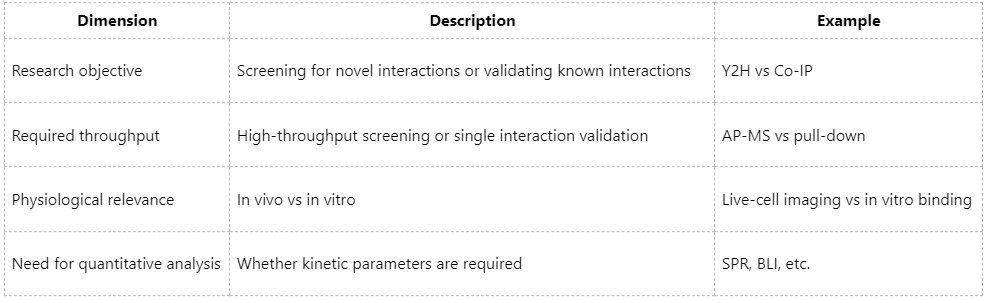
Selecting Appropriate PPI Research Methods
Researchers should select methods based on several considerations:
Detailed Overview of Mainstream PPI Methods
1. Yeast Two-Hybrid (Y2H)
Y2H is a classical PPI screening method suitable for genome-wide interaction mapping. It relies on reconstitution of transcription factor activity, wherein protein interactions activate reporter gene expression.
Applications:
Y2H has been employed across multiple model organisms to generate genome-wide PPI maps, advancing functional genomics research.
2. Co-Immunoprecipitation (Co-IP)
Co-IP is a gold standard for studying known or candidate PPIs. Using specific antibodies to precipitate target proteins and their binding partners, combined with Western blotting or mass spectrometry, allows identification of interacting proteins.
3. Pull-Down Assay
Typically used for in vitro analysis of interaction mechanisms. A tagged “bait protein” is immobilized on an affinity matrix and incubated with a “prey protein,” followed by analysis of binding.
Applications:
4. Fluorescence-Based Interaction Techniques (FRET, BiFC)
FRET and BiFC enable observation of PPIs in live cells with temporal and spatial resolution.
5. Cross-Linking Mass Spectrometry (XL-MS)
XL-MS employs chemical crosslinkers to “lock” interaction interfaces, followed by enzymatic digestion and mass spectrometry, allowing precise mapping of binding residues.
Advantages:
6. Affinity Purification Mass Spectrometry (AP-MS)
Combining immunoenrichment with high-resolution mass spectrometry, AP-MS systematically analyzes the interaction network of a protein. Features include high throughput and suitability for studying complex assembly and reconstructing signaling pathways.
7. Kinetic Analysis: SPR and BLI
Surface plasmon resonance (SPR) and biolayer interferometry (BLI) are label-free, real-time techniques for monitoring protein interactions. They provide kinetic parameters (e.g., Kd, ka/kd) and are widely used to characterize the affinity and stability of PPIs, including antibody-target interactions, during biopharmaceutical development.
Multi-Platform Integration: Constructing a Comprehensive PPI Map
To achieve high-confidence PPI data, the following integrated strategy is recommended:
In the post-genomic era, research has increasingly shifted from the study of individual genes or single proteins toward a network-level understanding of cellular systems. Protein–protein interactions, which link functional modules within these networks, are essential for elucidating the regulatory mechanisms of cells. Leveraging advanced technological platforms and specialized analytical tools, researchers are now able to characterize the dynamic organization of cellular networks with greater precision. MtoZ Biolabs aims to serve as a reliable partner in supporting these research efforts, facilitating the exploration of complex biological processes at the forefront of life sciences.
MtoZ Biolabs, an integrated chromatography and mass spectrometry (MS) services provider.
Related Services
How to order?




