



A protein or peptide that reads zero in all three replicate liquid chromatography-tandem mass spectrometry (LC-MS/MS) runs is not yet a differential biology result. In quantitative proteomics tables, zero often means no usable quantitative value was extracted: the feature was not identified, the peak failed filters, the reporter was below noise, or the software wrote a placeholder for a missing cell. Analysis starts by naming which of those events occurred, not by filling the three cells with an imputed number.
Three zeros across replicates can be a global acquisition failure, a feature-specific detection limit, or structured missingness that tracks one group. Each pattern needs a different next step. In MtoZ Biolabs quantitative proteomics projects, zeros are reviewed against identification status, extraction rules, and study design before any group contrast is interpreted.
What Three Zeros Usually Mean in a Quantitative Matrix
A quantitative value of zero is rarely a calibrated amount of zero moles. For unlabeled data-dependent acquisition (DDA) or data-independent acquisition (DIA) matrices, a missing intensity more often means the peptide was not extracted under the declared false discovery rate (FDR), alignment, or peak-quality rules. For tandem mass tag (TMT) channels, a missing or near-noise reporter means that channel did not contribute a usable reporter intensity for an accepted peptide.
Replicates must be classified. Technical injection replicates describe instrument noise. Biological replicates describe independent samples. Three technical zeros after one digest point to extraction or acquisition. Three biological zeros can still be biology if the protein is below detection in every sample of that arm, but only after search and prep failures are ruled out.
Zeros in every replicate of every group are a weak discovery claim for that protein. Zeros confined to one treatment arm are a design or detection problem until proven otherwise (Lazar et al. 2016). Writing a fold change from zeros created by imputation invents a difference that was never measured.
Researchers can refer to How to Analyze Quantitative Proteomics Data for how generic protein-matrix statistics are set after missingness rules are declared.
How to Triage Zeros Before Any Statistical Test
A practical triage order is stable across software environments.
Confirm whether the protein or peptide was identified in any run. If identification failed everywhere, the problem is search settings, database, digestion, chromatography, or load, not differential statistics. If identification exists but quantification is empty, inspect the extraction rule: MS1 peak area, DIA fragment filters, or TMT reporter thresholds.
Decide whether zeros are global or feature-specific. If many proteins are empty in the same three files, check total ion chromatograms, spray stability, peptide load, and whether the wrong raw files were searched. If only one protein row is empty while neighboring proteins look normal, treat the row as below the quantitative filter for that feature.
Do not impute first. Imputation can enable a moderated test. It can also manufacture a group difference from structured holes (Lazar et al. 2016). Record the missing-value rule with the matrix. Proteins with high missingness in every replicate are better left as not quantified than forced into a ranked list.
Three replicate zeros are a QC finding until identification, extraction, and design have been checked.
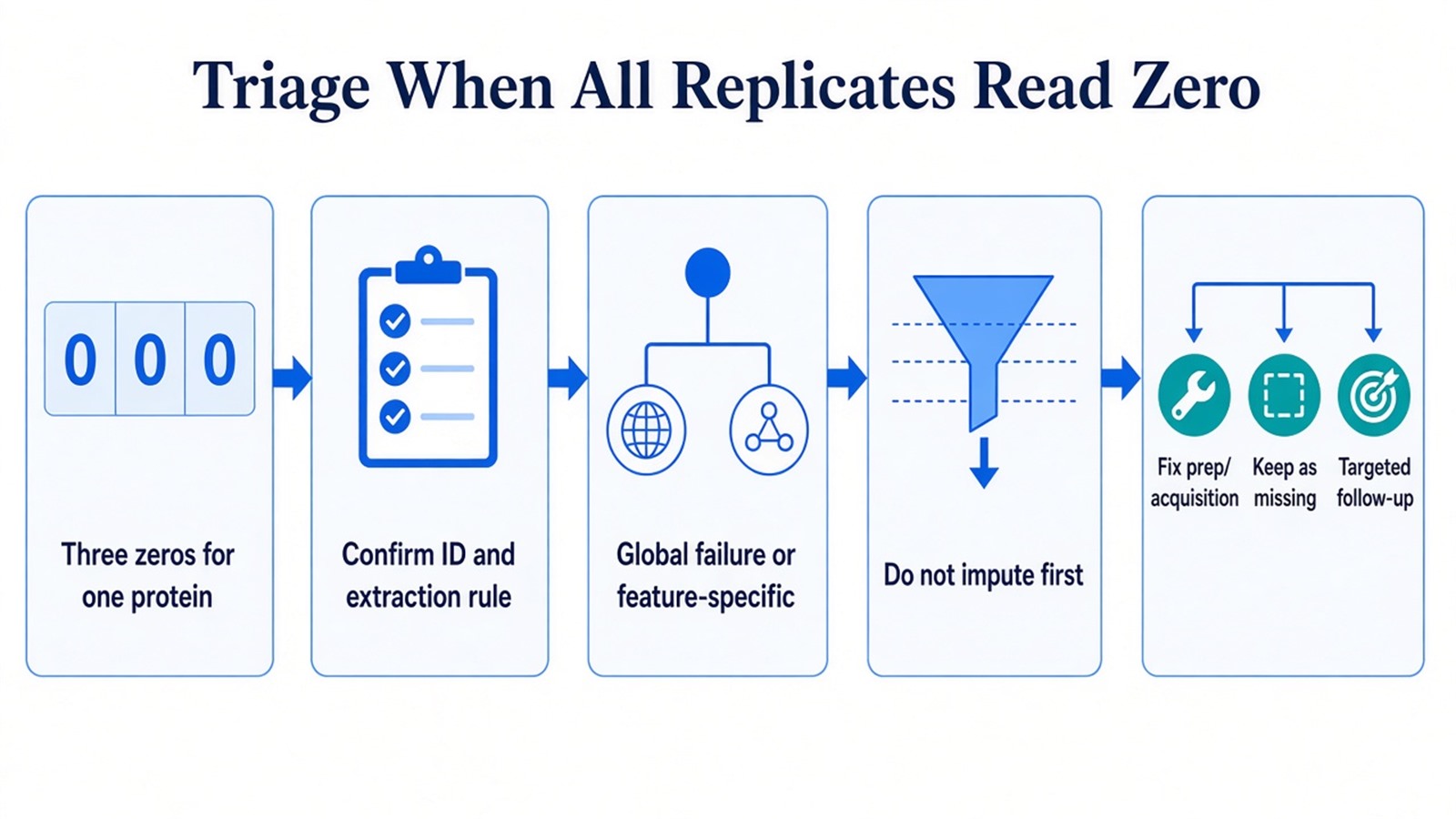
Figure 1. Analysis of all-replicate zeros starts with triage of identification and extraction, not with a statistical contrast on imputed cells.
For unlabeled matrices, match-between-runs and library transfer can fill some missing cells and can also transfer incorrect assignments if tolerances are too open. Alignment settings belong in the methods record before a zero row is reinterpreted as a detected peptide. Researchers can refer to A Guide to Label-Free Quantitative Proteomics: From Experiment to Data Analysis when the zeros sit in an unlabeled LFQ matrix and missing-value rules still need locking.
Parameters That Separate Detection Failure from a Real Absence Claim
Key parameters to inspect with the three zeros include peptide and protein FDR, the quantification rule, peak-quality or reporter signal-to-noise thresholds, alignment tolerances, and whether the replicate label is technical or biological.
Sample and acquisition parameters matter when zeros are global. Matched protein input, digestion completeness, desalting recovery, injection volume, and column performance decide whether peptides reached the instrument. Dynamic exclusion, cycle time, and isolation windows decide whether a weak peptide was ever sampled.
Design parameters matter when zeros track one group. Run order, batch identity, and extraction order should be compared with group labels. Missingness that copies a treatment arm is not fixed by a global imputation model. Interleaving groups remains a design requirement.
Software version and parameter lock matter when reanalysis changes which cells are zero. A new extractor version can turn previous zeros into values, or the reverse. Reanalysis should be reported as a new matrix if thresholds changed.
When chromatograms or load still explain most empty rows, researchers can refer to Quantitative Proteomics: Strategies, Advantages, and Challenges for how those failure patterns are traced before a new digest is queued.
Limits of Interpreting All-Replicate Zeros as Biology
Absence of a quantitative value is not proof that the protein is absent from the organism. It is proof that the declared pipeline did not return a usable number. Low-abundance proteins, shared-peptide inference, and aggressive filters can all produce three zeros for a protein that is biologically present.
Zeros also do not support an absolute concentration claim. An amount of zero would require a matched stable isotope-labeled internal standard (SIS) assay that demonstrates the analyte was below a stated lower limit of quantification. Ordinary discovery zeros do not meet that bar.
Pathway enrichment on a list built by imputing all-zero rows is premature. So is calling a knockout-style conclusion from discovery missingness alone. Targeted follow-up can test a named peptide. It does not validate every empty cell in the matrix.
What to Do Next for Each Zero Pattern
The useful test is whether zeros are widespread, feature-specific, or group-structured.
Observed pattern |
Check first |
Next step that often fits |
|---|---|---|
Many proteins zero in the same three runs |
Load, spray, file identity, search settings |
Fix prep or acquisition; re-search before imputation |
One protein zero in all replicates, others quantified |
ID status and extraction filters |
Keep as not quantified, or schedule PRM/MRM confirmation |
Zeros only in one treatment arm |
Run order versus group labels |
Redesign or re-acquire; do not impute the structured hole |
Identified in DDA library but zero in DIA extraction |
Library provenance and window scheme |
Rebuild extraction; do not force a library mismatch |
TMT channel reporters near noise in all channels |
Labeling completeness and reporter thresholds |
Review labeling QC; empty reporters are not amounts |
Named protein still required after discovery zeros |
Peptide detectability |
Move to a targeted assay in a new digest |
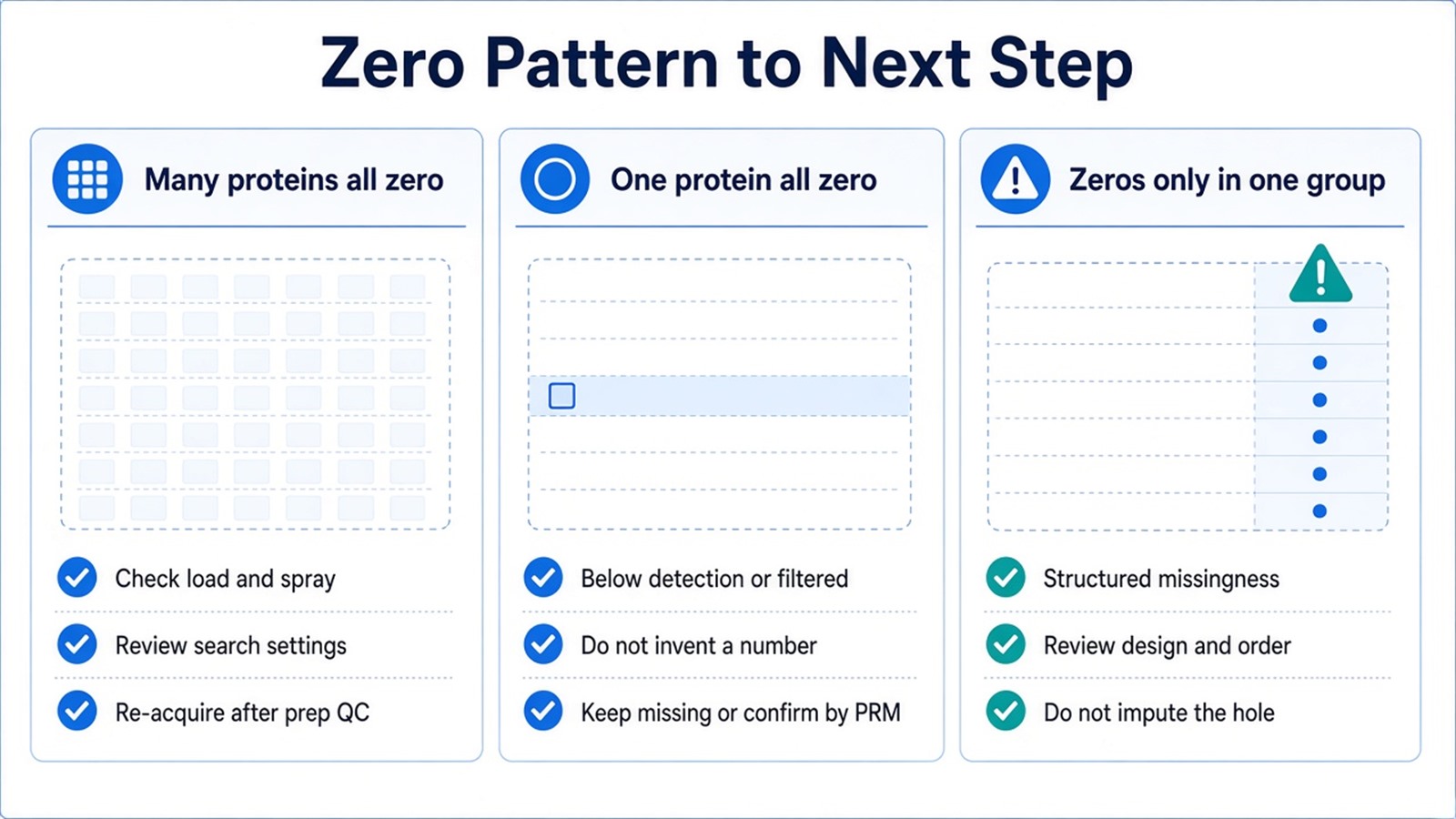
Figure 2. All-replicate zeros need different next steps depending on whether the empty pattern is global, feature-specific, or group-structured.
Unlabeled discovery more often keeps incomplete cells when abundance is low. An exception is a clean, high-load cohort with a stable extractor. Targeted acquisition more often recovers a short named list after discovery zeros. An exception is a peptide that never yields a unique, detectable sequence in that matrix.
Researchers who already have raw files, a protein row with three zeros, and a declared replicate design can also review the MtoZ Biolabs Quantitative Proteomics Service for project-specific QC review and reanalysis planning.
Frequently Asked Questions
1. Should three replicate zeros be replaced with a small number so statistics can run?
No as a default. Imputation can enable a test and can invent a group difference. Keep the feature as missing, or confirm it with a targeted assay, until the missingness mechanism is known.
2. Do three zeros mean the protein is absent from the sample?
No. They mean the pipeline returned no usable quantitative value. Absence claims need a method that can show the analyte was below a declared detection or quantification limit.
3. How should technical and biological replicate zeros be read differently?
Technical zeros after one digest point to acquisition or extraction. Biological zeros across independent samples can still reflect biology, but only after prep and search failures are excluded and the missingness pattern is reported.
4. Can match-between-runs fix a protein that is zero in all three files?
It can transfer an identification from another run when retention time and mass match. It cannot create signal that was never recorded, and open tolerances can assign the wrong peak. Document the setting if it changes a former zero row.
5. When should a zero discovery row move to targeted MS?
Move when the protein name is already closed and a unique peptide can be scheduled. Keep discovery troubleshooting when many proteins are empty or when names are still being added.
MtoZ Biolabs can provide quantitative proteomics QC review for projects where replicate quantitative values are missing or zero, including identification checks, extraction-parameter review, and guidance on whether re-acquisition or targeted follow-up is the better next step when project files and study design are available.
If further evaluation of missing-value rules, reanalysis settings, or targeted confirmation routing is needed, project details can be submitted for a feasibility review.
Reference
- C. Lazar, L. Gatto, M. Ferro, C. Bruley, T. Burger (2016). Accounting for the multiple natures of missing values in label-free quantitative proteomics data sets to compare imputation strategies. J. Proteome Res., 15, 1116-1125. https://doi.org/10.1021/acs.jproteome.5b00981
