






How Does ABPP Support High-Throughput Compound Screening?
In the early stages of drug discovery, researchers often need to screen hundreds or even thousands of candidate compounds to identify molecules with favorable potency, selectivity, and safety profiles. Traditional screening approaches, such as enzyme inhibition assays and binding affinity analyses, are amenable to high-throughput implementation, but they generally lack direct functional readouts at the target level. As a result, they cannot provide clear evidence that a compound is exerting its intended effect in cells or in vivo.
Activity-Based Protein Profiling (ABPP) is emerging as an important complementary tool for compound screening. Its key advantage is that it not only enables functional validation of target engagement in complex biological systems, but also allows proteome-wide assessment of potential off-target liabilities. This gives high-throughput compound screening an unprecedented level of resolution and confidence.
What Is ABPP, And Why Is It Well Suited For High-Throughput Compound Screening?
ABPP is a technique that uses covalent activity-based probes to selectively label protein active sites, followed by detection using high-resolution mass spectrometry. Unlike conventional proteomics, ABPP focuses on functional proteins, namely, enzymes that are truly active and exert biological effects under specific biological conditions.
For drug screening, ABPP enables:
- Functional target validation: determining whether a small molecule truly affects the activity of the target enzyme.
- Off-target profiling: assessing whether the compound unintentionally perturbs other enzymatic proteins.
- Function-based screening at the proteome level: avoiding reliance solely on expression abundance or structural affinity.
Core Application Scenarios Of ABPP In High-Throughput Compound Screening
1. Evaluation Of Target Inhibition: Competitive ABPP
One of the most important ABPP strategies is the competition-based assay, which is used to evaluate whether candidate compounds interact with the active site of a target protein.
The experimental principle is as follows:
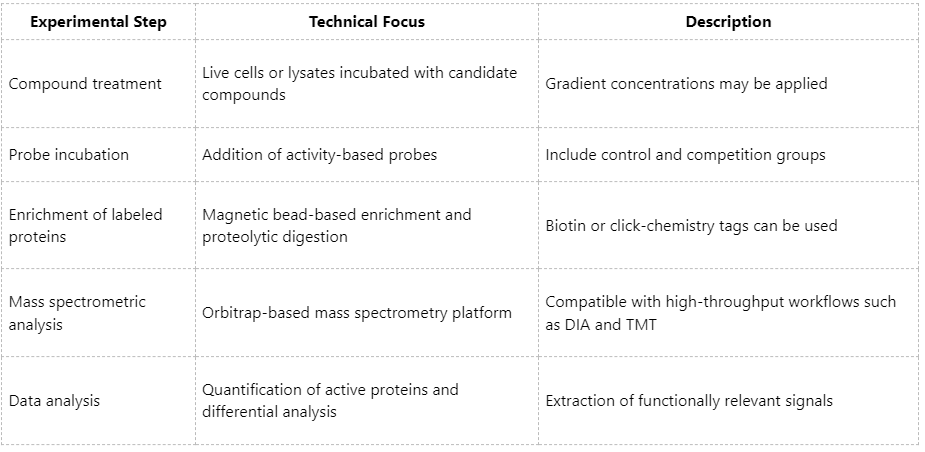
(1) Samples, such as cells or lysates, are first incubated with the compound.
(2) An activity-based probe is then added to label the enzyme.
(3) If the compound occupies the active site, probe labeling is reduced.
(4) Probe-labeled proteins are quantified by mass spectrometry to assess the extent of competition and inhibition.
Advantage: Direct functional validation of target engagement without relying on expression levels or hypothetical mechanisms.
2. Comprehensive Evaluation Of Off-Target Effects: Functional Proteome Profiling
In drug development, off-target activity is one of the major causes of clinical failure. ABPP enables simultaneous measurement of the activity of multiple enzymes, thereby providing a panoramic view of the active proteome in response to candidate compounds.
(1) It can simultaneously monitor dozens to hundreds of enzyme targets.
(2) It can uncover previously unrecognized off-target liabilities.
(3) It can support compound optimization and improvement of selectivity.
3. Activity-Driven Screening Platforms For Candidate Molecules
ABPP is not limited to validation of existing compounds; it can also be used to establish activity-driven screening platforms:
(1) High-throughput LC-MS/MS is used to profile active proteins after compound treatment.
(2) Molecules capable of modulating disease-relevant enzymatic activities are identified.
(3) Integration with phenotypic data further improves screening precision.
Applications: This approach is well suited for functional compound screening in oncology, inflammation, neurological disorders, and related therapeutic areas.
How Can An ABPP Screening Workflow Be Designed? (Recommended Experimental Framework)
MtoZ Biolabs ABPP Drug Screening Platform
As a leading proteomics service provider, MtoZ Biolabs has established a mature ABPP-based drug screening platform with the following advantages:
- Support for diverse enzyme-targeting probe libraries, including probes for serine hydrolases, cysteine-dependent enzymes, and HDACs.
- A standardized competitive ABPP workflow adaptable to high-throughput compound evaluation.
- Integration with TMT- and DIA-based quantitative strategies to improve activity-profile resolution and cross-sample comparability.
- One-stop reporting that includes off-target profiles, heatmaps, pathway analysis, and target prioritization recommendations.
- High-throughput capacity that supports parallel screening of dozens of compound combinations in a single study.
ABPP does more than identify which proteins are expressed; it reveals which proteins are functionally active, thereby providing a strong basis for precision drug design. For researchers seeking a more intelligent and reliable strategy for candidate compound screening, MtoZ Biolabs offers customized ABPP-based high-throughput screening solutions to support next-generation drug discovery through activity-centered proteomic analysis.
MtoZ Biolabs, an integrated chromatography and mass spectrometry (MS) services provider.
Related Services
How to order?




