






High-Sensitivity HCP Quantification: Label-Based vs Label-Free Approaches
Host Cell Proteins (HCPs) are endogenous protein impurities derived from expression systems, such as CHO cells, Escherichia coli, and yeast, during the manufacture of biopharmaceutical products. Even at trace levels, certain HCPs may induce immunogenic responses, compromise product stability, or adversely affect product safety. Consequently, accurate HCP quantification represents a critical component of biopharmaceutical quality control.
High-sensitivity HCP detection is equally important during process development and optimization. Precise quantification of HCP levels enables the identification of purification steps with suboptimal clearance efficiency and facilitates the detection of specific HCP species that are difficult to remove. These insights support process optimization and improve impurity removal performance. In long-term stability studies, sensitive HCP monitoring can also reveal potential quality risks at an early stage, helping to prevent product deterioration during storage and transportation.
Overall, accurate and highly sensitive HCP quantification is not only essential for regulatory compliance but also serves as a key technological foundation for ensuring the quality, safety, and commercial competitiveness of biopharmaceutical products. Owing to its high throughput and broad proteome coverage, mass spectrometry has emerged as an important complementary approach to ELISA for HCP analysis. Among currently available quantitative methodologies, label-based and label-free approaches represent the two dominant strategies, each offering distinct advantages and limitations.
Core Requirements for Mass Spectrometry-Based HCP Quantification
To support reliable HCP analysis, quantitative methodologies should satisfy several key requirements:
-
Ultra-High Sensitivity: Detection of protein impurities at the ng/mg level or lower.
-
Wide Dynamic Range: Accurate quantification across both highly abundant structural proteins and trace-level contaminating proteins.
-
High Reproducibility: Consistent and comparable results across manufacturing batches and production conditions.
-
Traceability: Quantitative results should be directly linked to specific protein sequences and their biological functions.
Meeting these requirements presents substantial analytical and technical challenges for HCP quantification strategies.
Label-Based Quantification
1. Principle
Label-based quantification employs stable isotope labeling strategies, such as SILAC, TMT, and iTRAQ, to introduce distinguishable mass differences between corresponding peptides derived from different samples. These mass shifts enable relative or absolute protein quantification by mass spectrometry.
Common label-based approaches include:
(1) SILAC (Stable Isotope Labeling by Amino Acids in Cell Culture): Stable isotope-labeled amino acids are incorporated during cell culture, making this approach particularly suitable for metabolic labeling studies.
(2) TMT (Tandem Mass Tag) / iTRAQ: Chemical labeling techniques that generate reporter ions during MS/MS fragmentation, enabling multiplexed analysis of multiple samples within a single experiment.
2. Advantages
(1) High Quantitative Accuracy: Stable isotope labeling minimizes variability introduced during sample preparation and mass spectrometric analysis.
(2) Multiplexing Capability: TMT and iTRAQ support the simultaneous analysis of up to 16 samples.
(3) Suitability for Absolute Quantification: When combined with internal standard proteins, absolute concentration measurements can be achieved.
3. Limitations
(1) Higher Cost: Labeling reagents can significantly increase experimental expenses.
(2) Workflow Complexity: Additional labeling procedures increase sample preparation time and operational complexity.
(3) Potential Coverage Limitations: Certain low-abundance or poorly labeled peptides may be underrepresented or missed.
Label-Free Quantification (LFQ)
1. Principle
Label-Free Quantification (LFQ) estimates protein abundance based on MS1 signal intensity or spectral counting without requiring the introduction of chemical or isotopic labels.
Common LFQ strategies include:
(1) Intensity-Based LFQ: Quantification is achieved through direct comparison of peptide peak intensities across samples.
(2) Spectral Count LFQ: Protein abundance is inferred from the frequency with which peptide-derived MS/MS spectra are acquired.
2. Advantages
(1) Cost-Effective: No additional expenditure on labeling reagents is required.
(2) Simplified Workflow: Reduced sample processing steps minimize experimental complexity and sample loss.
(3) Broad Proteome Coverage: Particularly suitable for exploratory studies and the discovery of previously uncharacterized HCP species.
3. Limitations
(1) Susceptibility to Batch Effects: Quantitative performance depends heavily on consistency in sample preparation and instrument operation.
(2) Lower Quantitative Precision: Particularly for proteins present at very low abundance.
(3) Limited Suitability for Direct Multi-Batch Comparisons: Additional normalization and standardization procedures are often required.
High-Sensitivity HCP Quantification: Recommendations for Strategy Selection
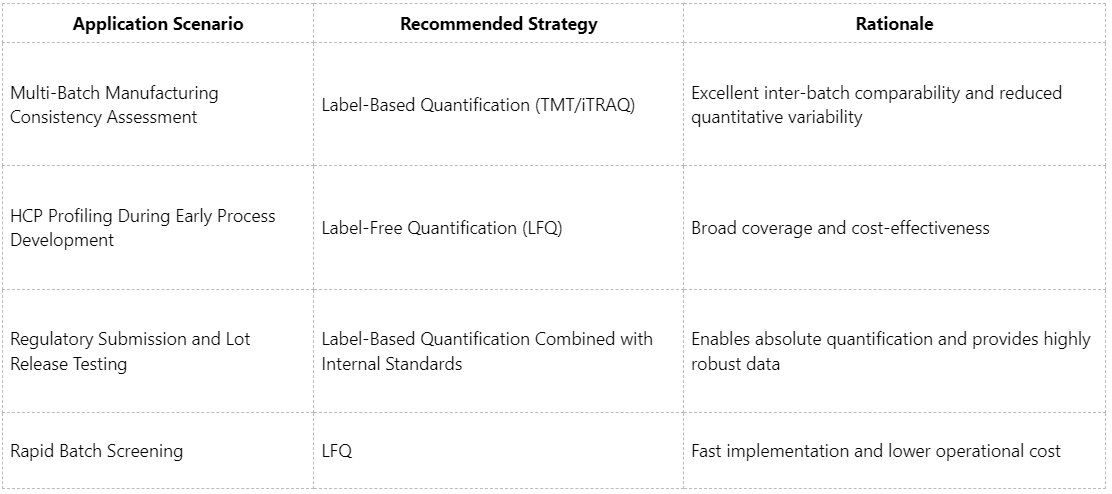
Advances in Orbitrap high-resolution mass spectrometry, trapped ion mobility spectrometry (TIMS), and data-independent acquisition (DIA) technologies are increasingly blurring the distinction between label-based and label-free workflows. As these technologies continue to evolve, future HCP quantification strategies are likely to adopt hybrid approaches that combine the quantitative precision of labeling techniques with the broad analytical coverage of LFQ. Such integrated solutions can better address the diverse requirements of biopharmaceutical manufacturers throughout the product development lifecycle.
HCP quantification is not merely an analytical challenge but also a critical factor influencing product quality, patient safety, and regulatory compliance. Both label-based and label-free approaches offer unique strengths and limitations. Appropriate selection, or strategic integration, of these methodologies is essential for achieving optimal analytical performance across different application scenarios. MtoZ Biolabs leverages advanced analytical platforms and experienced scientific teams to support biopharmaceutical companies in achieving higher standards of HCP characterization and quality control.
MtoZ Biolabs, an integrated chromatography and mass spectrometry (MS) services provider.
Related Services
How to order?




