






Gas Chromatography Analytical Service
- Pharmaceuticals and Biopharmaceuticals: Used for purity testing, impurity profiling, and residual solvent determination of active pharmaceutical ingredients (APIs), intermediates, and finished formulations to ensure drug quality and compliance.
- Food and Environmental Testing: Monitors pesticide residues, food additives, and volatile organic compounds (VOCs) to safeguard food safety and environmental health.
- Materials Science: Evaluates residual solvents and small molecular components in polymers, excipients, and packaging materials to support studies on material performance and safety.
- Metabolism and Life Science Research: Detects small-molecule metabolites or volatile compounds in complex biological samples, providing support for metabolomics and pathological mechanism studies.
Gas Chromatography Analytical Service is a professional testing service based on gas chromatography (GC) technology, primarily used for the separation, qualitative identification, and quantitative analysis of volatile and semi-volatile compounds in complex mixtures. In fields such as pharmaceuticals, life sciences, environmental monitoring, food safety, and materials research, GC has become a core method for detecting small organic molecules, volatile components, and residual solvents due to its high resolution and sensitivity. With the continuous advancement of pharmaceutical quality standards and regulatory requirements, gas chromatography analysis is not only applied to purity testing and impurity identification of active pharmaceutical ingredients (APIs) and intermediates but is also widely used in process monitoring and stability studies, providing reliable quality evaluation tools for both research and industry.
Technical Principles
The basic principle of GC is to use a gaseous carrier, typically helium or nitrogen, to deliver the sample mixture into a capillary chromatographic column. Because the components of the sample interact differently with the stationary phase, each migrates at a different speed within the column, resulting in effective separation. The separated compounds then enter the detector, where they generate corresponding signal intensities, and qualitative and quantitative analysis can be achieved by comparison with reference standards. For low-boiling and highly volatile compounds, direct injection can be used, while for complex matrices or residue analysis, headspace sampling can be applied to improve selectivity and sensitivity.
Analysis Workflow
The general process of Gas Chromatography Analytical Service is as follows:
1. Sample Preparation
Select an appropriate pretreatment method based on the sample properties to ensure that the target components can be effectively vaporized and introduced into the chromatographic system.
2. Chromatographic Separation
Efficiently separate the sample components using a high-performance GC system.
3. Signal Detection
Record chromatographic signals with detectors such as FID or TCD.
4. Data Analysis
Interpret the chromatogram by extracting parameters such as retention time and peak area, and complete qualitative and quantitative analysis by comparison with reference standards or databases.
5. Report Generation
Provide a complete report that includes experimental conditions, chromatograms, and detailed result analysis.
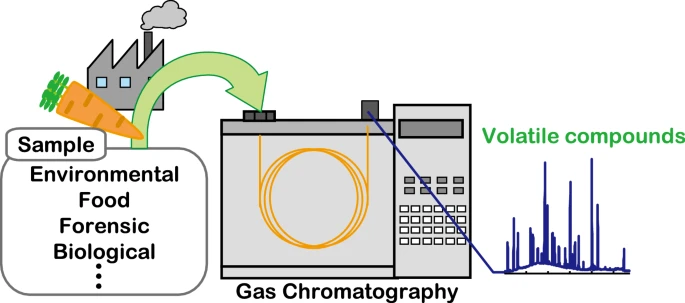
Ueta I. ANAL SCI. 2022.
Figure 1. Gas Chromatography determination of volatile compounds
Service Advantages
1. High-Resolution Separation Capability
Accurately distinguishes various small molecules with similar structures in complex mixtures, providing reliable evidence for impurity identification and purity evaluation.
2. Compatibility with Multiple Detection Modes
Supports detectors such as FID, TCD, and GC-MS, enabling the selection of optimal analytical strategies based on sample characteristics to ensure both sensitivity and specificity.
3. Multiple Method Adaptation
MtoZ Biolabs Gas Chromatography Analytical Service accommodates client-developed methods, pharmacopeial methods, and customized method development to meet diverse analytical needs.
4. Comprehensive Data Support
Provides not only qualitative and quantitative results but also impurity profiles, residual solvent detection, and stability analysis data to help clients fully understand the structural and compositional characteristics of their samples.
Services at MtoZ Biolabs
Relying on advanced gas chromatography platforms and multiple types of detectors, MtoZ Biolabs provides Gas Chromatography Analytical Service covering sample purity identification, impurity and residual solvent detection, stability studies, and quantitative composition analysis. We can carry out method development and validation according to client requirements and deliver complete chromatograms, qualitative and quantitative data, and standardized analytical reports, providing reliable data support for both research and industry.
Sample Submission Suggestions
Samples should have good volatility or undergo appropriate pretreatment, and substances that are easily degradable or highly volatile must be stored in sealed containers. It is recommended to contact our technical support team before submission to assess sample suitability and obtain tailored submission guidance.
Applications
How to order?




