






Fruit Ripening Proteomics: Linking Protein Changes to Quality Traits
Fruit ripening proteomics compares protein abundance across ripening stages, genotypes, or postharvest treatments to reveal candidate proteins linked to quality traits such as firmness, color development, sugar accumulation, or storage life. The method measures the proteome in a defined fruit tissue at a defined ripeness window. It does not by itself measure Brix, shelf life under different storage conditions, or causal control of quality.
The useful output is a stage-matched set of candidate proteins and pathway themes that track the ripening contrast and quality notes recorded at harvest, not an automatic list of quality marker proteins.
If you are planning plant proteomics for fruit ripening, share the species, fruit part sampled, ripening stage rule, quality scoring plan, and comparison design with MtoZ Biolabs while collection is still open.
What Fruit Ripening Proteomics Can Reveal
Quantitative plant proteomics during ripening can highlight:
-
Protein abundance shifts between immature, turning, ripe, and late-ripening stages
-
Differences between breeding lines or cultivars at the same ripening stage
-
Remodeling themes in cell wall, primary metabolism, stress-response processes, or transport when supported by annotation
-
Postharvest or treatment-associated protein changes under matched storage or ethylene protocols
Standard analysis may include differential screening, functional annotation, GO and KEGG pathway views, protein interaction context, and Reactome analysis when the species is supported.
Fruit ripening proteomics does not by itself:
-
Prove that a protein controls firmness, flavor, or shelf life
-
Replace sugar, acid, pigment, or texture measurements when those define quality
-
Merge peel and flesh biology into one contrast without design intent
-
Predict commercial storage performance from one laboratory harvest alone
Results should be interpreted as candidate proteins and pathway priorities tied to the sampled fruit part and ripening stage until phenotype linkage and follow-up work support stronger quality claims.
Define the Ripening Contrast Before Sampling
Ripening stage is a major source of proteome variation in fruit. If compared groups are not defined and matched using consistent maturity criteria, differential proteins may primarily reflect ripening-stage differences rather than the cultivar, treatment, or quality trait being studied.
Before proteomics sampling, define the comparison clearly, such as a ripening time course within one genotype, a cultivar comparison at a matched ripening stage, or a postharvest treatment versus control with matched starting maturity.
Ripening stage should be defined using appropriate and consistently recorded criteria, such as color stage, firmness, time after anthesis or treatment, or an established harvest-maturity standard. These measurements provide the biological context needed to interpret proteomic differences and reduce the risk of attributing stage-dependent protein changes to the wrong experimental factor.
Biological replicates should also represent independent experimental units. Depending on the study design, multiple fruits from the same plant may be subsamples rather than independent biological replicates.
Fruit Part, Collection, and Quality Metadata
Ripening biology differs between peel, flesh, and vascular tissue. Sample the part that matches the quality question.
Peel proteomics often fits color development, cuticle-related changes, and surface disorder questions. Flesh or pulp proteomics often fits softening, soluble solids-linked remodeling, and eating-quality contrasts. Whole-fruit homogenates can be used when the design explicitly targets bulk fruit change, but they blur peel and flesh differences.
Fruit tissue requirements depend on tissue type, composition, extraction difficulty, and analytical workflow. Confirm the required sample amount before collection rather than applying one fixed amount across fruit types.
Record relevant quality metadata at harvest:
-
Ripening stage score
-
Firmness, color, or Brix if measured
-
Fruit size class and orchard or chamber block
-
Time from harvest to freezing
-
Postharvest temperature if relevant
Collection and storage should minimize protein degradation, contamination, and unnecessary freeze-thaw cycles before analysis.
| Ripening Study Type | Primary Fruit Part | Quality Trait Linkage | Design Caution |
| Softening during ripening | Flesh or pulp | Firmness class or texture score | Keep ripening stages clearly separated |
| Peel color development | Peel or flavedo | Color stage index | Record relevant sampling-position differences |
| Cultivar quality contrast | Flesh at matched maturity | Eating-quality or storage class | Match harvest maturity across cultivars |
| Postharvest storage | Whole fruit or flesh aliquot | Disorder score over storage time | Separate storage time-point groups |
| Ethylene or treatment response | Tissue relevant to the treatment | Ripening response score | Match starting maturity across groups |
These rows are planning guides, not guaranteed outcomes for every crop.
Match Ripening Conditions Across Compared Groups
Proteomic differences can be difficult to interpret when maturity or handling differs systematically between groups.
Match across groups whenever possible:
-
Cultivar, rootstock, and orchard or growth environment
-
Fruit size and sampling position when relevant
-
Harvest maturity rule rather than calendar date alone
-
Postharvest temperature and ethylene exposure protocol
-
Sampled fruit part and collection method
-
Time from harvest to freezing
For a cultivar comparison at commercial maturity, for example, comparing a fully ripe cultivar with another still at the turning stage can confound cultivar effects with ripening-stage effects.
For time-course designs, keep ripening stages as separate groups. Proteins changing during early ripening may represent different biological processes from those associated with late ripening or senescence.
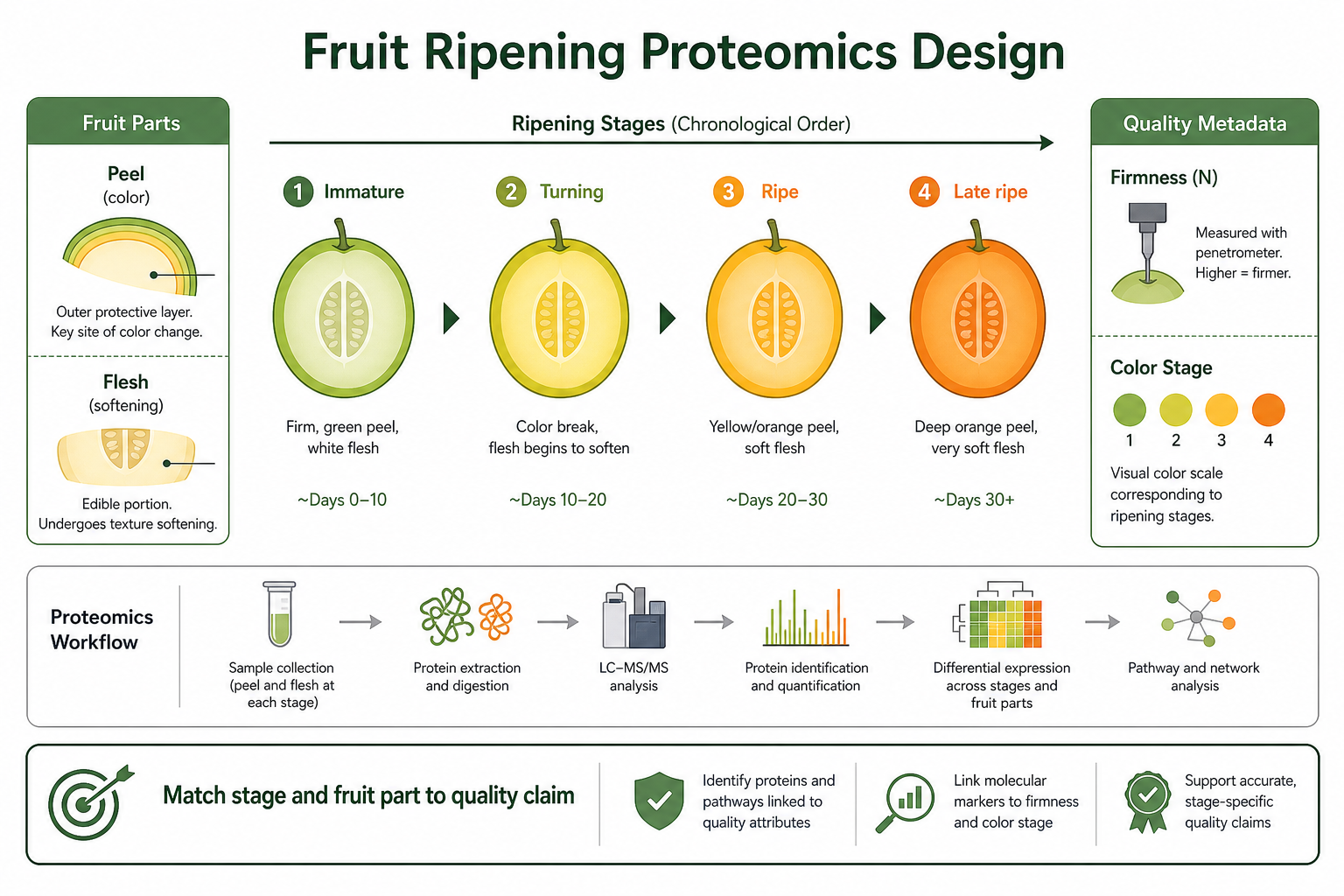
Figure 1. Ripening stage, fruit part, and quality metadata should be defined before protein changes are linked to quality traits.
From Ripening-Stage Proteins to Quality-Linked Pathway Themes
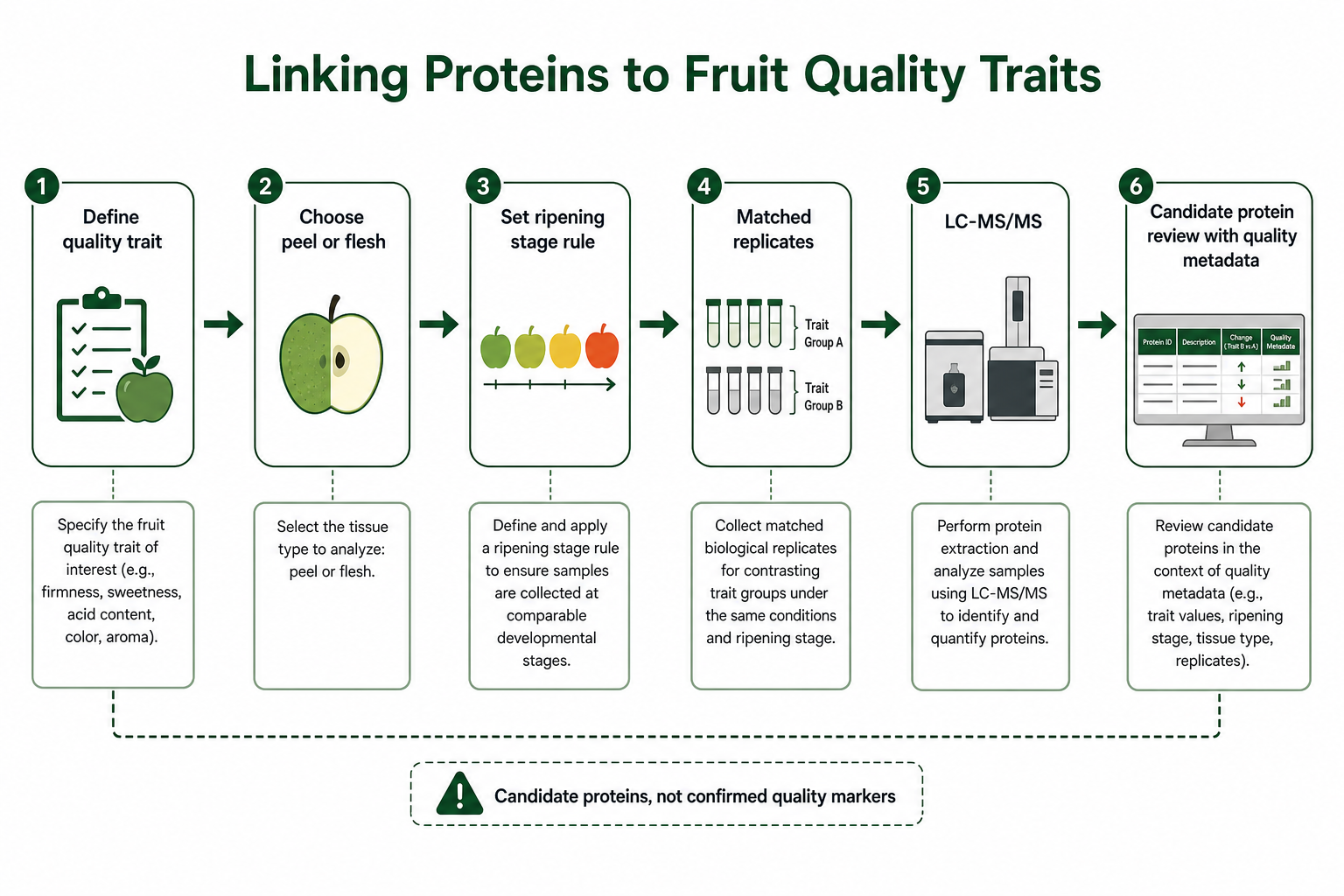
After LC-MS/MS and quantitative comparison, interpret proteins in the context of ripening stage, sampled fruit part, and recorded quality traits.
Prioritize proteins with:
-
Consistent direction of change across biological replicates
-
Alignment with firmness, color, or other recorded quality traits
-
Annotation support in cell wall, metabolism, development, or other relevant processes
-
Consistent detection across biological replicates
Use GO, KEGG, PPI, and Reactome views to organize candidates when the species is supported. Cell-wall or metabolism pathway themes may support hypotheses about softening or flavor-related remodeling, but enrichment alone does not prove a quality mechanism.
Cross-check candidates against the biological context:
-
Proteins consistently associated with a defined quality contrast are stronger candidates for follow-up
-
Proteins appearing mainly in overripe or damaged fruit may reflect senescence or tissue deterioration
-
Peel-associated proteins should not be interpreted as drivers of flesh traits without corresponding flesh evidence
Keep conclusions at the candidate-protein level until phenotypic, storage, sensory, genetic, or other follow-up evidence supports stronger claims.
Choosing a Quantitative Strategy for Ripening Comparisons
Quantitative proteomics is appropriate when the study aims to compare protein abundance across ripening stages, cultivars, or postharvest conditions. Identification-focused analysis may also be useful for early feasibility assessment in a new fruit species or tissue type.
The acquisition and quantification strategy should be selected according to the comparison design, sample number, required data completeness, and project objectives rather than sample number alone.
Plant proteomics service scope typically includes protein extraction or purification, enzymatic digestion, LC-MS/MS analysis, and bioinformatics reporting.
When quality traits also involve sugar, organic acid, pigment, or hormone changes, metabolomics or hormone analysis may be considered alongside proteomics when relevant to the study question.
Related Services
Plant Hormone Analysis Service
Frequently Asked Questions
1. Can Fruit Ripening Proteomics Replace Quality Measurements?
No. Proteomics reports protein abundance patterns. Firmness, Brix, color, and sensory quality still need appropriate measurement when they define the trait.
2. Should Peel or Flesh Be Sampled for Ripening Studies?
Sample the fruit part that matches the biological question. Peel is more relevant to color and surface traits, while flesh is generally more relevant to softening and pulp-quality comparisons.
3. Can Several Ripening Stages Be Analyzed in One Group?
Not when the goal is to compare defined ripening stages. Time-course studies should keep different stages as separate groups with consistent sample handling.
4. How Should Fruit Tissue Be Collected for Proteomics?
Collect the fruit part that matches the biological question and keep tissue type, ripening stage, and handling consistent across groups. Confirm the required sample amount according to the fruit type and analytical workflow before collection.
5. Do Differential Proteins Prove a Quality Gene or Marker?
No. Differential proteins are candidates until their relationship with the quality trait is supported by appropriate biological replication and follow-up evidence.
6. What Should Be Shared Before Starting a Ripening Proteomics Project?
Share the species, fruit part, ripening stage criteria, quality measurements available, comparison design, and planned biological replicates.
Conclusion
Fruit ripening proteomics can help connect protein abundance changes with fruit quality traits when ripening stage, fruit part, comparison design, and quality metadata are appropriately matched. Its primary value is to prioritize candidate proteins and biological pathways for further investigation rather than to provide confirmed quality markers or causal mechanisms.
To discuss a fruit ripening proteomics project, contact MtoZ Biolabs with the crop, ripening-stage criteria, fruit part, comparison design, and quality traits the study aims to investigate.
How to order?




