






Fluorescence Recovery after Photobleaching (FRAP) Service
Fluorescence Recovery after Photobleaching (FRAP) is a powerful live-cell imaging technique that enables researchers to measure molecular diffusion, binding kinetics, and spatial distribution within cells. By selectively bleaching a defined region with a focused laser and tracking the recovery of fluorescence over time, FRAP provides quantitative insights into protein interactions, membrane dynamics, signaling pathways, and molecular transport. It is widely used in cell biology, structural biology, and drug discovery.
MtoZ Biolabs offers Fluorescence Recovery after Photobleaching (FRAP) Service supported by advanced confocal microscopy platforms and high-sensitivity detection systems. We deliver a complete solution that includes experimental design, sample preparation, data acquisition, and kinetic modeling, ensuring reliable, high-quality results for both academic and industrial research.
Technical Principles
In a FRAP experiment, molecules of interest are labeled with fluorescent probes or proteins. A high-intensity laser is then directed to a small region of the sample, causing irreversible bleaching of fluorescence within that area. Recovery occurs as unbleached molecules migrate or bind into the bleached zone, gradually restoring fluorescence intensity. The recovery curve is recorded and fitted with kinetic models to calculate diffusion rates, mobile fractions, binding constants, and half-life parameters. These quantitative data provide essential insights into molecular dynamics and regulatory mechanisms inside living systems.
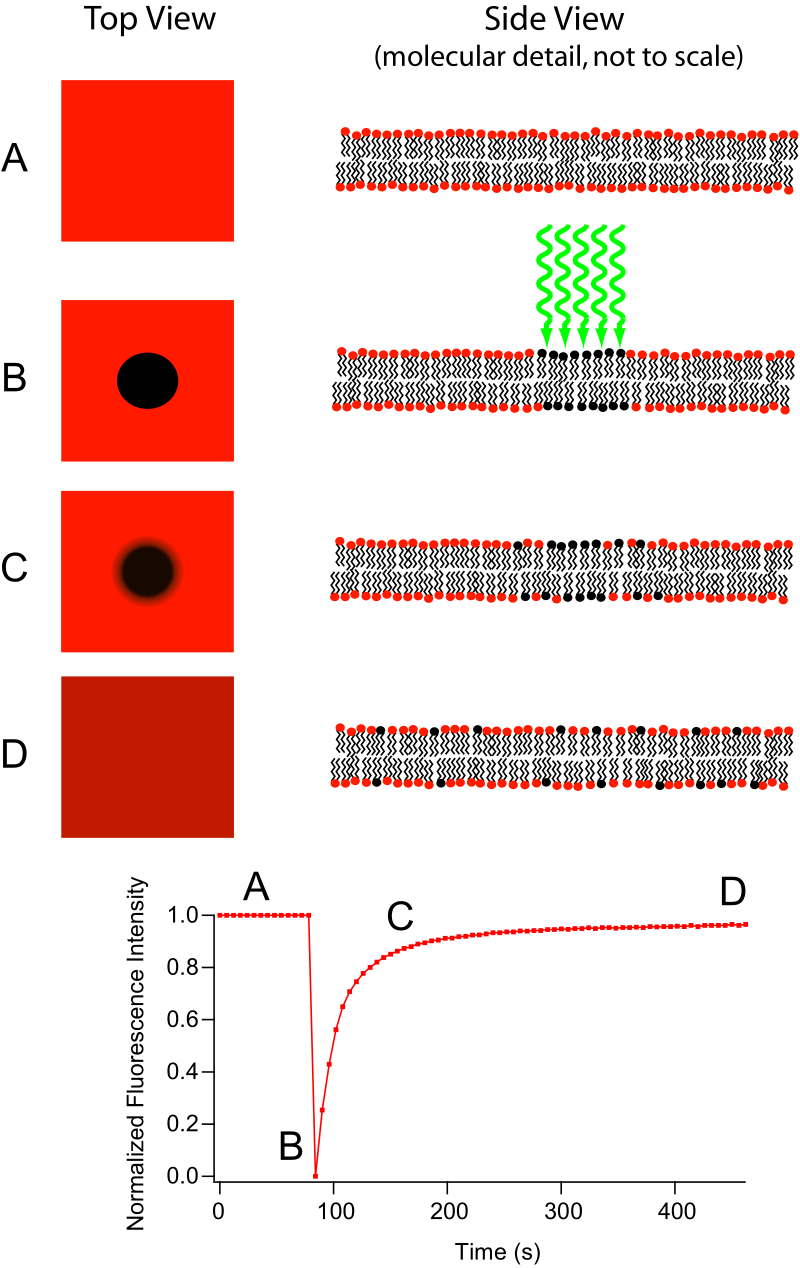
Source: Wikipedia
Figure 1. Principle of FRAP
Analysis Workflow
1. Sample Preparation
Processing of cell lines, tissue sections, or protein complexes with appropriate fluorescent labeling.
2. Pre-scan
Evaluation of fluorescence distribution and definition of bleaching regions to ensure accuracy.
3. Laser Bleaching
Application of rapid bleaching to the selected area to remove local fluorescence.
4. Recovery Monitoring
Real-time tracking of fluorescence signal recovery within the bleached zone.
5. Data Processing
Normalization and curve fitting to extract kinetic parameters.
6. Result Interpretation
Delivery of professional analysis and biological interpretation aligned with the study objectives.
Why Choose MtoZ Biolabs?
✔ Advanced Imaging Platforms: High-sensitivity confocal and real-time imaging systems for precise molecular tracking.
✔ Versatile Experimental Models: Support for both standard FRAP and inverse FRAP (iFRAP) to address diverse research needs.
✔ Expert Scientific Team: Skilled specialists in molecular kinetics and cell imaging provide end-to-end guidance.
✔ Tailored Experimental Design: Customized bleaching regions, conditions, and modeling strategies to fit specific research goals.
✔ High-quality Deliverables: Standardized protocols and rigorous quality control ensure reproducible and publication-ready data.
Sample Submission Suggestions
Our Fluorescence Recovery after Photobleaching (FRAP) Service accepts diverse sample types, including cultured cells, tissue sections, organoids, and recombinant protein systems. To ensure optimal imaging, clients should provide samples with strong and stable fluorescence signals. Both fixed and live cells can be submitted, although live cell samples should be transported under low temperature and delivered promptly. Detailed submission guidelines are available upon request from MtoZ Biolabs.
FAQ
Q1: Is FRAP suitable for studying small molecules?
Yes. FRAP is applicable not only to proteins and lipids but also to small molecules in cells, tissues, or material systems. With high-sensitivity imaging and advanced modeling, MtoZ Biolabs provides precise diffusion and binding parameters across molecular scales.
Q2: Can FRAP be integrated with other imaging techniques?
Yes. Our Fluorescence Recovery after Photobleaching (FRAP) Service can be combined with complementary techniques such as Fluorescence Lifetime Imaging Microscopy (FLIM) and Förster Resonance Energy Transfer (FRET). This integration allows simultaneous acquisition of diffusion rates, energy transfer efficiency, and structural dynamics, providing multidimensional insights for more competitive publications.
MtoZ Biolabs Fluorescence Recovery after Photobleaching (FRAP) Service offers reliable and reproducible data on molecular dynamics at the cellular level. Whether exploring diffusion processes, protein interactions, or drug mechanisms, our service delivers accurate results and clear visual outputs to advance both fundamental research and translational applications.
Related Services
How to order?




