






Flow Cytometry Service
Flow cytometry is a powerful single-cell analysis technology that enables rapid multiparameter measurement of thousands of cells within seconds. It provides quantitative data on cell size, internal complexity, and the expression of surface or intracellular molecules. This technology is widely applied in immunology, oncology, stem cell research, vaccine development, and drug discovery, offering critical support for both academic research and industrial development.
MtoZ Biolabs offers Flow Cytometry Service using advanced multi-laser, multi-channel instruments and a team of experienced scientists. Our end-to-end Flow Cytometry Service covers experimental design, sample preparation, data collection, and comprehensive analysis, ensuring results that are reliable, reproducible, and publication-ready.
Technical Principles
Flow cytometry uses a sheath fluid system to align cells in single file as they pass through a focused laser beam. Light scattering signals are produced, with forward scatter reflecting cell size and side scatter indicating internal complexity. In addition, fluorescence signals from labeled probes or antibodies are detected. Photomultiplier tubes or photodiodes capture these signals and convert them into electronic data for real-time computer analysis.
With the capability of multi-laser and multiparameter systems, flow cytometry can simultaneously measure dozens of fluorescent markers. It also supports applications such as cell sorting, rare cell enrichment, and imaging flow cytometry, making it a versatile tool for both qualitative and quantitative research.
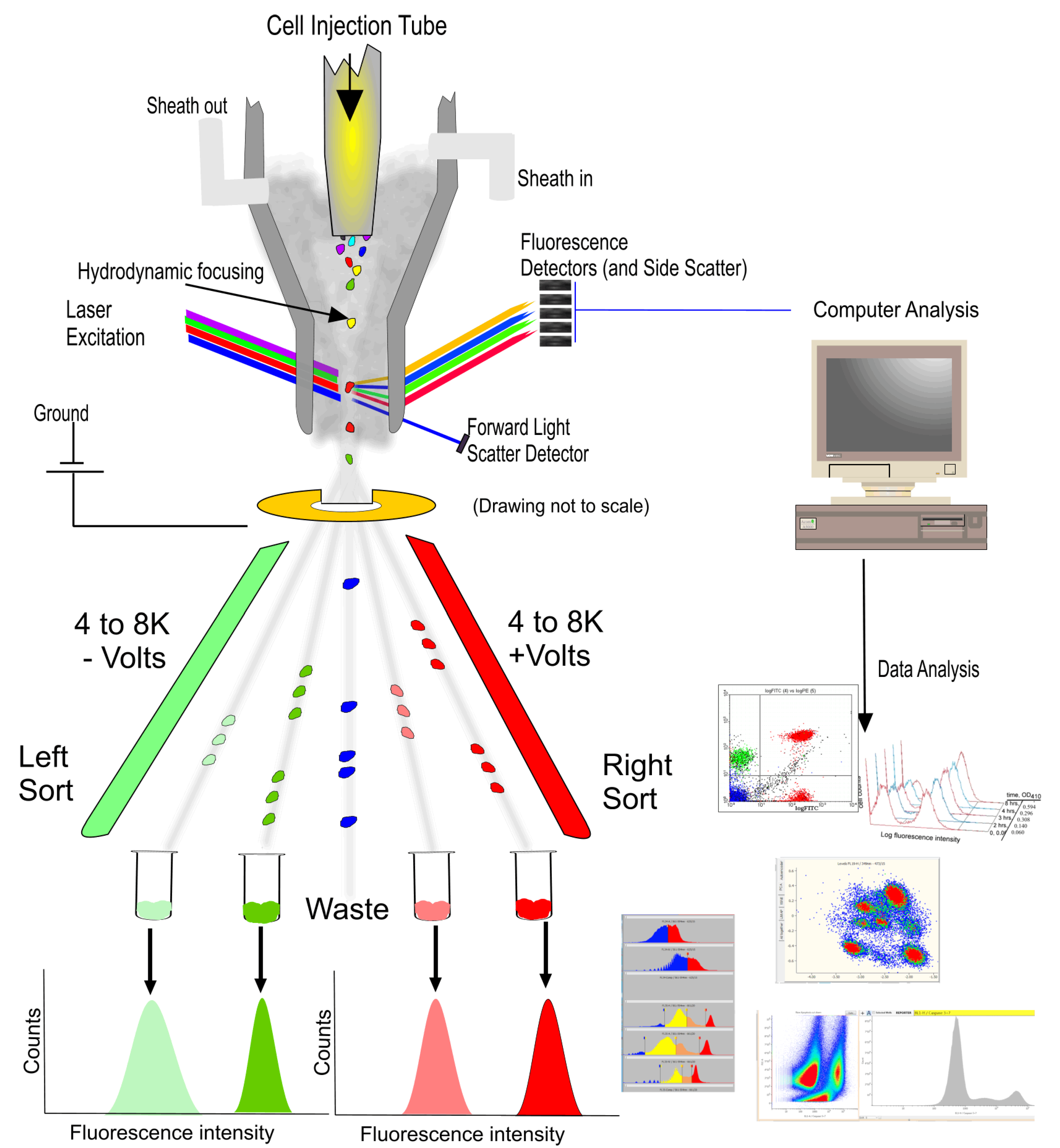
Robinson, J. P. et al. Cells. 2023.
Figure 1. Schematic of Flow Cytometry Analysis and Sorting
Analysis Workflow
1. Sample Preparation
Collection and processing of cells from various sources to ensure high-quality suspensions.
2. Fluorescent Labeling
Application of probes or antibodies to mark target molecules with high specificity and sensitivity.
3. Laser Detection
Passage of single cells through the laser beam to generate scatter and fluorescence signals.
4. Signal Acquisition
Detection and electronic conversion of optical signals followed by real-time recording.
5. Data Analysis
Software-based compensation, gating, and statistical processing to deliver accurate multiparameter results.
6. Cell Sorting (optional)
Isolation of specific cell subsets with high precision for downstream studies.
Why Choose MtoZ Biolabs?
✅ Multiparameter Detection: Multi-laser, multi-channel systems capable of simultaneous measurement of numerous markers.
✅ High sensitivity and Precision: Capable of detecting rare populations and low-abundance molecules with excellent stability.
✅ Efficiency: Automated and standardized workflows that reduce turnaround time and accelerate data delivery.
✅ Flexible Cell Sorting: Options for isolating specific cell subsets while preserving viability.
✅ Comprehensive Support: From tissue handling and sample preparation to data analysis, all steps are managed by a dedicated expert team.
Sample Submission Suggestions
Our Flow Cytometry Service accepts a wide range of cell sources, including peripheral blood, bone marrow, tissue digests, cultured cells, and organoid-derived samples. For the best results, freshly processed samples are recommended. Live cells should be transported at low temperatures, while fixed samples may be shipped at room temperature. Detailed submission guidelines are available from MtoZ Biolabs upon request.
What Could be Included in the Report?
· Detailed records of sample preparation and detection
· Raw data files in FCS format
· Visualized plots including scatter plots, histograms, and gating diagrams
· Purity and recovery data if cell sorting is performed
· A complete experimental report with conditions, methodology, and interpretation
FAQ
Q1: How do you handle spectral overlap in multicolor experiments?
Fluorescence overlap is addressed at the design stage by careful selection of dye combinations. Our team applies compensation strategies to separate signals effectively, ensuring data clarity and reliability.
Q2: What is the impact of dead cells on results?
Dead cells can contribute to nonspecific binding and background fluorescence. We recommend providing viable samples whenever possible. Viability dyes may also be included in the workflow to improve data quality.
MtoZ Biolabs Flow Cytometry Service delivers high-quality, reproducible single-cell analysis. With advanced instrumentation and expert scientific support, we provide the reliable data and insights needed to accelerate your research and development goals.
Related Services
How to order?




