






Energy Dispersive X-ray Spectroscopy (EDS) Analytical Service
- Rapid Analysis Capability: Preliminary compositional detection can be performed simultaneously with microscopic imaging.
- Elemental Qualitative and Semi-Quantitative Capability: The main elements in a sample can be quickly identified, and their relative abundances can be semi-quantitatively estimated.
- Spatially Resolved Imaging: Supports point analysis, line scanning, and two-dimensional elemental mapping to reveal the spatial distribution and interfacial features of elements within a sample.
- Wide Elemental Coverage: Capable of detecting a broad range of elements from B to U with detection limits reaching 0.1-1 at%, meeting the research needs of complex materials and multi-element systems.
- Biological and Medical Materials: Elemental characterization and compliance verification of implants, injection devices, and drug delivery carriers.
- Quality Control and Failure Analysis: Rapid compositional analysis of raw materials, products, and failed components during the production process.
- Environmental and Energy Research: Elemental composition detection of environmental particulates, energy storage materials, and catalysts.
Energy Dispersive X-ray Spectroscopy (EDS) Analytical Service is an elemental analysis service based on the detection of characteristic X-ray signals generated by the interaction between an electron beam and a sample. EDS is commonly combined with scanning electron microscopy (SEM), transmission electron microscopy (TEM), and scanning transmission electron microscopy (STEM), enabling qualitative and semi-quantitative elemental detection simultaneously with imaging, and supporting point analysis, line scanning, and two-dimensional compositional mapping.
As a fast, flexible, and widely applied micro-area chemical analysis tool, EDS can be used to study elemental distribution from the nanoscale to the microscale. It is broadly applied in materials science, semiconductors, biomedical materials, environmental science, and quality control, providing efficient and reliable elemental composition information for both scientific research and industrial applications.
Technical Principles
The principle of EDS is based on the detection of characteristic X-ray signals generated when a high-energy electron beam interacts with the atoms of a sample. When the electron beam bombards the sample, inner-shell electrons are excited and ejected, and the relaxation process in which outer-shell electrons fill the vacancies releases X-rays with characteristic energies. Since the characteristic X-ray energies of different elements are unique, by detecting and analyzing the energy and intensity of these X-rays, it is possible to determine the types of elements present in the sample as well as their relative abundances.
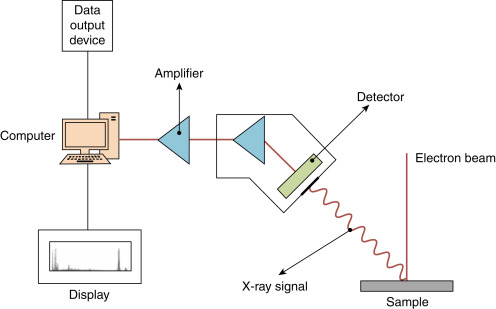
Colpan CO. et al. Comprehensive Energy Systems. 2018.
Figure 1. Energy Dispersive X-Ray Spectroscopy
Analysis Workflow
The general workflow of Energy Dispersive X-ray Spectroscopy (EDS) Analytical Service is as follows:
1. Sample Preparation
Samples are prepared by fixation, sectioning, or coating according to their characteristics to ensure compatibility with vacuum conditions and electron beam irradiation.
2. Microscopic Imaging
Morphological observation is conducted under SEM, TEM, or STEM, and the target area is selected.
3. X-ray Signal Acquisition
The electron beam irradiation generates characteristic X-rays, which are recorded by the EDS detector.
4. Spectral Analysis
By analyzing the positions and intensities of the characteristic X-ray peaks, the elemental composition of the target area is determined, and semi-quantitative analysis is performed.
5. Result Report
A complete report is generated, including experimental methods, raw data, and result interpretation.
Service Advantages
Services at MtoZ Biolabs
MtoZ Biolabs provides Energy Dispersive X-ray Spectroscopy (EDS) Analytical Service that enables qualitative and semi-quantitative elemental analysis simultaneously with microscopic imaging. This service supports point analysis, line scanning, and two-dimensional elemental mapping, offering a clear visualization of the composition and spatial distribution characteristics of samples. With standardized workflows and flexible analytical solutions, we help clients obtain reliable and efficient data support for material characterization, defect identification, and quality control.
Sample Submission Suggestions
Samples must be able to withstand a high-vacuum environment and are not suitable if they contain water or volatile organic materials. The sample surface should be as flat and clean as possible to avoid contamination or surface layers that could interfere with elemental analysis.
It is recommended to contact our technical support team before submitting samples to determine their suitability and to receive tailored sample submission guidance.
Applications
How to order?




