






Ellipsometry Analytical Service
Ellipsometry is a high-precision characterization method based on optical principles, used to study the optical properties and thin-film structures of material surfaces. Its basic principle is to irradiate the sample surface with polarized light, and by measuring the change in the polarization state of the reflected light (ellipsometric parameters Ψ and Δ), obtain information such as film thickness, refractive index, extinction coefficient, and interfacial characteristics. This method has the advantages of being non-destructive, highly sensitive, and high-resolution, enabling accurate measurements at the nanoscale. Due to its unique characterization capability, ellipsometry is widely applied in the precise measurement of film thickness, refractive index, and interfacial properties, and can also be used to study other properties that affect light polarization.
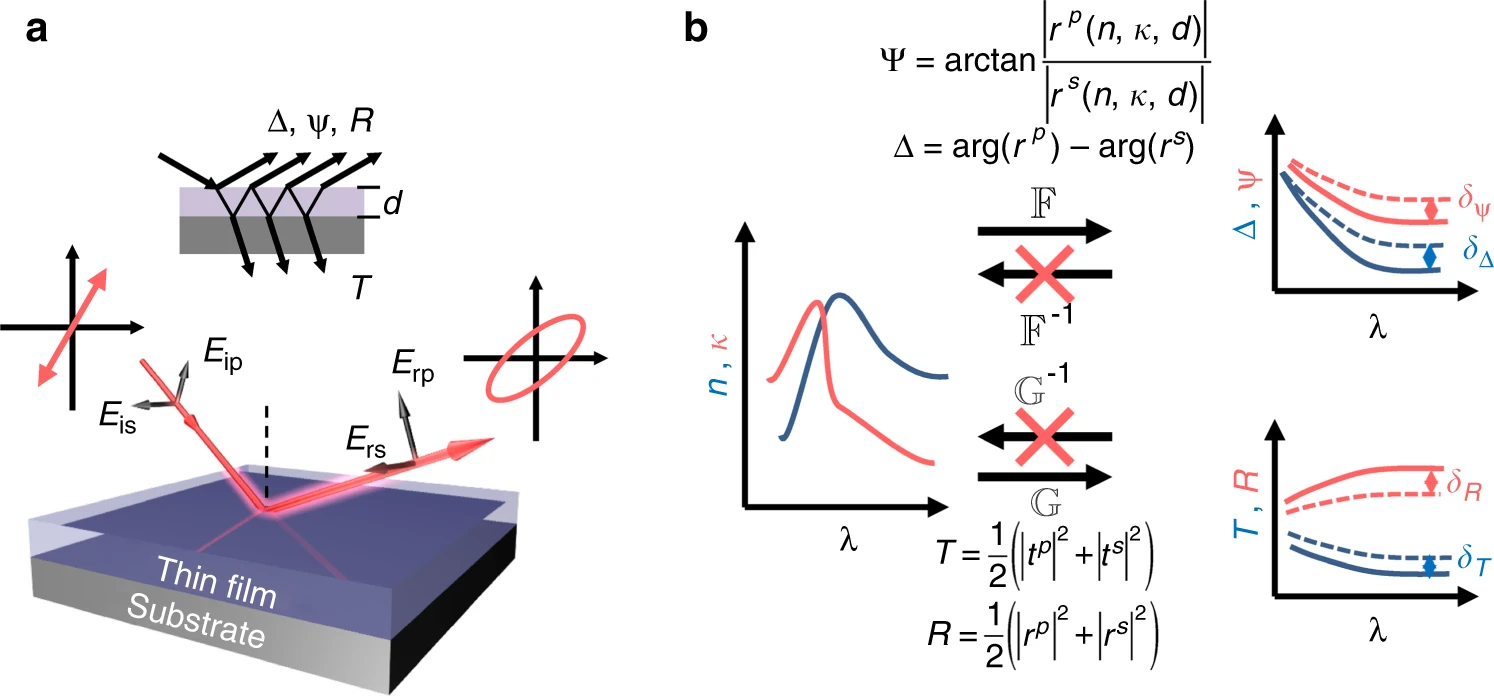
Liu, J C. et al. Light: Science & Application, 2021.
Figure 1. Principle of R, T Assisted Ellipsometry
Services at MtoZ Biolabs
Based on a high-performance ellipsometry platform, MtoZ Biolabs has launched an ellipsometry analytical service that can characterize the optical and structural features of sample surfaces with nanoscale precision. This service can accurately measure changes in the polarization state of reflected light, thereby obtaining key parameters such as film thickness, refractive index, extinction coefficient, and interfacial stability. The output results include complete thickness distribution, optical constants, and interfacial characteristic data, providing researchers with reliable optical and structural characterization information to support sample performance evaluation and quality control.
Analysis Workflow
1. Sample Preparation
Clean and pre-treat the sample surface to ensure smoothness and the absence of contamination, in order to obtain stable optical signals.
2. Polarized Light Irradiation
Project polarized light onto the sample surface using the ellipsometer to generate reflected light signals.
3. Spectral Acquisition
Record the changes in the polarization state of the reflected light (Ψ and Δ parameters), covering the required wavelength range.
4. Data Processing
Extract information such as film thickness, refractive index, and extinction coefficient through optical model fitting and parameter calculation.
5. Result Output
Generate complete spectral curves and parameter analysis reports to intuitively present the optical and structural characteristics of the sample.
Sample Submission Suggestions
1. Sample Types
Applicable to films, coatings, polymer materials, and biomembranes. The sample surface must be uniform, smooth, and representative to ensure stable optical signal acquisition.
2. Sample Purity
It is recommended to minimize surface impurities, contamination, or scratches to avoid interference with the polarized light reflection signal, thereby affecting the interpretation of optical parameters.
3. Sample Storage
Samples should be stored in dry, dark, and ambient or low-temperature conditions to prevent changes in performance caused by moisture, oxidation, or light exposure.
4. Sample Transportation
During transportation, sealed containers should be used to avoid vibration and contamination. If necessary, moisture-proof packaging should be applied to ensure that the samples remain stable and intact before reaching the testing platform.
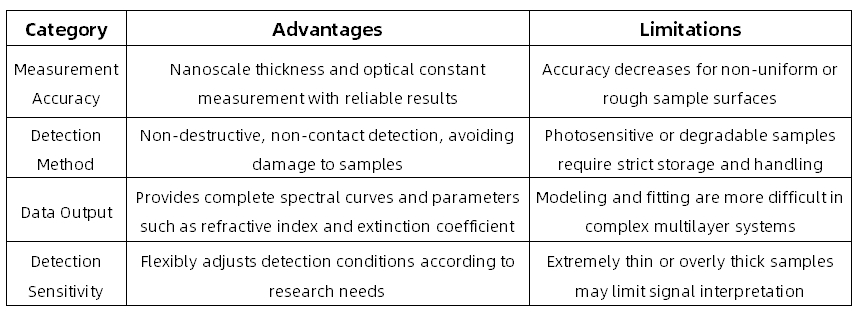
Advantages and Limitations
Applications
1. Biomembrane and Protein Layer Characterization
The ellipsometry analytical service can be used to measure the thickness and optical properties of cell membranes, protein adsorption layers, or artificial biomembranes, helping to study molecular layer structures and stability.
2. Cell and Tissue Sample Analysis
By analyzing ellipsometric parameters, it can reveal optical differences on cell surfaces or tissue sections, assisting in the study of their microscopic structures and characteristics.
3. Drug Delivery System Analysis
The ellipsometry analytical service can be applied to coating detection and interfacial characterization of drug carrier surfaces, supporting the evaluation of drug binding efficiency and release properties.
4. Biomaterial Performance Research
It is suitable for optical and interfacial characterization of degradable biomaterials and medical excipients, assessing their performance in biological systems.
FAQs
Q1: Will the Testing Process Damage the Sample?
A1: Ellipsometry analysis is a non-destructive test and does not damage the sample structure or affect its subsequent use.
Q2: Will an Uneven Sample Surface Affect the Results?
A2: Yes. Surface roughness, impurities, or non-uniformity can interfere with the reflection signal and reduce measurement accuracy. It is recommended to perform appropriate treatment before submission.
Q3: Can Ellipsometry Analysis Be Applied to Multilayer Film Structures?
A3: Yes, but it requires building an appropriate optical model for fitting. For complex multilayer systems, the difficulty of interpretation will increase.
How to order?




