






ELISA vs LC-MS: Comparing Two Core Methods for Host Cell Protein Detection
During biopharmaceutical development and manufacturing, monitoring residual host cell proteins (HCPs) is critical for ensuring product safety and therapeutic efficacy. HCPs represent process-related impurities originating from production cell substrates (e.g., Escherichia coli, yeast, or CHO cells). If present in the final formulation, these impurities may elicit immunogenic responses, compromise drug stability, or reduce clinical performance. Within current quality control frameworks, enzyme-linked immunosorbent assay (ELISA) and liquid chromatography-mass spectrometry (LC-MS) constitute the two most widely adopted analytical approaches for HCP characterization. These techniques differ in analytical sensitivity, proteome coverage, and traceability, making it essential to understand their respective capabilities when establishing HCP monitoring strategies.
Core Challenges in HCP Detection
Before comparing ELISA and LC-MS, several analytical challenges associated with HCP detection must be noted:
1. High diversity: A single production system may contain thousands of distinct HCP species, spanning 6-7 orders of magnitude in abundance.
2. Matrix interference: Therapeutic proteins typically exist at concentrations several orders of magnitude higher than HCPs, suppressing mass signals from low-abundance impurities and complicating detection.
3. Batch-to-batch variability: Changes in cell line selection, process parameters, or culture conditions can alter HCP profiles and abundance distributions.
Taken together, these challenges indicate that an effective HCP assay should combine high sensitivity, broad proteome coverage, and robust quantitative performance.
ELISA Detection: A Well-Established Immunological Method
1. Principle
ELISA relies on the specific binding between polyclonal or monoclonal antibodies and HCP antigens, followed by chromogenic or fluorescent readouts for quantitative measurement.
2. Advantages
(1) High sensitivity: Detection limits commonly reach below 1 ng/mL.
(2) Regulatory acceptance and methodological maturity: Most pharmacopoeial standard methods are ELISA-based, facilitating assay validation and regulatory filing.
(3) High throughput capability: Dozens to hundreds of samples can be processed per assay run, supporting routine batch-level monitoring.
3. Limitations
(1) Antibody dependence: Detection is restricted to HCPs recognized by the immunogen-induced antibody repertoire; weakly immunogenic or non-immunized species may remain undetected.
(2) Lack of component-level resolution: The assay provides total HCP burden without identifying individual protein species.
(3) Potential batch variability: Differences in antibody preparation and batch replacement may affect inter-batch reproducibility.
LC-MS Detection: Comprehensive Molecular-Level Characterization
1. Principle
LC-MS workflows involve enzymatic digestion of proteins into peptides, chromatographic separation, and mass spectrometric analysis for peptide identification and quantification based on mass-to-charge signatures.
2. Advantages
(1) Comprehensive proteome coverage: Single analyses can identify and quantify hundreds to thousands of HCP species, enabling investigation of unknown impurities.
(2) Non-antibody dependent: The method is applicable to HCPs generated from different cell substrates and process configurations.
(3) Traceable and quantitative datasets: The use of isotope-labeled internal standards can support absolute quantitation and enable cross-laboratory comparisons.
3. Limitations
(1) High instrumentation and expertise requirements: Operation requires high-resolution mass spectrometers (e.g., Orbitrap or Q-TOF) and experienced analytical personnel.
(2) Lower throughput: Sample preparation and instrument runtimes are relatively long, making the approach less suitable for high-volume QC release testing.
(3) Complex data processing: Identification and quantitation rely on database searching and specialized computational algorithms, increasing interpretation complexity.
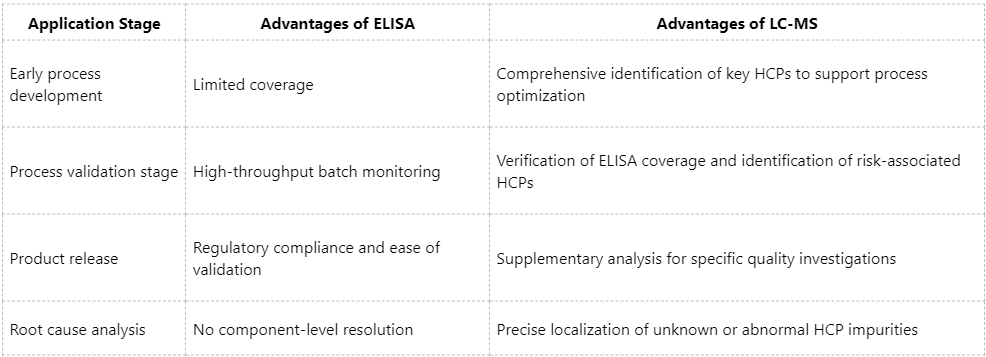
Comparison of Application Scenarios
Complementary Strategies for HCP Monitoring
Industry practice suggests that LC-MS and ELISA should be deployed as complementary rather than competing technologies:
1. Early research and development: LC-MS enables full-spectrum characterization and the establishment of risk-associated HCP inventories.
2. Routine monitoring: Targeted ELISA assays are developed for critical HCPs to support regulatory compliance and high-throughput monitoring.
3. Investigation of abnormal batches: LC-MS is used to identify specific protein species when ELISA measurements yield unexpected results.
ELISA and LC-MS each offer distinct advantages: ELISA is established and efficient for routine bulk testing, whereas LC-MS provides high-resolution molecular insights for proteome-level analysis and impurity tracing. Integrating the two platforms enables a comprehensive HCP control strategy that spans total burden monitoring to molecular-level resolution. MtoZ Biolabs leverages multi-platform analytical capabilities to deliver high-quality and regulatory-compliant HCP detection solutions to the global biopharmaceutical industry, supporting the safety and efficacy of therapeutic products.
MtoZ Biolabs, an integrated chromatography and mass spectrometry (MS) services provider.
Related Services
How to order?




