






Electron Energy Loss Spectroscopy (EELS) Analytical Service
- High Spatial Resolution: The probe size can reach 1 nm, which is superior to the 1-3 nm resolution typically achieved by conventional EDS.
- High Energy Resolution: With an energy resolution of less than 1 eV, EELS can not only distinguish subtle energy differences but also provide information on chemical bonding and valence states for certain elements.
- Strong Low-Z Element Detection Capability: Particularly sensitive for detecting light elements such as C, N, O, and B.
- Materials Science: Elemental distribution and compositional analysis of nanoparticles, thin films, and composite materials.
- Semiconductors and Electronic Devices: Studies of element doping, distribution, and defects in Si/C/O/N system materials.
- Life Sciences and Biomedical Materials: Elemental analysis of nanodrug carriers, biomedical materials, and complex organic–inorganic hybrid systems.
- Environmental and Energy Research: Detection of composition and valence states in catalysts, energy storage materials, and environmental particulates.
Electron Energy Loss Spectroscopy (EELS) Analytical Service is an electron energy loss spectroscopy analysis service based on transmission electron microscopy (TEM) or scanning transmission electron microscopy (STEM). This method detects the energy loss of an electron beam as it passes through a sample to obtain information about elemental composition, spatial distribution, and partial chemical bonding states. Compared with conventional energy dispersive X-ray spectroscopy (EDS), EELS offers significant advantages in spatial resolution (up to 1 nm), energy resolution (less than 1 eV), and sensitivity for detecting light elements such as B, C, N, and O. With the rapid development of research on nanomaterials, biomedical materials, semiconductors, and functional thin films, EELS has become a key tool for revealing the relationship between microscopic composition and structure of materials and for performing nanoscale chemical analysis.
Technical Principles
The core principle of EELS is to measure the energy loss of a high-energy electron beam as it penetrates a sample, caused by interactions with the inner-shell electrons of atoms. Different elements exhibit characteristic energy loss peaks, and by analyzing the energy loss spectrum, elemental identification and quantification can be achieved. EELS provides outstanding energy resolution (less than 1 eV), enabling not only nanoscale elemental distribution imaging but also, in certain cases, the revelation of chemical bonding states and valence information. When combined with TEM or STEM, EELS delivers comprehensive structural and compositional information with spatial resolution of approximately 1 nm, making it a powerful analytical method for nanoscale material research.
Analysis Workflow
The general process of Electron Energy Loss Spectroscopy (EELS) Analytical Service is as follows:
1. Sample Preparation
The sample is prepared as an ultrathin section, typically less than 100 nm, to ensure sufficient electron transmission.
2. Electron Beam Irradiation
A high-energy electron beam is applied to the sample under TEM or STEM platforms, either through scanning or localized irradiation.
3. Energy Loss Signal Acquisition
The energy loss of transmitted electrons is recorded to obtain an energy loss spectrum that reflects the characteristic peaks of different elements.
4. Spectrum Analysis and Imaging
Specialized software is used to analyze the energy loss peaks, extract elemental composition information, and perform point analysis, line scanning, and two-dimensional elemental mapping.
5. Result Confirmation and Report
Elemental information is confirmed with standard libraries or databases, and a standardized analysis report is generated.
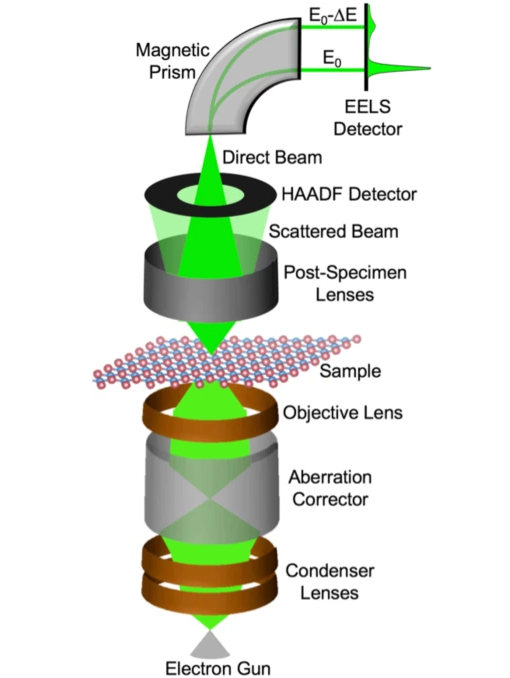
Hachtel JA. et al. Sci Rep. 2018.
Figure 1. Schematic of an Electron Energy-Loss Spectroscopy (EELS) Experiment in a Scanning Transmission Electron Microscope (STEM)
Service Advantages
Services at MtoZ Biolabs
MtoZ Biolabs provides Electron Energy Loss Spectroscopy (EELS) Analytical Service, which enables precise detection and state analysis of elements at the nanoscale. This service is particularly suitable for the compositional and valence state characterization of nanomaterials, biomedical materials, and functional thin films. EELS supports point analysis, line scanning, and two-dimensional elemental mapping, and in certain systems, it can also capture chemical bonding information. Through standardized workflows and customized solutions, we ensure that clients obtain high-resolution and reliable data to support new material development and complex system research.
Sample Submission Suggestions
Samples should be free from surface contamination or excessive residues in order to reduce background interference. It is important to avoid selecting samples that are easily damaged or rapidly degraded by the electron beam.
We recommend contacting our technical support team prior to sample submission to assess sample suitability and obtain tailored submission guidance.
Applications
How to order?




