






Electric Sensing Zone Analytical Service
- Cell and Microbial Analysis: Characterization of size and concentration in cultured cells, yeast, or bacterial suspensions
- Hematology: Blood cell counting and sizing for clinical or preclinical studies
- Pharmaceutical Quality Control: Assessment of particulate contamination in parenteral drugs and protein therapeutics
- Protein Stability Studies: Detection of aggregates that may compromise biopharmaceutical safety
- Industrial Formulations: Analysis of suspensions, emulsions, and dispersions in chemical and materials engineering
- Comprehensive experimental details
- Particle size distributions across the analyzed range
- Particle concentration values expressed per unit volume
- Data summaries including statistical metrics (mean, median, mode, and standard deviation)
- Graphical outputs such as histograms and scatter plots for visualization
- Customized reports suitable for research, development, or regulatory submission
MtoZ Biolabs provides a professional Electric Sensing Zone Analytical Service that enables precise measurement of particle size distribution and particle concentration in liquid suspensions. This technique, also known as the Coulter principle, detects changes in electrical resistance as particles pass through a small aperture, delivering reliable and reproducible data on both particle diameter and particle counts.
As one of the most established methods for particle analysis, the electric sensing zone approach is widely applied in biological research, pharmaceutical development, clinical diagnostics, and materials science. Electric Sensing Zone Analytical Service has proven particularly valuable for analyzing cell suspensions, blood samples, protein aggregates, and other particulate systems that require accurate characterization in liquid media. By offering this service, MtoZ Biolabs helps clients obtain actionable insights into particle-based systems.
Technical Principles
The electric sensing zone method is based on the fundamental concept that particles suspended in an electrolyte solution can alter electrical resistance when passing through a narrow aperture. The principle can be summarized as follows:
1. Particle Passage
A suspension containing particles flows through a small orifice immersed in an electrically conductive liquid.
2. Resistance Change
As each particle displaces electrolyte in the aperture, it produces a temporary change in resistance proportional to its volume.
3. Signal Generation
These resistance changes are recorded as voltage pulses, where pulse height corresponds to particle size and pulse frequency reflects particle number.
4. Data Interpretation
By analyzing thousands of pulses, a detailed distribution of particle sizes and concentrations is generated, providing a comprehensive view of the sample.
Because the measurement is direct and does not rely on optical properties or chemical labeling, the electric sensing zone method is particularly robust for heterogeneous or opaque suspensions.
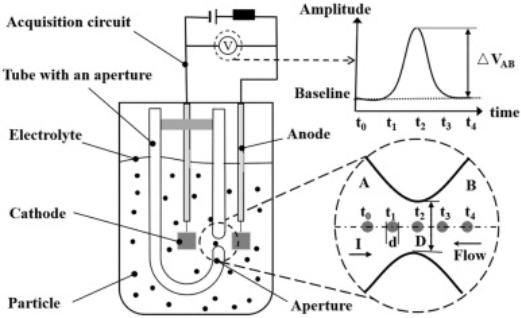
Cao, H. et al. Powder Technol. 2024.
Figure 1. Principle of the Electric Sensing Zone Method
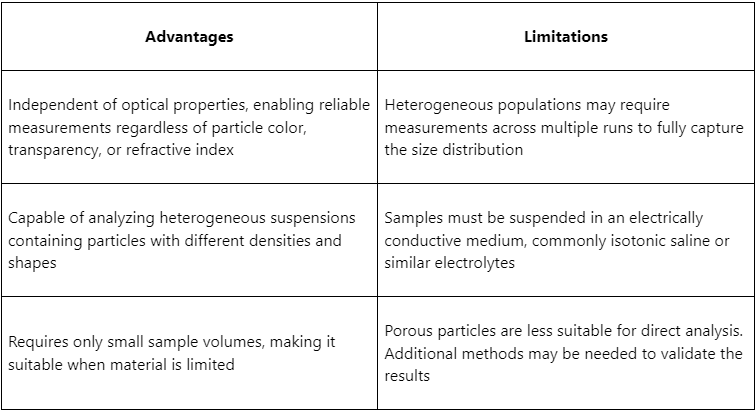
The main strengths and limitations of the electric sensing zone method:
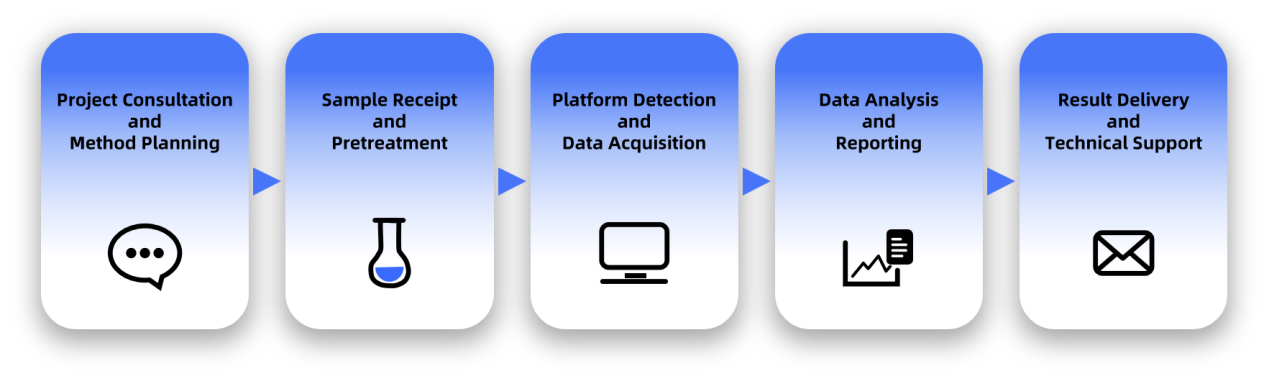
Analysis Workflow
Service Advantages
☑️Advanced analytical platforms ensure precise and reliable particle measurement.
☑️Experienced team with extensive expertise in biological and pharmaceutical sample analysis.
☑️One-stop service covering measurement, data processing, and interpretation.
☑️Customizable reporting tailored to research, regulatory, or industrial needs.
☑️Consistent quality control guarantees reproducible results across projects.
Applications
The Electric Sensing Zone Analytical Service can be applied to a wide range of research and industrial fields:
Sample Submission Suggestions
1. Sample Types
Suspensions of cells, blood, protein aggregates, or other particles in electrolyte-compatible media.
2. Sample Volume
If the sample contains a large number of visible particles, approximately 20 mL may be required, whereas nearly transparent samples may need at least 100 mL to ensure adequate particle detection.
Note: If you have special sample types or require additional guidance, please contact us for personalized support before sample preparation.
Deliverables
For more information about the Electric Sensing Zone Analytical Service, please contact us. Our technical specialists are available to provide a free business assessment.
How to order?




