






Efficient Identification of Histone Post-Translational Modifications Using LC-MS/MS
Histone post-translational modifications (PTMs) constitute a central regulatory mechanism governing chromatin organization and gene expression. Acetylation, methylation, phosphorylation, ubiquitination, and other PTMs collectively form the so-called histone code, which plays a pivotal role in diverse biological processes, including cell differentiation, oncogenesis, and stem cell fate determination. Despite their biological significance, histone PTMs present substantial analytical challenges due to their structural complexity, extensive diversity, high density of modification sites, and frequent coexistence on the same histone molecules. Conventional analytical approaches often lack the throughput and resolution required to address these challenges effectively. As a result, liquid chromatography-tandem mass spectrometry (LC-MS/MS) has emerged as a cornerstone technology for comprehensive histone PTM analysis.
Rationale for Employing LC-MS/MS in Histone PTM Analysis
1. High-Sensitivity Detection of Low-Abundance Modifications
Certain histone PTMs, such as trimethylation or monoubiquitination, occur at extremely low abundance and are difficult to detect using traditional methodologies. Tandem mass spectrometry enables sensitive detection of low-abundance peptides and their diagnostic fragment ions, thereby allowing accurate identification of rare histone modifications.
2. High-Throughput Profiling and Simultaneous Detection of Multiple PTMS
Mass spectrometry enables concurrent identification of multiple PTM types within a single analysis and facilitates the characterization of combinatorial PTMs. This capability is critical for reconstructing the authentic epigenetic landscape of histone regulation.
3. High Site-Specific Resolution and Robust Quantitative Performance
When combined with tailored enzymatic digestion strategies and labeling-based quantitative approaches, such as TMT or iTRAQ, LC-MS/MS supports precise localization of modification sites and enables relative or absolute quantitative comparisons across experimental conditions.
Core Technical Workflow for LC-MS/MS-Based Histone PTM Analysis
1. Sample Preparation: From Nuclear Isolation to Histone Purification
(1) Cell lysis and Nuclear Isolation
Cell nuclei are enriched through sonication or mild lysis procedures.
(2) Histone Extraction
Basic histones are extracted using acid-based protocols, such as hydrochloric acid or sulfuric acid extraction.
(3) Histone Purification
Distinct histone variants (e.g., H3.1 and H3.3) may be further resolved using SDS-PAGE or high-performance liquid chromatography (HPLC).
2. Targeted Enzymatic Digestion to Overcome Site-Resolution Limitations
Given the high lysine and arginine content of histones, conventional proteases such as trypsin often generate excessively short peptides, compromising site-specific analysis. To address this issue, the following strategies are commonly employed:
(1) Sequential digestion using GluC and trypsin.
(2) Alternative proteases, including AspN or ArgC.
(3) Chemical derivatization-based protection strategies.
For instance, propionylation or butyrylation can be applied to block unmodified lysine residues, thereby enhancing peptide length and improving site resolution.
3. PTM Enrichment Strategies for Enhanced Detection Sensitivity
(1) Antibody-Based Enrichment
Modification-specific antibody pull-down approaches, such as enrichment using anti-H3K27ac antibodies.
(2) TiO₂ or IMAC-Based Enrichment
Selective capture of phosphorylated peptides.
(3) Chemical Derivatization and Stable Isotope Labeling
These methods expand PTM coverage while improving quantitative accuracy.
4. LC-MS/MS Analysis and Data Acquisition
(1) Liquid Chromatography System
Nano-flow HPLC coupled with C18 reversed-phase columns.
(2) Mass Spectrometry Platforms
High-resolution instruments such as the Orbitrap Fusion Lumos or timsTOF Pro are recommended.
(3) Data Acquisition Strategies
Data-dependent acquisition (DDA) is well suited for exploratory analyses, whereas data-independent acquisition (DIA) enables high-throughput quantitative analysis of predefined targets.
Data Processing and Annotation of Histone PTMs
1. Database Search Engines
(1) Commonly Used Software Tools
MaxQuant, Proteome Discoverer, and MSFragger provide robust support for PTM identification and localization probability scoring.
(2) Database Resources
The Unimod database can be incorporated to expand the repertoire of identifiable PTMs.
2. Combinatorial Annotation of Coexisting Modification Sites
Multiple PTMs frequently coexist on the same peptide. Software platforms such as Spectronaut or PEAKS Studio are recommended for combinatorial pattern-matching analyses.
3. Quantitative Strategies
(1) Label-Free Quantification (LFQ)
Primarily applied in exploratory studies.
(2) TMT or iTRAQ Labeling
Well suited for parallel analysis of multiple experimental groups, enhancing quantitative consistency and comparability.
Common Challenges and Mitigation Strategies in Histone PTM Analysis by LC-MS/MS
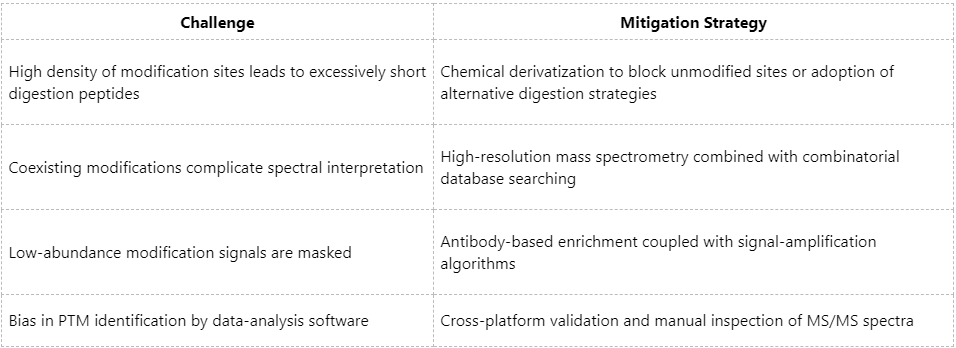
Histone PTM analysis is evolving from a phase of mere detection toward a new paradigm characterized by precise quantification and integrative interpretation of combinatorial modification patterns. LC-MS/MS remains the central technology driving this transition. MtoZ Biolabs is dedicated to providing reliable, high-throughput, and high-precision histone PTM analysis services, enabling researchers to advance their studies with greater depth and rigor. For project inquiries or complimentary experimental design consultations, we welcome you to contact our technical team. We are committed to delivering customized strategies tailored to your specific histone PTM research objectives.
MtoZ Biolabs, an integrated chromatography and mass spectrometry (MS) services provider.
Related Services
How to order?




