



Choose labeled quantitative proteomics when samples can share one tagging chemistry and a frozen multiplex design (for example TMT, iTRAQ, or a planned metabolic SILAC-style scheme) and relative ratios inside that design are the claim. Choose label-free quantification (LFQ or unlabeled DIA) when independent injections, open enrollment, or labeling-incompatible matrices fit better; comparability then depends on matched prep, chromatography, and normalization rather than pooled reporters (Thompson et al. 2003; Cox et al. 2014). Neither route delivers absolute concentration by default. Prefer isobaric labeling for closed multi-arm panels; prefer LFQ or DIA when samples keep arriving; move to PRM or AQUA when a closed list needs confirmation or amount units.
Researchers who already have defined samples, comparison groups, or a specific project objective can also review the MtoZ Biolabs Label-Free Quantitative Proteomics Service and TMT Quantitative Proteomics Analysis Service for project-specific feasibility and analysis planning.
Labeled Versus Label-Free: Comparison at a Glance
Both families usually defend relative same-protein change. They differ in where chemistry and comparability enter the workflow.
Dimension |
Labeled (isobaric or metabolic tags) |
Label-free (LFQ or unlabeled DIA) |
|---|---|---|
Sample chemistry |
Tagging step before or during culture |
No isotopic or isobaric tag on peptides |
Mixing |
Often pooled after labeling for isobaric kits |
Independent LC-MS/MS injections |
Quant readout |
Reporter ions or light/heavy pairs |
MS1 areas, counts, or DIA fragment peak groups |
Enrollment |
Often must freeze before pool |
Samples may arrive across weeks |
Main prep focus |
Amine cleanup, equal load before tag |
Matched lysis, digest, load every run |
Typical risk |
Incomplete labeling, ratio compression |
Batch drift, missing values |
Default claim |
Relative inside plex or label design |
Relative across matched runs |
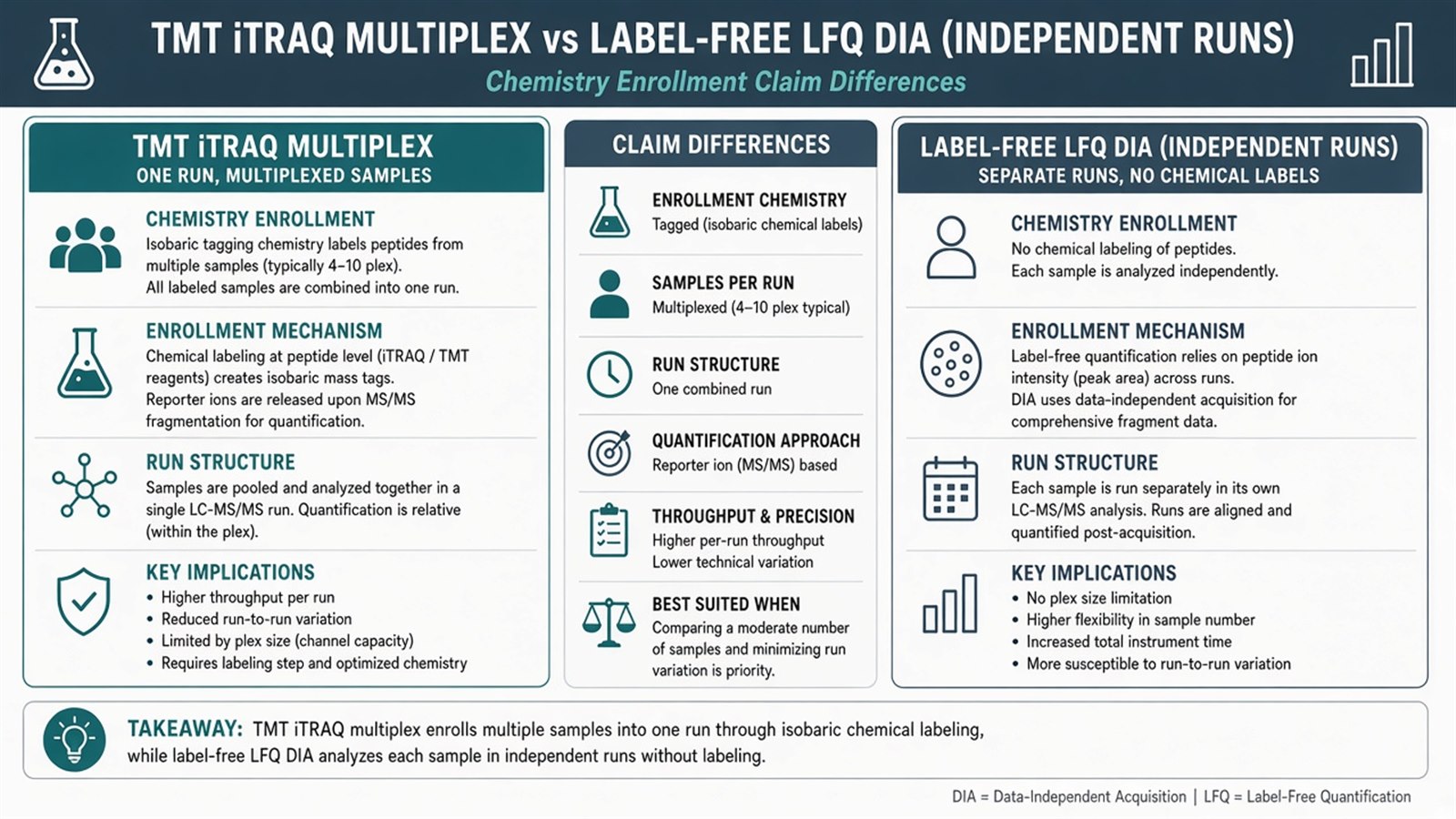
Figure 1. Labeled and label-free quantitative proteomics differ in chemistry and mixing; both still require a declared relative claim.
Calling label-free simpler because tags are omitted ignores that independent runs carry full chromatographic and prep comparability burden.
For isobaric depth, see Quantitative Analysis of Proteomics Using Isotopic Labeling Methods and Tandem Mass Tag Quantitative Proteomics. For label-free strategy maps, see Label-Free Quantification Methods: Mass Spectrometry-Based Protein Quantification Strategies.
Prep and Chemistry: What Changes for Label-Free LFQ
Label-free routes keep digestion simple but demand strict prep parity across contrast arms.
Label-free prep judgment |
Why it matters for LFQ |
Labeled contrast |
|---|---|---|
Matched lysis and digest |
Ratios inherit extraction and enzyme yield |
Tagging still needs matched load first |
Protein assay and load |
Prevents volume-only bias across runs |
Required before NHS isobaric labeling |
Detergent and salt control |
Protects chromatography on every injection |
Also critical before amine reactive tags |
Run order and QC pools |
Damper injection drift without pooled reporters |
QC still needed inside plex design |
Acquisition branch |
DDA-LFQ vs unlabeled DIA must be declared |
Isobaric usually DDA reporter readout |
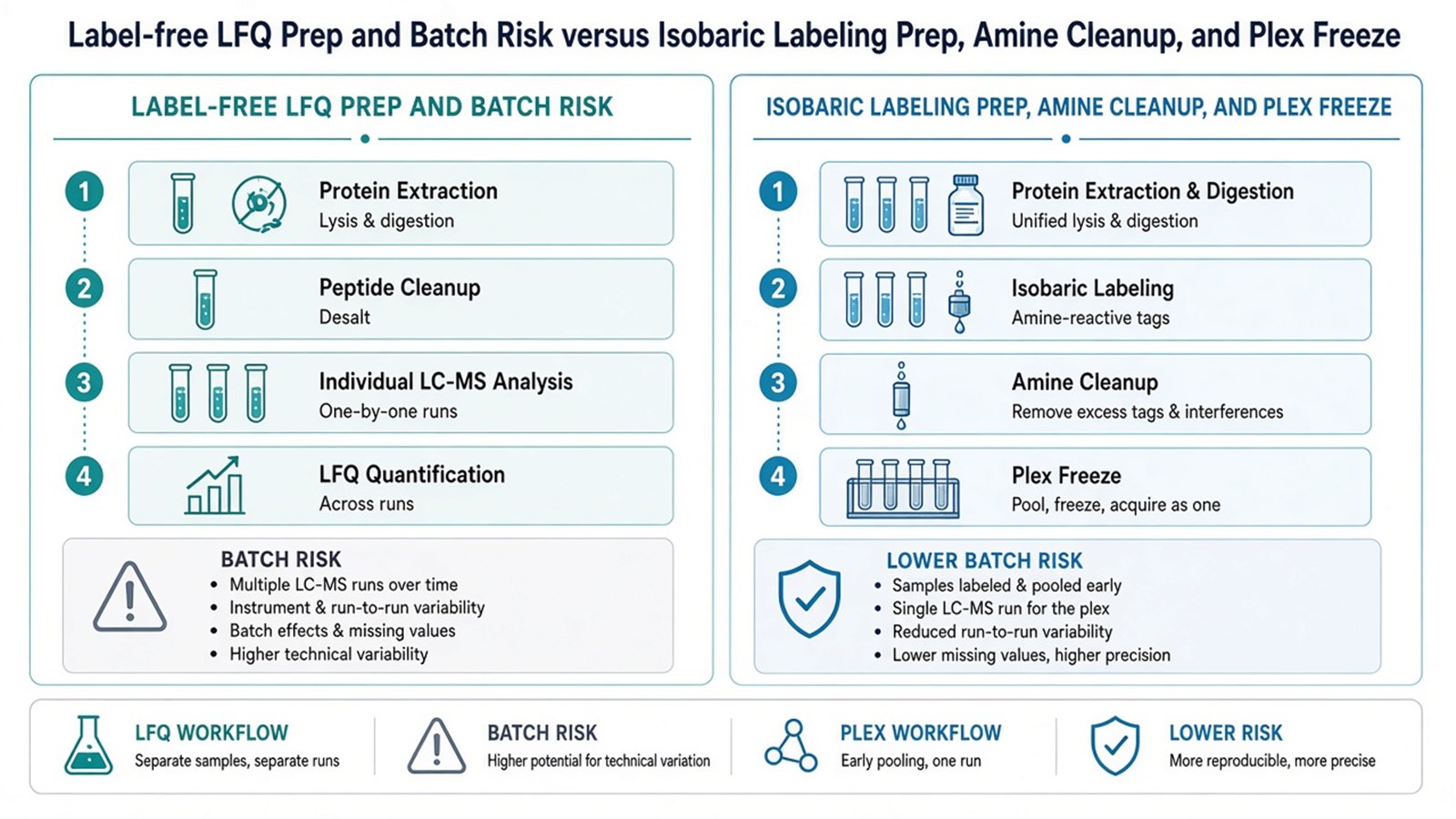
Figure 2. Label-free LFQ differences show up in prep and batch control; labeled routes add tagging chemistry and plex closure.
For label-free prep detail, see Precise Quantitative: Label-free Protein Analysis and The Impact of Sample Preparation on Quantitative Results in Quantitative Proteomics. For TMT prep controls, see How to Optimize Proteomics TMT Experimental Design and Sample Prep.
Judgment Criteria: Selecting Label-Free Versus Labeled Quantification
Study need |
Label-free LFQ or DIA often fits |
Labeled TMT or iTRAQ often fits |
Reassess |
|---|---|---|---|
Claim |
Relative discovery with flexible enrollment |
Relative ratios inside one multiplex kit |
Absolute amount without standards |
Sample timing |
Late arrivals expected |
Cohort can freeze before pooling |
Diagnostic cutoff |
Matrix |
Labeling impractical or costly |
Clean amine labeling feasible |
Scarce input cannot support tags |
Acquisition |
DDA-LFQ or unlabeled DIA planned |
Reporter readout with closed channel map |
Closed PRM panel already defined |
Follow-up |
Open inventory for later targeting |
Multi-arm screen in one plex |
Amount units needed immediately |
Prefer LFQ when MaxLFQ-style DDA peak areas fit matched prep and enrollment stays open. Prefer unlabeled DIA when windowed completeness matters. Prefer TMT or iTRAQ when multi-arm contrasts fit one kit and amine prep is controlled. Prefer PRM, MRM, or AQUA when peptides are closed or concentration units are required.
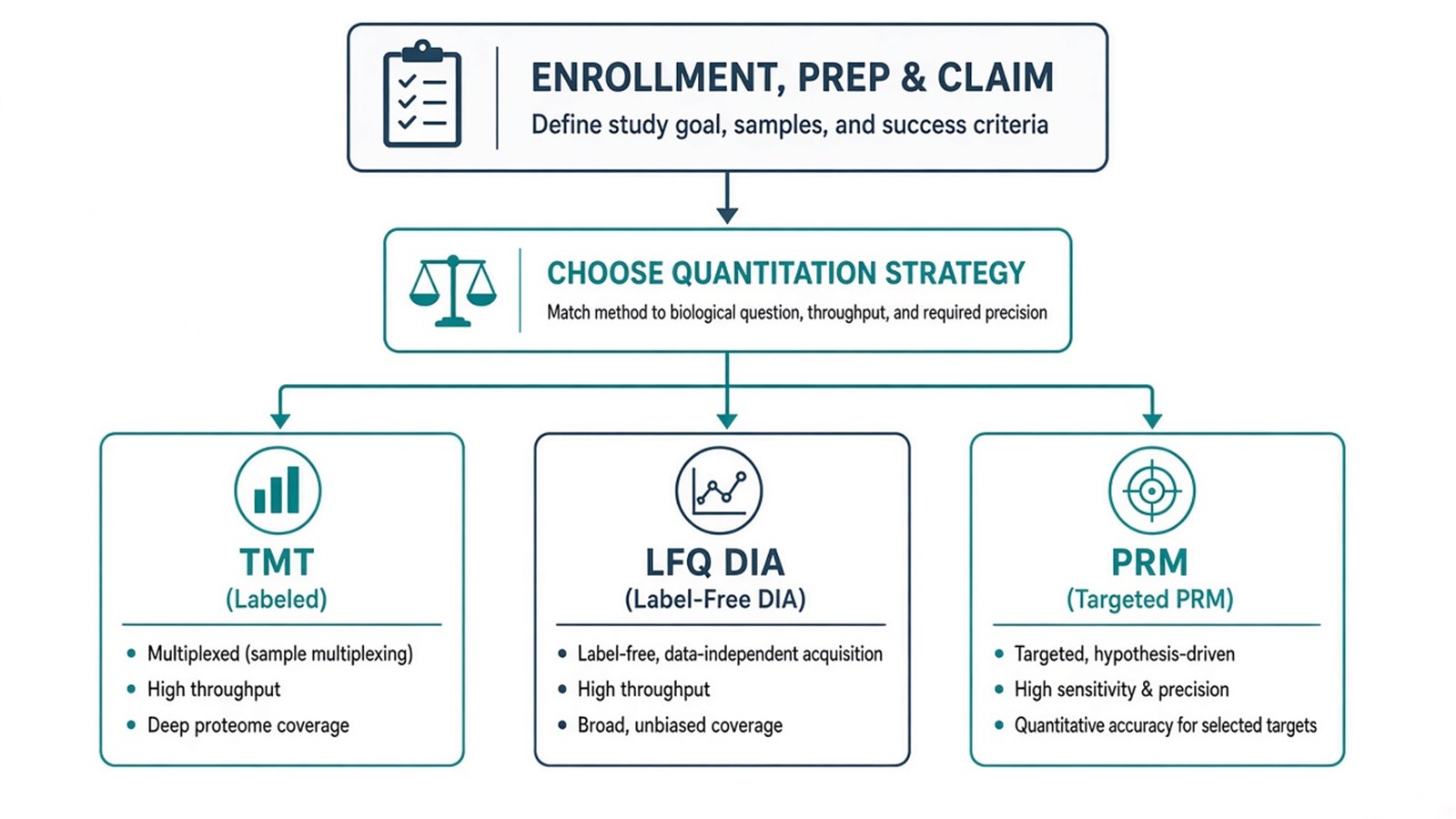
Figure 3. Selection between labeled and label-free quantitative proteomics follows enrollment, prep chemistry, and claim type.
For focused TMT versus LFQ selection, see TMT vs Label Free Quantitative Proteomics and Comparing LFQ and Isobaric Labeling Strategies in Proteomics Quantification. For DDA versus DIA inside label-free work, see DIA vs. DDA in Label-Free Quantitative Proteomics: A Comparative Analysis. For advantage lists, see Label-Free Quantification: Advantages, Applications, and Tools.
Limits and Label-Free Application Boundaries
Label-free quantification does not remove batch effects without design. Omitting tags does not mean omitting prep rigor. DDA-LFQ can show stochastic missingness; DIA completeness is not accuracy. Labeled routes do not automatically fix unequal protein load or incomplete tagging. Both families leave ordinary intensities relative unless matched standards and calibration are added. Pathway enrichment shows overrepresentation relative to the quantified background; it does not prove pathway activity.
Typical label-free applications when differences favor unlabeled routes:
- Cohorts with open enrollment or late sample arrival.
- Matrices where isobaric labeling fails or consumes too much material.
- Disease or drug screens needing relative discovery across independent injections.
- Biofluid or tissue projects planning PRM or AQUA confirmation later.
- Hard-to-label models where matched unlabeled prep is the stable choice.
Diagnostic cutoffs sit outside ordinary research label-free reporting unless a separately validated assay framework is in place.
Once chemistry class, prep rules, acquisition branch, and claim type are aligned, the project can be scoped as labeled or label-free quantitative proteomics. Researchers can review the MtoZ Biolabs Label-Free Quantitative Proteomics Service and TMT Quantitative Proteomics Analysis Service for sample evaluation and workflow planning.
Frequently Asked Questions
1. What is the main difference between labeled and label-free quantification?
Labeled methods add tags and often pool samples for multiplex readouts. Label-free methods use independent unlabeled runs and rebuild comparability after acquisition.
2. Is label-free always lower cost?
Reagent cost can be lower, but instrument time scales with sample count and prep QC demands can rise.
3. Can label-free data be as comparable as TMT in one plex?
Label-free comparability is achievable with matched prep, run-order control, and normalization. It does not use same-run reporter damping by default.
4. When should a project switch from label-free to labeled quantification?
When enrollment can freeze, amine labeling is clean, and multi-arm contrasts fit one isobaric kit better than many unlabeled runs.
5. Do labeled and label-free routes support absolute quantification?
Only with added stable isotope standards and calibration, usually on targeted panels, not from ordinary discovery intensities alone.
Reference
- A. Thompson, J. Schafer, K. Kuhn, et al. (2003). Tandem mass tags: a novel quantification strategy for comparative analysis of complex protein mixtures by MS/MS. Anal. Chem., 75, 1895-1904. https://doi.org/10.1021/ac0262560
- J. Cox, M.Y. Hein, C.A. Luber, et al. (2014). Accurate proteome-wide label-free quantification by delayed normalization and maximal peptide ratio extraction, termed MaxLFQ. Mol. Cell. Proteomics, 13, 2513-2526. https://doi.org/10.1074/mcp.M113.031591
