






Combined Drought and Salt Stress: Why Proteomic Responses Differ
Combined drought and salt stress often produces a different plant proteomics profile than drought alone or salt alone because the combined condition can alter water relations, ion homeostasis, and resource allocation in ways that differ from either stress alone. The proteome shifts with stress order, exposure duration, and harvest timing. Early time points may capture changes associated with signaling and early stress-response processes, mid-phase sampling may reflect acclimation remodeling, and late sampling may show damage-associated changes that can dominate a combined-stress contrast if time points are mixed.
For plant proteomics under combined abiotic stress, time point design is therefore as important as treatment labels. A useful project defines when samples are harvested relative to drought onset, salinity exposure, and visible injury—not only which treatments were applied.
If you are planning plant proteomics for combined drought and salt stress, share the stress sequence, time point map, tissue type, and comparison design with MtoZ Biolabs while the protocol is still open.
Why Combined-Stress Proteomic Responses Differ
Single-stress experiments compare one challenge against control under matched conditions. Combined drought and salt stress introduces an additional question: whether the protein response under the combined condition differs from the responses observed under either stress alone.
Plant proteomics captures the protein abundance state at the moment of harvest. That snapshot depends on:
-
Whether drought and salt started together or in sequence
-
How long each stress lasted before sampling
-
Whether the sampled tissue shows acclimation, injury, or recovery
-
Whether compared genotypes reach the same stress stage at the same clock time
A protein that changes under salt alone may no longer be a major differential candidate under combined stress if drought has already altered the physiological state. A drought-responsive protein may appear differently after salinity has affected root and water relations. Such patterns can reflect the combined stress context, but they should not automatically be interpreted as formal interaction effects.
Combined-stress proteomics does not by itself:
-
Prove synergy or antagonism without an appropriate comparison design, matched sampling, and supporting phenotype data
-
Replace separate single-stress contrasts when the goal is to isolate drought-only or salt-only responses
-
Support pooling early-response and late-damage samples into one combined-stress group
-
Predict field performance under variable rainfall and soil salinity from one controlled time window alone
Results should be read as time-matched candidate proteins and pathway themes until replicate behavior and follow-up work support stronger interaction claims.
Time Point Design: The Core Planning Decision
Harvest timing determines which proteomic story the project can tell. The same combined drought and salt protocol can emphasize early response, acclimation, established or severe stress, or recovery depending on when tissue is collected.
Use separate time point groups rather than pooling samples harvested at different stress stages. Combining samples from biologically different phases into one treatment group can obscure phase-specific protein changes and make pathway interpretation ambiguous.
| Time Window | What Proteomics May Capture | When This Window Fits the Question | Design Caution |
| Early response | Changes associated with signaling, transport, and early stress-response processes | Testing whether combined stress triggers a rapid distinct response | Phenotypes may still look similar; precise timing metadata is essential |
| Acclimation phase | Osmotic, ion-homeostasis, transport, and metabolic remodeling | Comparing responses before severe visible injury | Genotypes may reach different injury stages at the same clock time |
| Established or severe stress | Sustained stress and injury-associated protein patterns | Examining the proteome after a defined period of continued stress | Do not compare groups at strongly unequal damage severity without accounting for it |
| Recovery | Rehydration- or salt-removal-associated protein changes | Questions about recovery after combined challenge | Define the recovery clock separately from the stress-exposure clock |
| Developmental anchor | Responses sampled at a defined growth stage such as flowering or seed fill | Crop studies tied to development rather than elapsed time alone | Keep developmental stage matched across treatments |
These phases are biological planning categories rather than fixed clock-time rules. The actual harvest schedule should be defined for the plant species, organ, developmental stage, and stress protocol before collection.
Independent biological replicates should be harvested using the same predefined sampling rule within each comparison. Replicate number should be planned according to biological variability, group structure, and the statistical comparisons required by the study.
Single Stress, Combined Stress, and Control: How to Structure Comparisons
Combined-stress proteomics is easiest to interpret when the design states exactly what is being compared.
Common structures include:
-
Control versus drought alone versus salt alone versus combined drought and salt at one defined harvest
-
Combined stress at early, acclimation, and established-stress phases with matched controls at each harvest
-
Tolerant versus sensitive genotype under the same combined-stress protocol and defined sampling rule
-
Sequential stress, such as salinity first then water withholding, versus simultaneous application
The comparison sentence should name both stresses and the harvest condition. Examples include:
-
Combined drought and a defined salinity treatment versus control leaf at a predefined harvest time after simultaneous onset
-
Drought alone versus combined drought and soil salinity in root at a defined harvest
-
Salt-tolerant versus salt-sensitive line under combined stress at matched leaf injury score
Avoid comparing combined stress at one time point with drought alone at another unless time-shift effects are the explicit research question.
Starting-material requirements depend on the plant species, tissue type, stress design, and analytical objective and should be evaluated before large-scale collection.
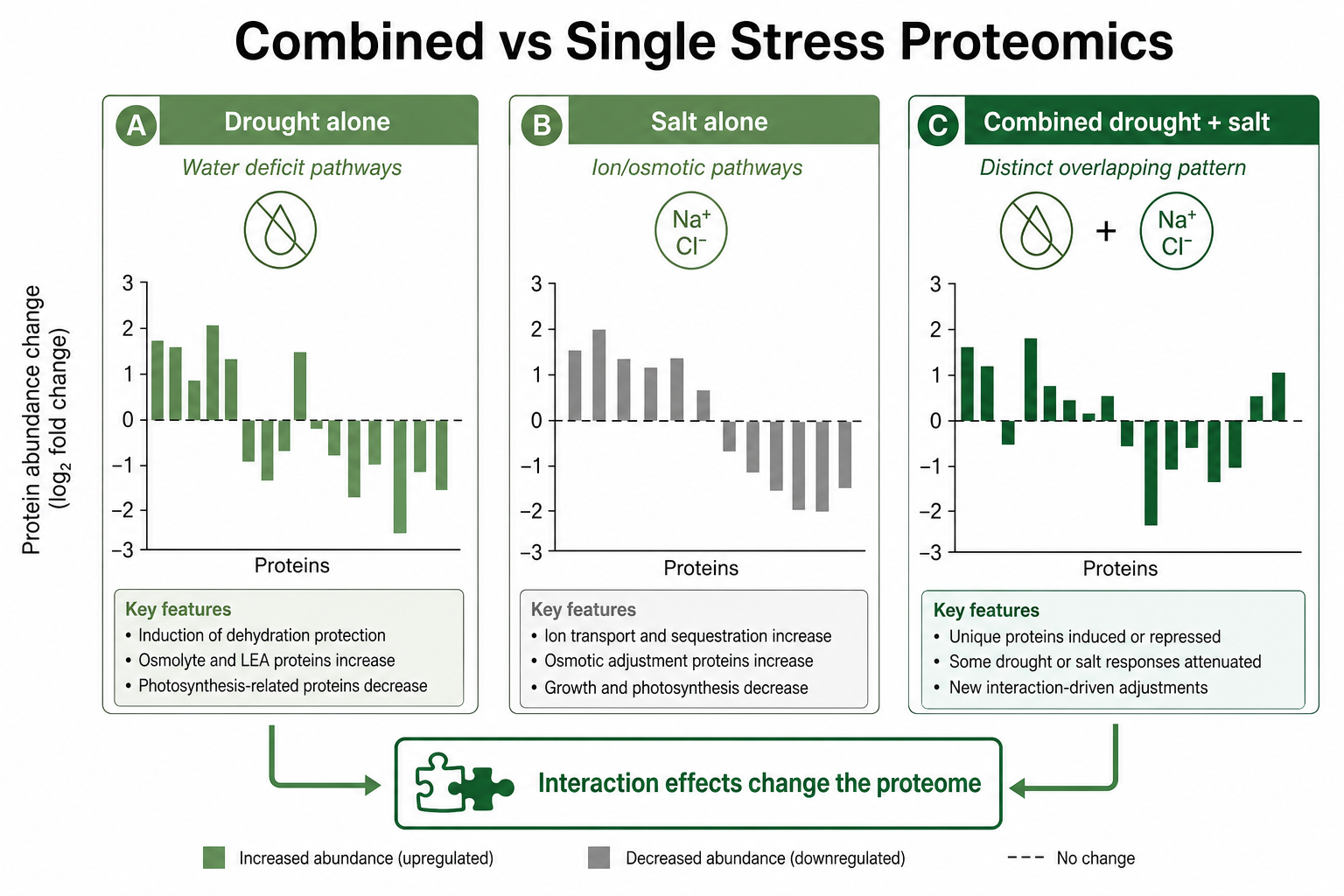
Figure 1. Combined drought and salt stress can produce protein-response patterns that differ from either single-stress contrast.
Match Stress Timing and Phenotype Across Groups
Combined-stress designs become difficult to interpret when groups reach different effective injury stages at the same nominal harvest time.
Match these elements across compared arms:
-
Stress start clock and whether drought and salt are simultaneous or sequential
-
Developmental stage at treatment start
-
Sampled organ, leaf rank, or root zone
-
Time of day at harvest
-
Pot size, medium, pre-stress watering, light, and temperature
Record phenotype notes at every harvest: wilting score, relative water content if measured, visible leaf injury, growth reduction, or survival status. A combined-stress sample harvested at 5 d with advanced wilting is not biologically equivalent to a 5 d sample from another line with only mild symptoms, even if the protocol clock matches.
When genotypes differ in stress pace, phenotype-threshold harvesting can be considered alongside clock-based harvesting. However, clock-matched and phenotype-matched designs answer different biological questions and should not be treated as interchangeable. Do not mix threshold-based and clock-based samples inside one group without explicitly defining the design.
For multi-time-point studies, preserve sufficient material for each planned harvest rather than repeatedly sampling the same plant unless repeated measures are an explicit design feature.
From Time-Matched Protein Changes to Pathway Interpretation
After LC-MS/MS and quantitative comparison, interpret proteins in the context of the harvest window and combined-stress protocol.
Prioritize proteins with:
-
Direction consistency across biological replicates at that time point
-
Clear linkage to phenotype notes recorded at the same harvest
-
Annotation related to osmotic regulation, ion transport, antioxidant processes, photosynthesis-related remodeling, or stress-response pathways where supported
-
Stable detection across the relevant samples in the group
Depending on study design and available species annotation, downstream analysis may include functional annotation, pathway enrichment, and interaction-network analysis.
Cross-check combined-stress candidates against single-stress contrasts when those arms exist:
-
Proteins changing only in the combined-stress contrast may be candidates for combined-stress-associated responses
-
Proteins shared with drought alone or salt alone may reflect common stress-response patterns
-
Proteins appearing mainly at late damage stages may reflect injury-associated remodeling rather than adaptive response
A protein that changes only under the combined condition is not, by itself, proof of a statistical drought × salt interaction. A formal interaction claim requires an experimental design and statistical model that explicitly test the interaction term.
Pathway wording should stay time-aware. An early-response pathway theme should not be described as a late-injury mechanism, and a recovery-phase protein should not be relabeled as an acute combined-stress tolerance factor without time-matched evidence.
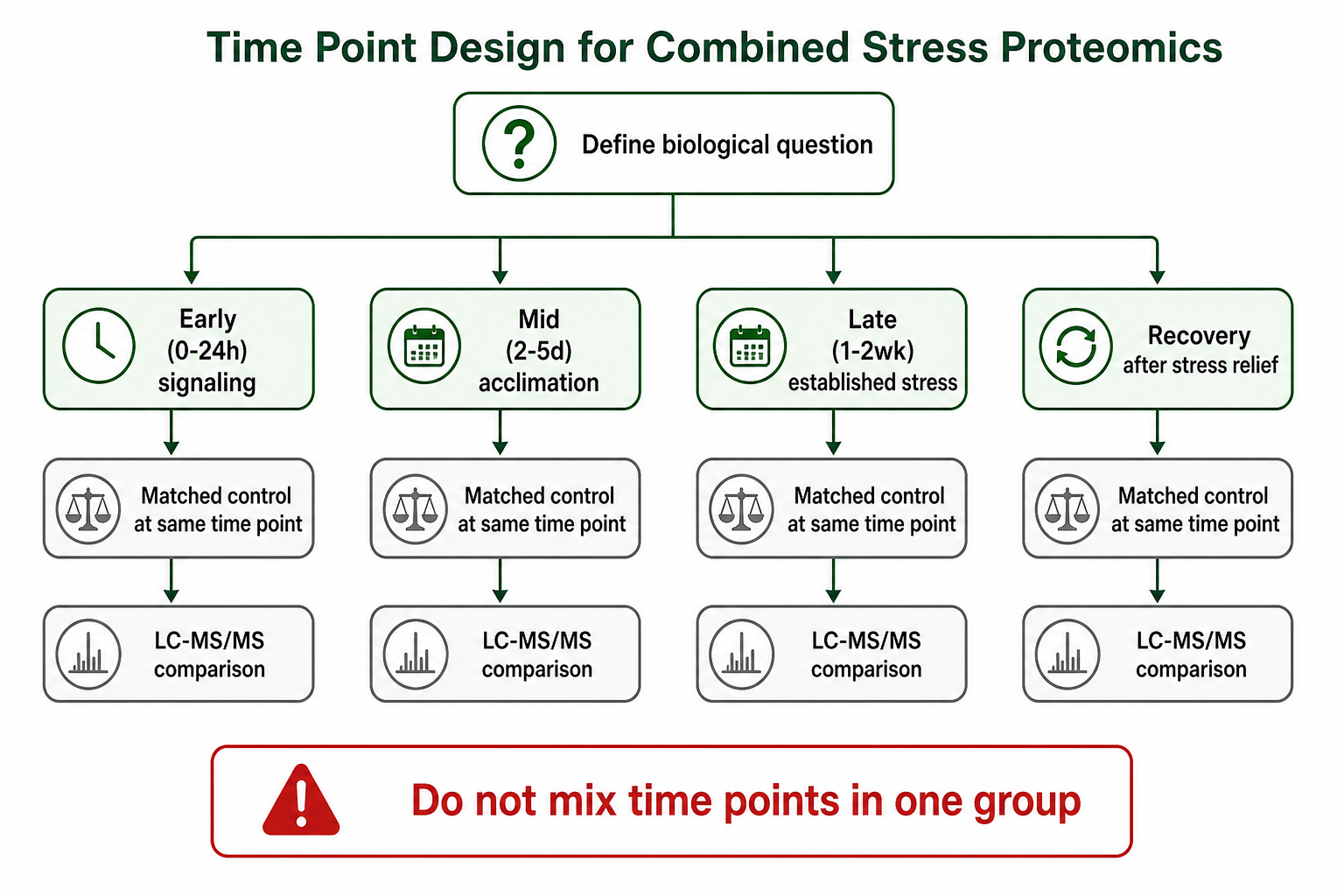
Figure 2. Define the harvest window and comparison arms before combined drought and salt stress samples enter LC-MS/MS analysis.
Analytical Choices After Time Points Are Fixed
Once time points, organs, and group labels are stable, choose the proteomics strategy according to the biological question and comparison design.
Quantitative comparison is required when the project depends on abundance differences between combined-stress and control groups or between time points. Identification-focused work may fit an early feasibility study when the main objective is to characterize proteins detectable in a new tissue or experimental system.
Both DDA and DIA can support quantitative plant proteomics. The acquisition strategy and mass spectrometry platform should be selected according to the study objective, sample number, quantitative requirements, sample characteristics, and overall comparison design.
The analytical strategy should follow the biological question rather than being determined solely by cohort size or a preferred acquisition method.
Common Mistakes in Combined-Stress Proteomics
-
Pooling different harvest phases into one combined-stress group
-
Comparing combined stress with drought alone or salt alone at unequal injury stages
-
Starting salinity and drought on different clocks without documenting sequence
-
Ignoring phenotype notes and relying only on treatment labels
-
Treating combined-stress-associated proteins as tolerance markers or formal interaction effects without appropriate evidence
-
Expanding to many time points before the stress protocol and scoring rule are stable
A Practical Time Point Planning Checklist
-
Write the combined-stress comparison sentence with the harvest rule included.
-
Decide simultaneous versus sequential stress application.
-
Choose clock-based, phenotype-threshold, or developmental-anchor harvesting.
-
Define single-stress arms if interaction claims are planned.
-
Keep organ choice constant across compared groups at each time point.
-
Plan independent biological replicates for each group and harvest.
-
Record phenotype status for every replicate at collection.
-
Reserve sufficient material for each planned harvest according to project-specific sample requirements.
When the time point map is ready, share species, stress protocol, harvest schedule, tissue type, and group plan so combined-stress plant proteomics can be reviewed before collection.
Related Services
Plant and Animal Multi-Omics Analysis Service
Frequently Asked Questions
1. Why does combined drought and salt stress give a different proteomics result than either stress alone?
Combined stress can alter water relations, ion homeostasis, and resource allocation differently from either stress alone. The proteome therefore reflects the combined physiological state at harvest rather than a simple merge of two single-stress protein lists.
2. How should time points be chosen for combined-stress plant proteomics?
Choose harvest windows based on the biological question: early response, acclimation, established or severe stress, or recovery. The actual clock time for each phase should be defined for the specific plant and stress protocol.
3. Is one harvest enough for a combined drought and salt study?
One time point can answer a focused question if the harvest window is defined and phenotype notes are recorded. Interaction and dynamic-response questions usually require additional comparison arms, multiple defined harvests, or both, depending on the intended claim.
4. Can early and late combined-stress samples be analyzed together?
Not when the goal is one treatment-versus-control contrast. Combining biologically different stress phases weakens phase-specific interpretation and can obscure distinct protein-response patterns.
5. Should drought-alone and salt-alone groups be included?
Include them when the project must distinguish responses shared with the individual stresses from changes associated specifically with the combined condition. They are particularly important when the study intends to test a drought × salt interaction; a combined-stress-versus-control comparison alone cannot establish that interaction.
6. What information should be shared before starting combined-stress proteomics?
Share species, tissue type, drought and salt protocol, stress sequence, harvest schedule, phenotype scoring rule, group design, and planned replicate structure.
Conclusion
Combined drought and salt stress proteomics differs from single-stress plant proteomics because the combined physiological context and harvest timing can reshape the observed protein profile. Time point design should be fixed before collection so early-response, acclimation, injury-associated, and recovery changes are not merged into one ambiguous group.
Single-stress reference arms, matched phenotype records, and an appropriate statistical design become especially important when the study aims to distinguish combined-stress-associated changes from formal drought × salt interaction effects.
To plan combined-stress plant proteomics with a defensible time point map, contact MtoZ Biolabs with the stress protocol, harvest schedule, tissue choice, and comparison the study must support.
How to order?




