






ChIP-Sequencing (ChIP-Seq) Service
What Is ChIP-Sequencing (ChIP-Seq)?
Chromatin immunoprecipitation sequencing (ChIP-Seq) is a high-throughput sequencing technique widely used to investigate DNA-protein interactions and chromatin modifications. It is primarily used to map the genomic binding regions of transcription factors and other chromatin-associated proteins and to characterize the genomic distribution of specific histone modifications. By identifying genomic regions associated with target proteins or histone modifications, researchers can investigate transcriptional regulation, changes in chromatin states, and related epigenetic mechanisms.
ChIP-Seq begins with chromatin preparation and fragmentation, followed by antibody-mediated enrichment of chromatin fragments associated with the target protein or histone modification. The recovered DNA is then used to construct sequencing libraries. After high-throughput sequencing, the reads are aligned to a reference genome, and peak calling is performed to identify significantly enriched genomic regions relative to the background or appropriate controls. Genomic annotation can then be used to characterize the relationships between these regions and promoters, enhancers, and other functional genomic elements.
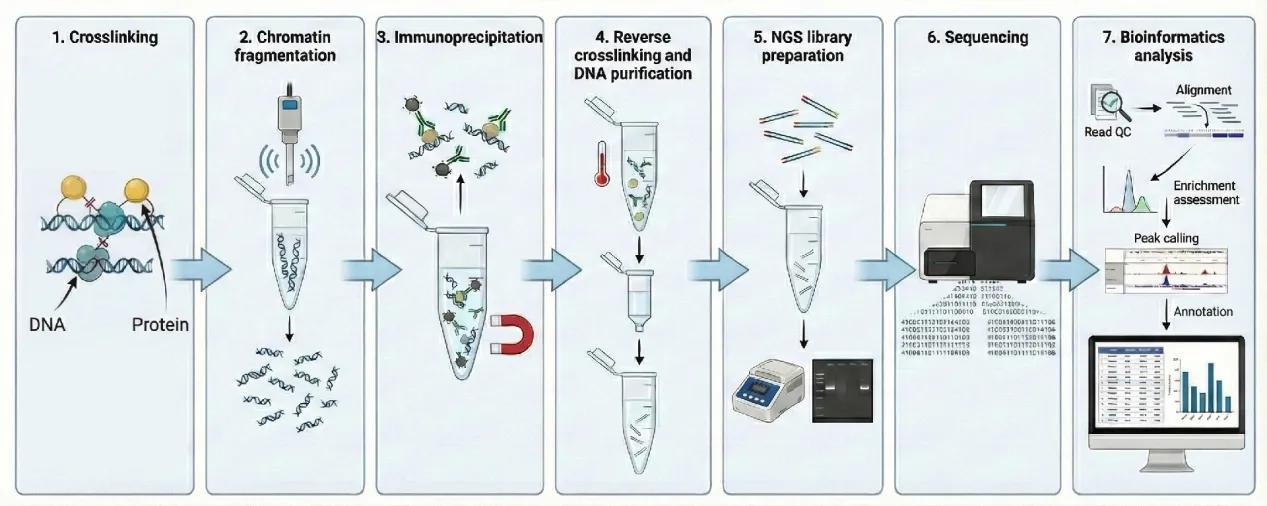
Figure 1. ChIP-Sequencing Workflow
Service at MtoZ Biolabs
MtoZ Biolabs provides ChIP-Seq service for genome-wide characterization of protein-DNA interactions and chromatin modifications. Our service offerings include:
1. Transcription Factor ChIP-Seq
Identify transcription factor-associated genomic regions across the genome and prioritize candidate target genes and regulatory elements to support investigations into transcriptional regulation.
2. Histone Modification ChIP-Seq
Characterize the genomic distribution of histone modifications, including H3K4me3, H3K27ac, and H3K27me3, to investigate chromatin modification patterns and their relationships with gene regulation.
3. RNA Polymerase II ChIP-Seq
Map the genomic occupancy of chromatin-associated proteins or RNA Polymerase II to investigate chromatin regulation and transcription-related mechanisms.
4. Enhancer and Super-Enhancer Analysis
Identify candidate enhancers and super-enhancers using appropriate histone modifications or other relevant targets, supporting the characterization of genomic regulatory elements.
5. Differential ChIP-Seq Analysis
Compare peak distributions and enrichment signals across experimental conditions, genetic backgrounds, or biological states to investigate changes in transcription factor occupancy or histone modification patterns.
6. FFPE ChIP-Seq Analysis
Evaluate the feasibility of ChIP-Seq using formalin-fixed, FFPE samples based on sample preservation and fixation conditions, chromatin integrity, and target suitability.
Service Advantages
1. Rigorous Antibody Suitability Assessment
Prioritize ChIP-validated, target-specific antibodies and evaluate their suitability based on target characteristics and available validation data to improve enrichment specificity and peak detection reliability.
2. Flexible Support for Diverse Sample Types
Support samples from diverse biological sources, including cells, tissues, and microorganisms. Project feasibility is assessed based on sample type, quality, target characteristics, and experimental conditions to establish an appropriate workflow.
3. End-to-End Bioinformatics Support
Integrate sequencing quality control, reference genome alignment, peak calling, and gene annotation. Depending on research objectives, additional analyses may include motif analysis, GO/KEGG functional enrichment, and integration with RNA-Seq data, supporting the interpretation of sequencing results from raw data to biological insights.
4. One-Time Charge
Our pricing is transparent, with no hidden fees or additional costs.
ChIP-Seq vs CUT&Tag vs CUT&RUN: How to Choose?
ChIP-Seq, CUT&Tag, and CUT&RUN can all be used to investigate protein-associated genomic regions and chromatin modifications. However, they differ in chromatin processing, DNA enrichment mechanisms, and experimental requirements.
|
Comparison |
ChIP-Seq |
CUT&Tag |
CUT&RUN |
|
Core principle |
Enrich target-associated chromatin through immunoprecipitation, followed by sequencing |
Use antibody-guided Tn5 transposase activity to introduce sequencing adapters near target-associated chromatin |
Use an antibody-guided nuclease to cleave DNA near the target and release associated fragments |
|
Chromatin processing |
Commonly uses crosslinked chromatin followed by fragmentation |
Typically does not require conventional chemical crosslinking |
Typically does not require conventional chemical crosslinking |
|
Sample input |
Requirements depend on the target, sample type, antibody, and experimental protocol |
Generally well suited to low-input samples and offers efficient use of limited material |
Generally well suited to low-input samples |
|
Typical research applications |
Transcription factor binding site mapping, histone modification profiling, and chromatin-associated protein analysis |
Histone modification profiling and analysis of selected transcription factors and other chromatin-associated proteins |
Transcription factor binding site mapping, histone modification profiling, and chromatin-associated protein analysis |
|
Low-input sample studies |
Feasibility depends on sample quantity, target, and experimental conditions |
A preferred option to evaluate, particularly when sample availability is limited |
An alternative option for low-input studies |
|
Heterochromatin-associated modifications |
Can profile modifications such as H3K9me3 and H3K27me3 |
Can be prioritized for profiling selected heterochromatin-associated histone modifications |
Can also profile compatible heterochromatin-associated modifications |
|
Key selection factors |
Antibody performance, chromatin preparation, background signal, and study design |
Sample input, target compatibility, antibody performance, and background signal |
Target accessibility, antibody performance, sample characteristics, and experimental design |
No single method is optimal for every target and sample type. Method selection should consider the target protein or histone modification, antibody performance, sample quantity, chromatin characteristics, and research objectives.
Sample Submission Suggestions
|
Item |
Sample Requirements |
|
Sample types |
Animal cell lines, animal tissues, fresh young plant tissues, fungi, and bacteria |
|
Recommended sample quantity |
Animal cells: (1 × 10^7) cells per sample; animal tissues: 0.5 g per sample; plant tissues: 2 g per sample; fungal or bacterial samples: (1 × 10^9) microbial cells per sample |
|
Backup samples |
Prepare one additional tube for each sample |
|
Histone ChIP sample preservation |
Freeze cells in cell freezing medium using a controlled-rate freezing procedure. Wash tissue samples with PBS before snap-freezing in liquid nitrogen. |
|
Non-histone protein and transcription factor ChIP sample preparation |
Crosslink samples with formaldehyde before shipment |
|
Antibody requirements |
Provide an antibody suitable for ChIP experiments |
|
Samples not accepted |
Samples with low cell viability upon receipt, insufficient sample quantity, or no suitable ChIP-grade antibody cannot be accepted |
For low-input, preprocessed, or other nonstandard samples, provide the available sample quantity, preparation method, and preservation history before shipment so that project feasibility can be evaluated.
Deliverables
1. Raw Sequencing Data
2. Data Quality Control
3. Peak Calling and Gene Annotation
4. PDF Analysis Report
FAQs
Q1: Does ChIP-Seq require a ChIP-validated antibody?
A ChIP-validated antibody with demonstrated target specificity is strongly recommended, as antibody performance affects enrichment specificity and peak quality. Provide antibody validation information during project assessment.
Q2: How many biological replicates are needed for ChIP-Seq?
Replicate numbers depend on biological variability, expected effect size, and research objectives. Comparative studies benefit from independent biological replicates and consistent sample processing.
Q3: Can ChIP-Seq prove that a transcription factor directly regulates a gene?
ChIP-Seq identifies transcription factor-associated genomic regions but cannot alone establish direct gene regulation or causality. Integrating RNA-Seq and functional validation can strengthen the interpretation.
Contact Us
Planning a ChIP-Seq project? Share your target, organism, sample type, antibody information, and experimental groups with MtoZ Biolabs. Our team can assess project feasibility and discuss an experimental and analysis strategy suited to your research objectives.
How to order?




