






Chemical adsorption Analysis Service
Chemical adsorption, or chemisorption, is the process by which molecules, atoms, or ions form strong chemical bonds with the surface of a solid material. Unlike physical adsorption, which involves weak van der Waals forces and is easily reversible, chemisorption involves covalent or ionic interactions that lead to the formation of new chemical species on the surface. These interactions often result in changes to surface structure, composition, and reactivity, making chemical adsorption one of the most fundamental processes in catalysis, material surface modification, and energy conversion systems.
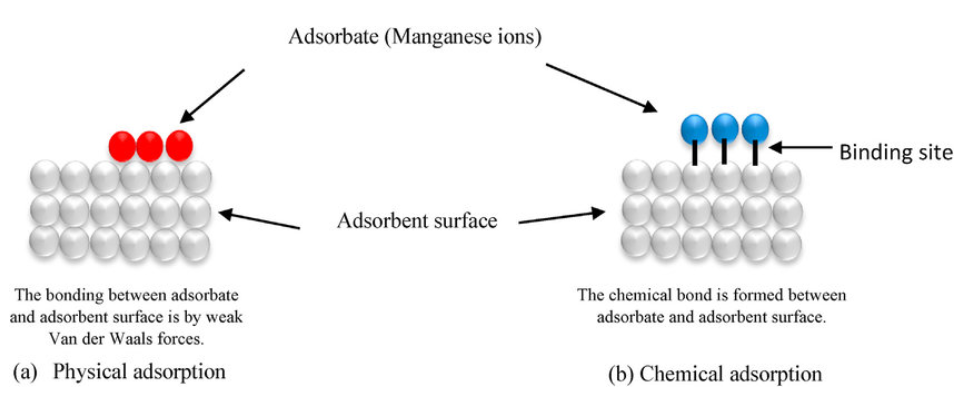
Rudi, N. N. et al. Heliyon. 2020.
Figure 1. The Mechanism of (a) Physical and (b) Chemical Adsorption
Chemical adsorption analysis is a critical technique for understanding how gases or vapors interact with solid surfaces. By quantitatively characterizing surface active sites, adsorption capacity, and reaction kinetics, the chemical adsorption analysis provides essential data for the design and optimization of catalysts, adsorbents, and functional materials. Through these measurements, researchers can determine the number and strength of active sites, identify reaction intermediates, and assess adsorption–desorption behavior under controlled conditions.
MtoZ Biolabs provides a comprehensive Chemical Adsorption Analysis Service that integrates advanced surface science instrumentation with thermodynamic and kinetic modeling. Our Chemical Adsorption Analysis Service enables precise evaluation of adsorption mechanisms, surface reactivity, and material performance, supporting research across catalysis, materials engineering, and environmental science.
Service at MtoZ Biolabs
MtoZ Biolabs offers a full suite of chemical adsorption and temperature-programmed experiments designed to characterize adsorption processes and surface reactivity under static or dynamic conditions. These tests can be applied to catalysts, nanomaterials, oxides, and porous solids to provide insights into active site density, adsorption energy, and reaction pathways.
1. Chemical Adsorption Tests
💠Static Chemisorption Analysis
Measures the equilibrium adsorption of gases on solid surfaces under controlled pressure and temperature. This method quantifies the number of adsorbed molecules and determines the dispersion and surface area of active metal sites.
💠Dynamic Chemisorption Analysis
Involves injecting small, precise pulses of adsorbate gas into a flowing carrier stream that passes over the sample. By monitoring gas uptake in real time, this method provides information on adsorption kinetics and surface accessibility.
💠Pulse Chemisorption Using Liquid Vapors
Extends the dynamic chemisorption approach to volatile liquids, enabling the study of adsorption from vapor-phase precursors. This technique is particularly useful for evaluating catalysts or sorbents interacting with organic vapors or polar compounds.
2. Temperature-Programmed Studies
💠Temperature-Programmed Oxidation (TPO)
Evaluates the oxidation properties of materials and the thermal stability of adsorbed species by monitoring reaction gases during programmed heating in an oxidizing atmosphere.
💠Temperature-Programmed Reduction (TPR)
Measures the reduction behavior of metal oxides or supported catalysts as a function of temperature, revealing the reducibility and strength of metal–oxygen interactions.
💠Temperature-Programmed Desorption (TPD)
Characterizes the strength and distribution of adsorption sites by heating the sample after gas adsorption and monitoring desorbed species. This provides detailed insights into adsorption energy and surface coverage.
3. Other Experiments
💠Heat of Desorption and First-Order Kinetics
Determines the energy required for adsorbate desorption and provides kinetic parameters describing surface reactions. These measurements help identify the strength of chemisorption and the activation energy of surface processes.
💠Isosteric Heat of Adsorption
Calculates the differential enthalpy of adsorption at constant surface coverage, revealing the heterogeneity of adsorption sites and the interaction strength between adsorbate and adsorbent.
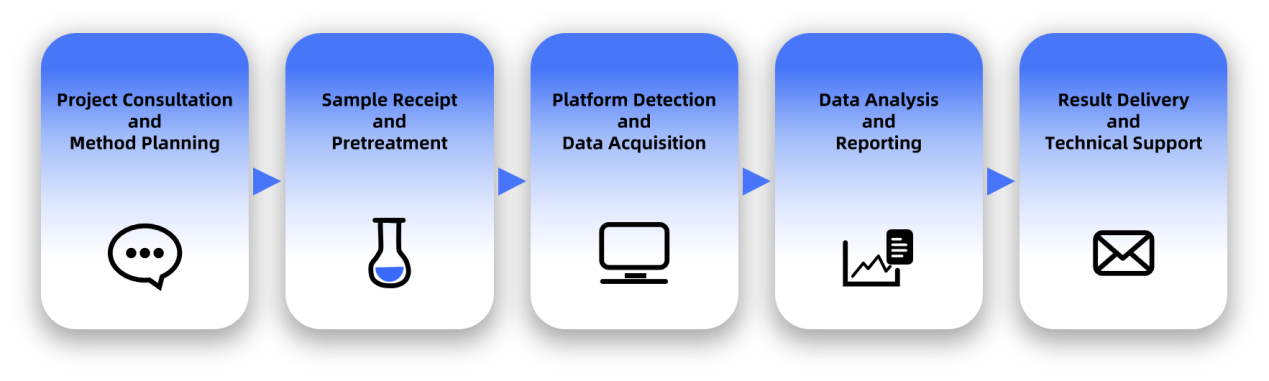
Analysis Workflow
Service Advantages
☑️Quantitative and Mechanistic Insights: Integration of multiple datasets with thermodynamic and kinetic modeling for accurate evaluation of adsorption strength and dynamics.
☑️End-to-End Workflow: From material preparation to data interpretation, we provide a streamlined analytical pipeline tailored to each project's objectives.
☑️Experienced Research Team: Our surface chemistry specialists and material scientists deliver expert guidance, ensuring reliable interpretation and technical support.
☑️Customizable Service Options: Flexible experimental design to accommodate specific adsorbates, materials, and environmental conditions.
Applications
MtoZ Biolabs' Chemical Adsorption Analysis Service supports a wide range of scientific and industrial applications:
1. Catalyst Characterization and Optimization
Determination of active surface sites, metal dispersion, and reactant binding mechanisms for heterogeneous catalysis.
2. Material Surface Engineering
Evaluation of coating adhesion, corrosion resistance, and functionalization efficiency in metals, ceramics, and polymers.
3. Environmental Adsorption Studies
Assessment of pollutant capture, gas sequestration, and adsorption kinetics in environmental remediation materials.
4. Energy Storage and Conversion
Investigation of adsorption-driven hydrogen storage, electrode surface interactions, and fuel cell catalyst design.
5. Biomedical and Pharmaceutical Applications
Study of drug–carrier binding, biomaterial surface interactions, and biosensor surface modification for improved performance.
6. Nanomaterial Functionalization
Characterization of molecular adsorption on carbon nanotubes, graphene, or quantum dots to tailor electronic and catalytic properties.
Sample Submission Suggestions
1. Sample Types
Solid catalysts, nanomaterials, films, powders, polymers, ceramics, or biological materials with adsorptive surfaces.
2. Required Quantity
Typically 2-5 g per sample; additional material may be requested for replicate or parallel analyses.
*Note: For other sample types or low-yield materials, please contact us before preparation.
Deliverables
Raw and Processed Data: Complete experimental datasets, including adsorption–desorption curves, temperature-programmed profiles, and calibration results.
Quantitative Parameters: Key adsorption metrics such as active surface area, metal dispersion, adsorption capacity, and heat of adsorption.
Graphical Reports: High-quality visual representations including adsorption isotherms, TPR/TPD/TPO plots, and kinetic fitting curves.
Analytical Summary: Comprehensive interpretation of adsorption mechanisms, surface reactivity, and catalyst behavior.
Technical Report: A detailed summary document describing experimental conditions, analytical methodology, and data interpretation ready for publication or regulatory submission.
MtoZ Biolabs delivers precise and reliable chemical adsorption analysis to reveal surface reactivity and adsorption behavior at the molecular level. Contact us to discuss how we can support your materials research.
How to order?




