






Can Crosslinking MS Prove a Direct Protein Interaction?
Introduction
Crosslinking MS is often used when researchers need interaction information beyond a protein list. A standard affinity purification experiment can show which proteins co-enrich with a bait, but it may not show which residues are close in space. Crosslinking mass spectrometry adds that spatial layer by chemically linking nearby amino acid residues and identifying crosslinked peptides by LC-MS/MS. This can provide valuable distance constraints for protein complexes, transient assemblies, and conformational models. The common question is whether this evidence proves a direct protein interaction. The careful answer is that crosslinking MS can strongly support proximity and structural compatibility, but a single crosslink usually does not prove direct physical binding by itself.
The distinction matters for experimental interpretation. A crosslink can form between residues on two proteins that directly contact each other. A crosslink can also form between proteins held close within a larger complex, phase-separated compartment, membrane region, or crowded intracellular environment. Sample preparation, crosslinker chemistry, search settings, and controls all influence confidence. Researchers should therefore treat XL-MS as a powerful source of spatial evidence, not as a standalone verdict. The best conclusions come from reproducible crosslinks, proper controls, structural plausibility, and orthogonal validation.
Related Services
| Service Area | Recommended Service |
| Protein interaction MS | Fusion Protein Interaction Analysis Service | Pull-Down and MS |
| Protein analysis | Protein Analysis Service |
| Protein identification | Protein Identification Service |
| Native protein complex analysis | Native MS Analysis |
For projects where crosslinking results will guide downstream validation, MtoZ Biolabs can help researchers align sample preparation, LC-MS/MS depth, and control design before full-scale analysis.
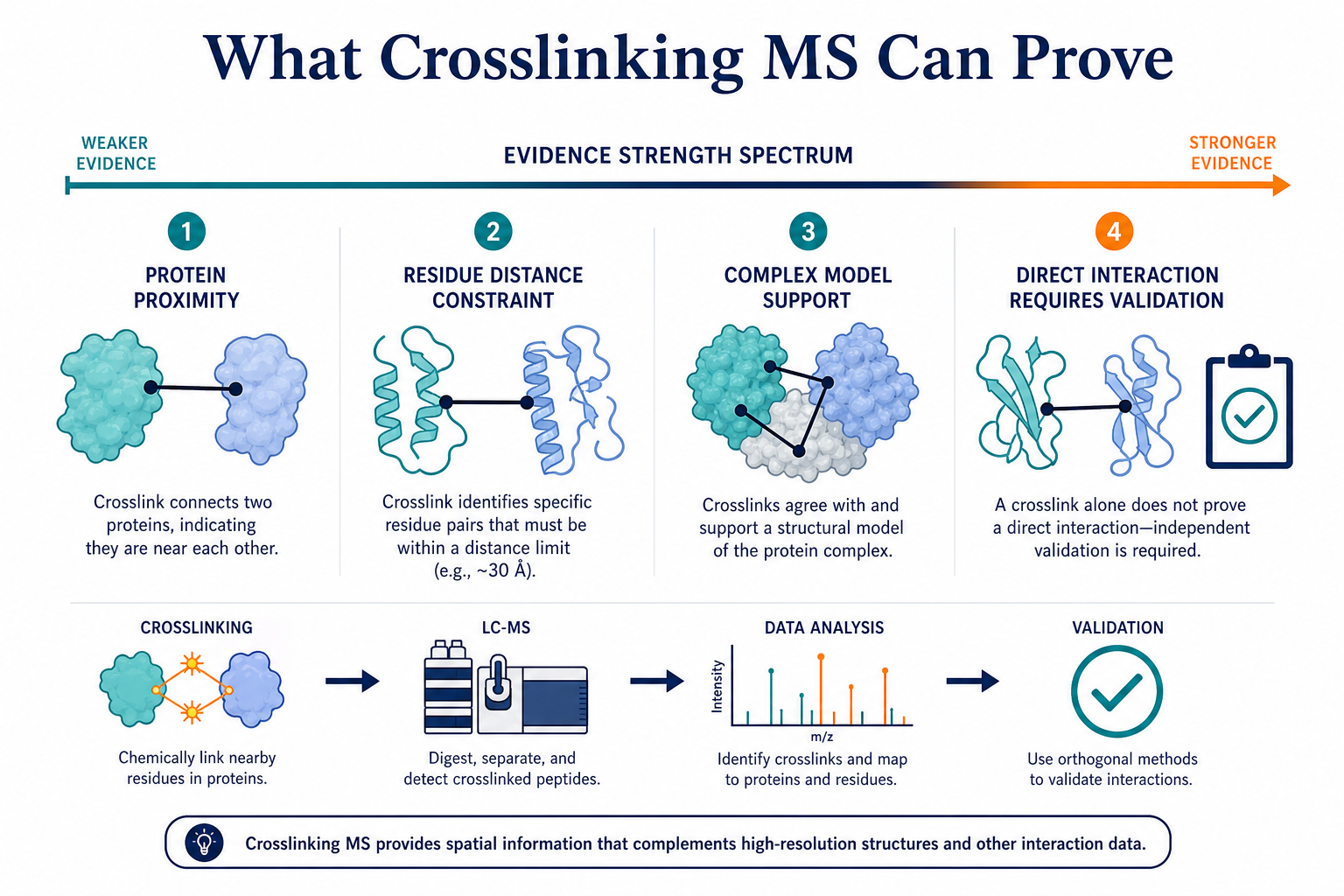
Figure 1. Crosslinking MS provides proximity and distance information, while direct interaction claims usually require additional validation.
What Crosslinking MS Actually Measures
Crosslinking MS measures chemically constrained proximity between reactive residues. In a typical workflow, proteins are treated with a bifunctional reagent that links two compatible amino acid side chains within a defined spacer length and reaction geometry. The protein mixture is then digested, crosslinked peptides are detected by LC-MS/MS, and database searching identifies the linked peptide pair.
The resulting evidence is residue-specific. If a lysine on protein A is linked to a lysine on protein B, the result suggests that those residues were close enough to react under the experimental condition. This information can support a protein complex model, test a predicted interface, or map conformational changes.
However, the measured event is a chemical link, not a direct binding assay. Crosslink formation depends on residue accessibility, reaction kinetics, local concentration, crosslinker permeability, protein flexibility, and sample handling. A missing crosslink also does not prove absence of interaction because the correct residues may not be accessible or reactive.
Why a Crosslink Is Not Always Proof of Direct Binding
A direct protein interaction means that two proteins physically contact each other through a binding interface. Crosslinking MS can support this conclusion when the linked residues are located near a plausible interface and the signal is reproducible. Still, several scenarios can create proximity without direct binding.
First, proteins may be close because they belong to the same multi-protein complex. Protein A and protein B can be held near each other by protein C. A crosslink between protein A and protein B would show distance-compatible proximity, but the primary binding interface may involve the bridging protein.
Second, proteins may be concentrated in the same membrane microdomain, organelle, condensate, or chromatin region. Local concentration can raise the chance of crosslinking even when the proteins are not stable binding partners.
Third, protein flexibility can make residues approach each other transiently. A crosslink captures a snapshot from a dynamic ensemble. The snapshot can be biologically meaningful, but it should not be overinterpreted as a stable direct interface without supporting data.
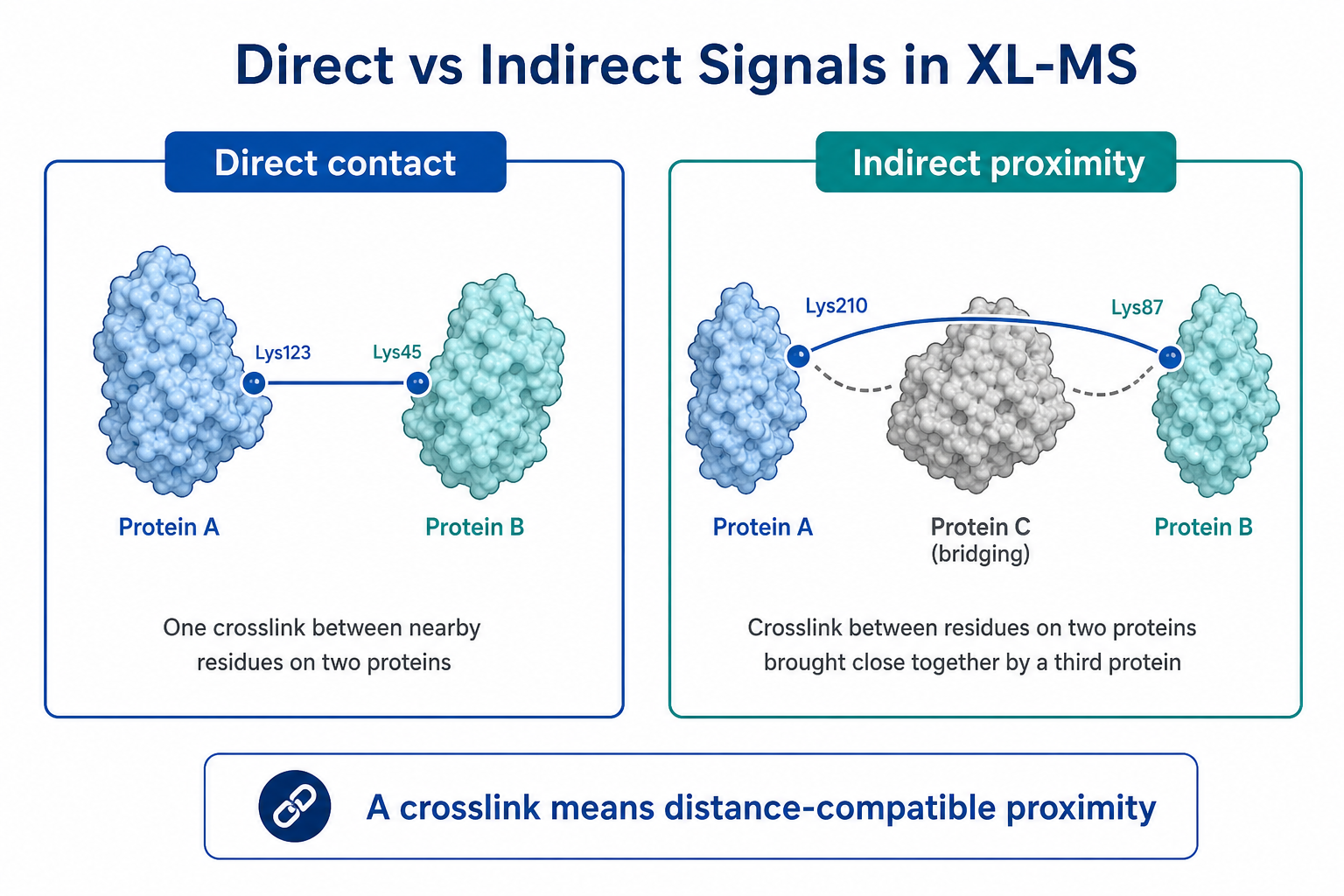
Figure 2. XL-MS can detect direct-contact evidence or indirect proximity within a larger protein assembly.
When Crosslinking MS Strongly Supports Direct Interaction
Crosslinking MS becomes stronger evidence when multiple conditions are met. One crosslink may be suggestive. Several reproducible crosslinks at a coherent interface are more convincing. Confidence increases when linked residues satisfy the expected distance limit, map to solvent-accessible regions, and agree with known structural domains.
Evidence is also stronger when the crosslink depends on the biological condition. For example, a stimulation-dependent crosslink that appears only when a pathway is active can support regulated interaction. A mutation that disrupts the predicted interface and reduces the crosslink provides even stronger support.
The strongest interpretation usually comes from combined evidence:
• Crosslinks are detected in biological replicates.
• Crosslinks pass defined false discovery rate thresholds.
• Crosslinks are reduced in relevant negative controls.
• Crosslinks fit a structural model or predicted interface.
• Orthogonal assays support physical association.
• Interface perturbation changes the crosslink or biological output.
This combined pattern can make a direct protein interaction claim credible, especially when the study avoids absolute language and describes the evidence level clearly.
Controls Needed Before Making an Interaction Claim
Controls are essential because crosslinking MS datasets can contain false positives, nonspecific proximity, and search artifacts. A no-crosslinker control helps identify signals that appear without active crosslinking chemistry. A quenched-crosslinker control can help evaluate reagent-dependent background during method development. Biological controls help determine whether the signal depends on the condition, bait, mutation, or cell state being studied.
Technical controls are also important. LC-MS blanks help detect carryover. Replicate injections can evaluate acquisition stability. Decoy database searching and crosslink-level FDR filtering help control search-space errors. When crosslink enrichment is used, enrichment controls should be processed in parallel.
The table below summarizes how different evidence types affect a direct interaction claim.
| Evidence Type | What It Supports | Main Limitation |
| Single inter-protein crosslink | Two residues were close enough to react | May reflect indirect proximity or transient contact |
| Multiple interface-consistent crosslinks | A plausible contact region or complex model | Still requires biological and technical controls |
| Condition-specific crosslinks | Interaction or conformation changes with treatment | Treatment may also alter abundance or localization |
| Mutation-sensitive crosslinks | Candidate interface involvement | Mutation may affect folding or protein expression |
| Orthogonal validation | Independent support for physical association | Each method has its own bias and resolution |
What Validation Methods Should Be Used?
The best validation method depends on the claim. If the claim is that two proteins associate in cells, reciprocal Co-IP, pull-down, proximity labeling, or native MS may provide useful support. If the claim is that a specific interface is involved, mutagenesis, peptide competition, HDX-MS, or structural modeling may be more informative. If the claim is functional, a downstream activity assay or phenotype rescue may be needed.
Co-IP can show that two proteins are present in the same captured complex, but Co-IP still does not always prove direct binding. Pull-down with purified proteins can provide stronger direct-binding evidence if the proteins are properly folded and purified. Native MS can help evaluate intact complexes and stoichiometry. HDX-MS can identify regions with altered solvent exposure after binding. Mutagenesis can test whether predicted interface residues are required.
Mass spectrometry-based protein analysis workflows can complement XL-MS findings, including protein identification, pull-down MS, and native MS analysis for complex-level evidence.
How to Phrase Crosslinking MS Conclusions
Scientific wording should match the strength of evidence. If the dataset contains a single reproducible inter-protein crosslink, it is safer to say that crosslinking MS supports close proximity between two proteins. If several crosslinks cluster at a predicted interface and orthogonal assays support association, the authors can state that the data support a direct interaction model.
Avoid statements such as "crosslinking MS proves direct binding" unless the study includes interface-level validation and rules out major alternative explanations. Better wording includes:
• "The XL-MS data support spatial proximity between protein A and protein B."
• "The crosslinks are consistent with a direct interaction model."
• "Crosslinking MS and mutagenesis together support this interface."
• "The interaction model is supported by XL-MS, Co-IP, and structural compatibility."
This careful language improves credibility and reduces the risk of overclaiming.
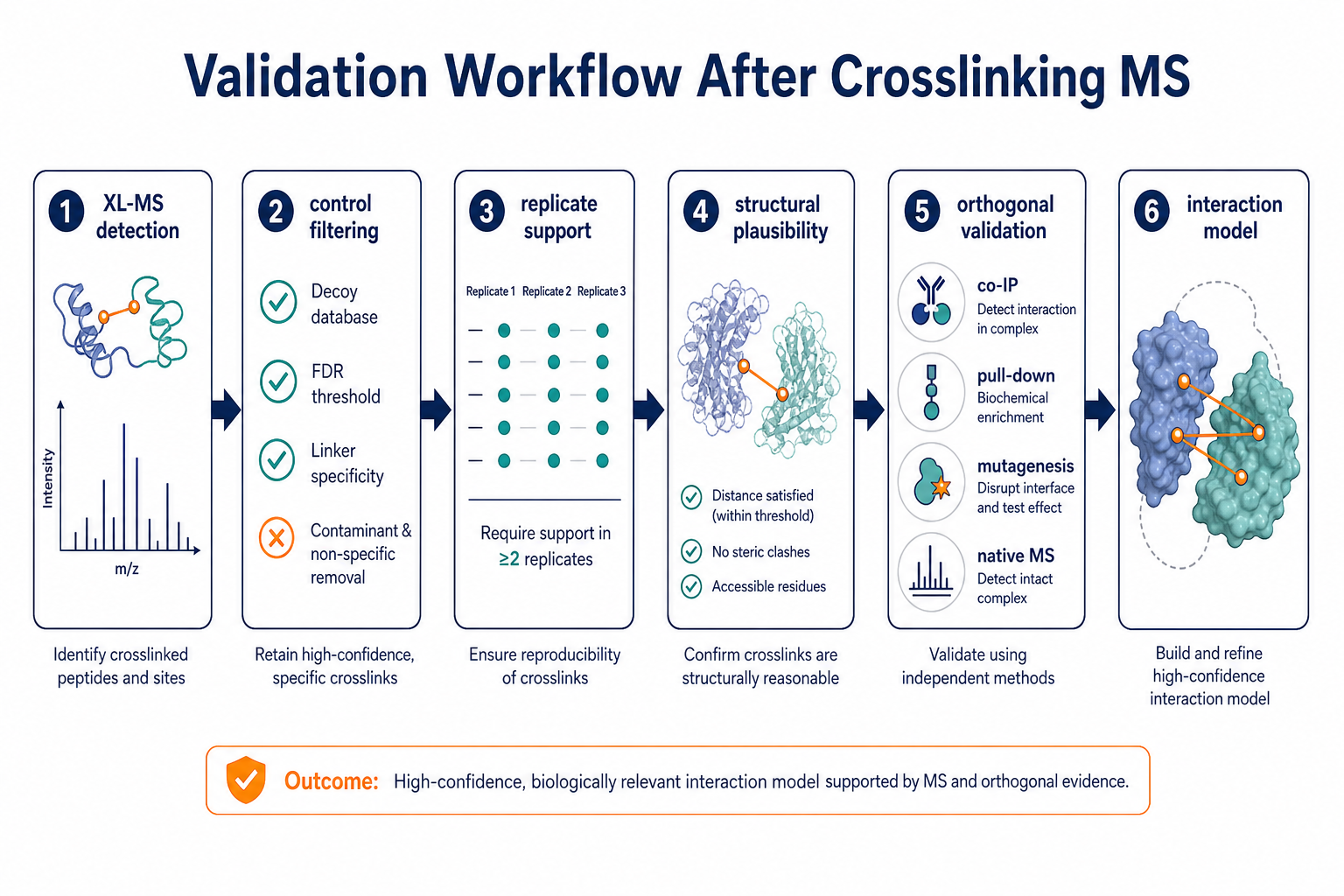
Figure 3. A validation workflow after crosslinking MS should combine control filtering, replicate support, structural plausibility, and orthogonal methods.
Common Interpretation Mistakes
One common mistake is treating every inter-protein crosslink as a direct interface. This is risky when the proteins are part of a large assembly or cellular compartment. Another mistake is ignoring crosslinker chemistry. Different reagents target different residues and have different spacer lengths, membrane permeability, and reaction behavior.
A third mistake is interpreting absence of crosslinks as absence of interaction. A real interaction may lack reactive residues within range. The relevant peptides may be too long, too hydrophobic, poorly fragmented, or below detection. The crosslinker may also fail to reach the compartment where the interaction occurs.
Researchers should also avoid comparing raw crosslink counts across conditions without considering protein abundance, digestion efficiency, enrichment efficiency, and LC-MS/MS depth. More crosslinks do not automatically mean stronger binding.
Practical Decision Guide
If the research goal is to discover whether two proteins are near each other in a complex, crosslinking MS is highly useful. If the goal is to prove a direct interface, XL-MS should be paired with structural modeling and perturbation experiments. If the goal is to validate binding for a therapeutic or mechanistic claim, orthogonal biochemical evidence is usually required.
A practical project plan can follow four steps. First, define the claim before running the experiment. Second, design controls that address proximity, chemistry, and search confidence. Third, evaluate whether crosslinks are reproducible and structurally plausible. Fourth, choose validation methods that match the strength of the intended conclusion.
Frequently Asked Questions
1. Can crosslinking MS prove that two proteins bind directly?
Crosslinking MS can strongly support a direct interaction model, especially when multiple crosslinks map to a plausible interface. However, crosslinking MS alone usually does not prove direct binding without controls and orthogonal validation.
2. What does an inter-protein crosslink mean?
An inter-protein crosslink means that two residues on different proteins were close enough and chemically accessible enough to be linked under the experimental condition. The result supports proximity, not necessarily stable direct binding.
3. Can a crosslink be a false positive?
Yes. False positives can arise from database search errors, insufficient FDR control, carryover, nonspecific proximity, reagent artifacts, or poor spectral quality. Replicates, controls, and manual review of key spectra can improve confidence.
4. What methods validate crosslinking MS results?
Useful validation methods include reciprocal Co-IP, purified-protein pull-down, mutagenesis, HDX-MS, native MS, structural modeling, targeted MS, and functional assays. The best choice depends on the claim.
5. Does no crosslink mean no interaction?
No. A real interaction may not generate a detectable crosslink if reactive residues are absent, inaccessible, too far apart, or poorly detected by LC-MS/MS. Negative XL-MS results should be interpreted cautiously.
Conclusion
Crosslinking MS is a powerful method for mapping proximity, residue-level distance constraints, and protein complex architecture. The method can provide strong support for a direct protein interaction when crosslinks are reproducible, structurally plausible, control-filtered, and supported by independent validation. A single crosslink, however, should usually be described as proximity evidence rather than proof of direct binding. Researchers planning XL-MS studies should define the intended claim early, build appropriate controls, and select validation methods that match the biological question. For interaction studies that need both spatial evidence and defensible interpretation, a technical consultation with MtoZ Biolabs can help align crosslinking mass spectrometry with downstream validation.
How to order?




