






Advantages and Disadvantages of Targeted Metabolomics
Targeted metabolomics, as a core strategy in metabolomics research, has been widely applied in life sciences, biomedical research, and clinical translation owing to its high sensitivity, specificity, and reproducibility. Nevertheless, like any analytical approach, it possesses inherent strengths as well as certain limitations.
Major Advantages of Targeted Metabolomics
1. High Sensitivity and Specificity
Targeted metabolomics typically utilizes multiple reaction monitoring (MRM) or selected reaction monitoring (SRM) modes to track predefined ion transitions of known metabolites, thereby significantly enhancing the signal-to-noise ratio and enabling accurate detection of low-abundance metabolites.
2. Absolute Quantification with Enhanced Biological Relevance
By incorporating stable isotope-labeled internal standards, targeted metabolomics enables absolute quantification of metabolites, providing robust quantitative data for metabolic pathway modeling and pharmacokinetic (PK) studies.
3. High Reproducibility Suitable for Large-Scale Studies
Targeted approaches are highly standardized with fixed analytical parameters, making them particularly suitable for multi-center, longitudinal, and large-cohort studies. Their data reproducibility and stability are significantly superior to those of untargeted metabolomics.
4. Facilitated Data Interpretation and Clinical Translation
Since the analytes are metabolites with known structures and biological functions, they can be directly linked to specific metabolic pathways, disease mechanisms, or clinical phenotypes, thereby improving interpretability and translational potential.
5. Ideal for Mechanism Validation and Biomarker Confirmation
Following the identification of candidate biomarkers through untargeted metabolomics, targeted quantitative analysis is typically employed for validation, enhancing the reliability and publication value of the findings.
Limitations of Targeted Metabolomics
1. Limited Coverage Dependent on Prior Knowledge
Targeted metabolomics is restricted to predefined metabolite panels and has limited capability for discovering unknown metabolites or novel metabolic pathways. Therefore, it is less suitable for exploratory studies. In early-stage investigations of disease mechanisms, untargeted metabolomics is generally recommended prior to targeted validation.
2. High Cost and Time-Consuming Method Development
Each metabolite-specific MRM method requires extensive optimization, including retention time, ion transitions, and collision energy. In addition, repeated validation across different sample matrices is necessary, resulting in a complex and time-intensive workflow.
3. Strong Dependence on Reference Standards
Accurate quantification relies heavily on stable isotope-labeled internal standards and high-quality reference standards. However, many rare metabolites, endogenous intermediates, or modified metabolites lack commercially available standards, which may compromise quantification accuracy.
4. Relatively Limited Throughput
Although modern triple quadrupole instruments enable the simultaneous detection of hundreds of metabolites, the overall throughput remains constrained by the instrument duty cycle and the number of MRM transitions, especially when compared to untargeted approaches capable of profiling thousands of metabolites.
5. Potential Neglect of System-Level Metabolic Alterations
Targeted strategies primarily focus on predefined metabolites and may overlook other critical nodes within metabolic networks, thereby limiting comprehensive system-level insights into metabolic regulation.
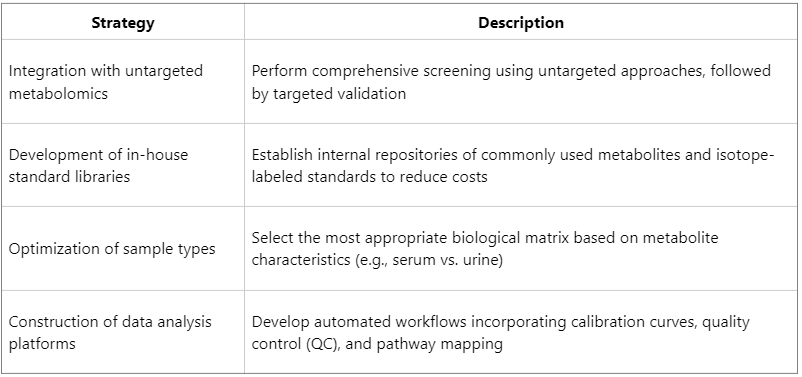
Strategies to Optimize Targeted Metabolomics Applications
How MtoZ Biolabs Supports High-Quality Targeted Metabolomics Research
MtoZ Biolabs recognizes the importance of targeted metabolomics in both fundamental research and translational applications and is dedicated to establishing a standardized, scalable, and professional service platform:
-
In-house developed standard libraries covering key metabolic pathways (e.g., glycolysis, TCA cycle, amino acid metabolism)
-
Multiple high-sensitivity triple quadrupole (QqQ) mass spectrometry systems enabling parallel detection of hundreds of metabolites
-
Automated quantification workflows and integrated bioinformatics pipelines to enhance research efficiency
-
Personalized technical consultation and data interpretation services to support rigorous experimental design
Targeted metabolomics represents one of the most quantitatively robust and translationally relevant approaches in metabolomics research, particularly suited for applications such as mechanism validation, clinical assessment, and drug evaluation. However, it is not universally applicable. In early-stage studies where target metabolites are unknown, untargeted strategies are recommended. MtoZ Biolabs suggests integrating targeted and untargeted approaches based on specific research objectives to develop tailored metabolomics solutions. For further information or technical support, please feel free to contact us.
MtoZ Biolabs, an integrated chromatography and mass spectrometry (MS) services provider.
Related Services
How to order?




