






How ABPP Supports High-Throughput Compound Screening: Target Engagement, Off-Target Profiling, and Workflow Design
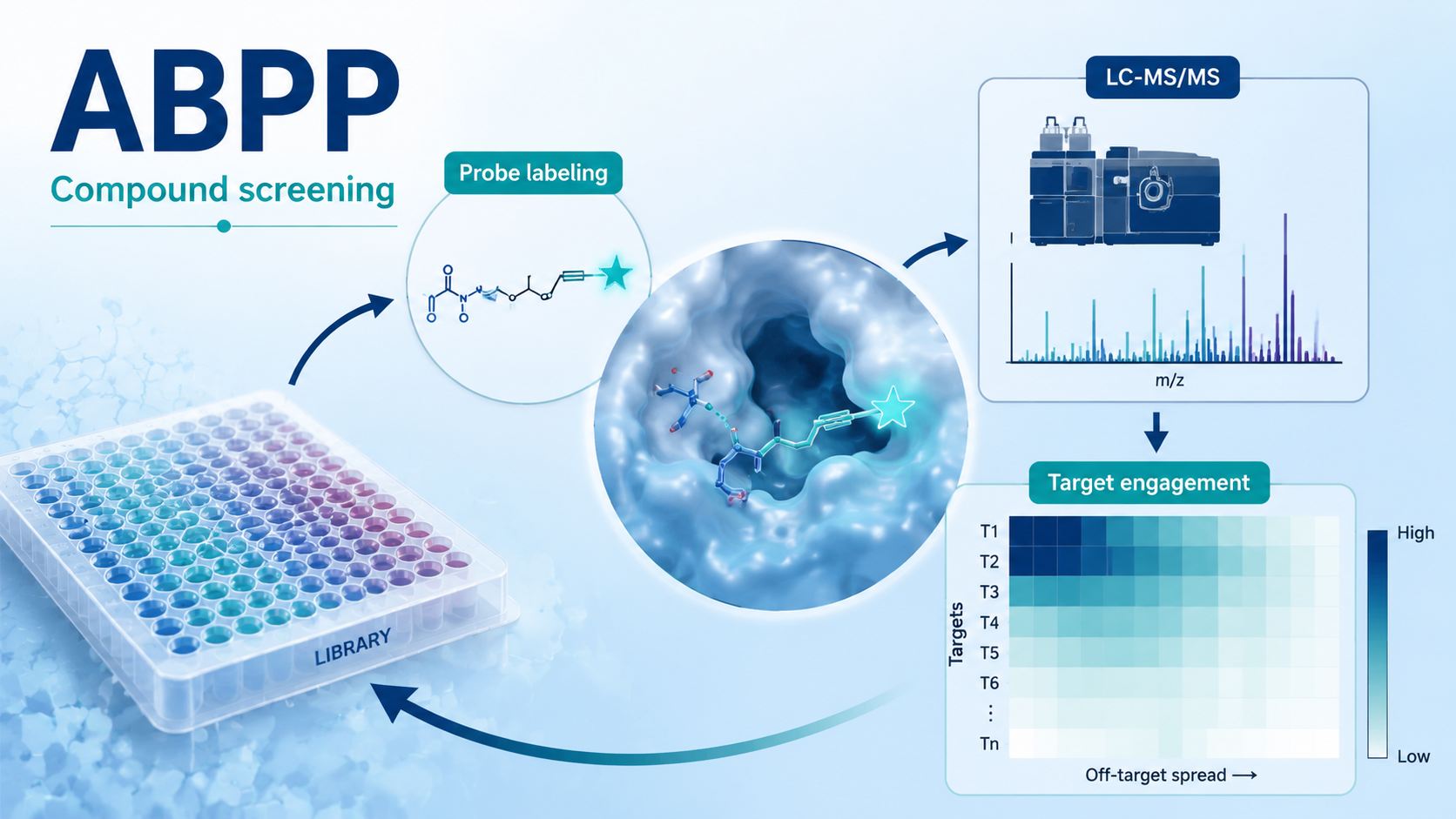
Activity-based protein profiling (ABPP) helps high-throughput compound screening move beyond binding assumptions toward functional target engagement. Instead of asking only whether a molecule binds a protein, ABPP asks whether active enzymes in cells or lysates are actually perturbed. That shift matters in early drug discovery, where weak selectivity, hidden off-targets, and poor translation from biochemical assays to cellular systems can waste large screening campaigns.
Key Takeaways
-
ABPP labels catalytically active proteins with activity-based probes, then reads probe occupancy changes by LC-MS/MS.
-
Competitive ABPP is the core assay format for testing whether compounds occupy target active sites.
-
ABPP can profile off-target enzyme engagement across large parts of the functional proteome in one experiment.
-
High-throughput screening benefits when ABPP is paired with multiplexed LC-MS/MS and structured compound matrices.
-
ABPP is strongest when the biological question is functional target validation, not only expression or binding affinity.
What ABPP Adds to Compound Screening?
Traditional high-throughput assays often score potency against one purified target or a narrow biochemical readout. They scale well, but they may miss whether the compound reaches the active site in cells, whether the target is functionally engaged, or whether other enzymes are unintentionally inhibited.
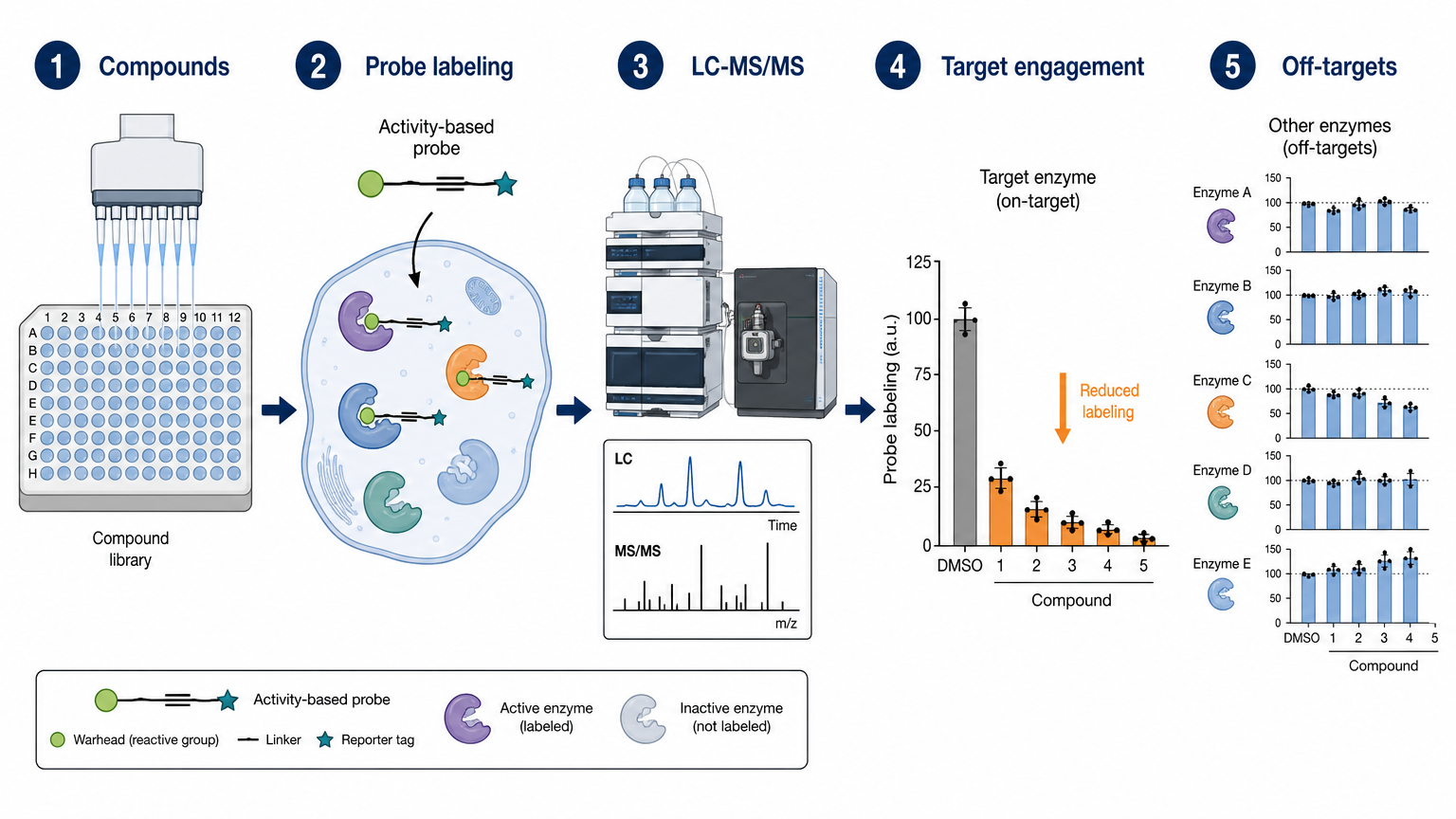
ABPP fills that gap by focusing on proteins that are active under the tested conditions. Activity-based probes covalently label active sites of enzyme families such as serine hydrolases, cysteine proteases, or other probe-compatible classes. If a compound competes for the same site, probe labeling drops and LC-MS/MS quantifies that change.
Related Services
Activity-Based Protein Profiling (ABPP) Service
Competitive Activity-Based Protein Profiling (ABPP) Service
Small Molecule Drug Targets Identification Service | ABPP
Activity Based Protein Profiling Service
Why ABPP Fits High-Throughput Screening Workflows?
High-throughput screening generates many candidate molecules, but downstream triage still needs fast evidence about mechanism. ABPP is useful because it can be run in a competitive format across many compound conditions in parallel, especially when sample handling, probe chemistry, and LC-MS/MS acquisition are standardized.
Practical advantages include direct readout of active-site occupancy for probe-compatible targets, ability to compare dozens of compounds against the same active proteome background, early visibility into off-target enzyme engagement before expensive follow-up, and better alignment between biochemical hits and cellular functional effects.
The method is not a replacement for every HTS assay. It is a functional layer that helps prioritize compounds with real target engagement and fewer hidden liabilities.
Core ABPP Application Scenarios
1. Competitive ABPP for Target Inhibition
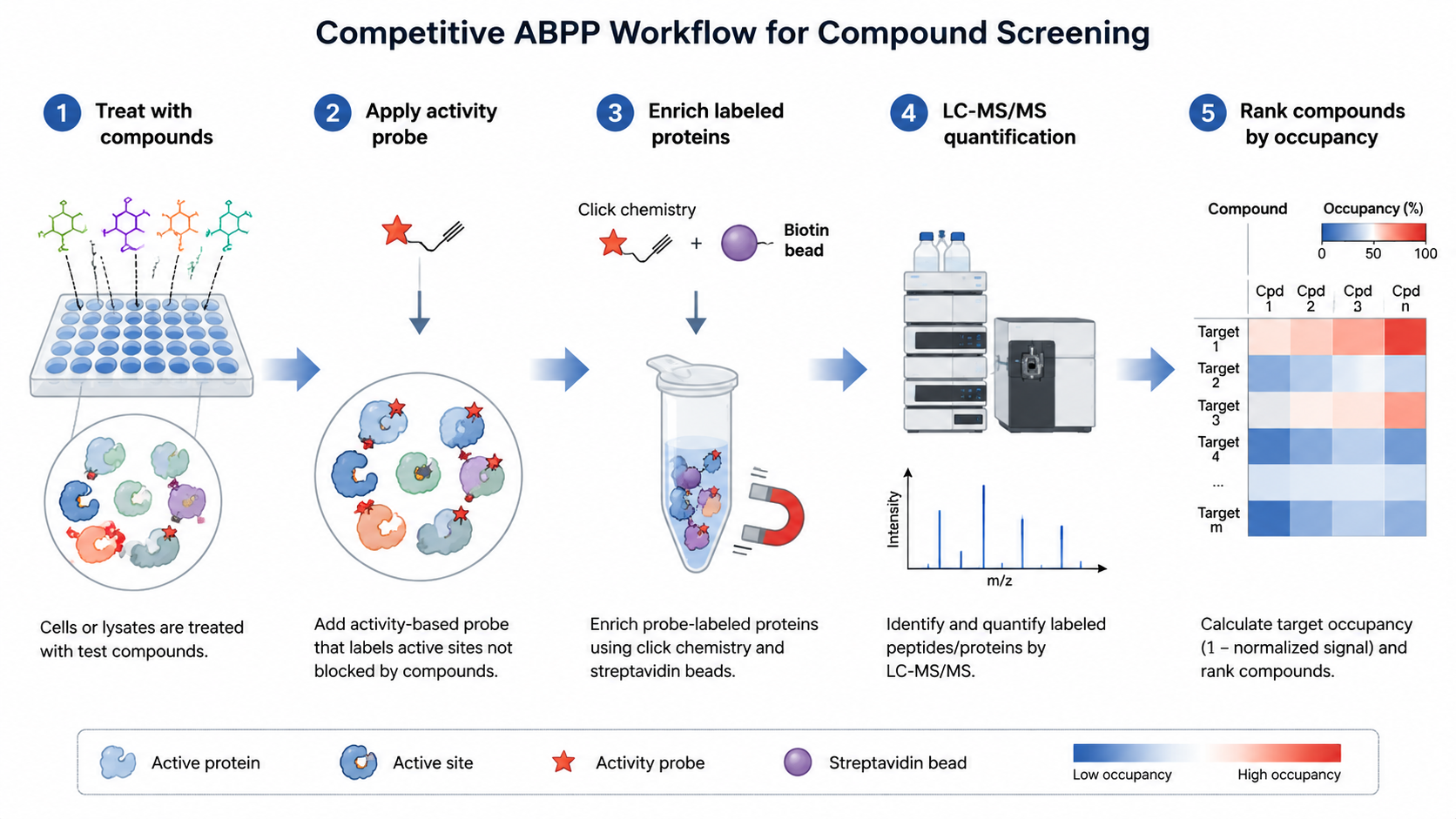
In competitive ABPP, samples are treated with compounds first, then labeled with an activity-based probe. Reduced probe signal on a target enzyme suggests the compound occupied or blocked the active site. This format is especially valuable when a hit series needs target engagement confirmation, selectivity must be compared across analogs, or cellular lysates or intact cells are more relevant than purified protein alone.
2. Off-Target Profiling Across the Active Proteome
Off-target effects remain a major source of attrition in drug discovery. ABPP can survey many active enzymes in the same experiment, revealing whether a compound perturbs only the intended target or also hits related enzyme families. That proteome-wide functional view is difficult to obtain from single-target biochemical assays alone.
3. Activity-Driven Screening Beyond Existing Hits
ABPP can also support discovery-oriented workflows. By comparing active enzyme profiles after compound treatment, researchers can identify chemotypes that reshape disease-relevant enzyme activities, then connect those changes to phenotypic outcomes. This is useful in oncology, inflammation, neuroscience, and other areas where the therapeutic hypothesis depends on enzyme activity states rather than static abundance.
Recommended ABPP Screening Workflow
A practical high-throughput ABPP workflow usually includes: defining the enzyme class and probe set; treating lysates or cells with compound panels; applying activity-based probes with consistent quench timing; enriching probe-labeled proteins when needed; quantifying occupancy changes by LC-MS/MS; ranking compounds by target engagement, selectivity, and off-target patterns; and integrating ABPP results with phenotypic, biochemical, and medicinal chemistry data.
Standardization matters. Small differences in probe concentration, treatment time, or sample processing can shift occupancy measurements and weaken cross-compound comparisons.
Strengths and Limitations
| Strength | Why It Matters | Limitation | Practical Consequence |
|---|---|---|---|
| Functional target readout | Confirms active-site engagement | Probe coverage is class-dependent | Not every protein is ABPP-compatible |
| Multiplexed enzyme profiling | Reveals off-target liabilities early | Requires careful quantitative analysis | Data interpretation is more complex than single-target assays |
| Cell-relevant context | Works with lysates or intact systems | Probe access varies by compartment | Some targets may be under-labeled |
| Scalable triage | Supports parallel compound comparison | MS depth still sets throughput limits | Study design must balance breadth and speed |
How to Interpret ABPP Screening Results?
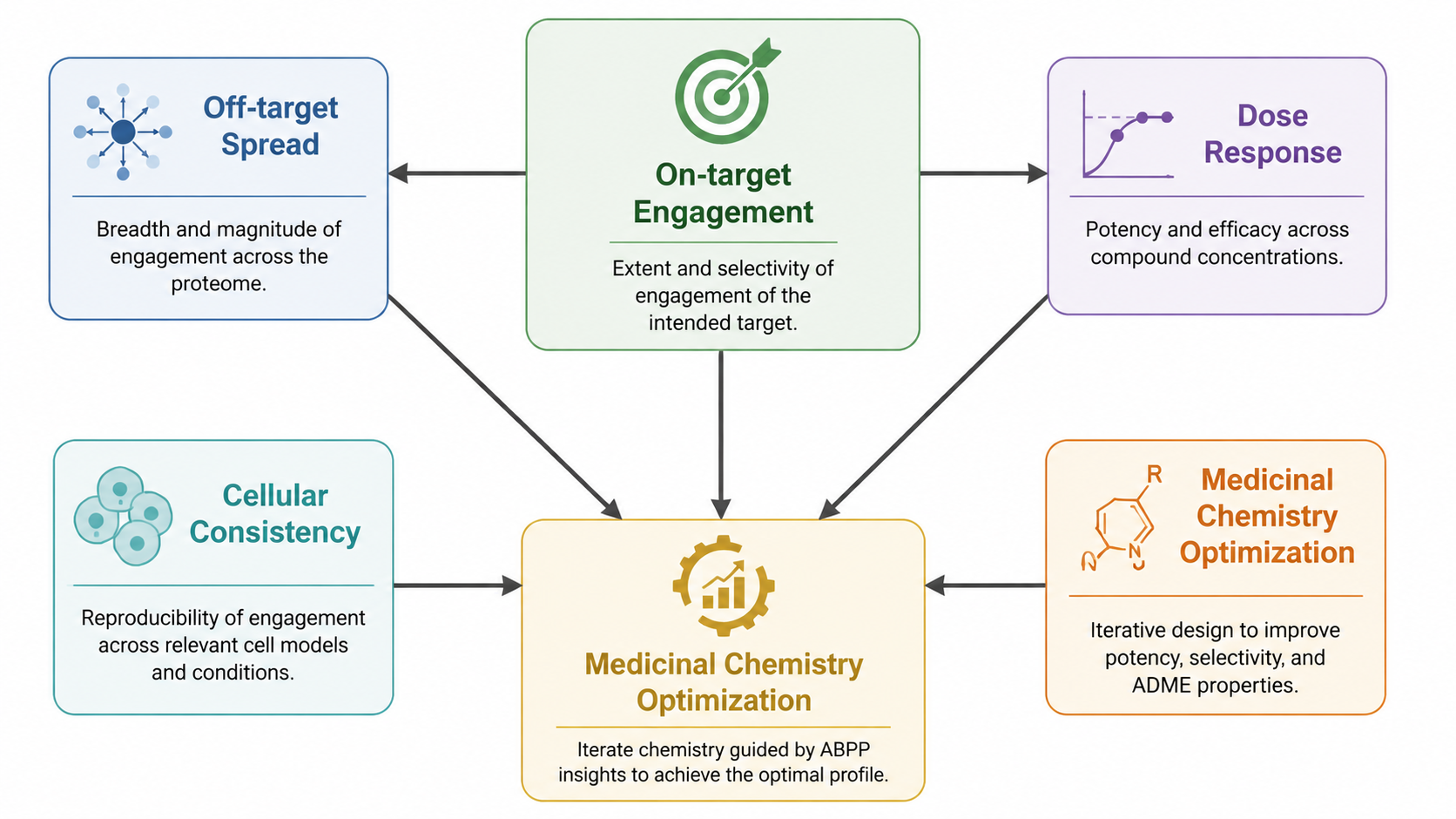
Strong target engagement is not the only criterion. The best compounds often show sufficient on-target occupancy, limited off-target perturbation, and consistency across concentrations or chemotypes.
Useful interpretation questions include whether the compound reduces probe labeling on the intended target in a dose-dependent manner, whether off-target changes are limited to closely related enzymes, whether active-site effects persist under cellular conditions used in phenotypic assays, and whether medicinal chemistry can improve selectivity while preserving target engagement.
ABPP is most powerful when treated as a decision tool for compound ranking, not as a standalone approval step.
FAQ
1. How does ABPP support high-throughput compound screening?
ABPP supports high-throughput screening by enabling parallel comparison of compound effects on active enzyme sites, using competitive probe labeling and LC-MS/MS quantification to measure target engagement and off-target activity.
2. What is competitive ABPP?
Competitive ABPP treats samples with compounds before probe labeling. If a compound occupies a target active site, probe labeling decreases and MS quantifies the competition.
3. Can ABPP identify off-target effects?
Yes. Because ABPP surveys many active enzymes in the same experiment, it can reveal unintended engagement beyond the primary target.
4. Is ABPP better than conventional biochemical HTS assays?
Not universally. Biochemical assays remain valuable for early potency screens. ABPP adds a functional layer that is especially useful for target validation, selectivity analysis, and cellular relevance.
Conclusion
ABPP gives high-throughput compound screening a functional readout that binding assays alone cannot provide. Competitive labeling, LC-MS/MS quantification, and proteome-wide active enzyme profiling help teams confirm target engagement, detect off-target liabilities, and prioritize chemotypes with a stronger mechanistic basis. For early drug discovery, that combination can make large screening campaigns more informative and less likely to advance compounds that look potent only in simplified assay systems.
How to order?




