



What Are the Protein Protein Interaction Databases?
Protein–protein interaction (PPI) databases are curated or computed catalogs of reported contacts between proteins. They do not all record the same evidence. BioGRID, DIP, IntAct, and MINT are built mainly from experimental literature and consortium submissions. STRING mixes experimental records with prediction, co-expression, and text mining and therefore reports associations, not a single experimental class. BIND, HPRD, and HPIDB are narrower or older collections for compounds and dimers, human annotation, or host–pathogen pairs. A download from any of these sources is prior knowledge around a protein list. It is not an interactome of the lysate on the bench.
The opening claim that PPI databases primarily store experimentally validated interactions is true only for the curated experimental group. It is the wrong umbrella for STRING and for any score that blends text mining with a physical assay. The useful first decision is which record class the next sentence needs: a curated physical or genetic edge, a functional association, or a specialized host–pathogen or human-annotation set.
Researchers who already have a protein list, a bait, or a project objective can also review the MtoZ Biolabs Protein-Protein Interaction Analysis Service for project-specific feasibility and analysis planning.
What a PPI Database Can and Cannot Report
A well-chosen database can list proteins already reported with a query protein, show the assay or inference used to create that edge, and help decide which antibody, clone, or second method to run next. IntAct can carry experimental condition and method fields. BioGRID can separate physical from genetic evidence. STRING can rank a neighborhood by a combined score.
The same download cannot identify interacting proteins in the current sample. It cannot prove that a hub is a drug target. It cannot replace co-immunoprecipitation (Co-IP), yeast two-hybrid (Y2H), or affinity purification–mass spectrometry (AP-MS) when the claim is recovery from this cell system. For how a public edge should be drawn as an overlay rather than as a measured contact, How to Build and Analyze Protein-Protein Interaction Networks? provides a complementary build-versus-overlay framework.
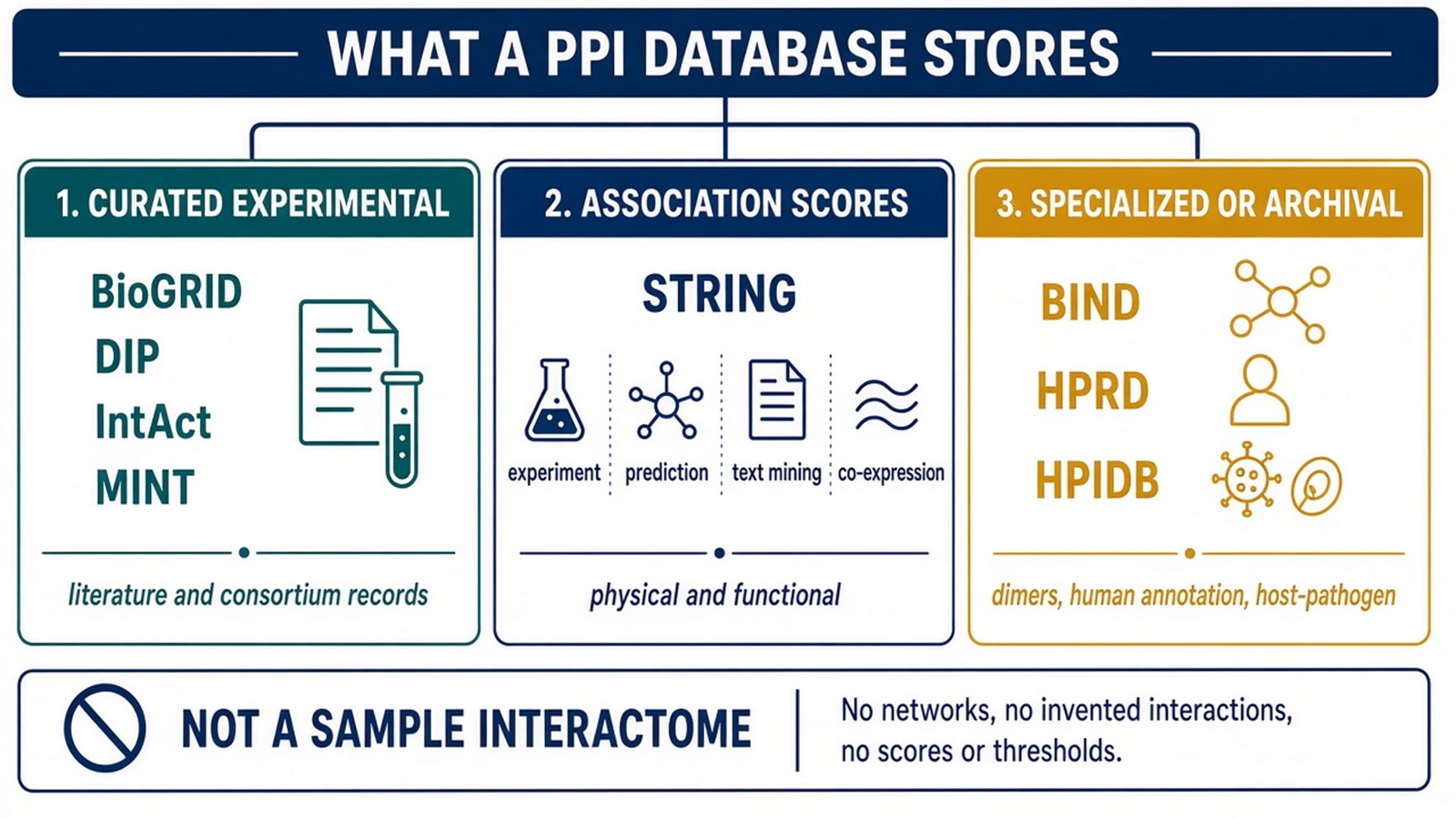
Figure 1. Experimental repositories, association resources, and specialized collections answer different queries. None of the three is a sample-level interactome.
Name the record class before opening the file. A STRING score and an IntAct experiment are not interchangeable edges.
Key Protein–Protein Interaction Databases
The resources below are the set already named on this page. They are grouped by what they actually store, not by popularity.
Curated experimental repositories
BioGRID (Biological General Repository for Interaction Datasets)
BioGRID curates biological molecular interactions, including protein–protein, protein–DNA, and genetic interaction data. Physical and genetic evidence should stay labeled. A BioGRID physical edge is a literature or high-throughput experimental record. It is not automatic proof of direct binding in a new lysate.
DIP (Database of Interacting Proteins)
DIP records known protein interactions in order to support work on the structure and function of molecular complexes. Entries are drawn from experimentally determined interactions. Coverage is narrower than IntAct or BioGRID, so DIP is a supporting experimental catalog rather than a first-pass genome-wide overlay.
IntAct
IntAct is an open-source molecular interaction database maintained by the European Bioinformatics Institute (EMBL-EBI) and is a core IMEx partner. It provides detailed interaction records, including experimental conditions and methods, usually in PSI-MI form. IntAct is the usual choice when the next sentence needs a documented assay, not only a protein pair.
MINT (Molecular INTeraction database)
MINT focuses on experimentally curated protein interactions. Its content is now largely available through IntAct. Treat a MINT identifier as an experimental record that should be reconciled with the current IntAct entry rather than as a second independent interactome.
Association and mixed-evidence resources
STRING (Search Tool for the Retrieval of Interacting Genes/Proteins)
STRING compiles proteins and their reported or inferred associations. Those associations include direct physical and indirect functional links and draw on experimental data, computational prediction, co-expression, and literature text mining. A STRING combined score is a confidence of association across those channels. It is not a substitute for an experimental repository and it is not a measurement in the present sample. Predicted channels belong on a separate layer from BioGRID or IntAct downloads. For how predicted pairs should be treated as a shortlist, What Is PPI Prediction? provides a complementary inference-versus-measurement discussion.
Specialized and archival collections
BIND
BIND stored interactions of proteins, compounds, and dimers. It is a historical biomolecular interaction resource, not a current first-line download for a new project. Legacy BIND identifiers should be traced into a maintained repository before they are drawn as live edges.
HPRD (Human Protein Reference Database)
HPRD assembled human-centric annotation, including subcellular location, expression, protein interactions, phosphorylation sites, and disease associations. The interaction slice is useful historical human context. The database is no longer an actively expanding PPI catalog, so new human edges should be checked in IntAct or BioGRID.
HPIDB (Host–Pathogen Interaction Database)
HPIDB focuses on protein–protein interactions between hosts and pathogens. Use it when the query is a cross-species infection interface. Do not treat it as a general eukaryotic interactome.
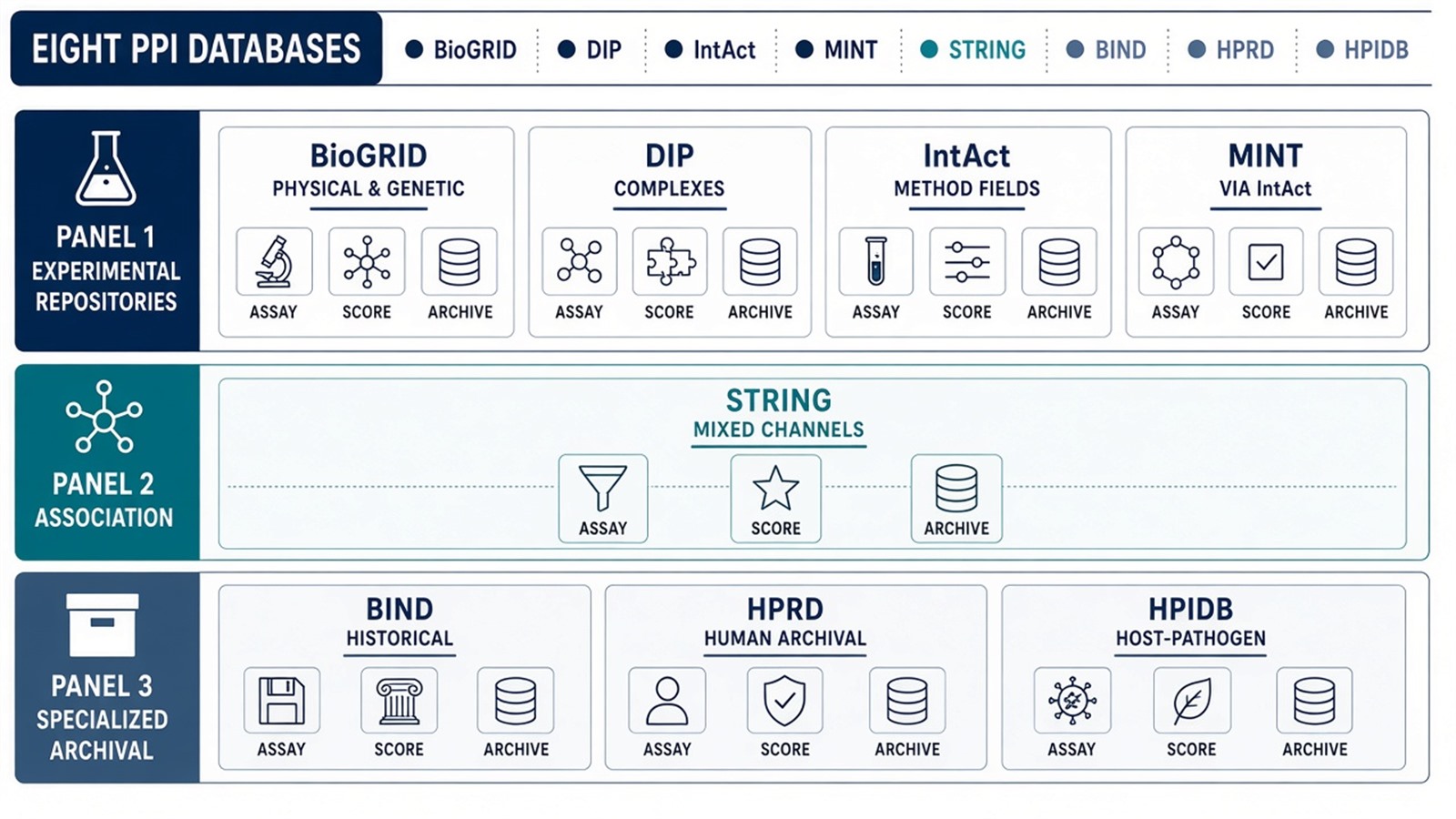
Figure 2. BioGRID, DIP, IntAct, and MINT hold curated experiments. STRING holds mixed associations. BIND, HPRD, and HPIDB are specialized or archival.
How to Choose a Database for the Next Sentence
Next sentence |
Database class that often fits |
Reassess before treating the download as proof |
|---|---|---|
Which assays already reported this pair? |
IntAct or BioGRID |
The pair was only text-mined or predicted |
Which genetic or protein–DNA links sit near this bait? |
BioGRID |
A physical complex inventory is required |
Which complex-oriented experimental edges exist? |
DIP, then IntAct |
Genome-wide coverage is the first need |
Which proteins are associated with this list? |
STRING, with channels labeled |
The claim is a sample-level physical interactome |
Which human annotation accompanies this protein? |
HPRD as archival context |
Current interaction evidence is required |
Which host–pathogen pairs are recorded? |
HPIDB |
A general human or yeast interactome is required |
Which legacy compound or dimer record was cited? |
BIND, then a current repository |
BIND is still being used as a live catalog |
Prefer IntAct when experimental method and condition fields must travel with the edge. Prefer BioGRID when physical and genetic evidence both matter. Prefer STRING only as a ranked association overlay, with experimental, text-mining, and predicted channels kept visible. Prefer HPIDB for infection interfaces. Prefer HPRD or BIND only when a cited legacy record must be interpreted, not when a new network is being built.
Drawing these downloads is a later step. For tool choice after the edge file exists, What Is Protein-Protein Interaction (PPI) Network Visualization? Recommended Tools and Software provides a complementary STRING-and-Cytoscape discussion. For how experimental, predicted, and database layers should stay separate on the map, Protein-Protein Interaction Mapping Methods and Applications provides a more detailed layering framework.
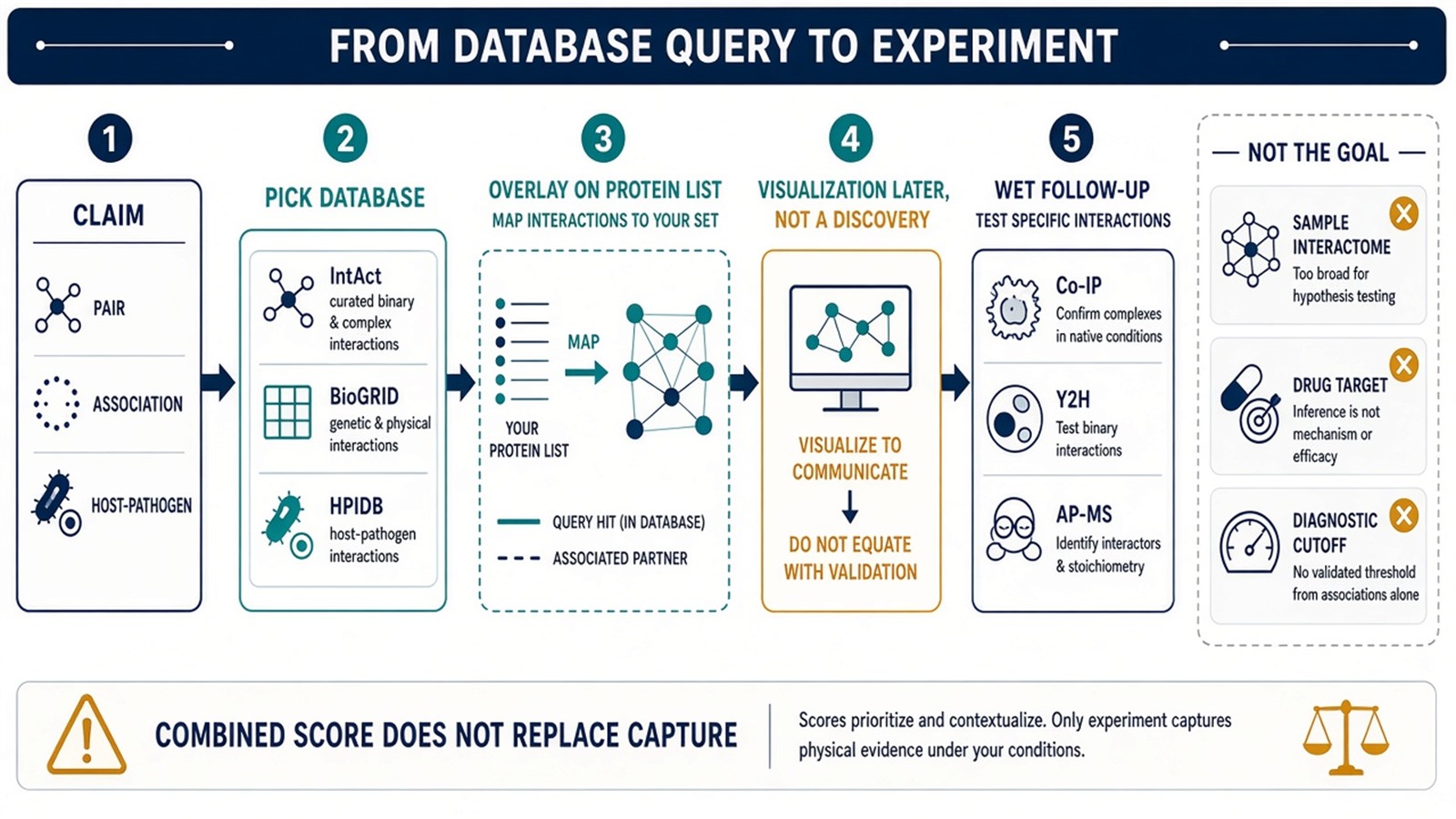
Figure 3. A database query ranks prior records. Overlay and visualization come next. Co-IP, Y2H, or AP-MS still has to test the edges that will be claimed for this sample.
Experimental Limits
Public PPI databases recycle well-studied hubs, inherit the false-positive structure of Y2H and AP-MS literature, and under-represent membrane and low-abundance proteins. STRING can look complete because it adds inferred edges. Completeness of a picture is not completeness of evidence. Merging BioGRID, IntAct, and STRING into one unlabeled graph produces a denser figure and a weaker sentence. Diagnostic or target-nomination language sits outside ordinary database use unless a separately validated assay framework is in place.
Project Planning and Service Scope
A usable plan names the query protein or list, the record class required, the database that holds that class, and which edges return to a wet assay. MtoZ Biolabs does not replace BioGRID or IntAct. It scopes Co-IP-MS, AP-MS, or related follow-up after a database shortlist is closed, on Orbitrap-class LC-MS/MS when an open partner table is needed. Recovery of a database edge in the current sample still depends on capture chemistry, not on the combined score that nominated the pair.
Once the query, database class, and follow-up assay are defined, the project can be scoped as an experimental PPI study informed by public records. Researchers can review the MtoZ Biolabs Protein-Protein Interaction Analysis Service for project-specific sample evaluation, feasibility assessment, and workflow planning.
Frequently Asked Questions
1. What are protein–protein interaction databases?
They are catalogs of reported protein contacts. Some hold curated experiments. Some hold mixed associations. Some hold specialized or archival sets. They are not measurements in the present lysate.
2. Is STRING an experimental PPI database?
STRING includes experimental records and also prediction, co-expression, and text mining. The combined score is an association confidence, not an experimental validation by itself.
3. Should BioGRID and IntAct be merged with STRING before analysis?
They can be compared. They should not be merged into one unlabeled edge set. Experimental and inferred channels support different sentences.
4. Is BIND still a current PPI database?
BIND is a historical store for protein, compound, and dimer records. Trace a BIND citation into a maintained repository before using it as a live edge.
5. Can a database replace Co-IP or AP-MS for a specific protein?
No. A database can prioritize which partners to test. Co-IP, Y2H, or AP-MS still has to recover those partners in the current system.
Reference
- Oughtred R., Rust J., Chang C., et al. (2021). The BioGRID database: A comprehensive biomedical resource of curated protein, genetic, and chemical interactions. Protein Sci., 30, 187-200. https://doi.org/10.1002/pro.3978
- Del Toro N., Shrivastava A., Ragueneau E., et al. (2022). The IntAct database: efficient access to fine-grained molecular interaction data. Nucleic Acids Res., 50, D648-D653. https://doi.org/10.1093/nar/gkab1006
- Salwinski L., Miller C.S., Smith A.J., et al. (2004). The Database of Interacting Proteins: 2004 update. Nucleic Acids Res., 32, D449-D451. https://doi.org/10.1093/nar/gkh086
- Licata L., Briganti L., Peluso D., et al. (2012). MINT, the molecular interaction database: 2012 update. Nucleic Acids Res., 40, D857-D861. https://doi.org/10.1093/nar/gkr930
- Szklarczyk D., Kirsch R., Koutrouli M., et al. (2023). The STRING database in 2023: protein-protein association networks and functional enrichment analyses for any sequenced genome of interest. Nucleic Acids Res., 51, D638-D646. https://doi.org/10.1093/nar/gkac1000
- Keshava Prasad T.S., Goel R., Kandasamy K., et al. (2009). Human Protein Reference Database—2009 update. Nucleic Acids Res., 37, D767-D772. https://doi.org/10.1093/nar/gkn892
- Ammari M.G., Gresham C.R., McCarthy F.M., Nanduri B. (2016). HPIDB 2.0: a curated database for host-pathogen interactions. Database, 2016, baw103. https://doi.org/10.1093/database/baw103
- Bader G.D., Betel D., Hogue C.W. (2003). BIND: the Biomolecular Interaction Network Database. Nucleic Acids Res., 31, 248-250. https://doi.org/10.1093/nar/gkg056
