



Quantitative protein analysis by liquid chromatography-tandem mass spectrometry (LC-MS/MS) starts before the instrument run. Sample type, lysis chemistry, cleanup, and digestion decide whether later peptide signals can support a relative comparison or a stable isotope-labeled internal standard (SIS) amount (Bantscheff et al. 2012). The guide below focuses on sample handling and pretreatment for quantitative work. It is not a disease-application catalog, not a method-definition encyclopedia, and not a bulk dye-assay tutorial.
Pretreatment still has to match the planned labeling and acquisition route. Unlabeled digests can be acquired as data-dependent acquisition (DDA) or data-independent acquisition (DIA). Isobaric tandem mass tag (TMT) work needs amine-compatible peptides before channel mixing. Named proteins followed by parallel reaction monitoring (PRM) or multiple reaction monitoring (MRM) still need clean digests and a scheduleable peptide list. In MtoZ Biolabs offerings, unlabeled discovery is commonly run as DDA label-free or DIA, multiplexed isobaric work is typically evaluated as TMT, and closed lists are typically followed by PRM, with MRM when a scheduled triple-quadrupole panel already exists.
Sample Types That Enter Quantitative Protein Analysis
Common quantitative inputs include cultured cells, tissues, plasma or serum, other biofluids, and purified protein fractions. Each matrix changes detergent needs, depletion or enrichment choices, and how much material is required for a matched digest.
Cells often accept detergent or urea lysis with controlled reduction and alkylation. Tissues usually need mechanical disruption plus the same denaturation chemistry, with debris removal before digestion. Plasma and serum often require abundant-protein depletion or fractionation before deep discovery, and they rarely fit metabolic labeling such as SILAC. Purified fractions can support targeted confirmation when the protein list is already short.
Sample type sets the first pretreatment bound: what can be lysed, depleted, or labeled without destroying the later quantitative claim.
Bulk Bradford, bicinchoninic acid (BCA), Lowry, and 280 nm assays help match total protein input. They do not replace peptide-level quantification after digestion.
Pretreatment Steps That Protect Quantitative Comparability
Quantitative comparability depends on matched steps across the cohort, not on a single aggressive lysis recipe.
Lysis and denaturation. Groups should share the same buffer family, protease inhibitors when needed, and reduction or alkylation timing. Filter-aided or detergent-compatible workflows help remove chaotropes and detergents that suppress LC-MS before trypsin digestion (Wisniewski et al. 2009).
Cleanup and digestion. Peptide yield must stay comparable after solid-phase or StageTip-style cleanup (Rappsilber et al. 2007). Incomplete digestion, over-digestion, or group-specific cleanup losses create fold changes that look biological.
Optional labeling and SIS timing. TMT labels free amines on peptides after digestion, so residual primary amines in the buffer compete with labeling. SIS peptides, when used for amount claims, need a declared spike point relative to digestion and cleanup (Gerber et al. 2003).
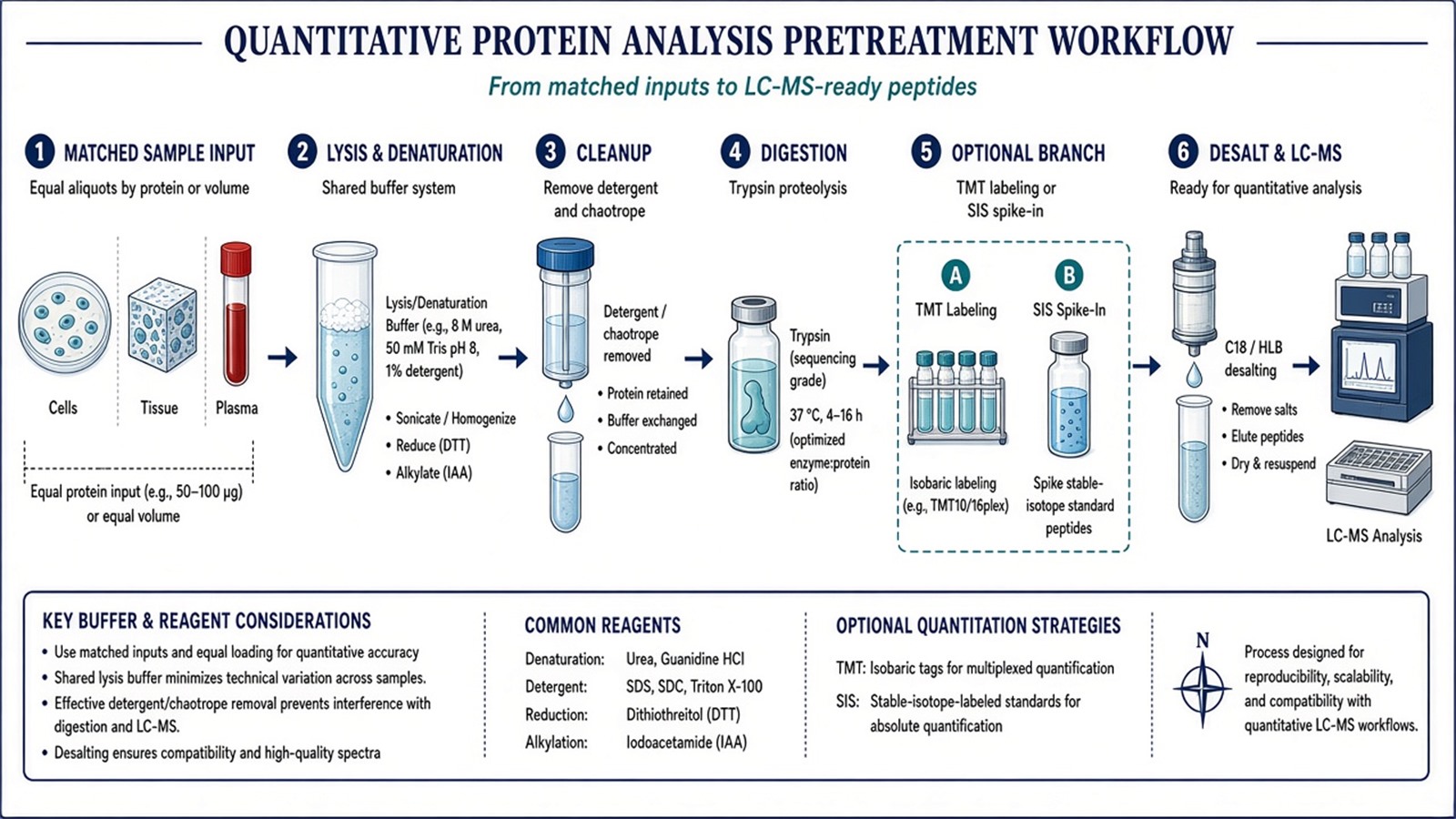
Figure 1. Quantitative protein analysis pretreatment keeps lysis, cleanup, and digestion matched across groups before optional labeling or SIS and LC-MS.
Researchers who need signal-type definitions after pretreatment is fixed can refer to What Are the Quantitative Methods for Proteomics?.
Shared Workflow from Sample Receipt to Digest
A practical pretreatment spine for quantitative protein analysis usually runs as follows.
- Confirm matrix, group map, and the intended claim (relative ratio or SIS amount).
- Aliquot matched wet weight, cell count, or total protein input after a load assay.
- Lyse or extract under one declared chemistry, then clarify debris.
- Reduce, alkylate, and digest under shared enzyme-to-substrate and time rules.
- Clean peptides; add TMT channels or SIS only when the design requires them.
- Desalt, dry, and resuspend for LC-MS/MS under the chosen acquisition mode.
Where samples diverge matters. Unlabeled designs keep each digest on its own injection after pretreatment. TMT mixes labeled digests after the labeling step. Targeted designs freeze the peptide list after discovery or prior knowledge, but they still need the same cleanup quality as discovery digests.
Order errors erase power early. Unequal input, treatment-confounded lysis batches, amine-rich buffers before TMT, or SIS spiked after an incomplete digest can break the claim before acquisition starts.
Parameters and Limits in Sample Preparation
Parameter |
Why it matters |
Failure mode if ignored |
|---|---|---|
Matched input (mass, cells, or total protein) |
Keeps peptide yield comparable |
Apparent fold changes from load bias |
Detergent or chaotrope removal |
Protects chromatography and ionization |
Suppressed peaks and unstable retention |
Digestion completeness |
Stabilizes peptide stoichiometry |
Missed cleavages that track groups |
Amine-free buffer before TMT |
Allows channel labeling |
Incomplete reporters and soft ratios |
SIS spike timing and stock assignment |
Supports amount claims |
Relative peaks read as concentration |
Shared cleanup recovery |
Limits group-specific losses |
Systematic missingness by treatment |
Limits follow the same table. Harsh lysis that differs by group is not a sensitivity upgrade. Plasma depletion that is applied to only one arm is not enrichment. TMT cannot rescue unlabeled late harvests as extra channels. Targeted pretreatment does not invent peptides outside the inclusion list. Ordinary discovery intensities after cleanup are still not ng per mL without SIS and calibration.
Missing values later in the matrix often begin as pretreatment dropout, not only as acquisition chance (Lazar et al. 2016). Pathway enrichment cannot repair that upstream bias.
Choosing Pretreatment for the Next Project
Use matrix, mixability, and claim unit to choose the pretreatment path.
Project need |
Pretreatment path that often fits |
Recheck before committing |
|---|---|---|
Cells or tissue, open enrollment |
Matched unlabeled lysis and digest; separate injections |
Run order identical to treatment |
Full set freezable now |
Matched digest plus TMT labeling and mix |
Amine carryover; later unlabeled files |
Plasma or serum discovery |
Depletion or fractionation plus matched digest |
Depletion applied to only one group |
Named peptides to remeasure |
Clean digest supporting a PRM or MRM panel |
Oversized panel; poor unique peptides |
Mass or molar unit required |
Matched digest plus assigned SIS and calibration |
Spike after incomplete digestion |
Only total load matching |
Bulk dye or A280 assay |
Not peptide-level quantitative analysis |
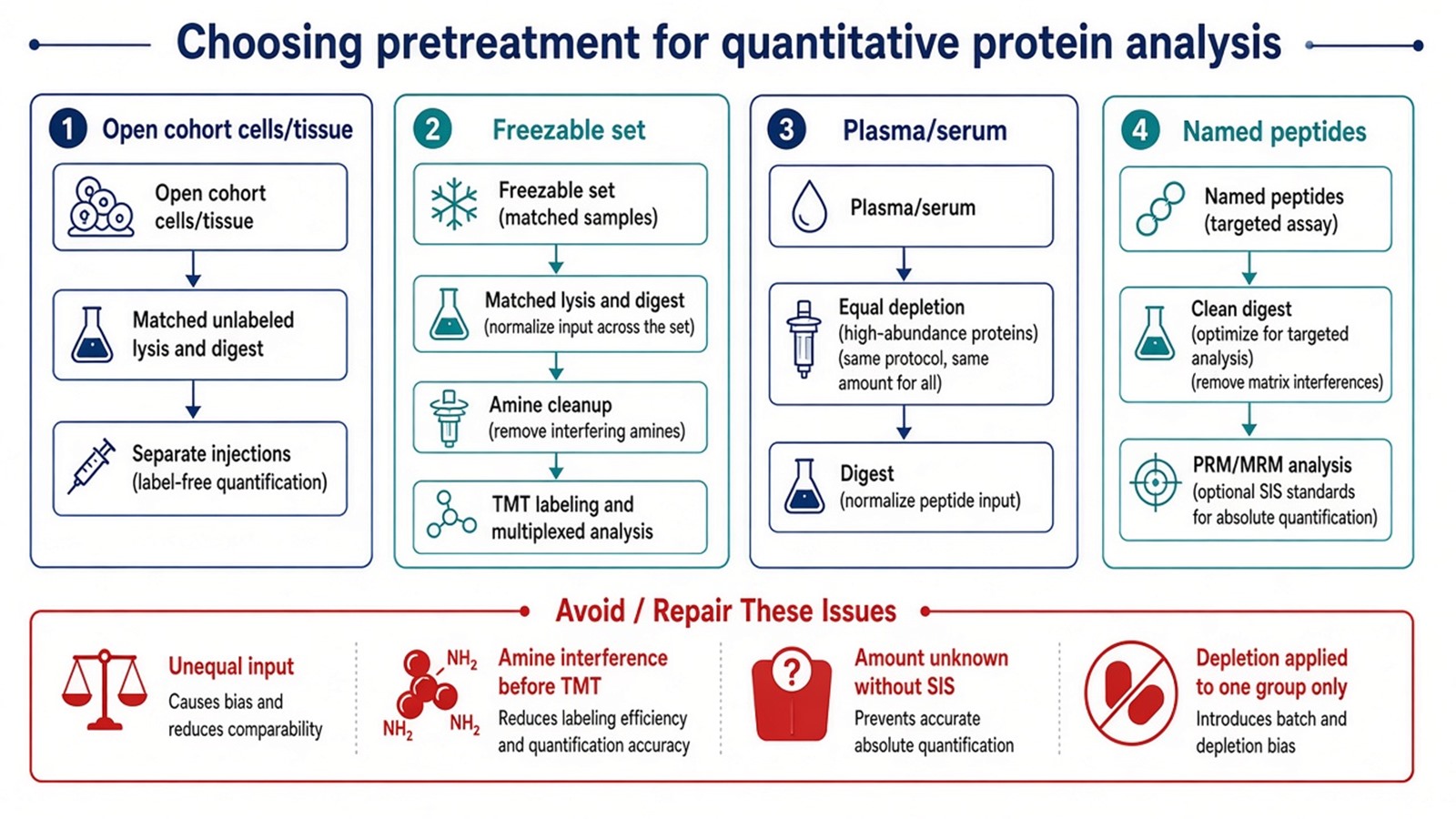
Figure 2. Choose pretreatment from matrix and claim unit; unequal input, amine interference, and amount-without-SIS requests need repair first.
Unlabeled pretreatment more often fits open cohorts. TMT pretreatment more often fits a freezable multi-group set after amine cleanup. Targeted confirmation more often fits after names freeze and digests stay clean. Exceptions exist when a tiny validated panel never needed discovery, or when a short closed cohort must share one injection to limit run-order drift.
Researchers who need labeling-versus-acquisition selection after pretreatment is clear can refer to Protein Quantification Method. For TMT-specific labeling chemistry after the digest is ready, see What Is TMT Isobaric Labeling?. Teams that already have matrix, group design, and a requested claim can also review the MtoZ Biolabs Quantitative Proteomics Service for project-specific sample-preparation planning.
Frequently Asked Questions
1. Is a bulk protein assay enough for quantitative protein analysis?
No. Bulk assays help match input before digestion. Peptide-level LC-MS/MS quantification still requires matched pretreatment and a declared quantitative claim.
2. Can one lysis buffer serve every matrix in a cohort?
Only when every sample truly belongs to that matrix family. Mixing tissue and plasma under one recipe without a declared adaptation usually breaks comparability.
3. When should SIS be spiked during pretreatment?
Spike timing must be declared with the amount claim. Many assays spike after digestion and before or after cleanup. Spiking into an incomplete or group-biased digest does not create a valid concentration.
4. Does depletion always improve quantitative plasma work?
No. Depletion can help deep discovery when applied equally across groups. Unequal depletion creates artificial contrasts.
5. Do unlabeled and TMT projects share the same pretreatment spine?
They share lysis, digestion, and cleanup principles. TMT adds amine-compatible labeling and mixing after digestion. Unlabeled designs keep digests on separate injections.
MtoZ Biolabs can support quantitative protein analysis pretreatment across unlabeled DDA or DIA discovery, TMT relative plexes, and targeted PRM or MRM follow-up when sample type, study design, and the intended claim are available.
If further evaluation of matrix-matched lysis, depletion needs, labeling compatibility, or SIS spike planning is needed, project details can be submitted for a feasibility review.
Reference
- M. Bantscheff, S. Lemeer, M.M. Savitski, B. Kuster (2012). Quantitative mass spectrometry in proteomics: critical review update from 2007 to the present. Anal. Bioanal. Chem., 404, 939-965. https://doi.org/10.1007/s00216-012-6203-4
- S.A. Gerber, J. Rush, O. Stemman, M.W. Kirschner, S.P. Gygi (2003). Absolute quantification of proteins and phosphoproteins from cell lysates by tandem MS. Proc. Natl. Acad. Sci. U.S.A., 100, 6940-6945. https://doi.org/10.1073/pnas.0832254100
- C. Lazar, L. Gatto, M. Ferro, C. Bruley, T. Burger (2016). Accounting for the multiple natures of missing values in label-free quantitative proteomics data sets to compare imputation strategies. J. Proteome Res., 15, 1116-1125. https://doi.org/10.1021/acs.jproteome.5b00981
- J. Rappsilber, M. Mann, Y. Ishihama (2007). Protocol for micro-purification, enrichment, pre-fractionation and storage of peptides for proteomics using StageTips. Nat. Protoc., 2, 1896-1906. https://doi.org/10.1038/nprot.2007.261
- J.R. Wisniewski, A. Zougman, N. Nagaraj, M. Mann (2009). Universal sample preparation method for proteome analysis. Nat. Methods, 6, 359-362. https://doi.org/10.1038/nmeth.1322
