

Principle of PCT-DIA Proteomics
Pressure cycling technology (PCT) and data-independent acquisition (DIA) are two separable layers in proteomics. PCT uses rapid high-low pressure cycles in a controlled vessel to disrupt cells or tissues and improve protein release into a lysis buffer (Guo et al. 2015). DIA acquires windowed MS/MS on liquid chromatography-tandem mass spectrometry (LC-MS/MS) injections and quantifies peptides by extracted fragment traces under false discovery rate (FDR) control (Gillet et al. 2012). PCT-DIA in project language means PCT-based prep upstream of label-free DIA or SWATH-style acquisition, not a single vendor mode name on the mass spectrometer. The guide below defines each part, shows how they connect, and states limits and project fit. It is not a Barocycler manual, not a DDA versus DIA essay, and not a claim that PCT is required for every DIA study.
PCT changes lysis and extraction efficiency. DIA changes acquisition and extraction statistics. Quantification still needs matched chemistry across contrast arms, a frozen group map, and documented missing-value policy after search (Rosenberger et al. 2017).
In MtoZ Biolabs offerings, DIA discovery is commonly run on label-free digests after a declared prep route. PCT may be evaluated when tough tissues, low input, or reproducible mechanical lysis in sealed vessels is part of the agreed sample plan.
What Pressure Cycling Technology Means in Proteomics Prep
PCT applies repeated pressure pulses to samples held in a sealed chamber with buffer and often mechanical beads. Cycles can improve disruption of fibrous tissue, dense matrices, or samples where manual homogenization varies by operator.
PCT is a sample-prep principle, not a quantification readout. Output is protein extract that still must move through reduction, alkylation, digestion, cleanup, and desalting under rules shared across groups (Wisniewski et al. 2009).
PCT does not replace contrast design. It does not label peptides. It does not set DIA window widths.
PCT belongs in the methods record under lysis and extraction, not under acquisition or FDR.
What DIA Quantification Means Separately from PCT
DIA divides the precursor m/z range into windows and fragments ions within each window on each cycle while peptides elute. Sequential window acquisition of all theoretical fragment ion spectra (SWATH) is one common window plan.
Quantification comes from library-based or library-free extraction of fragment chromatograms, normalization, and testing of a predefined relative contrast (Demichev et al. 2020). Relative discovery is the default claim. Amount on named peptides needs stable isotope-labeled internal standard (SIS) targeted assays, not open DIA intensities alone (Gerber et al. 2003).
DIA acquisition does not fix prep batch effects. Unequal digestion after PCT still creates missing values that track treatment (Lazar et al. 2016).
General DIA and SWATH program framing appears in SWATH Proteomics and SWATH Mass Spec. Extraction principles appear in DIA Data Analysis Methods in Proteomics.
How PCT-DIA Is Defined in a Project Methods Record
A clear PCT-DIA record names both scopes.
PCT scope lists vessel type, pressure-cycle program, buffer, bead use, temperature control, and input mass or cell count limits tested in pilot material.
DIA scope lists gradient, window table, cycle time, run-order plan, extractor, FDR model, and contrast arms frozen before threshold tuning.
Handoff criteria state when extract is considered digestion-ready. Changing PCT cycles mid cohort splits prep comparability even when DIA settings stay fixed.
PCT-DIA is matched PCT prep plus label-free DIA on separate injections with one declared contrast, not PCT performed without downstream quant rules.
Researchers who need standard lysis without PCT can refer to Quantitative Protein Analysis and SWATH MS Analysis.
Shared Workflow From PCT Lysis to DIA Matrix
A practical PCT-DIA spine usually runs as follows.
- Confirm matrix, contrast, relative claim, and whether PCT is in prep scope.
- Load sample, buffer, and beads; run declared PCT cycle program; collect extract.
- Reduce, alkylate, and digest under shared rules across all arms.
- Clean and desalt to injection-ready peptide loads; record yield QC.
- Pilot LC-MS when PCT or digestion is new for the matrix.
- Acquire DIA or SWATH-style windows under a locked plan.
- Extract peptides under FDR control; normalize; test predefined contrast only.
- Optional parallel reaction monitoring (PRM) on a short list after discovery.
Steps 2 through 4 define PCT-DIA prep differentiation. Steps 6 through 7 are standard label-free DIA analysis layers.
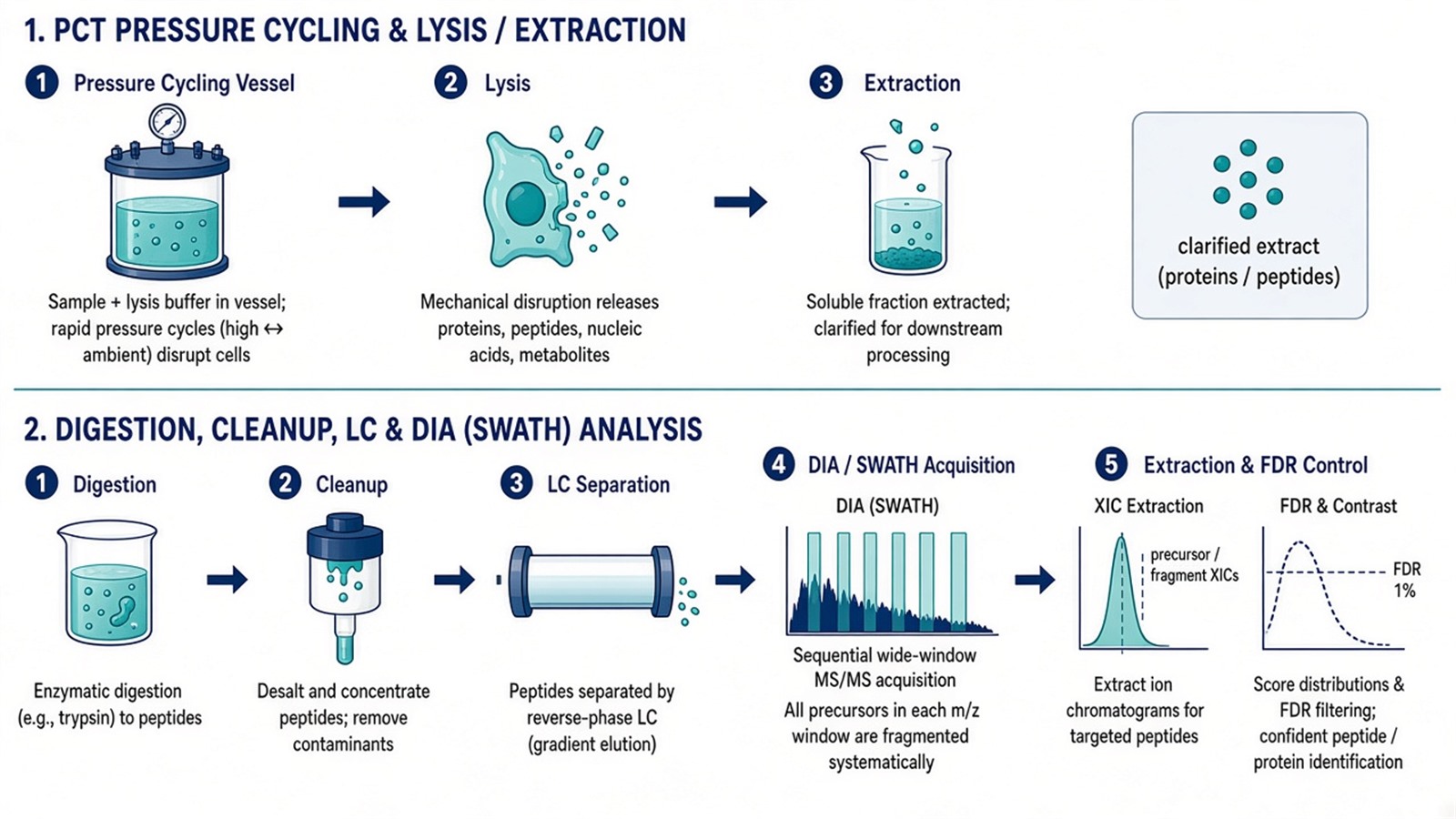
Figure 1. PCT-DIA couples declared PCT prep to label-free DIA quantification rules; neither step replaces contrast design.
Route selection across labeling and acquisition appears in Protein Quantification Method. Staged discovery and PRM appear in Application of DIA-PRM Proteomics.
Parameters and Limits in PCT-DIA Projects
Topic |
PCT prep sensitivity |
DIA layer sensitivity |
|---|---|---|
Input mass |
Low microgram pilots need yield QC |
Load affects ion statistics |
Cycle program |
Over- or under-lysis changes yield |
Unrelated to window width |
Buffer compatibility |
Must suit downstream digestion |
Salt and detergent carryover harm LC |
Matched arms |
Same PCT program per contrast |
Same window plan per cohort |
Batch tracking |
PCT run batch versus biology |
Injection order versus group |
Claim unit |
Prep only |
Relative matrix default |
Limits follow the same table. PCT-DIA does not automatically increase proteome depth in every matrix. PCT adds equipment and cycle optimization cost. DIA still misses low-abundance peptides when load, interference, or library mismatch limit extraction. FFPE, plasma depletion, and fractionation remain separate decisions from PCT itself.
Isobaric tagging fits closed same-day sets as a different chemistry path from label-free PCT plus DIA. Multi-omics overlay interprets contrasts. It does not replace matched prep.
How to Choose PCT-DIA Versus Standard Prep Plus DIA
Use matrix difficulty, input amount, and enrollment together.
Project need |
Plan that often fits |
Recheck before committing |
|---|---|---|
Fibrous or tough tissue |
PCT lysis pilot then DIA |
Manual homogenization varies by arm |
Low microgram tissue input |
PCT with yield QC then DIA |
DIA without load-matched digests |
Standard cultured cells |
Conventional lysis plus DIA |
Forced PCT without matrix need |
Open cohort, staggered files |
Label-free DIA after matched prep |
Mid-cohort PCT program change |
Short list after discovery |
Same prep path, then PRM |
Discovery intensities as final assay |
Closed multiplex same day |
TMT route, not default PCT-DIA label-free |
Tagging mixed with open DIA contrast |
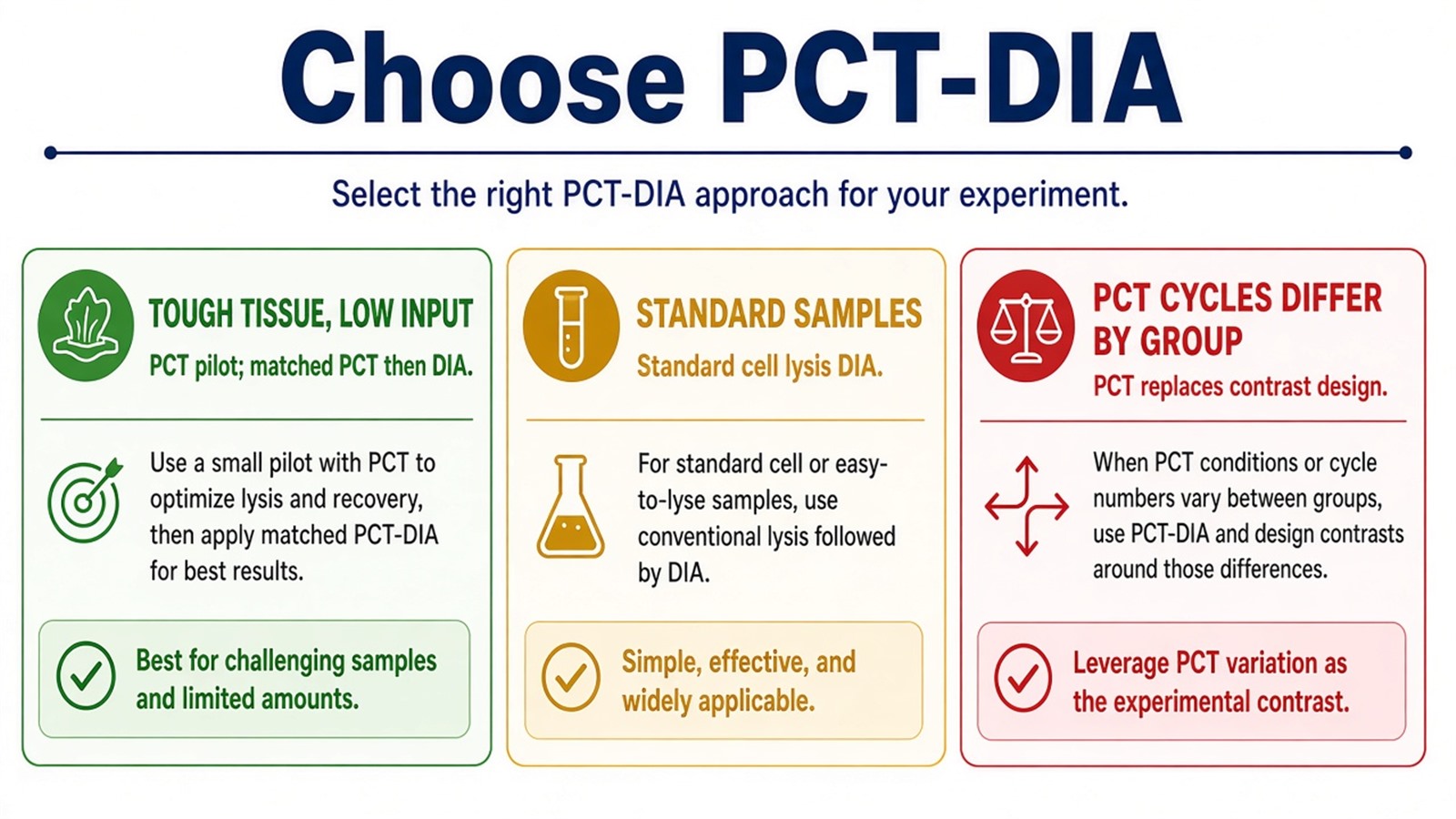
Figure 2. Choose PCT-DIA when PCT prep is justified by matrix or input; DIA contrast, window lock, and FDR rules apply either way.
Teams that already have matrix, input limits, contrast, and prep route can review the MtoZ Biolabs Label-Free Quantitative Proteomics Service for DIA planning with or without PCT in prep scope.
Frequently Asked Questions
1. Is PCT-DIA a new acquisition mode on the mass spectrometer?
No. PCT is prep. DIA is acquisition and extraction. The name describes a combined workflow.
2. Must all DIA projects use PCT?
No. Many matrices use conventional lysis plus cleanup before DIA.
3. Does PCT improve DIA FDR by itself?
No. FDR control sits in extraction software. PCT only affects extract quality and yield.
4. Can PCT cycles differ by treatment group?
Only when pressure program is the experimental variable. Otherwise matched PCT settings are required.
5. Is PCT-DIA the same as PCT-SWATH?
SWATH is a windowed DIA plan. PCT-SWATH and PCT-DIA share prep logic; the acquisition table must still be declared.
MtoZ Biolabs can discuss PCT-DIA feasibility when matrix type, input amount, contrast design, and intended relative claim are documented.
If further evaluation of PCT pilot yield, digestion after PCT, window locking, or discovery-to-targeted staging is needed, project details can be submitted for a feasibility review.
Reference
- T. Guo, P. Kouvonen, C.C. Koh, L.C. Gillet, W. Wolski, H.L. Röst, J. Rosenberger, R. Collins, S. Blum, K. Gillessen, H. Joost, R. Aebersold (2015). Rapid mass spectrometric conversion of tissue biopsy samples into permanent quantitative digital proteome maps. Nat. Med., 21, 407-413. https://doi.org/10.1038/nm.3807
- L.C. Gillet, P. Navarro, S. Tate, H. Rost, N. Selevsek, L. Reiter, R. Bonner, R. Aebersold (2012). Targeted data extraction of the MS/MS spectra generated by data-independent acquisition: a new concept for consistent and accurate proteome analysis. Mol. Cell. Proteomics, 11, O111.016717. https://doi.org/10.1074/mcp.O111.016717
- V. Demichev, C. Messner, S. Vernardis, K.S. Lilley, M. Ralser (2020). DIA-NN: neural networks and interference correction enable deep proteome coverage in high throughput. Nat. Methods, 17, 41-44. https://doi.org/10.1038/s41592-019-0638-x
- C. Lazar, L. Gatto, M. Ferro, C. Bruley, T. Burger (2016). Accounting for the multiple natures of missing values in label-free quantitative proteomics data sets to compare imputation strategies. J. Proteome Res., 15, 1116-1125. https://doi.org/10.1021/acs.jproteome.5b00981
- G. Rosenberger, S. Liu, J. Röst, H.L. Ludwig, C. Buil, B. Borchers, R. Aebersold, L. Collins (2017). Statistical control of peptide and protein error rates in large-scale targeted data-independent acquisition analyses. Nat. Commun., 8, 14224. https://doi.org/10.1038/ncomms14224
- J.R. Wisniewski, A. Zougman, N. Nagaraj, M. Mann (2009). Universal sample preparation method for proteome analysis. Nat. Methods, 6, 359-362. https://doi.org/10.1038/nmeth.1322
Support Documents
DIA-Based Quantitative Proteomics Service
Discover how DIA-based quantitative proteomics can support comprehensive protein profiling and comparative studies by downloading our service overview.
