



Parallel reaction monitoring mass spectrometry (PRM-MS) is the targeted LC-MS/MS detection mode that isolates scheduled peptide precursors, fragments them, and records high-resolution product-ion spectra for quantitative extraction (Peterson et al. 2012). In project language, PRM-MS names the mass spectrometry layer of a closed-panel assay, not a discovery search and not an intact-protein measurement. Selected reaction monitoring (SRM) and multiple reaction monitoring (MRM) record one predefined transition per dwell on a triple quadrupole (Lange et al. 2008). PRM-MS stores a product-ion spectrum so fragments can be reviewed after acquisition (Gallien et al. 2012). The guide below integrates PRM-MS with workflow, locked parameters, limits, and project fit. It is not an Orbitrap-only catalog, not a claim that PRM-MS works without study design or standards when amount is required, and not a disease biomarker tour.
PRM-MS peak groups support relative change of predefined peptides across frozen groups. Amount on named peptides needs stable isotope-labeled internal standard (SIS) peptides and a calibration model in the study matrix (Gerber et al. 2003). High resolving power improves fragment assignment. It does not by itself raise sensitivity in every matrix or create a diagnostic cutoff.
In MtoZ Biolabs targeted offerings, PRM-MS methods are built on high-resolution LC-MS/MS platforms when the peptide panel is closed and scheduling fits the cohort block. Service intake appears in Parallel Reaction Monitoring (PRM) Service.
What PRM-MS Detection Covers in a Targeted Record
Four detection layers belong in the brief.
Isolation scope schedules a precursor m/z window at a declared retention time. Only peptides on the inclusion list are isolated.
Fragmentation scope uses a collision cell to generate product ions from that precursor.
Analyzer scope records a high-resolution MS/MS spectrum of those product ions in one cycle. Quantification uses extracted fragment ion chromatograms, not a proteome-wide intensity matrix.
Claim scope is relative peptide change, or calibrated amount when SIS and a curve are declared. Protein inference still depends on surrogate uniqueness (Bantscheff et al. 2012).
PRM-MS detects scheduled precursors and their product ions in parallel. It does not profile unnamed proteins from the same file.
PRM-MS Versus SRM/MRM and Versus Discovery MS
Scan mode and instrument class should be chosen separately from the project question.
SRM and MRM on triple quadrupole LC-MS/MS pass a prechosen product ion. Method lock includes transition lists and dwell times. PRM-MS fits when post-acquisition fragment review is needed after matrix-matched MRM interference. Route choice after matrix pilot appears in Parallel Reaction Monitoring vs MRM: Which Fits?.
Quadrupole-Orbitrap systems are common PRM-MS hardware. Equivalent full-scan product-ion targeting can run on other high-resolution platforms. Naming one analyzer family does not define the scientific claim.
Discovery data-dependent acquisition (DDA) or data-independent acquisition (DIA) mass spectrometry profiles an open or semi-open list. PRM-MS is the follow-up scan after candidates are named. PRM principle language appears in From Principles to Applications: A Comprehensive Overview of PRM Technology.
Post-translational modification (PTM) detection in PRM-MS requires the modified peptide on the closed list and, for many sites, enrichment. Unenriched PRM-MS files do not map phosphorylation, acetylation, or glycosylation by default.
End-to-End Workflow From PRM-MS Acquisition to a Contrast Table
A practical PRM-MS spine usually runs as follows.
- Freeze contrast, replicates, and relative versus amount claim.
- Close the peptide panel and map each peptide to its protein or site.
- Match extraction, digest, and load across all contrast arms.
- Build inclusion lists with retention windows and realistic cycle time.
- Lock isolation width, collision energy, resolution, and fill-time rules.
- Acquire scheduled PRM-MS with quality control (QC) pools when design allows.
- Extract product-ion chromatograms; review interference across multiple fragments.
- Normalize or apply SIS calibration as declared; test predefined contrast only.
- Archive instrument method, panel version, and software with deliverables.
Steps 1 through 3 protect the sample record. Steps 4 through 9 are the PRM-MS detection and informatics record.
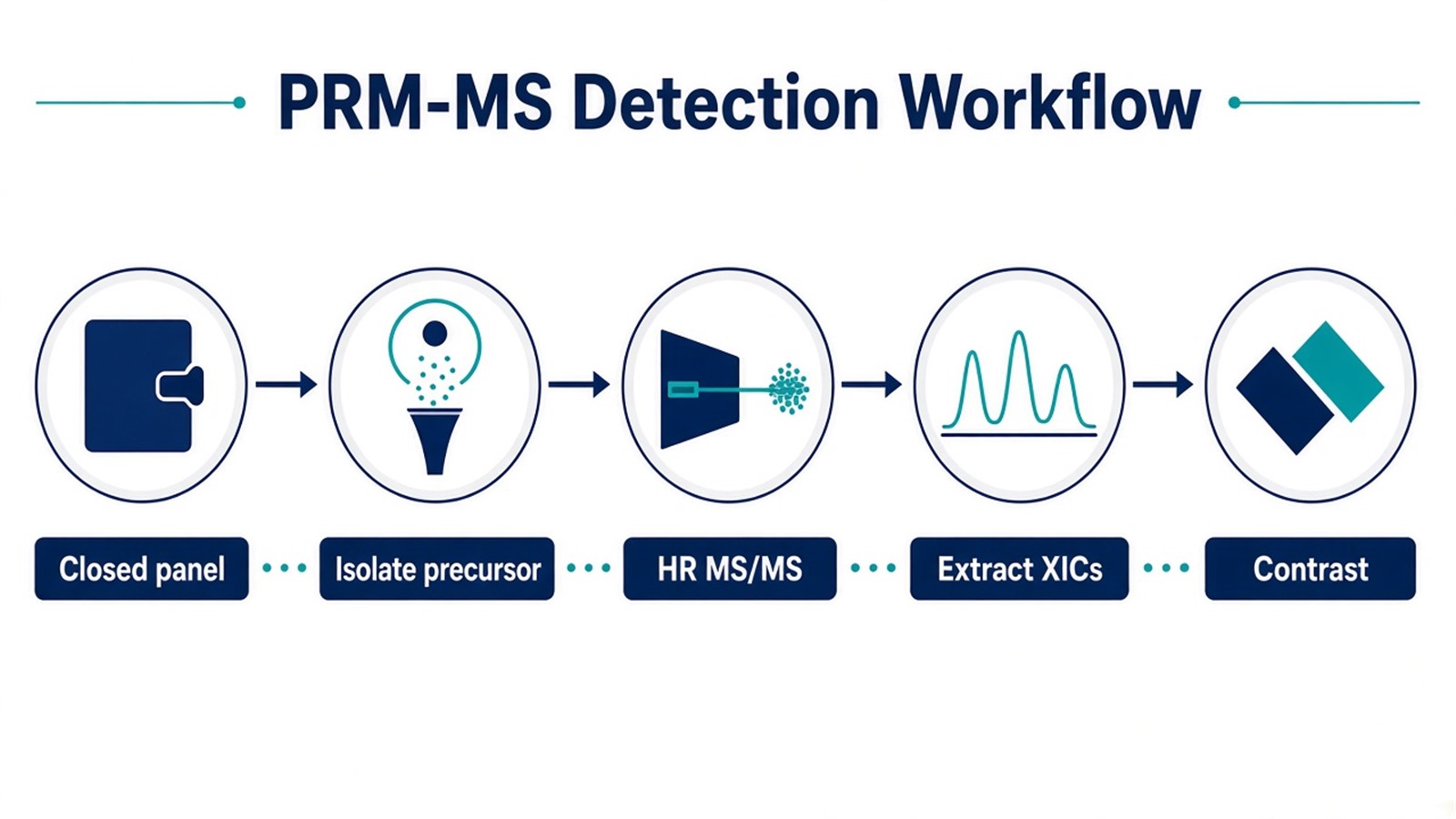
Figure 1. PRM-MS comparability depends on locked isolation and product-ion extraction after matched pretreatment.
PRM-MS Parameters That Must Be Locked
Layer |
Parameter that must be declared |
Failure mode if ignored |
|---|---|---|
Panel |
Peptide list version and protein mapping |
Moving targets mid study |
Isolation |
Precursor m/z window and retention gate |
Co-isolation or missed peaks |
MS/MS |
Collision energy, resolution, fill time |
Fragment yield or cycle drift |
Schedule |
Concurrent precursors versus peak width |
Undersampled chromatograms |
Fragments |
Extraction rules after review |
One noisy ion as the only metric |
Prep |
Matched digest and load |
Peptide-pool shift as biology |
SIS |
Spike step aligned to claim |
Relative peaks as concentration |
QC |
Pools, blanks, and bracket pattern |
Undetected source or analyzer drift |
Contrast |
Frozen before peak review |
Post hoc panel edits |
Software |
Extraction version archived |
Non-reproducible peak groups |
Limits follow the same table. PRM-MS does not remove ion suppression in plasma or tissue. Parallel product-ion recording does not mean multiplex sample mixing in one injection. Low-abundance detection still depends on load, chromatography, and missingness. Clinical diagnosis or drug-target validation needs separate study design.
How to Choose PRM-MS Versus Other Mass Spectrometry Routes
Use list status, interference evidence, hardware class, and claim unit together.
Project need |
MS route that often fits |
Recheck before committing |
|---|---|---|
Closed peptides, need fragment review |
PRM-MS on high-resolution LC-MS/MS |
Open DDA as the targeted table |
Clean transitions on triple quadrupole |
SRM or MRM LC-MS/MS |
Force PRM-MS without interference |
Open proteome relative profiling |
Discovery DDA, DIA, or LFQ MS |
PRM-MS on unnamed proteins |
Amount on named peptides |
PRM-MS or MRM with SIS and curve |
Light-only PRM-MS as concentration |
PTM site on the closed list |
PRM-MS after declared enrichment |
Unenriched file as PTM map |
Mobility platform and closed list |
4D-PRM-MS after mobility pilot |
4D naming without mobility lock |
Antibody already answers the epitope |
Keep immunoassay in parallel |
PRM-MS as automatic replacement |
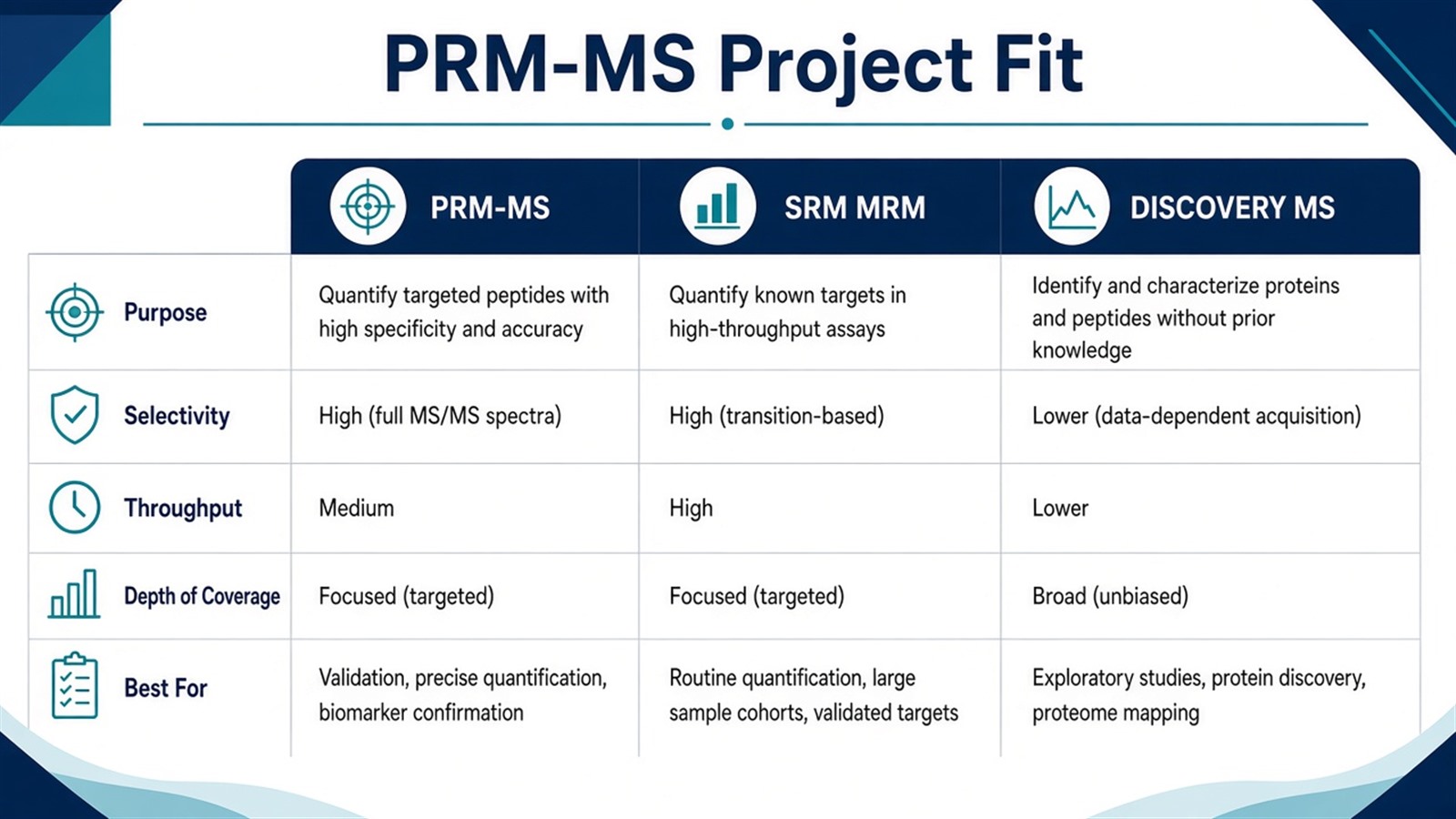
Figure 2. Choose PRM-MS when a closed peptide list needs scheduled high-resolution product-ion detection; keep MRM or discovery MS when list status or transitions say so.
Teams with closed peptide targets, instrument class notes, and contrast maps can review MtoZ Biolabs Parallel Reaction Monitoring (PRM) Service when those fields are declared in the project record.
Frequently Asked Questions
1. Is PRM-MS the same as PRM?
Yes. PRM-MS emphasizes the mass spectrometry detection layer. The assay still needs a closed panel, matched pretreatment, and a frozen contrast.
2. Does PRM-MS work without internal standards?
Relative contrasts can run light-only when that claim is declared. SIS and a curve become necessary when amount units are required. High-resolution MS/MS does not replace calibration.
3. Must PRM-MS use an Orbitrap analyzer?
PRM-MS needs high-resolution product-ion readout after isolation. Several LC-MS/MS platforms implement that pattern. Analyzer brand does not replace panel design.
4. Can PRM-MS quantify many proteins in one experiment without a list?
No. Parallel names product-ion recording for each scheduled precursor. Proteins not on the inclusion list are not quantified.
5. When should projects stay on SRM/MRM mass spectrometry?
When matrix-matched transitions are already stable on a triple quadrupole and post-acquisition fragment review is not required, SRM or MRM remains the matching scan mode.
MtoZ Biolabs can discuss PRM-MS scoping when peptide panel, isolation method, and contrast design are documented.
If further evaluation of PRM-MS versus MRM, SIS calibration, or discovery-to-PRM handoff is needed, project details can be submitted for a feasibility review.
Reference
- A.C. Peterson, J.D. Russell, A.A. Klammer, P.F. Doubleday, H. Liu, J.N. Anderson, M.J. MacCoss (2012). Parallel reaction monitoring for high resolution and high mass accuracy quantitative, targeted proteomics. Mol. Cell. Proteomics, 11, 1475-1488. https://doi.org/10.1074/mcp.O112.020271
- S. Gallien, E. Duriez, A. Crone, M. Kellmann, T. Moehring, T. Domon (2012). Targeted proteomic quantification on quadrupole-orbitrap mass spectrometers. Mol. Cell. Proteomics, 11, 1709-1723. https://doi.org/10.1074/mcp.O112.019232
- V. Lange, P. Picotti, B. Domon, R. Aebersold (2008). Selected reaction monitoring for quantitative proteomics: a tutorial. Mol. Syst. Biol., 4, 222. https://doi.org/10.1038/msb.2008.61
- S.A. Gerber, J. Rush, O. Stemman, M.W. Kirschner, S.P. Gygi (2003). Absolute quantification of proteins and phosphoproteins from cell lysates by tandem MS. Proc. Natl. Acad. Sci. U.S.A., 100, 6940-6945. https://doi.org/10.1073/pnas.0832254100
- M. Bantscheff, S. Lemeer, H.U. Haab, B. Kuster (2012). Quantitative mass spectrometry in proteomics: a critical review. Anal. Bioanal. Chem., 404, 939-965. https://doi.org/10.1007/s00216-012-5892-4
