



Sequential window acquisition of all theoretical fragment ion spectra (SWATH) proteomics is label-free quantitative proteomics in which unlabeled digests are acquired with a windowed data-independent acquisition (DIA) schedule on separate liquid chromatography-tandem mass spectrometry (LC-MS/MS) injections, then quantified by targeted extraction or library-free search under false discovery rate (FDR) control (Gillet et al. 2012). SWATH names the window plan. DIA names the acquisition class. Sample pretreatment, contrast design, and extractor choice still decide whether the resulting matrix supports a predefined relative claim. The guide below integrates SWATH proteomics from project framing through handoff to analysis. It is not a software catalog, not a clinical diagnostic promise, and not a repeat of every matrix-specific prep manual.
Unlabeled SWATH cohorts keep each digest on its own injection path. That pattern fits open enrollment when files may arrive across weeks. It also makes matched prep, locked window plans, unified FDR, and missing-value policy part of one methods record, not optional footnotes (Rosenberger et al. 2017).
In MtoZ Biolabs offerings, SWATH-style schedules are commonly applied to label-free digests for relative discovery contrasts, with targeted follow-up when a short peptide list must be remeasured.
How SWATH Proteomics Relates to DIA and Label-Free Quantification
Three labels appear together in proposals and should stay separated.
Label-free chemistry means no isobaric tag on peptides before injection. Ratios come from extracted fragment intensities across runs after normalization.
DIA acquisition means systematic windowed fragmentation, not intensity-triggered precursor picking alone. SWATH is a common DIA window implementation on many platforms.
Quantitative claim unit means relative contrast across predefined groups by default. Amount on named peptides needs stable isotope-labeled internal standard (SIS) assays or another declared targeted design, not open SWATH intensities alone (Gerber et al. 2003).
SWATH proteomics value for most projects is a contrast-tested relative matrix on matched digests, not proteome coverage keywords without replicate design.
Matrix-specific pretreatment is covered in SWATH MS Analysis and SWATH-MS Label-Free Protein Quantification Technology Analysis. Three-axis chemistry and acquisition selection appears in Protein Quantification Method.
Application and Cohort Patterns That Commonly Use SWATH
SWATH proteomics appears across matrices when the same structural needs repeat.
Large case-control or treatment cohorts with a frozen contrast and many separate injections.
Biofluid or tissue discovery where enrollment may continue after the first acquisition week.
Plant, agricultural, or mouse tissue panels that need unlabeled contrasts across batches when isobaric labeling cannot freeze the same day.
Candidate narrowing before parallel reaction monitoring (PRM) when discovery lists must stay open first.
High-file biomarker-oriented cohorts share enrollment rules with High-throughput SWATH-MS Quantitative Proteomics for Biomarker Discovery. Clinical and oncology framing appears in Typical Applications of DIA-Based Quantitative Proteomics in Clinical Research and DIA Proteomics Services for Cancer Biomarker Discovery at the application layer, not as substitutes for prep and contrast QC on a new cohort.
End-to-End SWATH Proteomics Workflow
A practical SWATH proteomics spine usually runs as follows.
- Confirm matrix, contrast, relative claim, and enrollment rules.
- Prepare matched digests with shared lysis, digestion, and cleanup (Wisniewski et al. 2009).
- Desalt to injection-ready loads; run pilot LC-MS when the route is new.
- Acquire SWATH windows under a locked plan across the cohort.
- Extract peptides by spectral library or library-free search under FDR and interference rules (Demichev et al. 2020).
- Normalize, apply missing-value policy, roll up proteins, test only the predefined contrast.
- Optional pathway overlay or PRM on a short list after QC.
Steps 1 through 3 are pretreatment. Steps 4 through 6 are acquisition and extraction. Step 7 is follow-up design, not automatic confirmation.
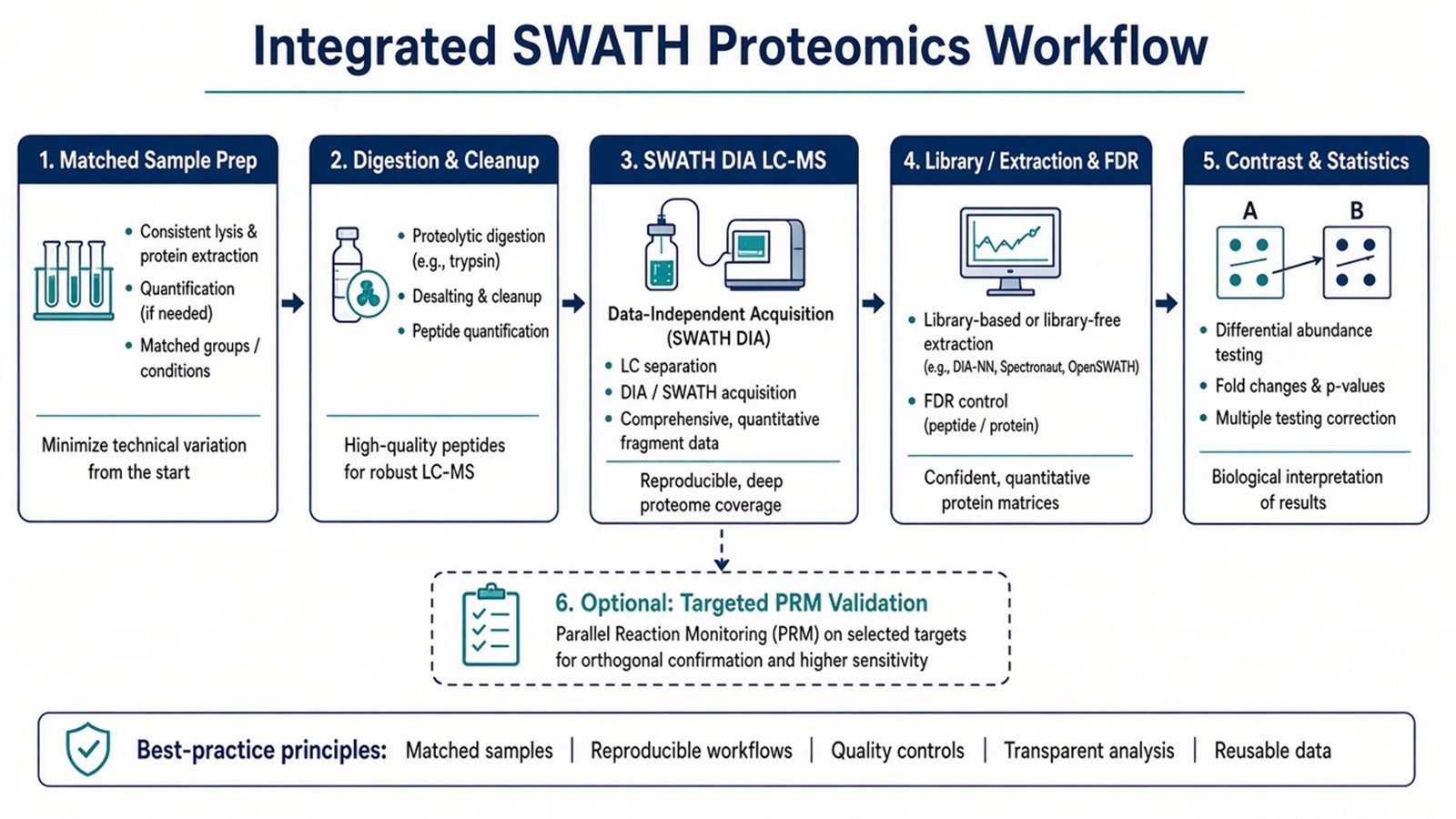
Figure 1. SWATH proteomics integrates matched prep, locked acquisition, and declared extraction before contrast claims.
Library-based extraction operations are outlined in Quantitative Analysis of SWATH Proteomics Using OpenSWATH: A Complete Workflow Overview. General extraction and matrix statistics belong with DIA Data Analysis Methods in Proteomics.
Parameters and Limits Across SWATH Proteomics Projects
Stage |
Parameter or decision |
Why it matters |
Failure mode if ignored |
|---|---|---|---|
Prep |
Matched input and cleanup |
Keeps peptide yield comparable |
Load bias mimics biology |
Design |
Contrast frozen before search |
Separates discovery from relabeling |
Post hoc arm merges |
Acquisition |
Window plan locked to cohort |
Keeps extraction valid |
Mid-study window changes |
Acquisition |
Run-order interleaving |
Separates batch from group |
Injection day tracks treatment |
Extraction |
One declared extractor version |
Keeps matrices comparable |
Mixed pipelines mid cohort |
Extraction |
Unified FDR model |
Controls peptide error rate |
Per-file cutoffs that drift |
Analysis |
Missing-value policy |
Handles low-abundance dropout |
Imputed gaps without evidence |
Follow-up |
PRM or SIS when required |
Separates discovery from deployment |
Discovery p-values as final assay |
Limits follow the same table. SWATH proteomics does not ensure every low-abundance protein in every matrix. Retrospective reanalysis still needs a declared extractor and contrast. Mobility-enhanced 4D-DIA is a related route when ion mobility is available; labeling rules for that path appear in Is Labeling Required for 4D-DIA Quantitative Proteomics. Closed-list confirmation compares with 4D-DIA vs 4D-PRM: Which 4D Quantitative Approach Suits Your Project Better when mobility platforms are in scope.
Isobaric tandem mass tag (TMT) may fit a freezable multi-arm set labeled the same day. Open SWATH more often fits staggered enrollment on separate injections. Missing values often track prep loss and abundance, not only window width (Lazar et al. 2016).
How to Choose SWATH Proteomics for the Next Project
Use list status, enrollment, and follow-up goal together.
Project need |
SWATH proteomics plan that often fits |
Recheck before committing |
|---|---|---|
Open inventory, relative contrast |
Label-free SWATH with locked extractor |
Contrast undefined before acquisition |
Many files, staggered arrival |
Separate unlabeled injections |
Forced TMT without freezable set |
Plasma discovery, equal prep |
SWATH after matched depletion |
Depletion on one arm only |
Short list after discovery |
Same prep, PRM panel |
Panel longer than duty cycle |
Amount on named peptides |
Targeted SIS assay |
Open SWATH as concentration |
Closed list, remeasurement only |
PRM or 4D-PRM, not open SWATH |
Full SWATH when names already fixed |
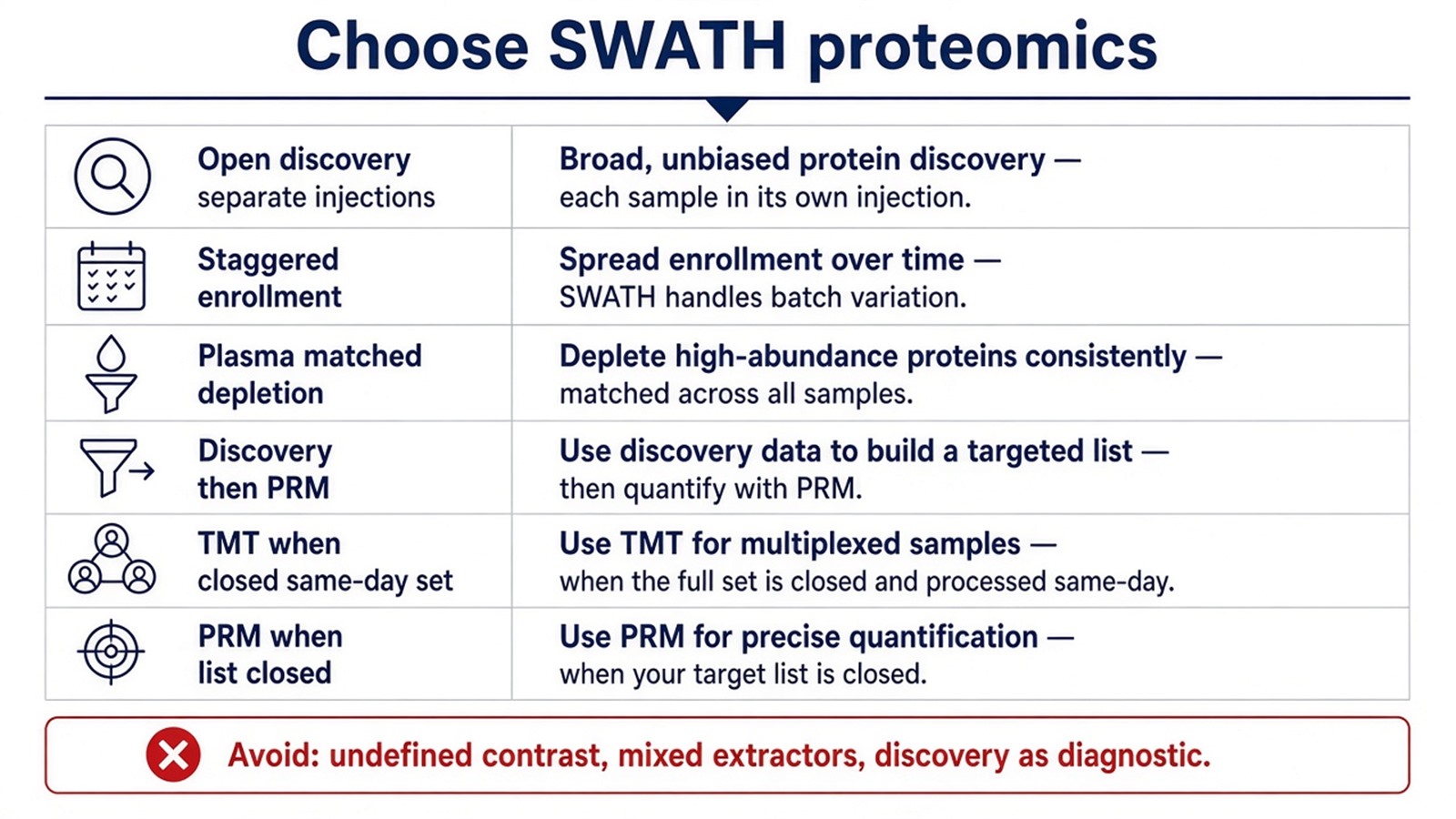
Figure 2. Choose SWATH when open relative discovery on unlabeled injections fits; closed confirmation and amount claims need targeted designs.
Teams that already have matrix, contrast, cohort design, and follow-up goal can review the MtoZ Biolabs Label-Free Quantitative Proteomics Service for SWATH proteomics planning.
Frequently Asked Questions
1. Is SWATH proteomics the same as label-free quantification?
Label-free is the chemistry. SWATH is a DIA window schedule on unlabeled digests. Both terms can apply to the same project when tagging is not used.
2. Must every SWATH project build a DDA library first?
No. Library-free extraction is an option. Prep, window plans, and FDR rules still must match the cohort.
3. Can SWATH replace PRM in validation work?
Not when a locked targeted method is required. SWATH remains discovery-oriented for open lists. PRM fits closed remeasurement.
4. Does deeper protein count mean a stronger contrast?
No. Count and quantitative precision differ. Contrast quality and missing-value rules decide interpretive strength.
5. Can SWATH data be reprocessed later?
Stored spectra can be re-extracted with a declared pipeline and contrast. Reprocessing does not fix unequal prep or undefined groups.
MtoZ Biolabs can support SWATH proteomics planning when sample type, contrast design, enrollment plan, and the intended relative claim are available.
If further evaluation of pretreatment, window locking, extractor choice, or discovery-to-targeted staging is needed, project details can be submitted for a feasibility review.
Reference
- S.A. Gerber, J. Rush, O. Stemman, M.W. Kirschner, S.P. Gygi (2003). Absolute quantification of proteins and phosphoproteins from cell lysates by tandem MS. Proc. Natl. Acad. Sci. U.S.A., 100, 6940-6945. https://doi.org/10.1073/pnas.0832254100
- L.C. Gillet, P. Navarro, S. Tate, H. Rost, N. Selevsek, L. Reiter, R. Bonner, R. Aebersold (2012). Targeted data extraction of the MS/MS spectra generated by data-independent acquisition: a new concept for consistent and accurate proteome analysis. Mol. Cell. Proteomics, 11, O111.016717. https://doi.org/10.1074/mcp.O111.016717
- V. Demichev, C. Messner, S. Vernardis, K.S. Lilley, M. Ralser (2020). DIA-NN: neural networks and interference correction enable deep proteome coverage in high throughput. Nat. Methods, 17, 41-44. https://doi.org/10.1038/s41592-019-0638-x
- C. Lazar, L. Gatto, M. Ferro, C. Bruley, T. Burger (2016). Accounting for the multiple natures of missing values in label-free quantitative proteomics data sets to compare imputation strategies. J. Proteome Res., 15, 1116-1125. https://doi.org/10.1021/acs.jproteome.5b00981
- G. Rosenberger, S. Liu, J. Röst, H.L. Ludwig, C. Buil, B. Borchers, R. Aebersold, L. Collins (2017). Statistical control of peptide and protein error rates in large-scale targeted data-independent acquisition analyses. Nat. Commun., 8, 14224. https://doi.org/10.1038/ncomms14224
- J.R. Wisniewski, A. Zougman, N. Nagaraj, M. Mann (2009). Universal sample preparation method for proteome analysis. Nat. Methods, 6, 359-362. https://doi.org/10.1038/nmeth.1322
