



Sequential window acquisition of all theoretical fragment ion spectra (SWATH-MS) analysis in service practice means unlabeled digests reach windowed data-independent acquisition (DIA) on separate liquid chromatography-tandem mass spectrometry (LC-MS/MS) injections, then pass to library or library-free extraction under false discovery rate (FDR) control (Gillet et al. 2012). SWATH names the acquisition schedule. Sample work before injection still decides whether extracted intensities support a predefined contrast. The guide below focuses on sample receipt, pretreatment, and SWATH-ready handoff. It is not a spectral extractor manual, not a disease biomarker catalog, and not a DDA versus DIA theory page.
Unlabeled SWATH analysis keeps each digest on its own injection path. Open cohorts that may still add files need matched prep batches and documented loads before the window plan is locked. In MtoZ Biolabs offerings, SWATH-style analysis is commonly run on label-free digests after pretreatment and pilot QC, with extraction documented once acquisition records are fixed.
Sample Inputs That Must Be SWATH-Analysis Ready
Common SWATH analysis inputs include cultured cells, tissues, plasma or serum, and other biofluids. Each matrix changes how much material is needed, whether depletion is applied, and how aggressively lipids and salts must be removed before LC.
Cells usually move through controlled lysis, reduction, alkylation, and trypsin digestion under one declared chemistry. Tissues need disruption and debris removal so peptide yield stays comparable across arms. Plasma and serum often need abundant-protein depletion or fractionation applied equally to every group when deep discovery is planned. Biofluids that cannot be relabeled later still fit SWATH analysis on separate injections when enrollment stays open.
SWATH MS analysis starts when digests are clean, desalted, and loaded under matched rules, not when a project title mentions SWATH alone.
Bulk Bradford, bicinchoninic acid (BCA), Lowry, and 280 nm assays help match total protein before digestion. They do not replace peptide-level extraction after SWATH acquisition.
Researchers who need extended label-free SWATH pretreatment detail can refer to SWATH-MS Label-Free Protein Quantification Technology Analysis. For mouse organ-specific prep notes, see DIA-MS Quantitative Proteomics Solutions for Mouse Tissue Samples.
Pretreatment Steps That Protect SWATH Analysis Comparability
SWATH analysis comparability depends on matched prep across groups, not on window count alone.
Lysis and digestion. Arms should share buffer family, enzyme-to-substrate ratio, and digestion time. Filter-aided or solid-phase cleanup helps remove detergents and chaotropes that suppress LC and fragment extraction (Wisniewski et al. 2009).
Cleanup and recovery. Peptide yield must stay comparable after StageTip-style or cartridge cleanup (Rappsilber et al. 2007). Group-specific losses create missing values that track treatment, not biology.
Desalting and injection load. SWATH schedules need stable chromatography across the cohort. Unequal dry-down recovery or mismatched peptide loads per injection distort extracted ion traces before FDR-controlled extraction runs.
Storage and freeze-thaw. Aliquot history should be recorded so thaw cycles do not align with group labels unless thaw is part of the design.
No isobaric tagging step appears in standard label-free SWATH analysis prep. Stable isotope-labeled internal standard (SIS) peptides belong to targeted follow-up on named targets, not to open SWATH discovery prep by default.
Cohort Design Checks Before SWATH Analysis Batches Scale
Application quality follows design choices that sit upstream of acquisition.
Contrast lock. Case-control, treatment, or time-point arms should be frozen before extraction thresholds are tuned on the first large batch.
Matched prep interleaved with run order. Prep day and injection day should not track treatment unless that structure is intentional.
Pilot injections. New matrices or cleanup routes need a pilot LC-MS injection before the full SWATH block is scheduled.
Material and consent boundaries. Clinical or biobank samples need declared aliquot rules so relabeling after acquisition does not redefine arms.
Enrollment flexibility. Separate unlabeled injections fit staggered sample arrival. Closed same-day sets may evaluate isobaric tagging as a different chemistry path from SWATH window plans.
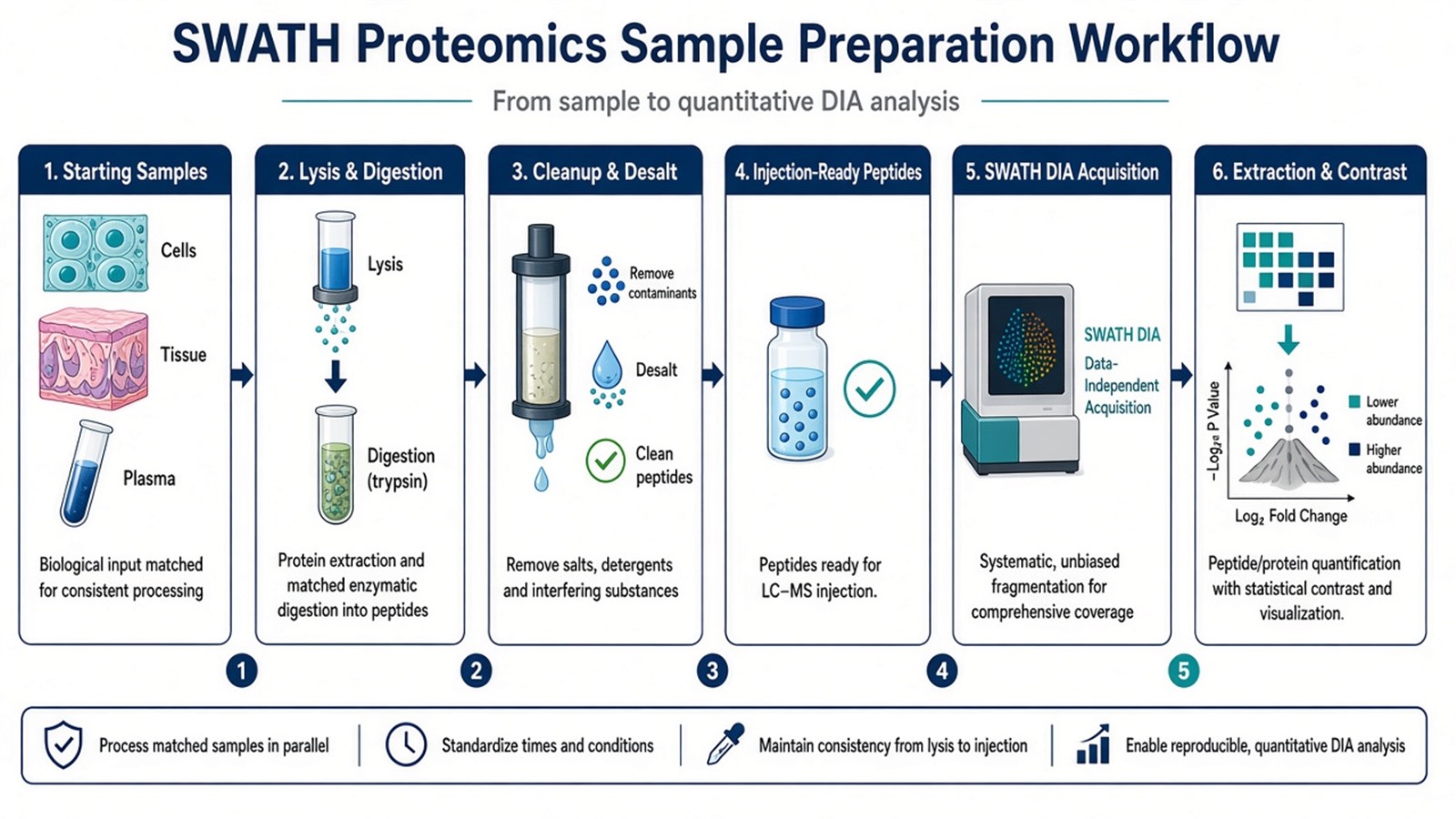
Figure 1. SWATH MS analysis depends on matched pretreatment and injection-ready digests before windowed acquisition and extraction.
Enrollment and pilot framing appears in Exploring Quantitative Analysis in Proteomics. Extraction, normalization, and contrast testing after acquisition belong with DIA Data Analysis Methods in Proteomics. Library-based extraction workflow context appears in Quantitative Analysis of SWATH Proteomics Using OpenSWATH: A Complete Workflow Overview.
Shared Workflow From Sample Receipt to SWATH Analysis Handoff
A practical SWATH analysis prep spine usually runs as follows.
- Confirm matrix, contrast, and relative claim across separate injections.
- Record receipt, storage, and aliquot metadata.
- Lyse, reduce, alkylate, and digest under shared rules.
- Clean peptides to LC-compatible purity and comparable recovery.
- Desalt and resuspend at a declared load; run pilot injection when the recipe is new.
- Acquire SWATH windows under a locked plan across the cohort.
- Hand raw data to the declared extractor with frozen contrast and missing-value policy.
- Test only the predefined contrast after FDR-controlled extraction (Rosenberger et al. 2017).
Steps 1 through 5 belong to sample and pretreatment on this page. Steps 6 through 8 cross into acquisition and analysis. Order errors show up as alignment failure or abundance-dependent missingness (Lazar et al. 2016). Pathway overlay after search cannot repair unequal cleanup or confounded injection order.
Researchers who need the general lysis-to-digest spine can refer to Quantitative Protein Analysis. LC injection discipline shared across routes appears in Quantitative Analysis of Proteins by Liquid Chromatography.
Parameters and Limits at the SWATH Analysis Prep Stage
Parameter |
Why it matters before SWATH analysis |
Failure mode if ignored |
|---|---|---|
Matched input and lysis |
Keeps peptide yield comparable |
Apparent fold changes from load bias |
Equal cleanup recovery |
Limits group-specific dropout |
Missingness that tracks treatment |
Detergent and salt removal |
Protects LC and extraction |
Weak or unstable fragment traces |
Injection load per run |
Stabilizes peak groups |
Saturation or weak alignment |
Pilot before cohort |
Catches bad loads early |
Full batch repeat digestion |
Run-order plan |
Separates biology from batch |
Treatment tracks injection day |
Contrast frozen |
Separates discovery from relabeling |
Post hoc arm merges |
Limits follow the same table. SWATH analysis prep does not label channels. Late samples cannot join prior injections as hidden replicates without a new prep record. SWATH does not report absolute concentration from open discovery intensities without SIS on named peptides. Window width, library choice, and software extractors are acquisition and analysis parameters. They must be declared with the matrix, but they do not replace matched pretreatment.
High-throughput discovery applications after prep are described in High-throughput SWATH-MS Quantitative Proteomics for Biomarker Discovery.
How to Choose Pretreatment for the Next SWATH Analysis Project
Use matrix, enrollment, and follow-up goal together.
Project need |
Pretreatment plan that often fits |
Recheck before committing |
|---|---|---|
Open cohort, cells or tissue |
Matched unlabeled prep, separate SWATH injections |
Run order identical to treatment |
Plasma or serum SWATH discovery |
Equal depletion plus matched digest |
Depletion on only one group |
Flexible time-course harvests |
Interleaved prep and injection order |
All late time points in one prep batch |
Freezable set for one labeling day |
Matched loads; consider TMT instead |
Forced SWATH when mixing is required |
Named peptides after SWATH analysis |
Same cleanup rules, then targeted panel |
Open SWATH stats as confirmation |
Amount on selected peptides |
Targeted SIS assay |
Discovery intensities as concentration |
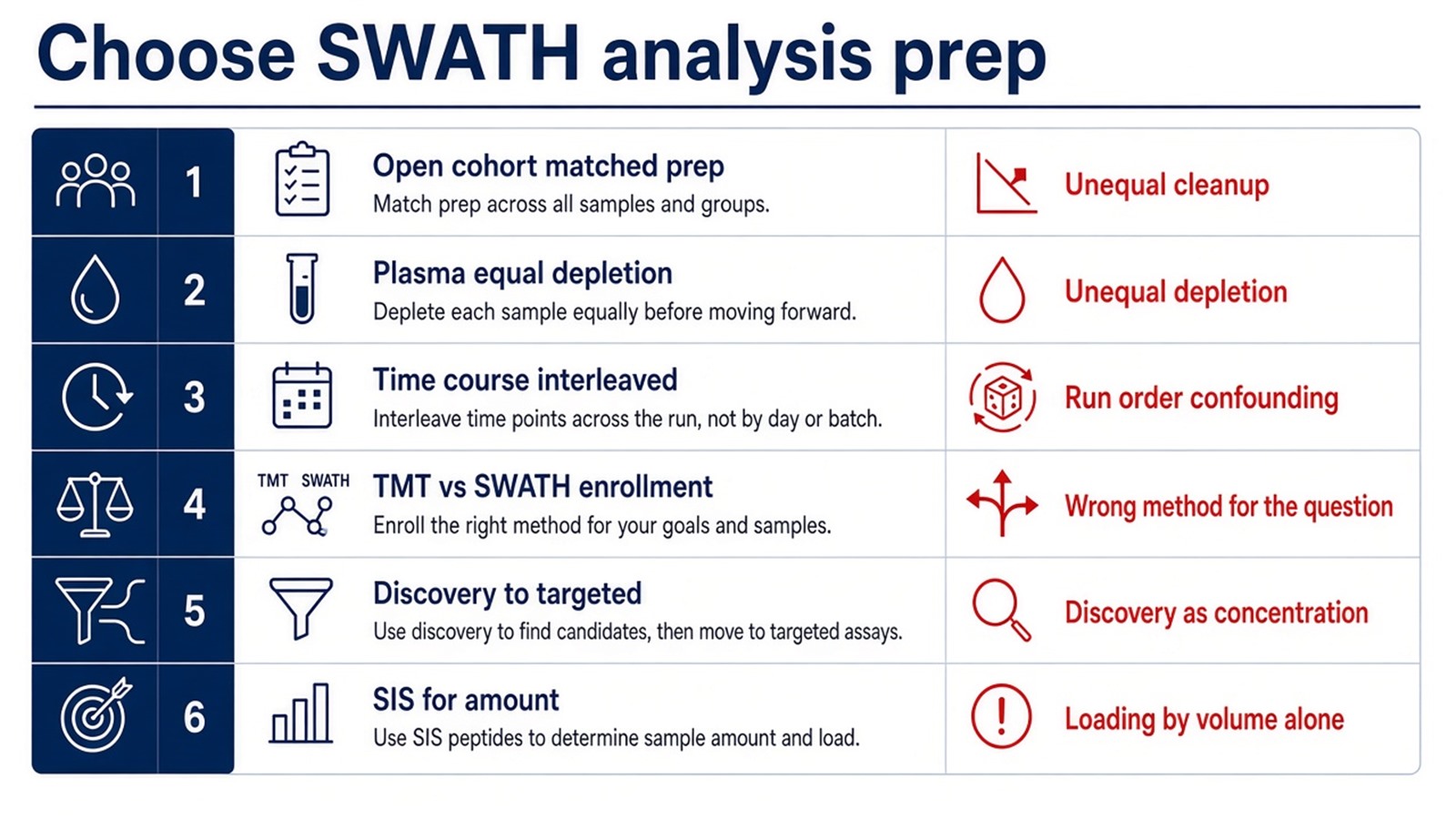
Figure 2. Choose SWATH analysis prep from matrix and enrollment; unequal cleanup, confounded run order, and amount-without-SIS requests need repair before acquisition.
Teams that already have matrix, contrast, and a requested relative claim can review the MtoZ Biolabs Label-Free Quantitative Proteomics Service for SWATH analysis pretreatment and acquisition planning. For three-axis route selection, see Protein Quantification Method.
Frequently Asked Questions
1. Does SWATH MS analysis require isobaric labeling?
No for standard label-free SWATH on separate injections. Isobaric tagging is a different chemistry route for closed multiplex sets.
2. Can SWATH analysis proceed without a pilot injection?
Only when the matrix and prep SOP already have QC records in the same lab. New routes need pilot loads before full batches.
3. Must a DDA library be built before sample prep?
No. Library strategy is an analysis decision. Prep quality rules stay the same for library-based and library-free extraction.
4. Can prep differ by treatment group?
Only when prep is an explicit experimental factor. Otherwise matched lysis and cleanup are required across groups.
5. Is a successful SWATH search proof that pretreatment was matched?
No. Extraction can return IDs from uneven prep. Matrix QC and contrast design still decide whether ratios are trustworthy.
MtoZ Biolabs can support SWATH MS analysis planning when sample type, study design, and the intended relative claim are available.
If further evaluation of matrix-matched lysis, depletion strategy, injection loads, or SWATH versus TMT enrollment is needed, project details can be submitted for a feasibility review.
Reference
- L.C. Gillet, P. Navarro, S. Tate, H. Rost, N. Selevsek, L. Reiter, R. Bonner, R. Aebersold (2012). Targeted data extraction of the MS/MS spectra generated by data-independent acquisition: a new concept for consistent and accurate proteome analysis. Mol. Cell. Proteomics, 11, O111.016717. https://doi.org/10.1074/mcp.O111.016717
- C. Lazar, L. Gatto, M. Ferro, C. Bruley, T. Burger (2016). Accounting for the multiple natures of missing values in label-free quantitative proteomics data sets to compare imputation strategies. J. Proteome Res., 15, 1116-1125. https://doi.org/10.1021/acs.jproteome.5b00981
- J. Rappsilber, M. Mann, Y. Ishihama (2007). Protocol for micro-purification, enrichment, pre-fractionation and storage of peptides for proteomics using StageTips. Nat. Protoc., 2, 1896-1906. https://doi.org/10.1038/nprot.2007.261
- J.R. Wisniewski, A. Zougman, N. Nagaraj, M. Mann (2009). Universal sample preparation method for proteome analysis. Nat. Methods, 6, 359-362. https://doi.org/10.1038/nmeth.1322
- G. Rosenberger, S. Liu, J. Röst, H.L. Ludwig, C. Buil, B. Borchers, R. Aebersold, L. Collins (2017). Statistical control of peptide and protein error rates in large-scale targeted data-independent acquisition analyses. Nat. Commun., 8, 14224. https://doi.org/10.1038/ncomms14224
