



A protein quantification method is not a single protocol. Dye binding, copper reduction, and 280 nm absorbance report total protein in a tube. Liquid chromatography-tandem mass spectrometry (LC-MS/MS) reports peptide signals that can become a relative protein matrix or, with a matched stable isotope-labeled internal standard (SIS), a peptide amount (Bantscheff et al. 2012). The method choice has to name three things together: whether samples are labeled, how precursors are acquired, and whether the claim is relative or absolute. Treating data-independent acquisition (DIA) as a synonym for unlabeled work collapses two of those axes.
In MtoZ Biolabs offerings, unlabeled digests are commonly acquired as data-dependent acquisition (DDA) label-free or as DIA. Tandem mass tag (TMT) workflows are typically acquired as DDA to read reporter ions. Named proteins are typically followed by parallel reaction monitoring (PRM), with multiple reaction monitoring (MRM) when a scheduled triple-quadrupole panel already exists.
What a Protein Quantification Method Has to Specify
A usable method statement names the quantitative object. Bulk assays estimate total protein mass in an extract and are useful for matching load before digestion. They do not identify which proteins changed. LC-MS/MS methods identify peptides and then quantify a declared signal: MS1 peak area, DIA fragment traces, TMT reporter ions, or targeted extracted peaks (Bantscheff et al. 2012).
The same statement must name the claim. Relative quantification compares the same protein across samples in one study. Absolute quantification reports amount or concentration only when a matched SIS and a calibration rule are present. Intensity-based copy-number estimates from unlabeled matrices are planning tools. They are not SIS-calibrated amounts.
If the protein list is still open, the method belongs in discovery. If names are already closed, the method belongs in a scheduled targeted assay. Those two jobs do not share the same inclusion list.
Bulk Assays Versus LC-MS/MS Proteome Quantification
Bradford, bicinchoninic acid (BCA), Lowry, and ultraviolet absorbance are load-control methods. They fail for different chemical reasons: detergent, reducing agent, nucleic acid, or an atypical amino-acid composition. They remain part of sample planning. They are not quantitative proteomics methods.
LC-MS/MS proteome quantification starts after digestion. Peptides are separated, fragmented, and scored against a protein database. The quantitative value is method-specific. Spectral counting can rank detectability. It is a weak substitute for a calibrated fold-change matrix when group statistics are required.
A project that only needs to confirm that two extracts have similar total protein can stop at a bulk assay. A project that needs a protein-by-sample matrix cannot.
How Labeling, Acquisition, and Claim Type Combine
Labeling chemistry and acquisition mode are independent choices.
Unlabeled work leaves each digest on its own injection. DDA label-free quantification commonly uses MS1 chromatographic peak areas after identification (Cox et al. 2014). DIA fragments scheduled m/z windows and extracts fragment chromatograms, often with a spectral library or a library-free search (Gillet et al. 2012). Unlabeled is the chemistry. DDA or DIA is the acquisition.
Isobaric TMT attaches channel-specific tags so mixed peptides share one precursor mass and split into reporter ions after fragmentation (Thompson et al. 2003). TMT more often fits a sample set that can be labeled and mixed together. Later-arriving samples need a bridge channel or a different route. Metabolic labeling, such as stable isotope labeling by amino acids in cell culture (SILAC), incorporates heavy amino acids during protein synthesis. It fits cells that can be grown on labeled media. Tissue and biofluid projects usually cannot use that step.
Targeted PRM or MRM schedules a closed peptide list. Relative targeted peak areas do not become ng per mL without SIS. AQUA-style heavy peptides are the peptide-level form of an amount claim (Gerber et al. 2003).
A protein quantification method is the combination of labeling, acquisition, and claim type, not a single product name.
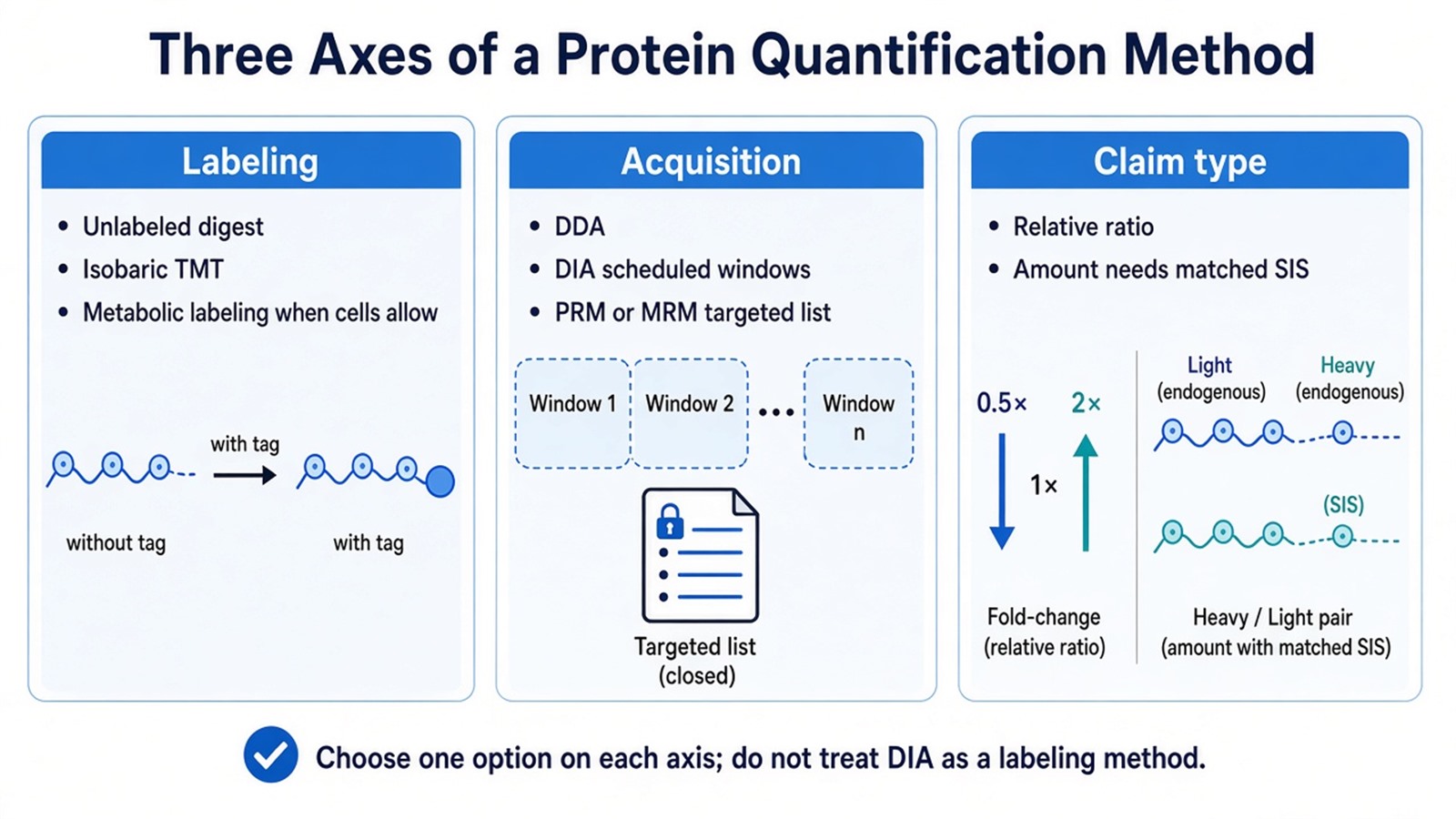
Figure 1. An LC-MS/MS protein quantification method has to specify labeling, acquisition, and whether the claim is relative or an SIS-supported amount.
Researchers can refer to A Guide to Label-Free Quantitative Proteomics: From Experiment to Data Analysis for unlabeled DDA or DIA matrices, to What Is TMT Isobaric Labeling? for reporter-ion multiplexing, and to DIA Data Analysis Methods in Proteomics for windowed fragment extraction.
Parameters That Decide Which Method Can Defend the Contrast
Study design comes before kit choice. The contrast, biological replicate structure, and whether extra samples will arrive later decide whether a mixed plex or independent injections are workable.
Sample chemistry constrains labeling. Amine-rich buffers compete with TMT reagents. Strong detergents and residual hemoglobin disturb both unlabeled and labeled runs. Bulk assays still matter for matching protein input, because later normalization does not repair failed digestion.
Acquisition parameters have to match the chemistry. TMT reporters need spectra in which those ions are measured. DIA extraction needs a declared window scheme and library or library-free settings. Targeted methods need a locked schedule and unique peptides. Mixing DDA MS1 tables with DIA fragment tables, or unlabeled files with a TMT plex, in one statistical model without a bridge creates contrasts the data cannot defend.
Claim parameters include FDR thresholds, uniqueness rules, normalization assumptions, missing-value rules, and, for amount claims, SIS identity and spike point. Those settings should be written with the method name. A method name alone is not a methods record.
How to Choose a Method for the Next Experiment
The useful test is whether the protein list is open, whether samples can be mixed, and whether the unit must be an amount.
Study need |
Method that often fits |
Limits to keep in view |
|---|---|---|
Open list, samples may still be added |
Unlabeled DDA LFQ or unlabeled DIA |
Cross-run alignment and missingness remain |
Open list, a defined set can be mixed now |
TMT relative plex |
Later files are not extra channels; MS2 ratios can compress |
Culturable cells, metabolic label available |
SILAC-style relative comparison |
Not a default for tissue or plasma |
Named peptides, remeasure across samples |
Targeted PRM or MRM |
Off-list proteins stay unseen |
Mass or molar unit for named peptides |
Targeted assay plus matched SIS |
Peptide amount is not automatically protein copy number |
Total protein load matching only |
Bradford, BCA, Lowry, or A280 |
Not protein-specific ratios |
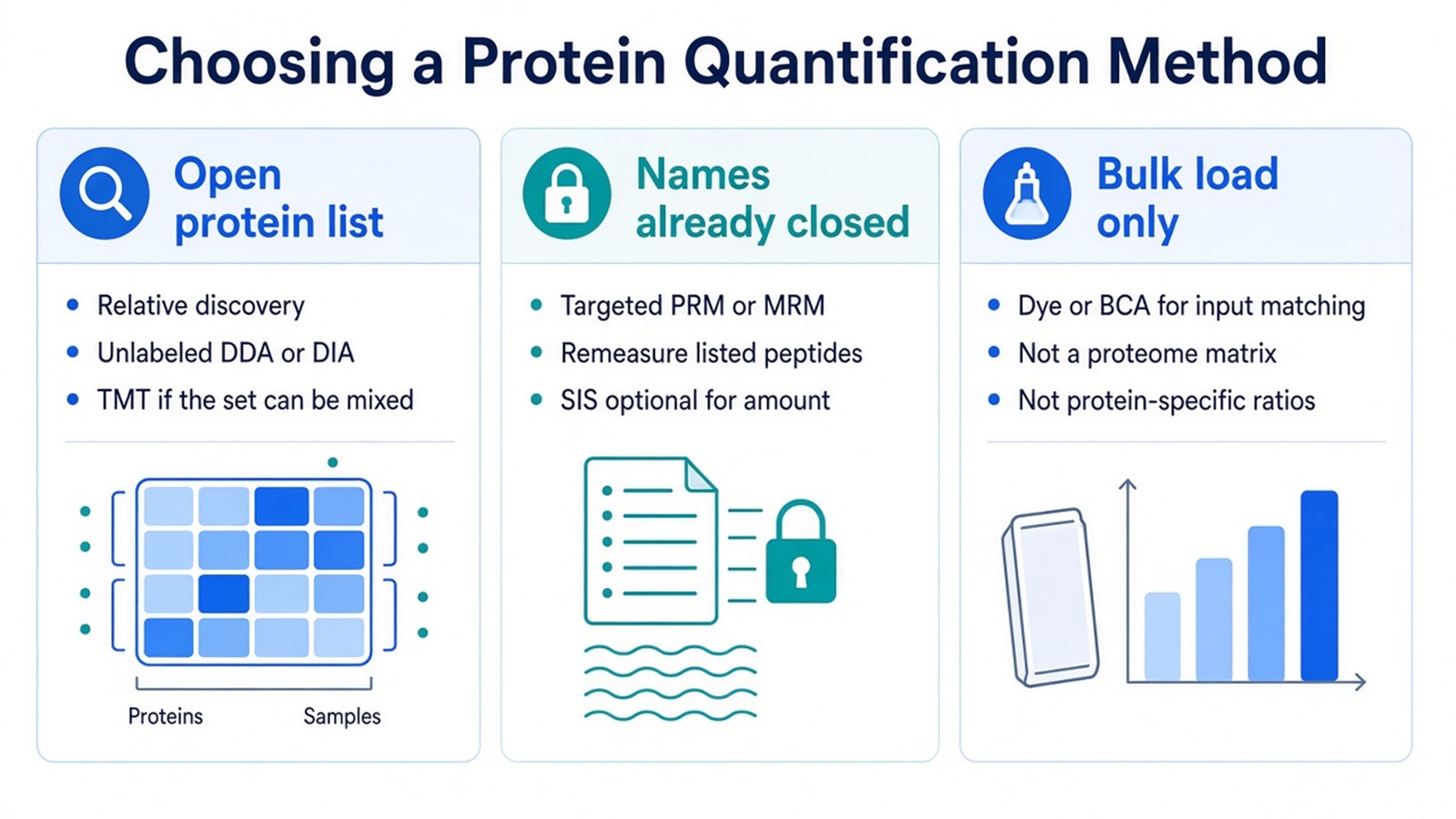
Figure 2. Choose discovery, targeted, or a bulk load assay from the protein list and the claim unit, not from a single preferred kit name.
TMT more often fits a multi-group design that can be frozen at labeling. Unlabeled DDA or DIA more often fits open enrollment. Targeted methods more often fit after names freeze. Exceptions exist when a tiny validated panel never needed discovery, or when a short closed cohort must share one injection to limit run-order drift.
Researchers who need the closed-list trade-off in more detail can refer to Advantages and Disadvantages of Targeted Proteomics. Researchers who already have sample type, group design, and a requested claim can also review the MtoZ Biolabs Quantitative Proteomics Service for project-specific method planning.
Frequently Asked Questions
1. Is a BCA or Bradford assay a protein quantification method for proteomics?
It is a total-protein load assay. Use it to match input before digestion. It does not produce a protein-by-sample matrix or a protein-specific ratio.
2. Is DIA the same thing as label-free quantification?
No. DIA is an acquisition schedule. Label-free is a chemistry choice. Unlabeled digests are often acquired as DIA, and a labeled digest can be acquired with DIA in other designs.
3. Can unlabeled MS1 or DIA intensities be converted to ng per mL after the run?
No reliable conversion exists without a matched SIS and a declared calibration for that peptide. A later universal factor does not repair digestion yield or ion suppression.
4. Should every multi-group study be run as TMT?
No. TMT fits when the set can be labeled and mixed. If harvests will continue, unlabeled injections or a bridge design are often simpler. Kit size is not a biological result.
5. When should a full proteome method stop and a targeted method start?
Move when the protein list can freeze and the remaining task is remeasurement or an SIS-supported amount. Keep discovery while new names are still required.
MtoZ Biolabs can provide quantitative proteomics method planning across unlabeled DDA or DIA discovery, TMT relative plexes, and targeted PRM or MRM follow-up when sample type, group design, and the intended claim are available.
If further evaluation of labeling versus acquisition, relative versus SIS-supported amount, or whether a bulk load assay is sufficient is needed, project details can be submitted for a feasibility review.
Reference
- M. Bantscheff, S. Lemeer, M.M. Savitski, B. Kuster (2012). Quantitative mass spectrometry in proteomics: critical review update from 2007 to the present. Anal. Bioanal. Chem., 404, 939-965. https://doi.org/10.1007/s00216-012-6203-4
- J. Cox, M.Y. Hein, C.A. Luber, I. Paron, M. Mann (2014). Accurate proteome-wide label-free quantification by delayed normalization and maximal peptide ratio extraction, termed MaxLFQ. Mol. Cell. Proteomics, 13, 2513-2526. https://doi.org/10.1074/mcp.M113.031031
- S.A. Gerber, J. Rush, O. Stemman, M.W. Kirschner, S.P. Gygi (2003). Absolute quantification of proteins and phosphoproteins from cell lysates by tandem MS. Proc. Natl. Acad. Sci. U.S.A., 100, 6940-6945. https://doi.org/10.1073/pnas.0832254100
- L.C. Gillet, P. Navarro, S. Tate, H. Rost, N. Selevsek, L. Reiter, R. Bonner, R. Aebersold (2012). Targeted data extraction of the MS/MS spectra generated by data-independent acquisition: a new concept for consistent and accurate proteome analysis. Mol. Cell. Proteomics, 11, O111.016717. https://doi.org/10.1074/mcp.O111.016717
- A. Thompson, J. Schafer, K. Kuhn, S. Kienle, J. Schwarz, G. Schmidt, T. Neumann, R. Johnstone, A.K. Mohammed, C. Hamon (2003). Tandem mass tags: a novel quantification strategy for comparative analysis of complex protein mixtures by MS/MS. Anal. Chem., 75, 1895-1904. https://doi.org/10.1021/ac0262560
