



Isotopic labeling quantitative proteomics depends on sample type and prep before any liquid chromatography-tandem mass spectrometry (LC-MS/MS) claim is valid. Metabolic routes such as SILAC need living cells that incorporate heavy amino acids; chemical isobaric tags such as TMT or iTRAQ need matched lysis, equal protein load, amine-compatible digests, and residual-amine cleanup before NHS tagging and pooling (Thompson et al. 2003; Ong et al. 2002). Incomplete labeling, unmatched loads, or detergent carryover become permanent ratio artifacts after mixing. Prefer metabolic labeling when culture systems can reach high incorporation; prefer chemical tags for tissues and biofluids that cannot grow on heavy media; keep label-free when labeling chemistry or plex closure fails.
Researchers who already have defined samples, comparison groups, or a specific project objective can also review the MtoZ Biolabs TMT Quantitative Proteomics Analysis Service and Label-Free Quantitative Proteomics Service for project-specific feasibility and sample planning.
Sample Type Decides Which Isotopic Route Is Open
Isotopic labeling is a family of prep choices, not one protocol. The sample must support either in vivo incorporation or post-digest chemical tagging.
Sample or matrix |
Often open isotopic route |
Prep gate that must hold |
|---|---|---|
Cultured cells on defined media |
SILAC or other metabolic labeling |
Near-complete heavy amino acid incorporation |
Fresh or frozen tissues |
Chemical isobaric tags (TMT/iTRAQ) |
Matched lysis, equal protein load, amine cleanup |
Plasma, serum, or other biofluids |
Chemical isobaric tags if cohort is closed |
Amine-free digests and a frozen plex map |
Primary cells that cannot grow on heavy media |
Chemical tags or unlabeled LFQ |
Enough input for labeling QC, or switch to LFQ |
Longitudinal clinical collections |
Often LFQ unless plexes are bridged |
Late arrivals cannot join an already pooled plex |
Scarce biopsy aliquots |
LFQ if tags would exhaust material |
Labeling and QC consume protein that may not exist |
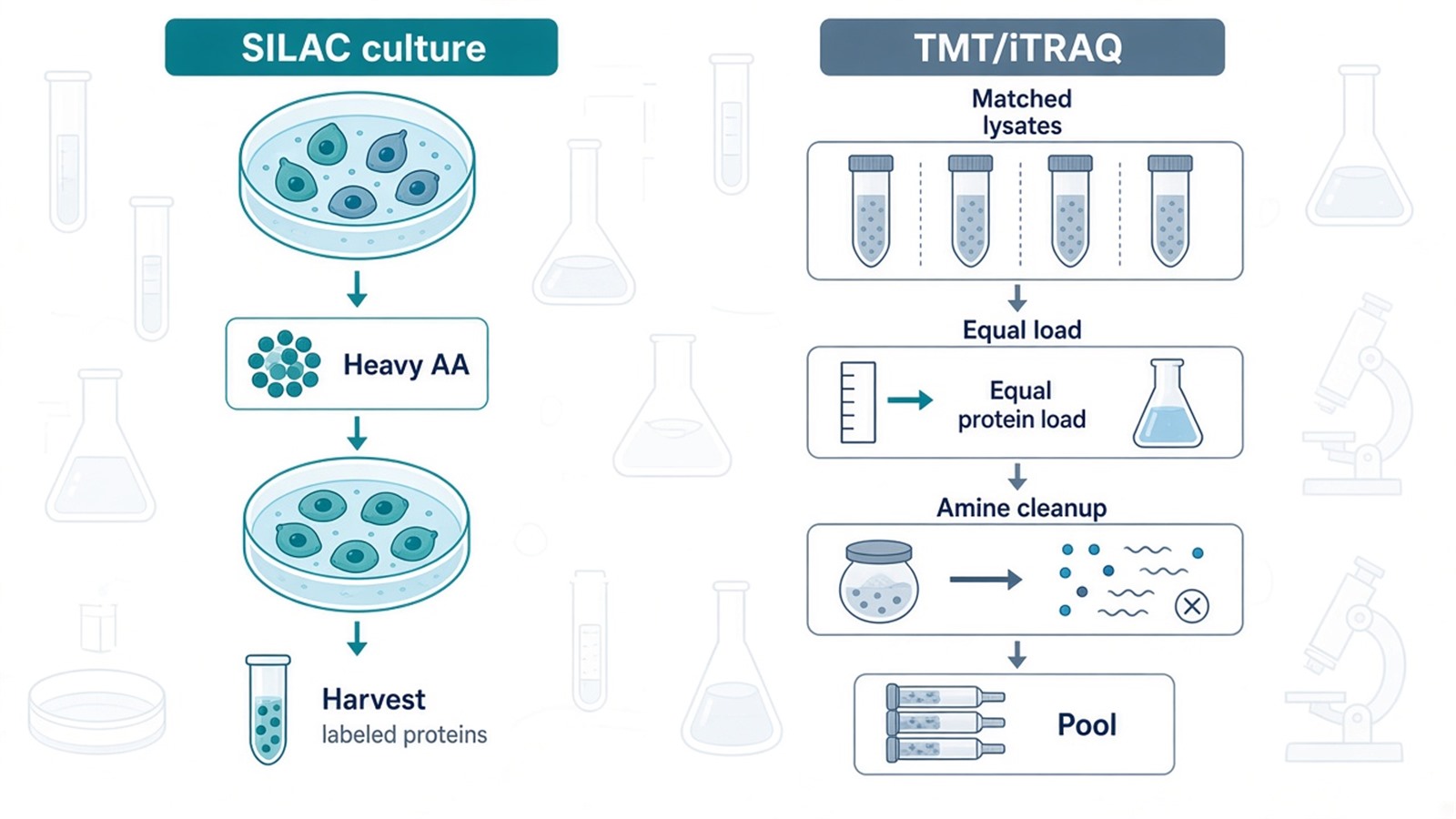
Figure 1. Sample type decides the isotopic prep route: metabolic labeling needs living culture systems; chemical tags need matched, amine-compatible digests before pooling.
Calling isotopic labeling universally accurate without stating sample type, incorporation or labeling completeness, and the relative claim overstates method class alone.
Shared Prep Path and Labeling Branches
Most bottom-up isotopic projects share early steps: declare lysis chemistry, clarify, assay protein, reduce and alkylate, digest (usually with trypsin), and clean up peptides. Loading for chemical tags should be matched on protein amount, not volume alone.
After that common path, labeling branches:
- Metabolic (SILAC-style): heavy amino acids enter proteins during culture; light and heavy samples are mixed after harvest or after digest under a declared plan (Ong et al. 2002). Incomplete incorporation looks like false ratios.
- Chemical isobaric (TMT/iTRAQ): each digest is NHS-labeled, quenched, and pooled. Residual free amines and unequal loads become channel artifacts after mixing (Thompson et al. 2003).
- Other chemical isotope labels (for example dimethyl labeling): still require matched digests and verified labeling completeness before pooling.
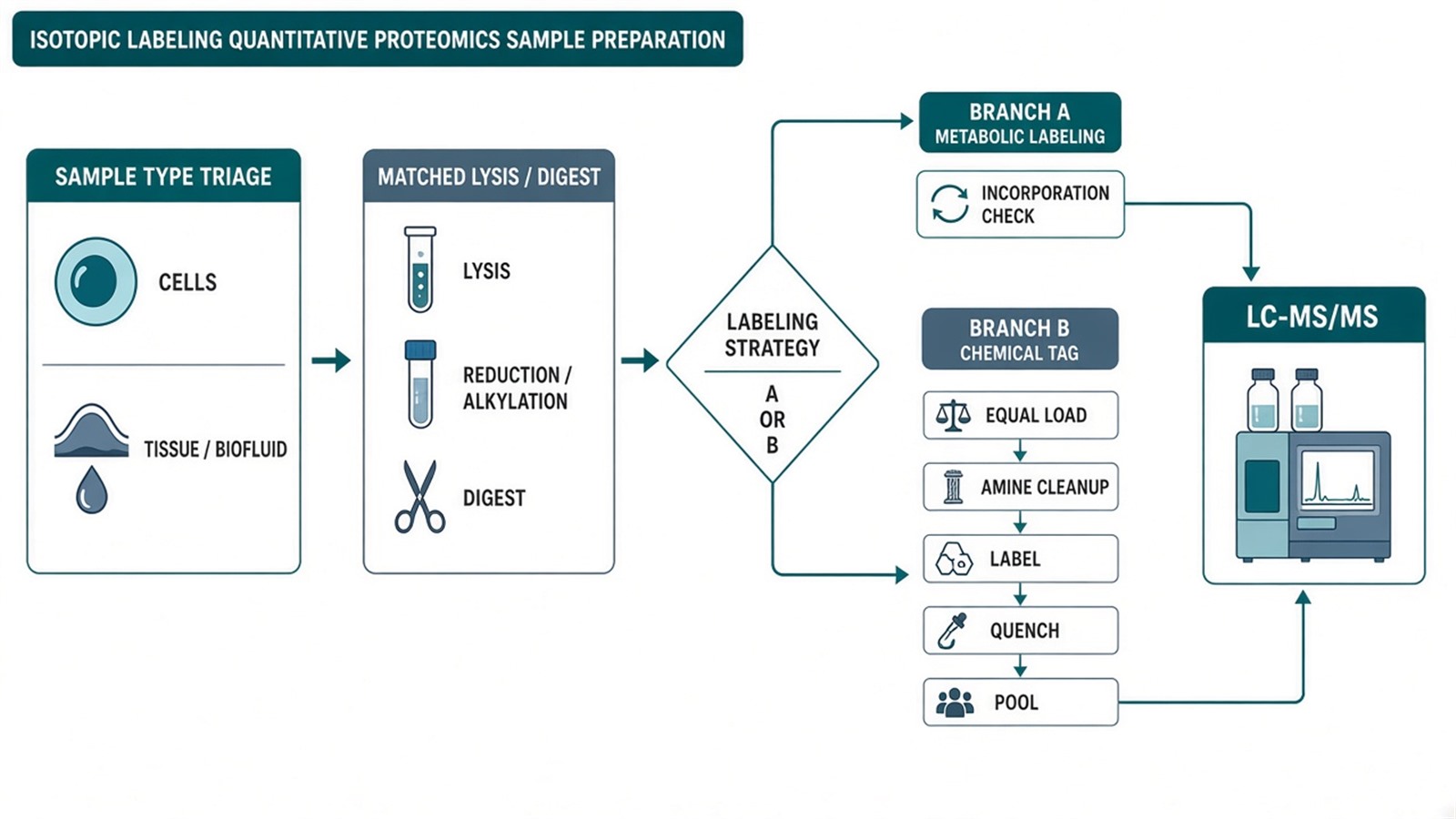
Figure 2. Isotopic quantitative analysis shares early prep; it diverges at metabolic incorporation versus chemical tagging and pooling.
For TMT-specific design and amine cleanup detail, see How to Optimize Proteomics TMT Experimental Design and Sample Prep and A Detailed Workflow of TMT-Based Quantitative Proteomics. For absolute versus relative prep constraints beyond isotopic chemistry, see Absolute and Relative Quantitative Proteomics Analysis. For labeling versus unlabeled selection, see Comparing LFQ and Isobaric Labeling Strategies in Proteomics Quantification.
Judgment Criteria: When Isotopic Prep Fits
Prep question |
Prefer metabolic labeling |
Prefer chemical isobaric tags |
Prefer unlabeled LFQ or DIA |
Reassess |
|---|---|---|---|---|
Can samples grow to high heavy incorporation? |
Yes |
Not required |
Not required |
Culture system unstable |
Are tissues or biofluids the only material? |
Usually blocked |
Often open |
Often open |
Input too scarce for tags |
Are amines free for NHS-style reagents? |
Not the main gate |
Required |
Not required |
Buffer exchange incomplete |
Can enrollment freeze before pooling? |
Mixing still planned |
Required for one plex |
Independent injections |
Samples keep arriving |
Is the claim relative ratios? |
Yes inside the design |
Yes inside the plex |
Yes across runs |
Absolute amount needed |
Prefer SILAC-style prep when cultured cells can incorporate heavy amino acids cleanly. Prefer TMT or iTRAQ prep when tissues or biofluids can be matched, amine-cleaned, and closed into one plex or a bridged multi-plex plan. Prefer LFQ or unlabeled DIA when labeling chemistry fails, enrollment stays open, or input cannot support tags and QC. Prefer PRM, MRM, or AQUA when a closed peptide list needs amount units after discovery.
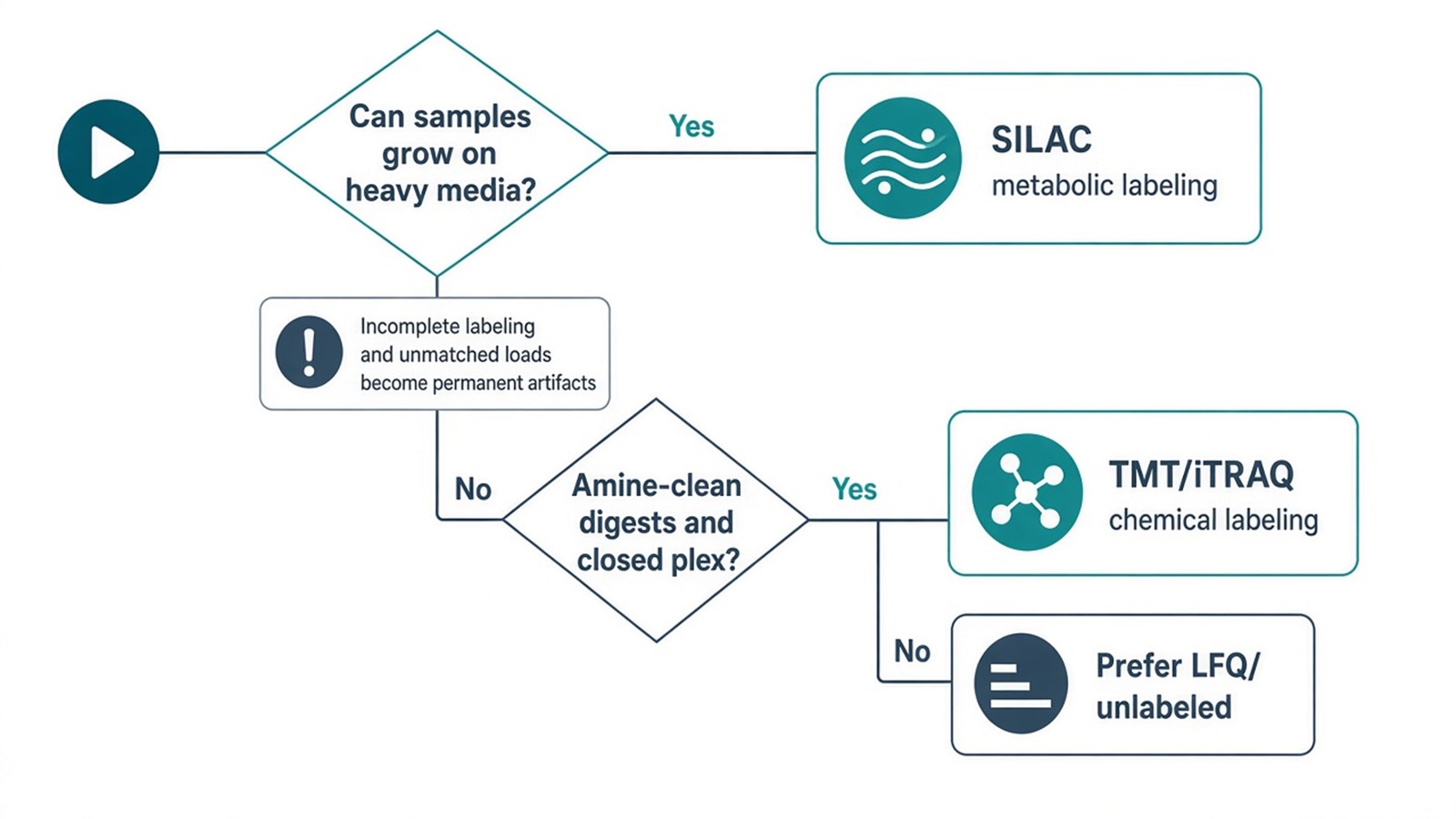
Figure 3. Select isotopic prep from sample biology and chemistry gates; change route when incorporation, amine cleanup, or plex closure fails.
For TMT versus LFQ framing, see TMT vs Label Free Quantitative Proteomics. For multiplex workflow after prep is locked, see TMT-Based Quantitative Proteomics: Multiplexing, MS3 Accuracy, and Workflow Design. For labeling chemistry limits, see Mechanism of TMT Labeling in Mass Spectrometry.
Limits and Application Boundaries
Isotopic labeling does not create absolute concentration without matched standards and calibration. Metabolic labeling does not apply to non-cultivable clinical matrices. Chemical tags do not repair unmatched lysis or residual amine buffers after pooling. Ratio compression in isobaric MS2 still needs fractionation or MS3 where appropriate; clean prep does not erase co-isolation by itself. Pathway enrichment from a differential list shows overrepresentation relative to the quantified background; it does not prove pathway activity.
Typical applications tied to sample and prep:
- Cell culture treatment or genotype panels that can reach high SILAC incorporation.
- Tissue or biofluid cohorts with matched loads and a frozen TMT or iTRAQ plex.
- Multi-arm drug screens that benefit from same-run multiplex ratios after clean labeling.
- Discovery followed by PRM, MRM, or AQUA on a closed shortlist when amount is later required.
Diagnostic cutoffs and companion-diagnostic claims sit outside ordinary research isotopic labeling reporting unless a separately validated assay framework is in place.
Once sample type, incorporation or amine chemistry, and mixing rules are defined, the project can be scoped as a metabolic or chemical isotopic study. Researchers can review the MtoZ Biolabs TMT Quantitative Proteomics Analysis Service for sample evaluation and workflow planning. For unlabeled alternatives when isotopic prep fails, see the Label-Free Quantitative Proteomics Service.
Frequently Asked Questions
1. Can SILAC be used directly on plasma or tissue?
Usually no. Metabolic labeling needs living systems that incorporate heavy amino acids. Clinical matrices typically use chemical tags or unlabeled LFQ.
2. What prep failure most often breaks TMT or iTRAQ ratios?
Unmatched protein loads and residual amine buffers are common. Both become permanent channel artifacts after pooling.
3. Does isotopic labeling always beat label-free for accuracy?
Not automatically. Accuracy follows incorporation or labeling completeness, matched prep, and QC. When chemistry cannot be controlled, LFQ may be the better fit.
4. Can late samples join an already pooled isobaric plex?
No. Enrollment closes at mixing. Plan a bridged plex or keep independent LFQ injections if arrival is open-ended.
5. Do isotopic methods report absolute protein concentration?
Not by default. Ordinary isotopic discovery reports relative ratios. Absolute amount needs matched standards and calibration on a closed panel.
Reference
- S.E. Ong, B. Blagoev, I. Kratchmarova, et al. (2002). Stable isotope labeling by amino acids in cell culture, SILAC, as a simple and accurate approach to expression proteomics. Mol. Cell. Proteomics, 1, 376-386. https://doi.org/10.1074/mcp.M200025-MCP200
- A. Thompson, J. Schafer, K. Kuhn, et al. (2003). Tandem mass tags: a novel quantification strategy for comparative analysis of complex protein mixtures by MS/MS. Anal. Chem., 75, 1895-1904. https://doi.org/10.1021/ac0262560
