



Absolute QUAntification (AQUA) proteomics uses stable isotope-labeled synthetic peptides as internal standards to report amount or concentration for named proteotypic targets (Gerber et al. 2003). After digestion, a heavy peptide of known amount is spiked, light and heavy signals are acquired by targeted LC-MS/MS, and matrix-matched calibration converts the light-to-heavy response into units. Acquisition is commonly MRM or PRM; neither platform alone creates absolute units without standards (Lange et al. 2008; Peterson et al. 2012). AQUA reports peptide amount under stated spike timing, not open discovery, and does not replace relative LFQ, DIA, or TMT when fold change alone suffices, or clinical cutoffs without separate validation.
Researchers who already have a closed target list and required reporting units can also review the MtoZ Biolabs Absolute Quantitative Analysis (AQUA) Service and Targeted Proteomics Service for project-specific feasibility and assay planning.
Principle: What Absolute AQUA Quantification Means
AQUA implements isotope dilution on closed peptide targets. The heavy standard matches the sequence of the endogenous digest peptide and differs by stable isotope mass so both forms co-elute and ionize under closely related conditions. The defended output is peptide-level amount or concentration under the chosen spike point and calibration range.
Protein concentration is inferred from that peptide only when digestion, enrichment, and calibration support the inference. Post-digestion spiking does not automatically correct lysis or digestion losses that occurred before the standard entered the sample. Intensity-based proxies such as iBAQ rank proteins within a sample under model assumptions and are not interchangeable with a spiked AQUA curve.
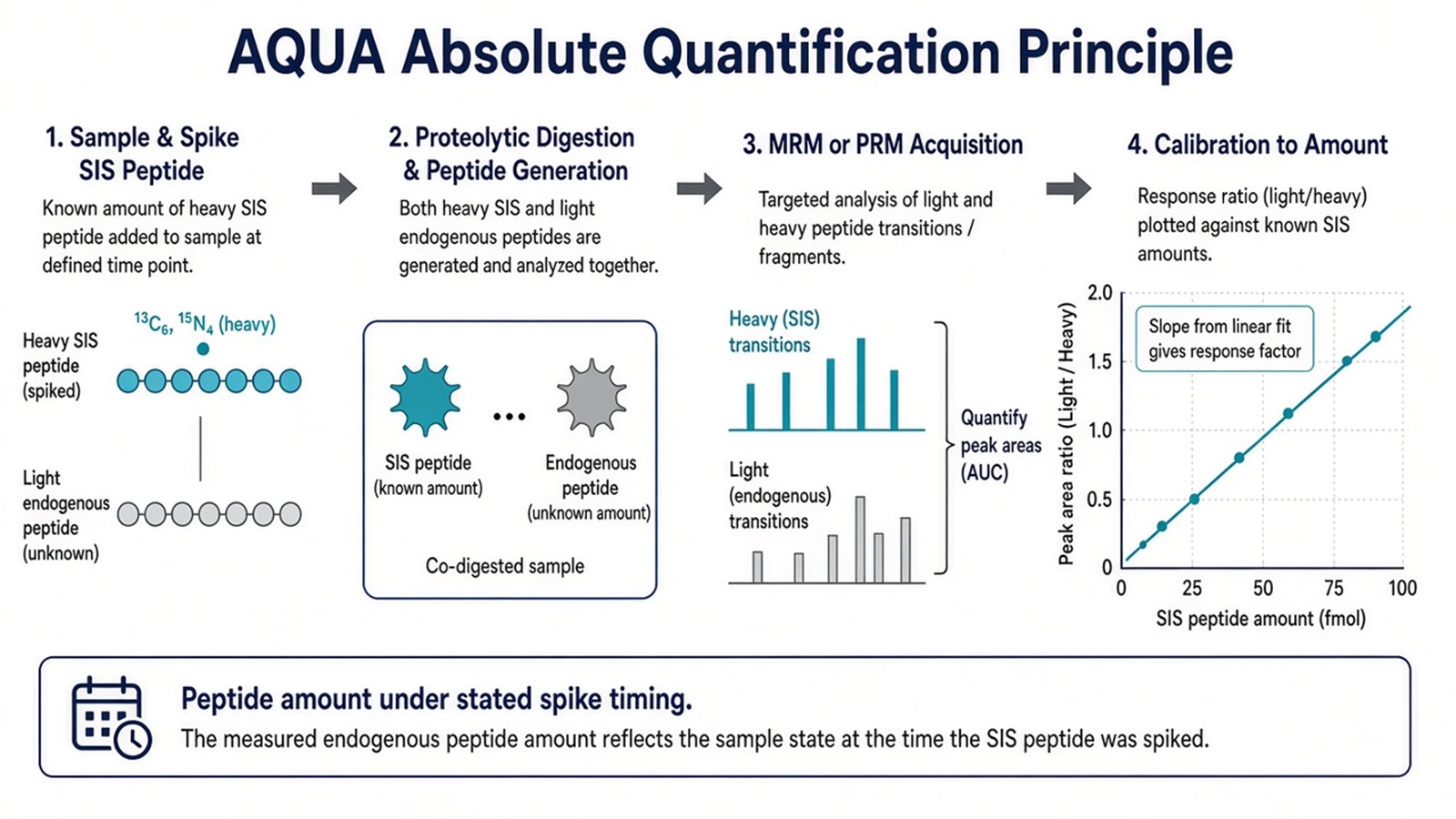
Figure 1. AQUA absolute quantification converts light-to-heavy peptide signals into amount only after standards, spike timing, and calibration are defined.
Without matched standards and a stated calibration model, targeted peak areas remain relative.
For a broader absolute method family map, see Absolute Protein Quantification: Methods and Uses. For targeted absolute framing, see Absolute Quantification in Targeted Proteomics.
Methods: AQUA Workflow and Related Options
Method layer |
What it contributes |
Main limit |
|---|---|---|
AQUA / SIS peptides |
Known-amount heavy peptides for isotope dilution |
Peptide-level claim; synthesis cost and lead time |
Matrix-matched calibration |
Places native-to-heavy ratios on an amount scale in study-like background |
Samples outside the curve need dilution or redesign |
MRM acquisition |
Fast Q1-Q3 transitions for light/heavy pairs |
Transitions must be locked; unit-resolution interference risk |
PRM acquisition |
Full high-resolution MS2 with post-run ion choice |
Cycle-time caps on panel size |
Protein-level or QconCAT-style standards |
Can capture digestion or enrichment when that is part of the claim |
Higher design burden than peptide AQUA |
Typical AQUA method path
- Close proteotypic peptides for the named proteins or modification states.
- Synthesize or procure heavy standards that match the claim chemistry.
- Digest samples under one protocol and record whether the SIS is added before digestion, after digestion, or after enrichment.
- Build calibrators in a matrix similar to study samples and bracket the expected range.
- Acquire light and heavy signals by MRM or PRM with QC samples.
- Report amount only inside the validated range for peptides that pass peak and interference checks.
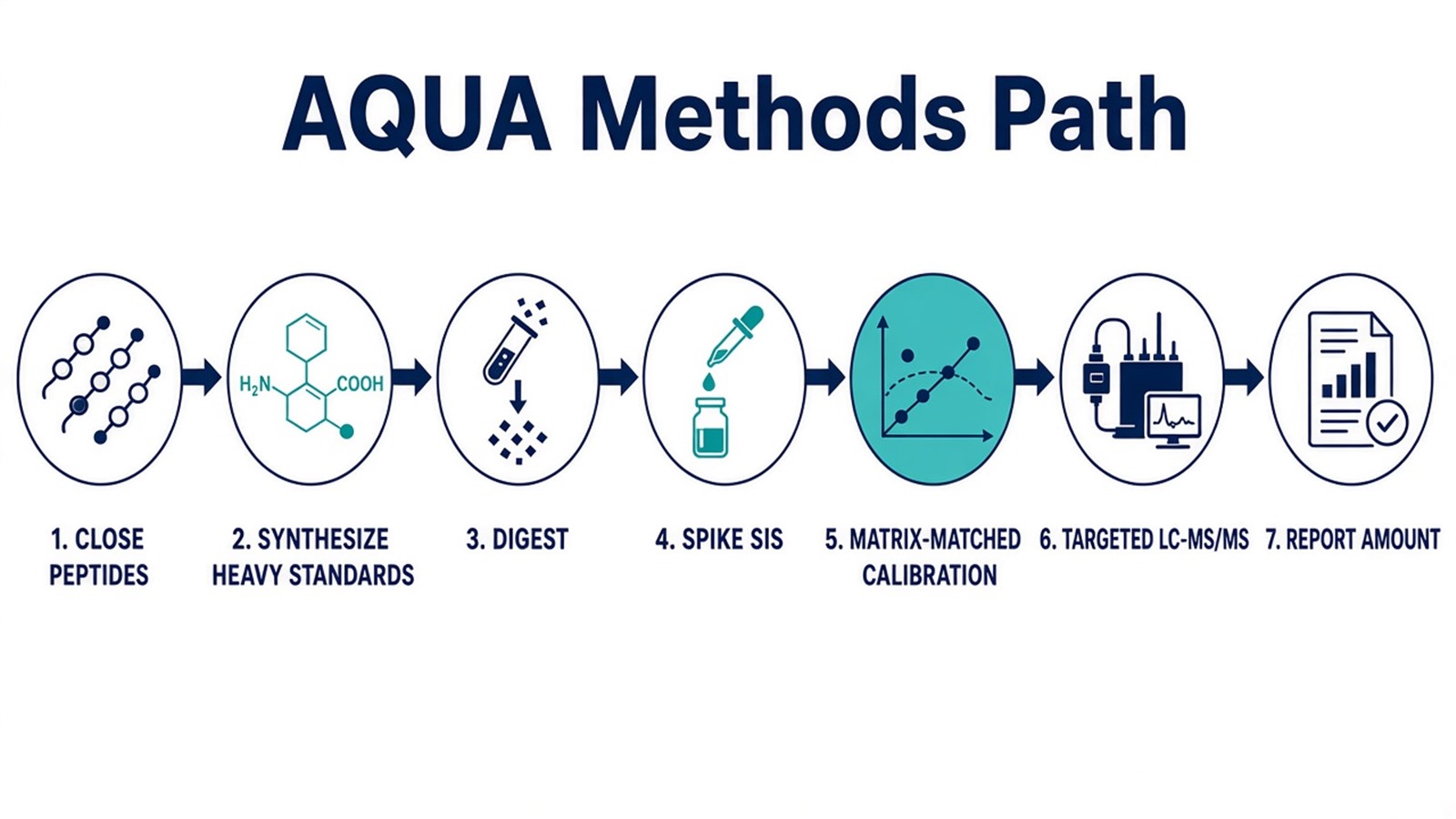
Figure 2. AQUA methods combine closed targets, isotope dilution, matrix-matched calibration, and targeted acquisition into one absolute claim.
For MRM/SRM operations, see SRM Mass Spectrometry and Principle of Multiple Reaction Monitoring. For PRM versus MRM trade-offs, see PRM and MRM in Targeted Proteomics: Advantages and Limitations. For AQUA advantage lists, see Advantages and Disadvantages of AQUA Technique.
Judgment Criteria: When Absolute AQUA Fits
Study need |
AQUA often fits |
Reassess before ordering standards |
|---|---|---|
Claim |
Concentration, stoichiometry, or specification units |
Relative fold change alone |
Targets |
Closed, mature proteotypic peptides |
Open discovery inventory still changing |
Range |
Expected amounts bracketed by calibrators |
Abundance unknown across many orders of magnitude |
Matrix |
Study-like calibrators and QC feasible |
No peptide survives digestion in that matrix |
Platform |
MRM or PRM method can be built for the panel |
Only unlabeled discovery runs are planned |
Validation stage |
Research assay for named amount |
Regulatory diagnostic cutoff without full validation |
Prefer AQUA when the decision sentence needs amount for named peptides and the panel is closed. Prefer relative PRM or MRM without full calibration when confirmation trends are enough. Prefer LFQ, DIA, or TMT while the inventory is still open. Prefer protein-level labeled standards when digestion recovery is part of the scientific claim.
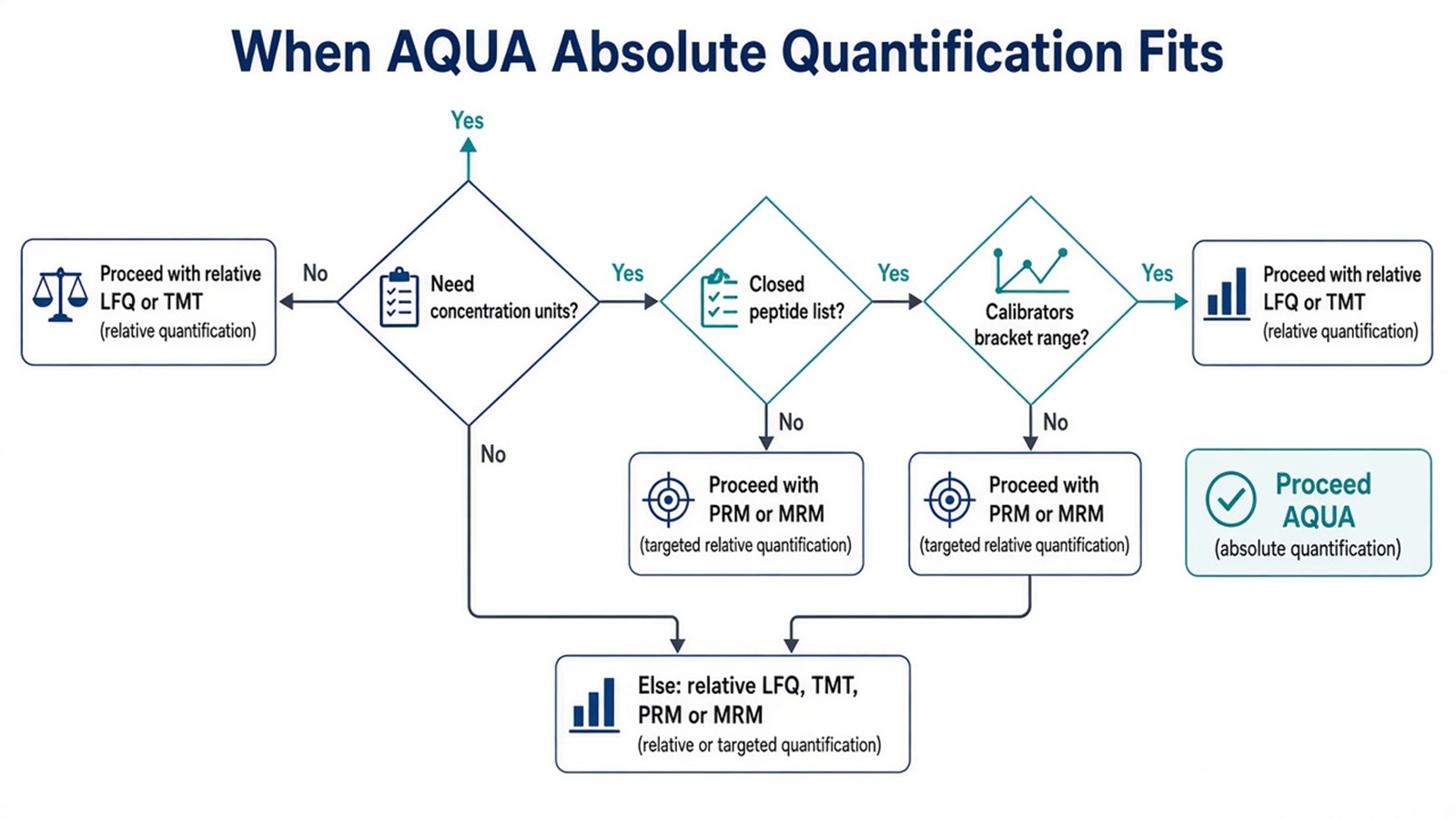
Figure 3. Choose AQUA when amount is part of the claim and the peptide list is closed; keep relative routes when it is not.
For claim-level selection across absolute and relative strategies, see Absolute and Relative Quantitative Proteomics Analysis and Protein Quantification Measured by Mass Spectrometry. For the shared targeted workflow, see Targeted Proteomics Workflow: How Does Targeted Proteomics Work?.
Limits and Application Boundaries
AQUA does not quantify proteins that lack a suitable proteotypic peptide or that fall outside the validated calibration range without redesign. Multiplexing many AQUA peptides raises synthesis cost and chromatographic scheduling load. Modified forms need standards that carry the same modification chemistry. Extremely low abundance in complex biofluids may still fail even with standards if the light peptide is not recovered.
Typical applications:
- Research biomarker amount for a closed shortlist after discovery.
- Stoichiometry or process specification for named proteins in biopharma matrices.
- Bridging MS peptide amount to later immunoassay development.
- Pharmacodynamic or pathway panels when concentration, not only fold change, is required.
Diagnostic cutoffs, companion-diagnostic claims, and open proteome concentration maps sit outside ordinary research AQUA reporting unless a separately validated assay framework is in place.
Once targets, spike timing, calibration range, and acquisition class are defined, the project can be evaluated as an AQUA absolute assay. Researchers can review the MtoZ Biolabs Absolute Quantitative Analysis (AQUA) Service for standard design, feasibility assessment, and workflow planning. For SRM/MRM service options, see SRM-MRM Quantitative Proteomics Services.
Frequently Asked Questions
1. Is AQUA the same as relative MRM or PRM?
No. Relative targeted assays compare peak areas across samples. AQUA adds known-amount standards and calibration for concentration or amount.
2. Does AQUA quantify the whole proteome?
No. Only closed, scheduled peptides are measured. Open inventories still need discovery methods such as LFQ, DIA, or TMT.
3. Can one AQUA peptide equal whole-protein concentration automatically?
The readout is the monitored peptide under the stated digestion and spike design. Protein inference needs explicit assumptions about proteotypic representation and processing.
4. Is AQUA only compatible with MRM?
No. AQUA logic works with MRM or PRM. Acquisition mode is chosen separately from the isotope dilution claim.
5. When should a project skip AQUA?
When the claim is relative fold change, when targets are not closed, or when budget and time cannot support standards and calibration.
Reference
- S.A. Gerber, J. Rush, O. Stemman, M.W. Kirschner, S.P. Gygi (2003). Absolute quantification of proteins and phosphoproteins from cell lysates by tandem MS. Proc. Natl. Acad. Sci. U.S.A., 100, 6940-6945. https://doi.org/10.1073/pnas.0832254100
- V. Lange, P. Picotti, B. Domon, R. Aebersold (2008). Selected reaction monitoring for quantitative proteomics: a tutorial. Mol. Syst. Biol., 4, 222. https://doi.org/10.1038/msb.2008.61
- A.C. Peterson, J.D. Russell, D.J. Bailey, M.S. Westphall, J.J. Coon (2012). Parallel reaction monitoring for high resolution and high mass accuracy quantitative, targeted proteomics. Mol. Cell. Proteomics, 11, 1475-1488. https://doi.org/10.1074/mcp.O112.020131
