



Protein TMT names tandem mass tag (TMT) quantitative proteomics when the reported claim is a protein-level relative ratio across channels that were labeled after digestion and mixed for one liquid chromatography-tandem mass spectrometry (LC-MS/MS) run (Thompson et al. 2003). In practice, TMT reagents attach to peptide amines, not to intact proteins in the usual bottom-up workflow. Peptide reporters are then rolled up to protein groups under declared unique-peptide and inference rules. The useful project question is whether a freezable multi-sample set needs protein-level relative contrasts, not whether multiplex kit size sounds broad.
Protein TMT tables are relative by default. Amount or concentration on named proteins needs matched standards and a separate targeted design. Shared peptides, missed cleavage, co-isolation, and unmatched protein load can all move a protein ratio before any disease or biomarker language is added (Ting et al. 2011; Nesvizhskii and Aebersold 2005).
In MtoZ Biolabs quantitative offerings, protein TMT projects are scoped when groups, replicates, channel map, and a protein-level relative claim are declared before tagging. Service intake appears in TMT Quantitative Proteomics Analysis Service.
What Protein TMT Covers
Four layers belong in a protein TMT brief and stay separated.
Design layer maps biological arms onto TMT channels, including replicates and any bridge channel across plexes.
Peptide layer digests proteins, labels peptide amines, pools channels, and records reporters at MS2 or MS3.
Protein layer summarizes accepted peptides to protein groups with unique-peptide and missingness rules locked.
Claim layer states relative protein change for the predefined contrast. Biomarker screening or drug-target language still needs separate validation beyond the protein matrix.
Protein TMT reports relative protein ratios from peptide-tagged channels. It does not label intact proteins as the default bottom-up assay.
From Peptide Labels to Protein Ratios
After digestion, each channel receives one TMT tag. Labeled peptides are mixed so the same sequence shares one precursor mass until fragmentation releases reporters (Thompson et al. 2003). Labeling chemistry and quench rules appear in Tandem Mass Tag Labeling. Isobaric definition appears in What Is TMT Isobaric Labeling?.
A protein ratio is not a raw reporter height. Peptides must be identified, impurity-corrected, and filtered, then summarized under a protein-inference rule (Nesvizhskii and Aebersold 2005). Shared peptides can pull homologs into one group or split one gene product across rows. Identification-to-reporter coupling appears in Principle of TMT-Based Quantitative Proteomics Analysis. Reporter quantification framing appears in TMT Quantification.
Co-isolated precursors at MS2 can compress peptide ratios and therefore shrink protein fold changes (Ting et al. 2011). MS3 options appear in TMT MS3 and SPS-MS3: How to Mitigate Ratio Compression and Enhance Quantitative Accuracy.
End-to-End Workflow for Protein TMT
A practical protein TMT spine usually runs as follows.
- Freeze contrast, replicates, channel map, and protein-level relative versus amount claim before labeling.
- Match extraction and protein load across all arms that will enter the plex.
- Digest under matched conditions; confirm amine-compatible buffers for tagging.
- Label each digest with one TMT channel; quench and clean up residual reagent.
- Pool channels; fractionate when protein identification depth is required for the claim.
- Acquire LC-MS/MS with declared MS2 or MS3 reporter readout and quality control (QC) injections.
- Search spectra; extract and correct peptide reporters; apply unique-peptide and protein-inference rules.
- Build the protein matrix; normalize within the plex under a stated assumption; test only the predefined contrast.
- Archive channel map, inference settings, instrument method, and software versions with deliverables.
Steps 1 through 3 protect the sample record. Steps 4 through 9 are the labeling, acquisition, and protein-rollup record.
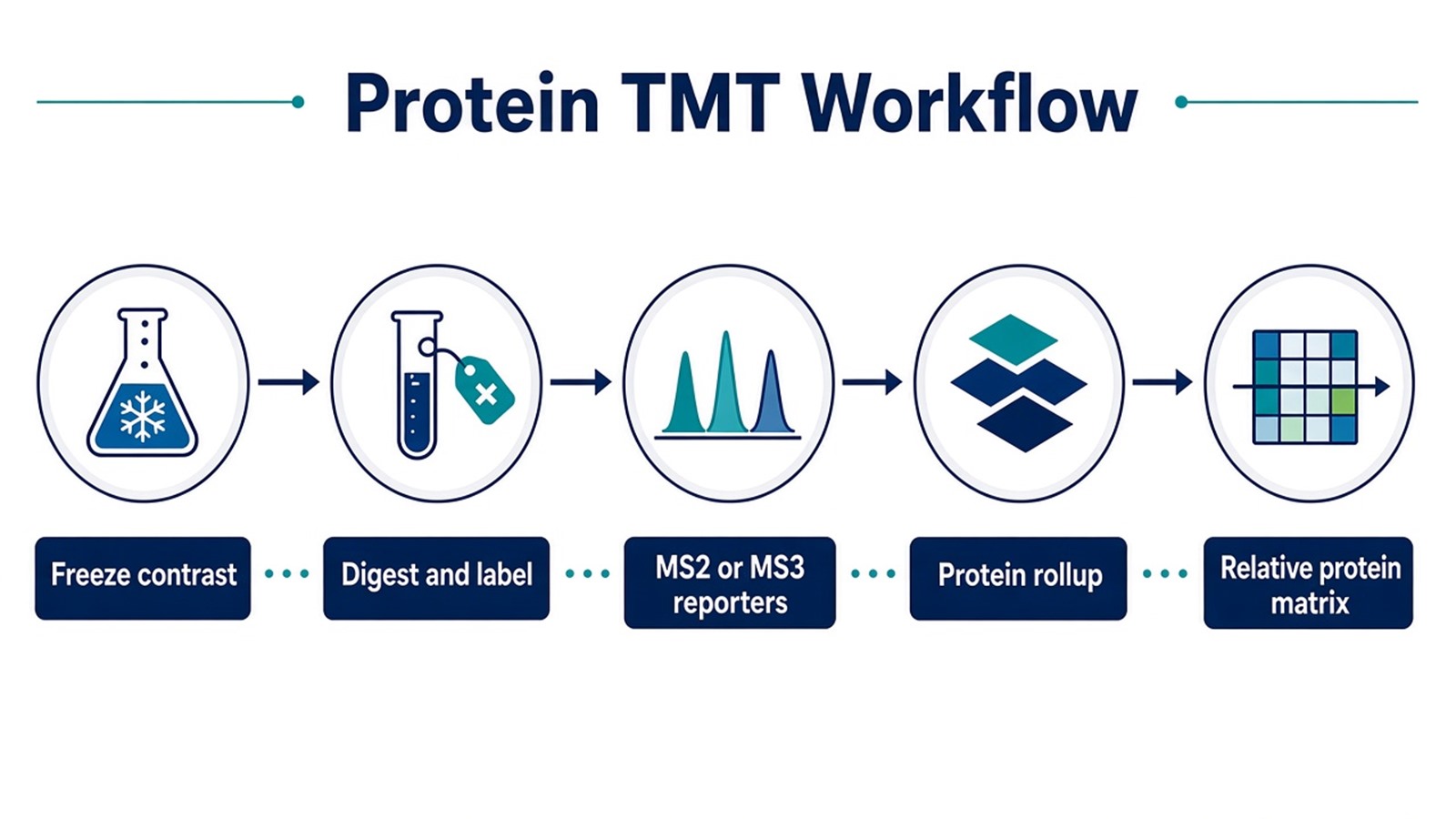
Figure 1. Protein TMT comparability depends on matched pretreatment and locked peptide-to-protein rules before protein contrasts are tested.
Parameters That Must Be Locked for Protein-Level Claims
Layer |
Parameter that must be declared |
Failure mode if ignored |
|---|---|---|
Contrast |
Groups and replicates before labeling |
Post hoc regrouping read as biology |
Channel map |
Tag-to-sample layout and bridge plan |
Unlinked plexes treated as one matrix |
Load |
Matched protein input across digests |
Channel offset as protein change |
Labeling |
Completeness checks and quench |
Incomplete tags as abundance change |
Reporter scan |
MS2 or MS3 rule |
Compressed peptide ratios as weak protein biology |
Inference |
Unique-peptide and protein-group rules |
Homolog mixing as differential protein |
Rollup |
Peptide-to-protein summary method |
Software default as silent biology change |
Normalization |
Within-plex assumption stated |
Scale drift as protein differential |
Missingness |
Protein filter and imputation policy |
Imputed zeros as real protein change |
Deliverable |
Protein matrix, channel map, method notes |
Report rebuilt after acquisition |
Limits follow the same table. Sample-type breadth language does not replace matched prep. Multiplex kit size does not raise biological replication by itself. High sensitivity claims do not create protein detectability for peptides that never yield an identification.
What a Protein TMT Result Can Support
A reviewed protein TMT matrix supports relative comparison of the same protein group across channels that were mixed into one plex. Pathway enrichment is optional after the matrix passes quality checks. It does not repair unmatched loads or invent diagnostic cutoffs.
A protein ratio inherits peptide-level failures: shared sequence, ratio compression, incomplete labeling, and missing reporters. Missing protein values do not prove absence in the sample. Different proteins cannot be ranked as copy numbers from reporter height.
A later unlabeled digest cannot join the same protein matrix. Named protein confirmation at the peptide level usually needs targeted parallel reaction monitoring (PRM) or multiple reaction monitoring (MRM). Absolute protein amount needs SIS-supported targeted assays.
A protein TMT table supports same-protein relative contrasts inside a locked plex. It does not certify biomarkers or therapy targets.
How to Choose Protein TMT Versus Adjacent Routes
Use freezable group structure, protein-level claim needs, and follow-up intent together.
Project need |
Route that often fits |
Recheck before committing |
|---|---|---|
Multi-group protein ratios on a fixed set |
Protein TMT in one plex |
Samples still arriving after mixing |
Shared chromatography across arms |
Matched load before labeling |
Channel offsets already visible in bulk assays |
Open enrollment cohort |
Unlabeled LFQ or DIA |
Force late samples into an existing TMT mix |
Compressed MS2 protein fold changes |
Protein TMT with MS3 review |
Keep MS2 without isolation QC |
Named peptide confirmation of a protein |
Targeted PRM or MRM follow-up |
Re-run the same protein matrix as confirmation |
Amount or concentration unit |
SIS-supported targeted assay |
Ordinary protein TMT ratios read as ng per mL |
Intact-protein mass claim |
Intact protein MS design |
Bottom-up protein TMT as intact mass |
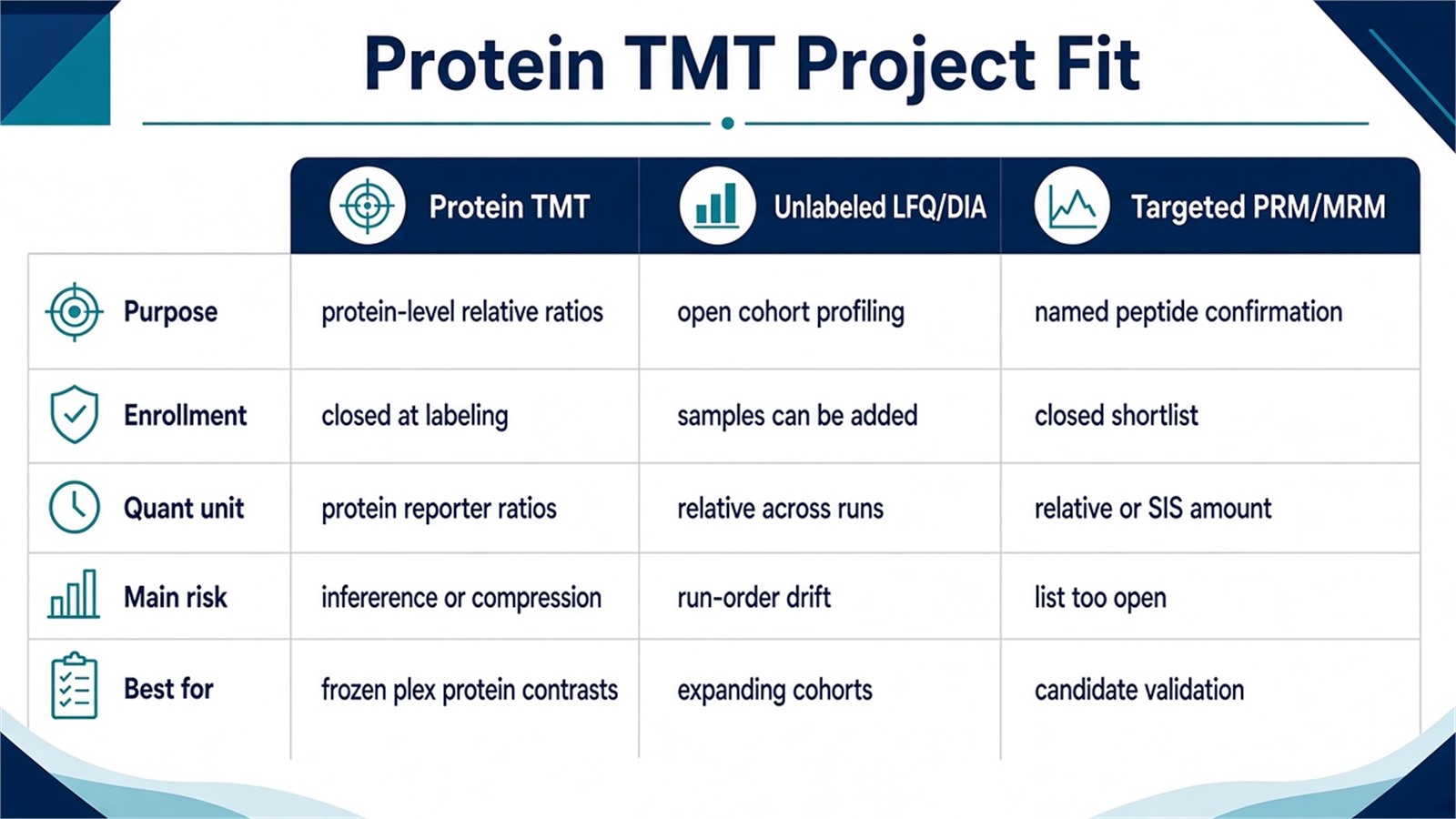
Figure 2. Choose protein TMT when groups can freeze into one plex and protein-level relative ratios are the claim; keep unlabeled or targeted routes when enrollment or claim unit changes.
Protein TMT more often fits a multi-group or closed time-course design that can be labeled together. An exception is a small, well-buffered set that still needs unlabeled flexibility because a follow-up harvest is already booked. Unlabeled label-free quantification more often fits open enrollment. An exception is a short closed cohort that must share one injection to limit run-order drift. Application framing for those designs appears in Application of TMT Labeling in Quantitative Proteomics Detection.
Teams with defined groups, matched protein material, and a requested protein-level relative contrast can review MtoZ Biolabs TMT Quantitative Proteomics Analysis Service when those fields are declared in the project record.
Frequently Asked Questions
1. Does protein TMT label intact proteins?
No in the usual bottom-up workflow. Proteins are digested first. TMT tags attach to peptide amines, and protein ratios are built after peptide-to-protein rollup.
2. Is a protein TMT ratio the same as a peptide reporter height?
No. Protein ratios depend on which peptides are accepted, how shared sequences are handled, and which summary rule is used after impurity correction.
3. Does protein TMT provide absolute protein concentration?
No. Standard protein TMT is relative inside a plex. Amount units need a matched SIS and a declared calibration.
4. Can one more sample join a protein TMT matrix after mixing?
Not as an extra reporter channel in the same mix. A new plex with a bridge or reference sample can connect experiments.
5. What project fields are needed before scoping protein TMT?
A versioned group map, sample matrix, matched protein material notes, protein-level relative versus amount claim, and any bridge plan help evaluate feasibility before labeling.
MtoZ Biolabs can provide protein-level TMT quantitative proteomics for predefined multi-group projects, including plex layout, labeling, LC-MS/MS, protein rollup, and relative matrix reporting when sample type and study design are available.
If further evaluation of channel mapping, protein-inference settings, MS2 versus MS3 readout, or whether unlabeled quantification fits better is needed, project details can be submitted for a feasibility review.
Reference
- A. Thompson, J. Schafer, K. Kuhn, S. Kienle, J. Schwarz, G. Schmidt, T. Neumann, R. Johnstone, A.K. Mohammed, C. Hamon (2003). Tandem mass tags: a novel quantification strategy for comparative analysis of complex protein mixtures by MS/MS. Anal. Chem., 75, 1895-1904. https://doi.org/10.1021/ac0262560
- L. Ting, R. Rad, S.P. Gygi, W. Haas (2011). MS3 eliminates ratio distortion in isobaric multiplexed quantitative proteomics. Nat. Methods, 8, 937-940. https://doi.org/10.1038/nmeth.1714
- A.I. Nesvizhskii, R. Aebersold (2005). Interpretation of shotgun proteomic data: the protein inference problem. Mol. Cell. Proteomics, 4, 1419-1440. https://doi.org/10.1074/mcp.R500012-MCP200
