



A laboratory applies label-free protein quantification when unlabeled digests must be compared as relative protein intensities across separate liquid chromatography-tandem mass spectrometry (LC-MS/MS) injections. Quantitative values come from MS1 chromatographic peak areas after data-dependent acquisition (DDA), or from extracted fragment traces when the same digests were acquired as data-independent acquisition (DIA) (Cox et al. 2014; Gillet et al. 2012). The useful application question is not which disease field mentions label-free methods. It is which study design needs open sample enrollment, or cannot freeze a multiplex set at labeling, and still needs a predefined group contrast.
Label-free application is relative by default. It does not report mass or molar concentration unless a matched stable isotope-labeled internal standard (SIS) is added for that peptide. Labeling chemistry and acquisition mode remain separate decisions. In MtoZ Biolabs offerings, unlabeled digests are commonly processed as DDA-based label-free or as DIA. Tandem mass tag (TMT) workflows are typically acquired as DDA to read reporter ions and are not interchangeable with a label-free matrix without a bridging design.
Study Designs Where Label-Free Quantification Is Commonly Applied
Label-free quantification is commonly applied to cohorts that may still receive later samples, to treatment-versus-control sets run as independent injections, and to time-course or phenotype panels where harvest dates cannot all be locked into one labeling day. Broad discovery inventories also fit when the protein list is still open and each file must keep its own chromatogram.
Those designs share one requirement. Each digest stays on its own injection path, so new files can be added if chromatography and processing stay comparable. The same requirement creates the main cost: cross-run alignment, normalization, and missing values must be handled explicitly. Spectral counting can rank detectability. It is a weak substitute for a calibrated fold-change matrix when group statistics are required.
Label-free quantification is applied to relative contrasts on independently injected unlabeled digests; acquisition as DDA or DIA is chosen next, not as a synonym for labeling.
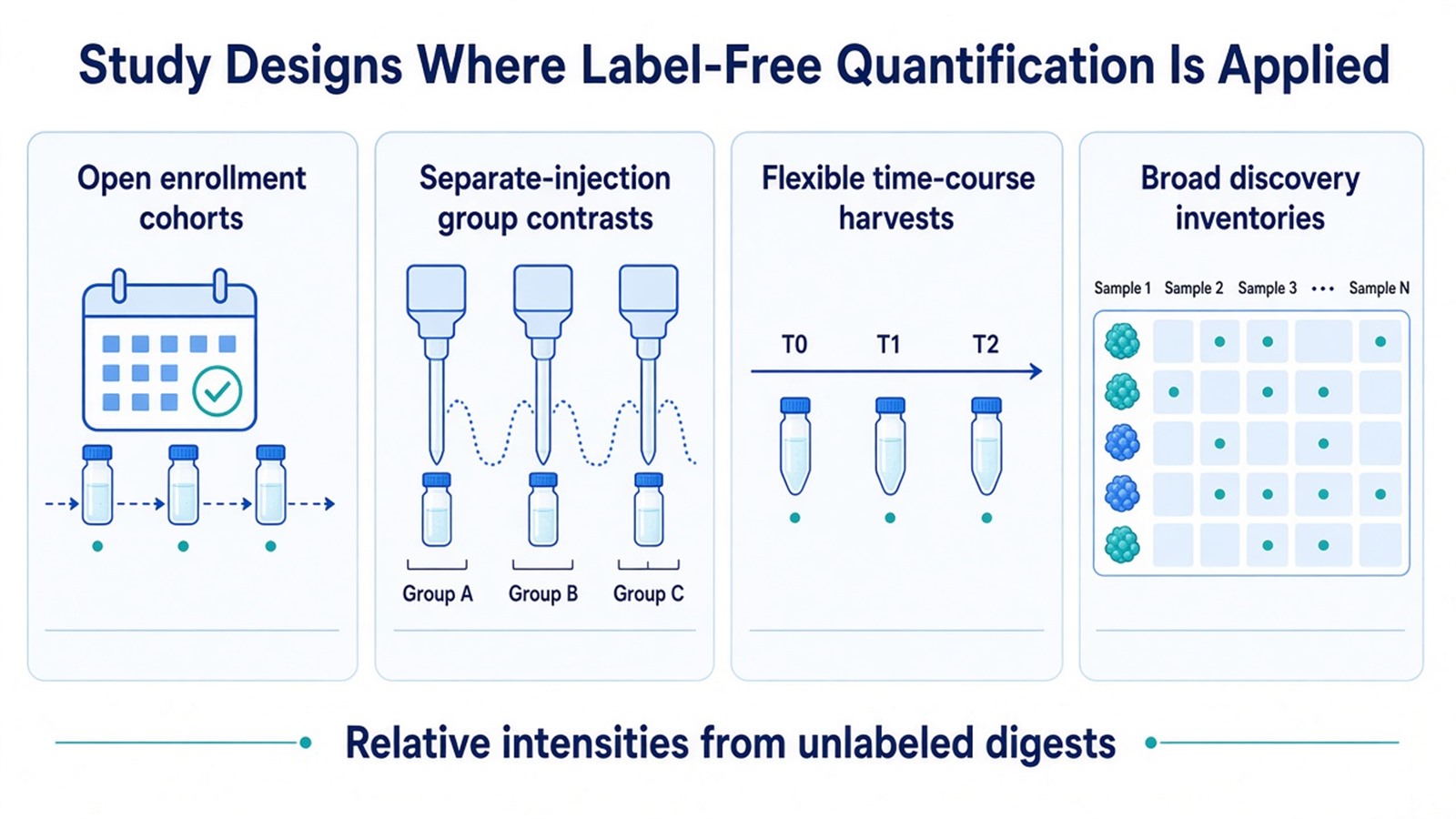
Figure 1. Label-free quantification is applied when samples need separate injections and the cohort may still grow after the first acquisition block.
A closed multi-group set that can be amine-labeled and mixed the same day more often fits TMT. Researchers can refer to Application of TMT Labeling in Quantitative Proteomics Detection when the remaining question is whether that freezable plex is available.
How an Application Moves from Separate Digests to a Relative Matrix
An applied label-free project follows a fixed order even when the biological theme changes. Proteins are extracted under matched conditions, digested, and checked for comparable load. Each digest is acquired as its own LC-MS/MS run under one chromatographic plan. Peptides are identified or extracted under declared false discovery rate (FDR) rules. Quantitative traces are aligned across runs, samples are normalized, peptides are summarized to proteins, and only then is the predefined contrast tested.
Application success depends on that order more than on a biomarker keyword. Unequal input, unstable spray, or run order that copies the experimental factor creates intensity shifts that look like biology after normalization. DDA label-free work commonly uses MS1 peak areas after identification. Unlabeled DIA extracts fragments from scheduled windows using a spectral library or a library-free route (Gillet et al. 2012). Database search identifies peptides. It is not itself a label-free quantification method.
Matrix construction details belong with analysis. Researchers can refer to A Guide to Label-Free Quantitative Proteomics: From Experiment to Data Analysis when the remaining question is alignment, missing values, or contrast testing on an LFQ table. Windowed fragment extraction details belong with DIA Data Analysis Methods in Proteomics.
Parameters That Decide Whether the Application Holds
Study design must name the contrast, biological replicate structure, and whether later files will be added. Interleaving groups across extraction and injection order remains a design task. Normalization cannot unmix a batch that is identical to treatment.
Matched protein input and digestion completeness decide whether separate injections remain comparable. Bulk assays still matter for load matching. They are not the label-free result. Chromatography stability, column age, and spray quality decide whether alignment can map the same peptide to the same row.
Acquisition parameters include DDA cycle settings or DIA window width and cycle time. Analysis parameters include FDR thresholds, quantification rule (MS1 area, MaxLFQ-style summarization, or DIA extractor settings), normalization assumption, missing-value rule, and the exact group contrast (Cox et al. 2014). Pathway enrichment is optional after the matrix passes quality checks. It is not a substitute for a failed acquisition block.
Limits of Applying Label-Free Quantification in Those Study Contexts
Label-free quantification does not invent proteins that were never identified. Missingness is expected at low abundance and is often abundance-dependent (Lazar et al. 2016). Imputation can enable a test and can invent a difference. Proteins missing in every group are weak discovery claims.
Application language such as biomarker discovery or mechanism study only holds when the assay returns a defensible relative matrix for predefined groups. It does not hold as a diagnostic claim, a therapy recommendation, or an absolute concentration. Multi-omics integration can use label-free ratios as one protein layer. It does not make intensities interchangeable with transcript or metabolite units.
A short named list that only needs fragment confirmation is a targeted follow-up application, not another round of open-list LFQ statistics. Amount claims need SIS-supported assays.
How to Choose Whether Label-Free Quantification Fits the Next Project
The useful test is whether samples must stay on separate injections, whether the claim is a relative ratio, and whether the protein list is still open.
Project need |
Label-free quantification often fits |
Recheck or choose another route |
|---|---|---|
Samples may be added after the first block |
Unlabeled DDA or DIA relative matrix |
Force late files into an already mixed TMT plex |
Treatment versus control, separate runs |
Independent-injection LFQ contrast |
Run order identical to treatment labels |
Flexible time-course harvests |
Label-free with interleaved acquisition |
All time points already frozen for one labeling day |
Closed set can be mixed now |
TMT relative plex |
Keep separate injections only for convenience |
Open protein inventory |
Label-free discovery matrix |
Closed peptide confirmation list |
Named peptides need remeasurement |
Targeted PRM or MRM |
Re-run open LFQ as confirmation |
Amount or concentration unit |
SIS-supported targeted assay |
Ordinary LFQ intensities read as ng per mL |
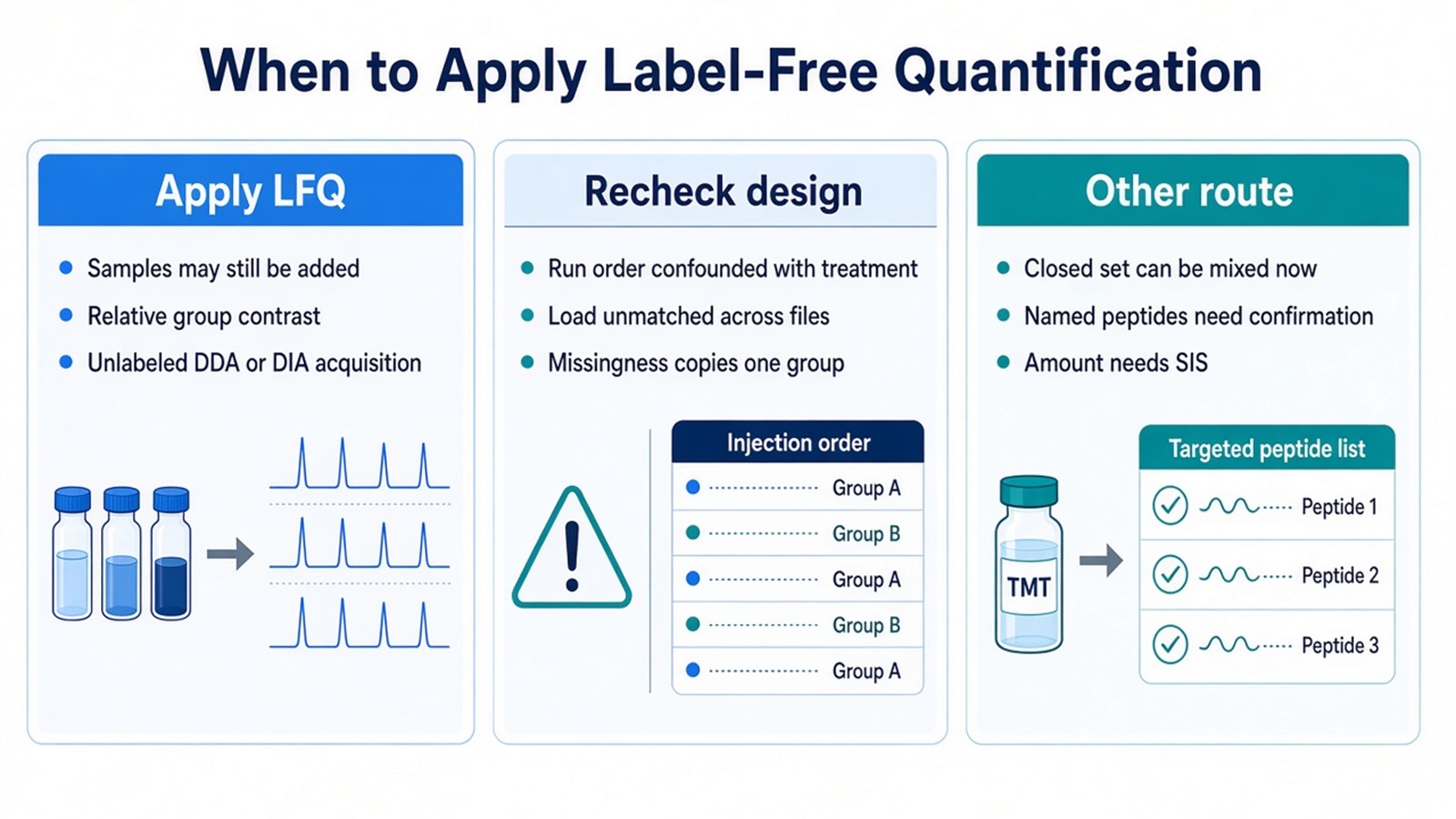
Figure 2. Apply label-free quantification when unlabeled separate injections and a relative contrast fit the study; closed multiplex sets and amount claims need another plan.
Label-free quantification more often fits open enrollment and flexible harvests. An exception is a short closed cohort that must share one injection to limit run-order drift, where TMT may fit better. TMT more often fits a freezable multi-group set. An exception is a tiny labeled-capable set that still expects a late harvest without a bridge sample.
Researchers who already have unlabeled digests, defined groups, and a requested relative contrast can also review the MtoZ Biolabs Label-Free Quantitative Proteomics Service for project-specific acquisition and analysis planning.
Frequently Asked Questions
1. Is a database search the same thing as label-free quantification?
No. Database search assigns peptide and protein identities. Label-free quantification extracts relative intensities from unlabeled MS1 or DIA fragment traces after those identities, or in parallel under a declared extraction rule.
2. Is DIA automatically the label-free application method?
No. DIA is an acquisition schedule. Label-free is a chemistry choice. Unlabeled digests are often acquired as DIA, and a labeled digest can be acquired with DIA in other designs.
3. Can label-free intensities be used as absolute biomarker concentrations?
No. Reporter-free intensities support relative comparison inside a study. Concentration reporting needs a matched SIS and a declared calibration.
4. When should a growing cohort stay on label-free methods instead of TMT?
Stay on label-free methods when later samples are expected and no bridge plex is planned. Move toward TMT when the full comparison set can be labeled and mixed before acquisition.
5. Does label-free application replace targeted confirmation of discovery candidates?
No. Label-free application builds or updates an open relative matrix. A short named list still belongs on a scheduled PRM or MRM assay when fragment-level confirmation is the remaining task.
MtoZ Biolabs can provide label-free protein quantification applications for unlabeled DDA or DIA projects, including separate-injection acquisition, relative matrix generation, and predefined group contrasts when sample type and study design are available.
If further evaluation of open enrollment versus a TMT plex, DDA versus DIA acquisition, or targeted follow-up routing is needed, project details can be submitted for a feasibility review.
Reference
- J. Cox, M.Y. Hein, C.A. Luber, I. Paron, M. Mann (2014). Accurate proteome-wide label-free quantification by delayed normalization and maximal peptide ratio extraction, termed MaxLFQ. Mol. Cell. Proteomics, 13, 2513-2526. https://doi.org/10.1074/mcp.M113.031031
- L.C. Gillet, P. Navarro, S. Tate, H. Rost, N. Selevsek, L. Reiter, R. Bonner, R. Aebersold (2012). Targeted data extraction of the MS/MS spectra generated by data-independent acquisition: a new concept for consistent and accurate proteome analysis. Mol. Cell. Proteomics, 11, O111.016717. https://doi.org/10.1074/mcp.O111.016717
- C. Lazar, L. Gatto, M. Ferro, C. Bruley, T. Burger (2016). Accounting for the multiple natures of missing values in label-free quantitative proteomics data sets to compare imputation strategies. J. Proteome Res., 15, 1116-1125. https://doi.org/10.1021/acs.jproteome.5b00981
