



Quantitative proteomics in disease and drug discovery is applied when a predefined biological contrast needs relative protein abundance changes, not when a disease keyword alone justifies a run (Bantscheff et al. 2012). Mechanism studies compare disease-model versus control states, genetic or environmental perturbations, or staged pathology. Drug discovery studies compare pre- and post-treatment samples, dose levels, or compound panels under matched matrix and timing rules. The guide below maps those application contexts to workable LC-MS/MS routes. It is not a diagnostic catalog, not a method-definition encyclopedia, and not a fixed price guide.
Application still depends on labeling chemistry, acquisition mode, and whether the claim is a relative ratio or a stable isotope-labeled internal standard (SIS) amount. Unlabeled digests can be acquired as data-dependent acquisition (DDA) or data-independent acquisition (DIA). Isobaric tandem mass tag (TMT) work needs a freezable plex. Named targets are typically followed by parallel reaction monitoring (PRM) or multiple reaction monitoring (MRM). In MtoZ Biolabs offerings, unlabeled discovery is commonly run as DDA label-free or DIA, multiplexed isobaric work is typically evaluated as TMT, and closed lists are typically followed by PRM, with MRM when a scheduled triple-quadrupole panel already exists.
Application Contexts in Disease Mechanism and Drug Studies
Two application families cover most disease and drug projects, and they differ in contrast design more than in disease name.
Disease mechanism contrasts compare states that define pathology or progression. Examples include mutant versus wild-type cells, staged tissue injury, or patient-derived models versus matched controls when enrollment allows. The scientific need is usually an open protein inventory with a declared group contrast.
Drug effect contrasts compare samples before and after intervention. Examples include compound treatment versus vehicle, dose titration, or time-course response after exposure. The scientific need is still a relative matrix, but harvest timing, washout, and matrix type must match the pharmacology question.
Both families fail when groups are confounded with batch, when only total protein load is measured, or when discovery intensities are read as clinical concentration. Bulk dye assays help match input. They do not replace peptide-level quantification.
Quantitative proteomics applies to disease and drug work when groups, timing, and claim type are fixed before acquisition, not when a disease label replaces study design.
Researchers who need cross-route definitions before choosing an application can refer to What Are the Quantitative Methods for Proteomics?.
Study Designs That Map Disease and Drug Questions to Routes
Application choice follows enrollment flexibility and whether samples can be mixed at labeling.
Open enrollment fits disease cohorts or drug studies that may still add samples. Unlabeled label-free quantification (LFQ) with separate injections more often fits that pattern (Cox et al. 2014). Unlabeled DIA fits when windowed acquisition and extraction rules are declared (Gillet et al. 2012).
Freezable multi-group sets fit treatment panels, dose levels, or time points that can be tagged the same day. TMT relative plexes more often fit when channel maps are written before mixing (Thompson et al. 2003). Researchers can refer to Application of TMT Labeling in Quantitative Proteomics Detection when the remaining question is a closed multiplex design.
Short candidate lists after discovery fit confirmation of named peptides. Targeted PRM or MRM more often fits when the list is closed and duty cycle is realistic (Lange et al. 2008; Peterson et al. 2012). SIS-supported targeted assays are required only when the claim is peptide amount (Gerber et al. 2003).
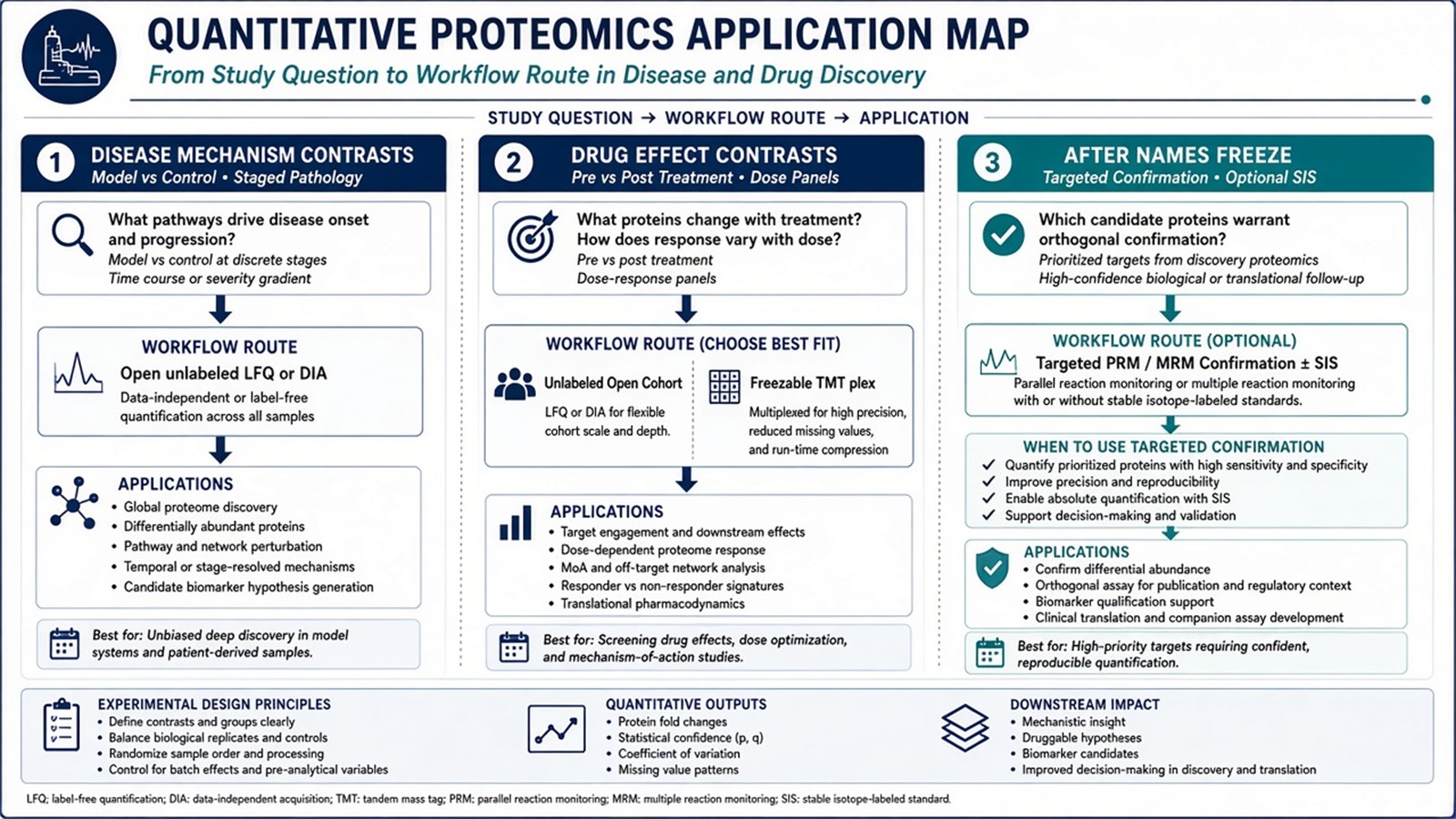
Figure 1. Disease mechanism and drug discovery applications map to open unlabeled contrasts, freezable TMT panels, or targeted confirmation after names freeze.
Post-translational modification enrichment is a separate application layer. It changes sample prep and interpretation. It does not replace a defensible relative matrix for the main contrast.
Shared Workflow from Contrast Design to Applied Results
Applied disease and drug projects still follow one spine: matched extraction and digestion, LC-MS/MS under a declared mode, identification or targeted extraction, protein rollup, and a contrast that matches the sample map.
Mechanism studies must keep genotype, stage, or model type out of run order. Drug studies must keep treatment, dose, and harvest time out of lysis batch unless interleaving is explicit. TMT adds labeling completeness and pooling before acquisition. Targeted work inserts peptide selection before cohort acquisition.
Application success depends on that order more than on field-specific language. Unequal input, treatment-confounded injection order, incomplete TMT labeling, or an oversized targeted panel can erase the contrast after the instrument run looks complete.
Pathway enrichment or multi-omic overlay can help interpret a cleaned matrix. It cannot repair missingness, batch effects, or amount claims made without SIS (Lazar et al. 2016).
Parameters and Limits That Decide Whether the Application Holds
Parameter |
Why it matters in disease and drug work |
Failure mode if ignored |
|---|---|---|
Predefined contrast |
Separates mechanism from drug claims |
Post hoc group labels on files |
Matched input and matrix |
Keeps peptide yield comparable |
Apparent drug effects from load bias |
Run-order or channel map |
Separates biology from batch |
Treatment tracks injection day |
Acquisition and FDR rules |
Define which features enter the matrix |
Long lists with weak quantitative traces |
Missing-value rule |
Controls dropout in open cohorts |
Soft contrasts after imputation |
SIS assignment |
Supports amount claims on targets |
Discovery peaks read as concentration |
Limits follow the same table. Quantitative proteomics does not prove diagnostic utility, predict therapy, or replace validated clinical assays. Candidate proteins from discovery are not biomarkers until a separate validation design exists. Drug target lists from one contrast are hypotheses until orthogonal evidence is planned.
Mechanism language and drug-response language only hold when the assay returns a defensible relative matrix for predefined groups. Plasma discovery with unequal depletion, or a full cohort run before a pilot digest, are design failures, not application upgrades.
Researchers who need unlabeled application detail can refer to The Importance and Applications of Label-Free Protein Quantification Methods in Mass Spectrometry. For three-axis selection after the application context is clear, see Protein Quantification Method.
How to Choose a Route for the Next Disease or Drug Project
Use contrast type, enrollment flexibility, and claim unit to choose the application route.
Project need |
Application route that often fits |
Recheck before committing |
|---|---|---|
Open cohort, mechanism or drug arms may grow |
Unlabeled DDA LFQ or unlabeled DIA |
Run order identical to treatment |
Closed treatment, dose, or time-course set |
TMT relative plex |
Later harvests without a bridge |
Pre versus post drug in matched models |
Relative contrast with interleaved acquisition |
Harvest time confounded with batch |
Plasma or fluid discovery |
Equal prep across groups |
Depletion on only one arm |
Short list after discovery |
PRM or MRM confirmation |
Panel longer than one duty cycle |
Mass or molar unit on named peptides |
Targeted assay plus matched SIS |
Relative peaks read as concentration |
Only pathway storytelling |
Fix matrix QC first |
Enrichment without a clean table |
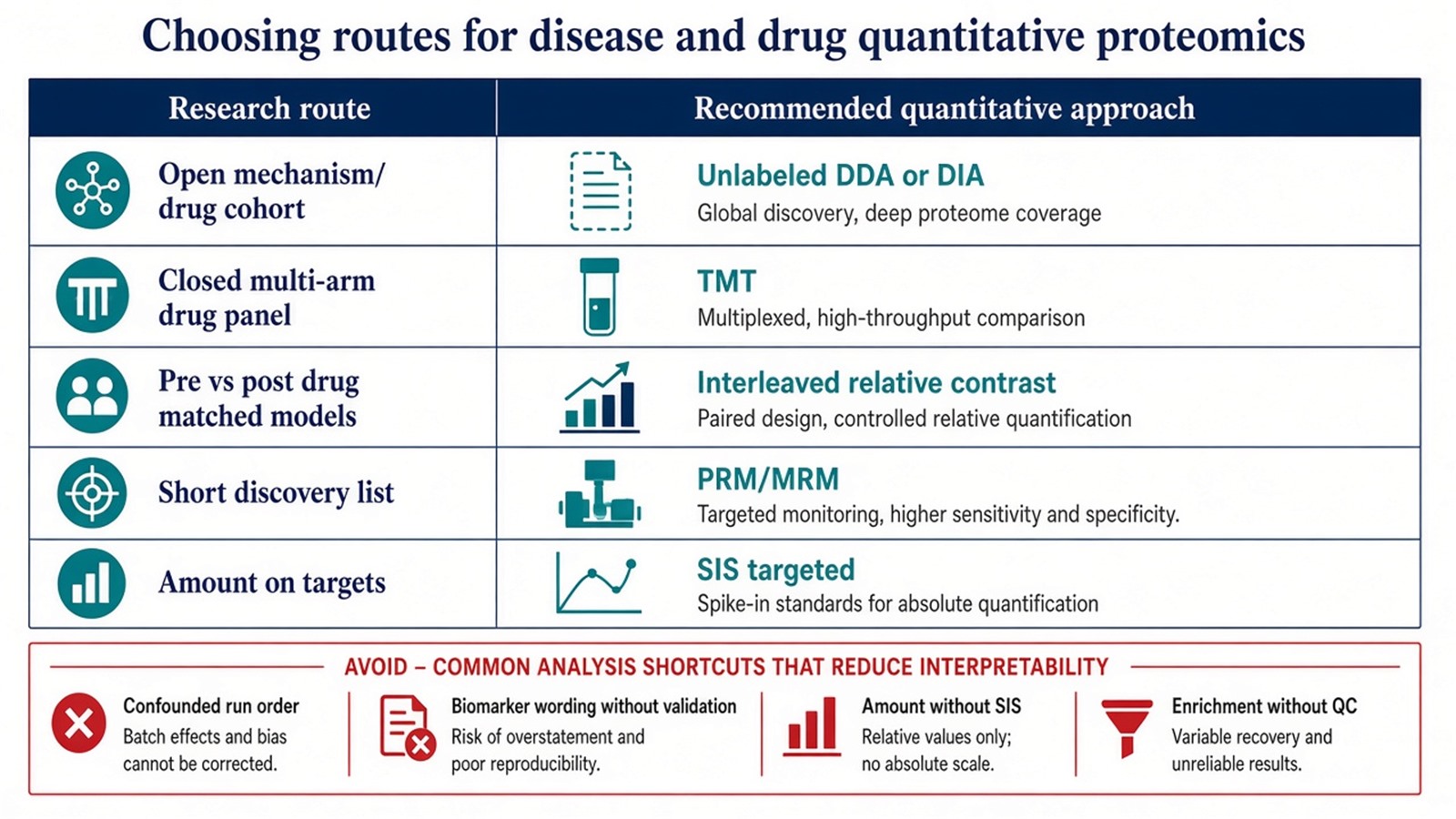
Figure 2. Choose unlabeled, TMT, or targeted routes from contrast design and claim unit; confounded groups and amount-without-SIS requests need repair first.
Unlabeled discovery more often fits open mechanism or drug cohorts. TMT more often fits freezable multi-arm drug panels. Targeted confirmation more often fits after names freeze. Exceptions exist when a tiny validated panel never needed discovery, or when a short closed cohort must share one injection to limit run-order drift.
Teams that already have model type, contrast, enrollment plan, and a requested claim can also review the MtoZ Biolabs Quantitative Proteomics Service for project-specific application planning.
Frequently Asked Questions
1. Does disease research automatically require TMT?
No. TMT fits when the full comparison set can be labeled and mixed. Open mechanism cohorts or ongoing drug enrollment more often stay unlabeled.
2. Can discovery results be called biomarkers for clinical use?
No. Discovery yields candidate proteins for predefined contrasts. Clinical biomarker use needs a separate validation and assay design.
3. Is a pre versus post drug design the same as a mechanism study?
No. Drug designs center on intervention timing and dose. Mechanism designs center on pathological state. Both need matched matrices and explicit contrasts.
4. When should targeted methods follow disease or drug discovery?
When names freeze and the next claim needs scheduled remeasurement or an SIS amount. Open discovery remains the first step when the list is still unknown.
5. Can pathway enrichment replace quantitative QC in drug studies?
No. Enrichment interprets a cleaned matrix. It cannot repair batch effects, missingness, or amount claims made without SIS.
MtoZ Biolabs can support quantitative proteomics applications across unlabeled DDA or DIA discovery, TMT relative plexes, and targeted PRM or MRM follow-up when sample type, study design, and the intended claim are available.
If further evaluation of mechanism versus drug contrasts, enrollment flexibility, or confirmation after discovery is needed, project details can be submitted for a feasibility review.
Reference
- M. Bantscheff, S. Lemeer, M.M. Savitski, B. Kuster (2012). Quantitative mass spectrometry in proteomics: critical review update from 2007 to the present. Anal. Bioanal. Chem., 404, 939-965. https://doi.org/10.1007/s00216-012-6203-4
- J. Cox, M.Y. Hein, C.A. Luber, I. Paron, M. Mann (2014). Accurate proteome-wide label-free quantification by delayed normalization and maximal peptide ratio extraction, termed MaxLFQ. Mol. Cell. Proteomics, 13, 2513-2526. https://doi.org/10.1074/mcp.M113.031031
- S.A. Gerber, J. Rush, O. Stemman, M.W. Kirschner, S.P. Gygi (2003). Absolute quantification of proteins and phosphoproteins from cell lysates by tandem MS. Proc. Natl. Acad. Sci. U.S.A., 100, 6940-6945. https://doi.org/10.1073/pnas.0832254100
- L.C. Gillet, P. Navarro, S. Tate, H. Rost, N. Selevsek, L. Reiter, R. Bonner, R. Aebersold (2012). Targeted data extraction of the MS/MS spectra generated by data-independent acquisition: a new concept for consistent and accurate proteome analysis. Mol. Cell. Proteomics, 11, O111.016717. https://doi.org/10.1074/mcp.O111.016717
- V. Lange, P. Picotti, B. Domon, R. Aebersold (2008). Selected reaction monitoring for quantitative proteomics: a tutorial. Mol. Syst. Biol., 4, 222. https://doi.org/10.1038/msb.2008.61
- C. Lazar, L. Gatto, M. Ferro, C. Bruley, T. Burger (2016). Accounting for the multiple natures of missing values in label-free quantitative proteomics data sets to compare imputation strategies. J. Proteome Res., 15, 1116-1125. https://doi.org/10.1021/acs.jproteome.5b00981
- A.C. Peterson, J.D. Russell, D.J. Bailey, M.S. Westphall, J.J. Coon (2012). Parallel reaction monitoring for high resolution and high mass accuracy quantitative, targeted proteomics. Mol. Cell. Proteomics, 11, 1475-1488. https://doi.org/10.1074/mcp.O111.013698
- A. Thompson, J. Schafer, K. Kuhn, S. Kienle, J. Schwarz, G. Schmidt, T. Neumann, R. Johnstone, A.K. Mohammed, C. Hamon (2003). Tandem mass tags: a novel quantification strategy for comparative analysis of complex protein mixtures by MS/MS. Anal. Chem., 75, 1895-1904. https://doi.org/10.1021/ac0262560
