



Selected reaction monitoring (SRM) is the triple quadrupole method that records predefined precursor-to-product transitions for targeted quantitative proteomics (Lange et al. 2008). In project language, SRM and multiple reaction monitoring (MRM) name the same scheduled transition logic on liquid chromatography-tandem mass spectrometry (LC-MS/MS). The assay uses a closed peptide panel, matched pretreatment, and contrast statistics on frozen groups. It is not open discovery label-free quantification (LFQ), not intact-protein mass measurement, and not a diagnostic test by default. The guide below integrates SRM within targeted quantitative proteomics with workflow, locked parameters, limits, and project fit. It is not an ionization textbook, not a disease application catalog, and not a software version list.
SRM outputs support relative change of the same peptide across samples in one study. Amount on named peptides needs stable isotope-labeled internal standard (SIS) peptides and a calibration model in the study matrix (Gerber et al. 2003). Protein inference still depends on peptide uniqueness and digest mapping (Bantscheff et al. 2012).
In MtoZ Biolabs targeted offerings, SRM or MRM methods are built when the peptide list is closed and matrix-matched transition pilots support the cohort block. Service intake appears in SRM-MRM Quantitative Proteomics Services.
What SRM Covers in Targeted Quantitative Proteomics
Four scopes belong in the brief and stay separated.
Assay scope is targeted. Only peptides and transitions on the inclusion list are scheduled. Open database search breadth is outside this record.
Detection scope is quadrupole isolation of a precursor, collision-cell fragmentation, and quadrupole passage of a prechosen product ion for each dwell period.
Informatics scope covers peak integration, transition-ratio review, normalization or SIS calibration, and statistics on predefined contrasts only.
Claim scope is relative peptide change, or calibrated amount when SIS and a curve are declared. Biomarker or drug-target language needs separate study design.
SRM is scheduled transition monitoring on a closed panel. It does not profile the proteome from the same method file.
SRM Versus MRM Naming, PRM, and Discovery LFQ
Naming and route choice should stay independent.
SRM and MRM are used interchangeably in many targeted proteomics briefs. Both describe scheduled precursor-product pairs on triple quadrupole instruments. The project record should lock one method name and one transition list version.
Parallel reaction monitoring (PRM) isolates the precursor and records a high-resolution product-ion spectrum so fragments can be reviewed after acquisition (Peterson et al. 2012). PRM fits when SRM transitions remain unstable after matrix-matched optimization. Route choice after matrix pilot appears in Parallel Reaction Monitoring vs MRM: Which Fits?.
Discovery LFQ compares aligned intensities across unlabeled injections without a closed schedule. SRM fits after candidates are named.
Electrospray LC-MS/MS is the usual SRM proteomics interface. Matrix-assisted laser desorption ionization is not the default sample introduction for scheduled peptide SRM cohorts.
End-to-End Workflow for Targeted SRM Quantification
A practical SRM spine usually runs as follows.
- Freeze contrast, replicates, and relative versus amount claim.
- Close the peptide panel and map each peptide to its protein or site.
- Match extraction, digest, and load across all contrast arms.
- Select transitions and collision energies on matrix-matched digests.
- Build dwell times and retention windows with realistic cycle time.
- Size biological n plus quality control (QC), blanks, and SIS if used.
- Acquire interleaved study and QC injections when cohort size allows.
- Integrate peaks; review transition ratios against prespecified rules.
- Test predefined contrast only; archive transition list and software versions with deliverables.
Steps 1 through 3 protect the sample record. Steps 4 through 9 produce the targeted quantitative record. Sample and pretreatment scoping appears in Scoping an MRM Quantitation Project: Transition Design, Sample Count, and Validation Deliverables.
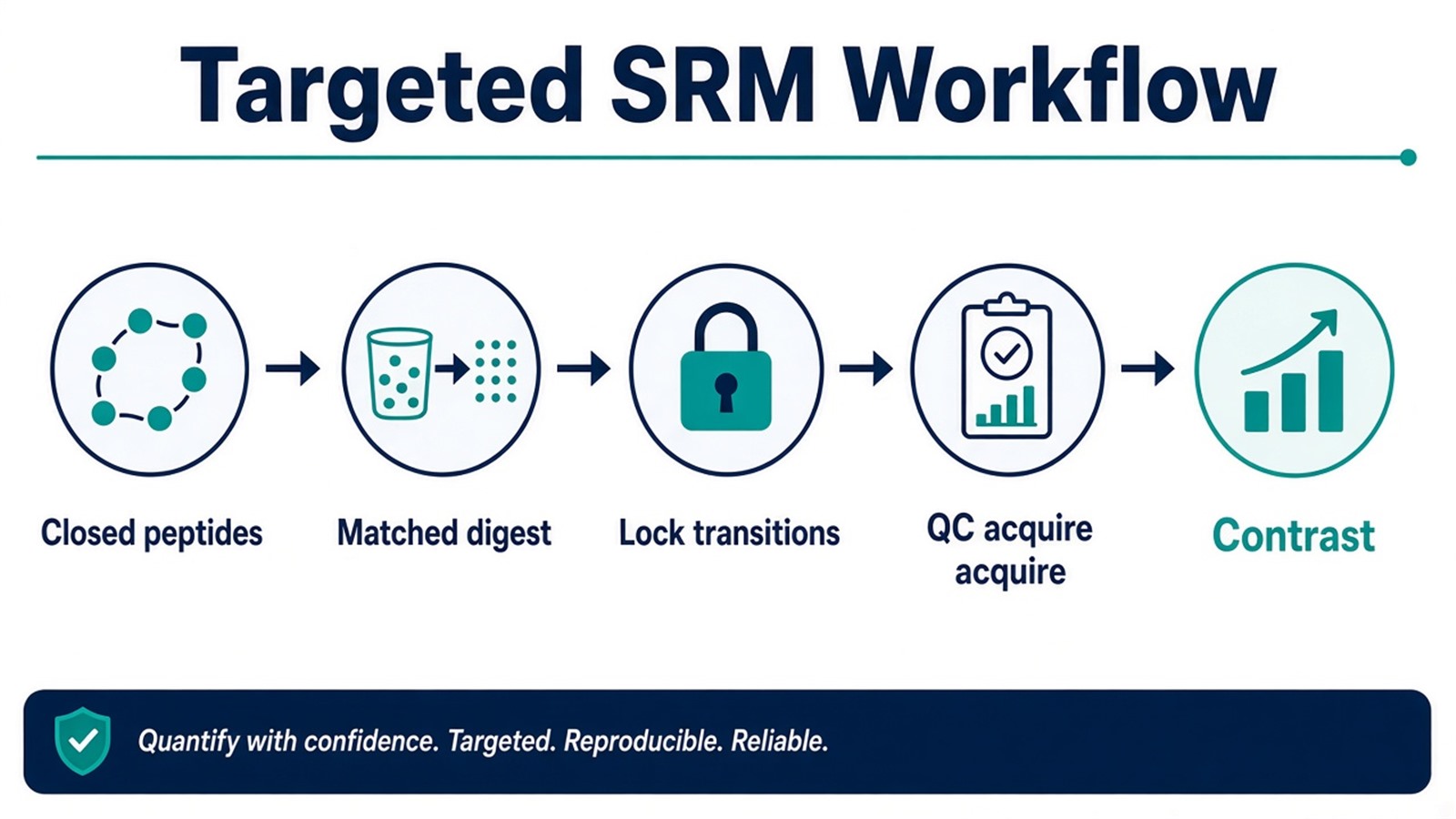
Figure 1. SRM comparability depends on a closed transition list and matched pretreatment before group contrasts are tested.
Parameters That Must Be Locked in SRM Methods
Layer |
Parameter that must be declared |
Failure mode if ignored |
|---|---|---|
Panel |
Peptide list version and protein mapping |
Moving targets mid study |
Transitions |
Precursor, products, dwell, collision energy |
Neat-standard methods fail in matrix |
Schedule |
Cycle time versus panel size |
Missing peaks at elution |
Prep |
Matched extraction and digest |
Peptide-pool shift as biology |
Load |
Mass on column from pilot |
Saturation or dropped transitions |
SIS |
Spike step aligned to claim |
Peptide amount as extract amount |
QC |
Pools, blanks, and bracket pattern |
Undetected batch drift |
Contrast |
Frozen before peak review |
Post hoc arm relabeling |
Software |
Integration version archived |
Non-reproducible peaks |
Deliverable |
Table, transition list, QC notes |
Report rebuilt after acquisition |
Limits follow the same table. SRM does not remove matrix suppression. Large panels do not replace a small, prep-stable list when cycle time is tight. Discovery identification of a peptide does not prove SRM quantifiability after cleanup (Gallien et al. 2012).
How to Choose SRM Versus Other Quantitative Routes
Use list status, matrix pilot, claim unit, and instrument context together.
Project need |
Route that often fits |
Recheck before committing |
|---|---|---|
Closed peptides, clean transitions in matrix |
SRM or MRM on triple quadrupole |
Open LFQ as the targeted table |
Transition ratios unstable after prep lock |
PRM subset or hybrid panel |
Whole-panel PRM without need |
Open proteome relative profiling |
Label-free LFQ or DIA |
SRM on unnamed proteins |
Amount on named peptides |
SRM or PRM with SIS and curve |
Relative peaks as concentration |
Transferred SRM method, same matrix |
Acquisition plus QC |
Assume free method rebuild |
Intact-protein or epitope claim |
Not peptide SRM alone |
Bottom-up surrogate as intact amount |
Diagnostic or prognostic cutoff |
Separate validation design |
Discovery or SRM table as clinical test |
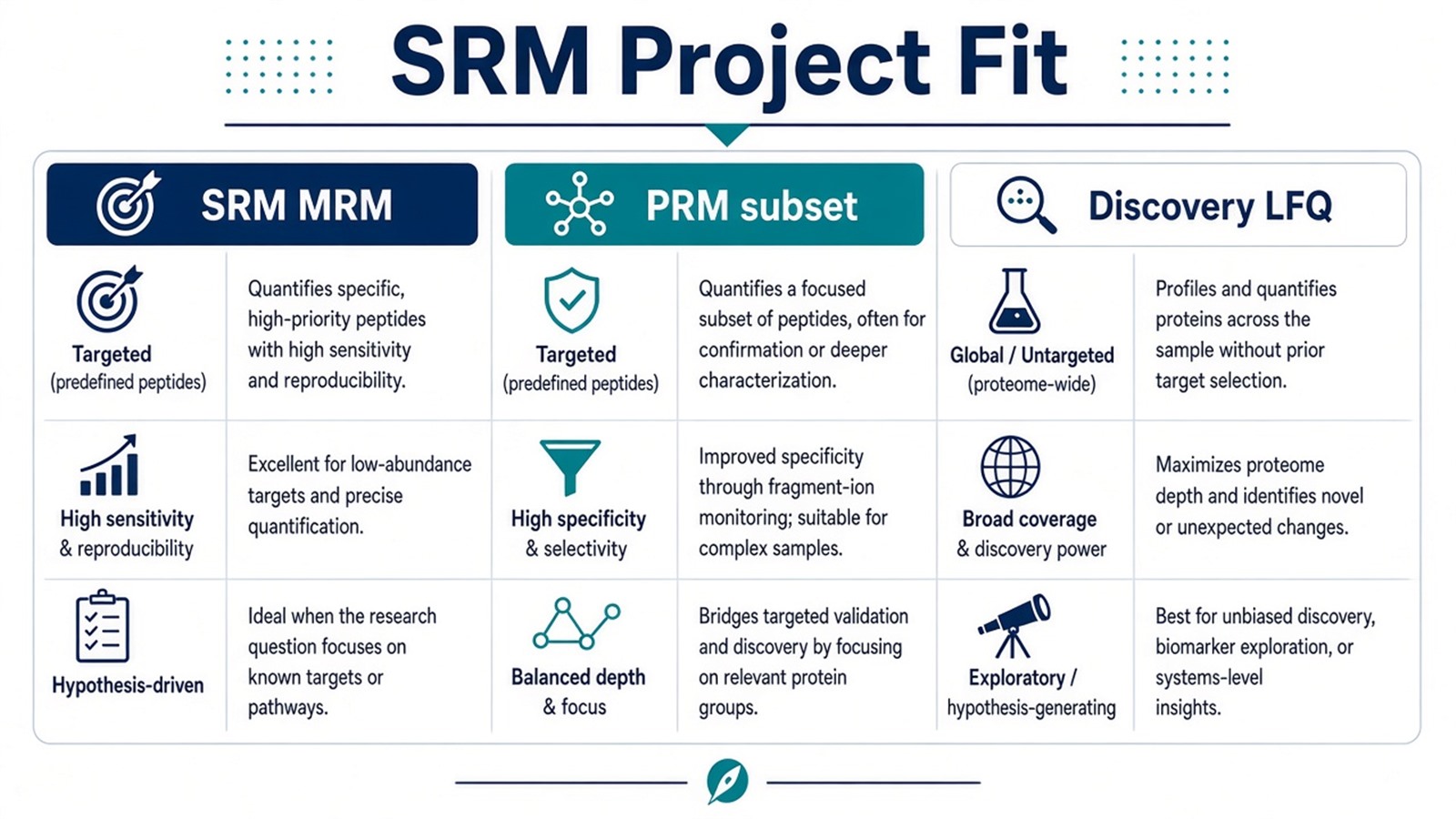
Figure 2. Choose SRM when a closed transition list is stable in the study matrix; use PRM or discovery when list status or interference changes the need.
Teams with closed peptide targets, contrast map, and matrix notes can review MtoZ Biolabs SRM-MRM Quantitative Proteomics Services when those fields are declared in the project record.
Frequently Asked Questions
1. Is SRM the same as MRM?
In most targeted proteomics briefs, yes. Both name scheduled precursor-product monitoring on triple quadrupole LC-MS/MS. The record should lock one name and one transition list.
2. Does SRM validate biomarkers or diagnose disease?
SRM can remeasure closed peptide candidates. Validation status and clinical cutoffs depend on study design, not on SRM acquisition alone.
3. Can SRM replace discovery quantitative proteomics?
No. Discovery nominates candidates. SRM measures a frozen shortlist. Mixing those intents on one file splits the analysis record.
4. Must every SRM project use SIS peptides?
No. Relative contrasts can run light-only when that claim is declared. SIS and a curve become necessary when amount units are required.
5. When should projects move from SRM to PRM?
When matrix-matched pilots still show unstable transition ratios after cleanup and collision-energy work, a PRM subset can be scoped.
MtoZ Biolabs can discuss SRM and MRM scoping when peptide panel, pretreatment parity, and contrast design are documented.
If further evaluation of SRM versus PRM, SIS calibration, or discovery-to-targeted handoff is needed, project details can be submitted for a feasibility review.
Reference
- V. Lange, P. Picotti, B. Domon, R. Aebersold (2008). Selected reaction monitoring for quantitative proteomics: a tutorial. Mol. Syst. Biol., 4, 222. https://doi.org/10.1038/msb.2008.61
- A.C. Peterson, J.D. Russell, A.A. Klammer, P.F. Doubleday, H. Liu, J.N. Anderson, M.J. MacCoss (2012). Parallel reaction monitoring for high resolution and high mass accuracy quantitative, targeted proteomics. Mol. Cell. Proteomics, 11, 1475-1488. https://doi.org/10.1074/mcp.O112.020271
- S.A. Gerber, J. Rush, O. Stemman, M.W. Kirschner, S.P. Gygi (2003). Absolute quantification of proteins and phosphoproteins from cell lysates by tandem MS. Proc. Natl. Acad. Sci. U.S.A., 100, 6940-6945. https://doi.org/10.1073/pnas.0832254100
- M. Bantscheff, S. Lemeer, H.U. Haab, B. Kuster (2012). Quantitative mass spectrometry in proteomics: a critical review. Anal. Bioanal. Chem., 404, 939-965. https://doi.org/10.1007/s00216-012-5892-4
- S. Gallien, E. Duriez, A. Crone, M. Kellmann, T. Moehring, T. Domon (2012). Targeted proteomic quantification on quadrupole-orbitrap mass spectrometers. Mol. Cell. Proteomics, 11, 1709-1723. https://doi.org/10.1074/mcp.O112.019232
