Targeted Quantitative Service
MtoZ Biolabs provides Targeted Quantitative Proteomics Service using PRM or MRM/SRM for predefined proteins and peptides. We support relative and absolute quantification, with stable isotope-labeled peptides and calibration curves available for absolute measurement.
This service is designed for studies with a defined target list, including validation of candidate proteins identified by DIA, TMT, or Label-Free proteomics, targeted quantification of pathway proteins, candidate biomarker studies, and quantification of specific proteins or PTM peptides.
- Orbitrap High-Resolution PRM with Quantitative CV <15%
- PRM & MRM/SRM Targeted Quantification
- Relative & Absolute Protein Quantification
What Is Targeted Quantitative Proteomics?
Targeted quantitative proteomics is a mass spectrometry-based strategy for selective detection and quantification of predefined proteins or peptides.
Target proteins are digested into peptides, and proteotypic peptides with suitable specificity and MS response are selected as quantitative surrogates. Following LC separation, the mass spectrometer selectively acquires signals from these target peptides for focused and reproducible quantification.
Common strategies include PRM (Parallel Reaction Monitoring) and MRM/SRM (Multiple/Selected Reaction Monitoring). PRM acquires high-resolution fragment-ion spectra of selected precursors, while MRM/SRM monitors predefined precursor-product ion transitions. Both support relative quantification, while stable isotope-labeled peptide standards and calibration curves can be incorporated for absolute quantification.
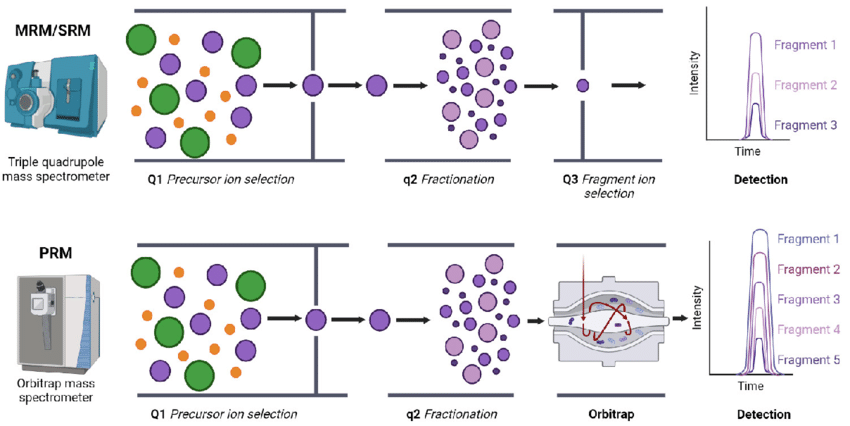
Guerrero, L. et al. Metabolites. 2022.
Figure 1. Principles of SRM/MRM and PRM
When combined with stable isotope-labeled internal standards (e.g., SILAC or AQUA peptides), we achieve absolute quantification, ensuring data accuracy and reproducibility in complex sample matrices.
When Is Targeted Quantitative Proteomics a Good Fit?
|
Your Research Need |
Recommended Targeted Quantification Strategy |
|
Validate candidate proteins identified by DIA, TMT, or Label-Free proteomics |
PRM or MRM/SRM relative quantification |
|
Compare target protein abundance across experimental groups |
PRM or MRM/SRM relative quantification |
|
Repeatedly measure a fixed protein panel across a larger sample cohort |
MRM/SRM or an optimized PRM workflow |
|
Quantify low-abundance target proteins |
PRM or MRM/SRM selected based on sample matrix, target abundance, and peptide response |
|
Determine absolute protein or peptide amount/concentration |
Stable isotope-labeled peptides + PRM/MRM-SRM + calibration curve |
|
Quantify specific PTM sites |
Targeted analysis of modification-specific peptides, with enrichment and isotope-labeled internal standards when needed |
Not sure whether PRM or MRM/SRM is appropriate? Method selection can be evaluated based on your target list, target abundance, sample matrix, sample number, and quantitative requirements.
Analysis Workflow
1. Target & Peptide Selection
Review target proteins and select suitable representative peptides based on sequence specificity, MS response, and project requirements.
2. Method Development
Select PRM or MRM/SRM and optimize target precursors, fragment ions/transitions, retention times, and acquisition parameters.
3. Internal Standard & Calibration Design
Design the quantification strategy and, for absolute quantification, incorporate stable isotope-labeled peptides and calibration curves.
4. Sample Preparation & LC-MS/MS Analysis
Perform protein extraction, enzymatic digestion, peptide purification, optional enrichment, and targeted LC-MS/MS acquisition.
5. Quantification & Data Reporting
Process quantitative signals, assess data quality, calculate relative or absolute quantities, and deliver the final results and data files.
Service Advantages
1. Orbitrap High-Resolution Mass Spectrometry
PRM analysis is performed using Orbitrap high-resolution mass spectrometry platforms to obtain high-resolution, high-quality MS/MS spectra, improving the selectivity and reliability of target peptide quantification. Under standardized experimental conditions, quantitative CVs can be controlled below 15%.
2. Multi-Target Protein Quantification
We support targeted method development and quantitative analysis for multiple predefined proteins. Methods can be designed according to target number and project requirements, supporting candidate protein validation and multi-target studies.
3. Cross-Batch Quality Control
Standardized instrument maintenance, performance monitoring, and MS acquisition procedures are used to control instrument status and analytical conditions across batches, helping reduce technical variation in multi-sample and cross-batch targeted quantification studies.
Applications
1. Candidate Protein Validation
Candidate proteins identified through DIA, TMT, Label-Free, or other discovery proteomics approaches can be independently quantified using targeted MS to confirm changes across experimental conditions.
2. Biomarker Candidate Quantification
Targeted assays can be developed for predefined biomarker candidates to support quantitative comparisons across sample groups or research cohorts.
3. Pathway and Mechanism Studies
Key proteins within predefined signaling pathways or biological mechanisms can be quantified to evaluate protein responses to treatments, drugs, or other biological perturbations.
4. Drug Response Studies
Target proteins, pathway proteins, or pharmacodynamic markers can be monitored before and after drug treatment to provide quantitative data for studies of drug response and mechanism of action.
Sample Submission Requirements
|
Item |
Requirement |
|
Supported Sample Types |
Conventional biological samples are supported. A defined target protein ID and corresponding amino acid sequence should be provided for target peptide selection and method feasibility assessment. |
|
Sample Amount and Concentration |
Protein solution samples should contain >50 μg total protein at a concentration of >0.5 μg/μL. Specific sample requirements may be further evaluated according to sample type, target abundance, and project design. |
|
Buffer Requirements |
Protein solutions should preferably be prepared in water or PBS. High concentrations of salts, detergents, and other components that may interfere with enzymatic digestion or LC-MS/MS analysis should be avoided. |
|
Storage and Shipping |
Samples should be properly stored at low temperature and shipped on dry ice. Repeated freeze-thaw cycles should be avoided whenever possible. |
|
Samples Requiring Prior Evaluation |
Severely degraded samples, samples containing high concentrations of detergents or cross-linking reagents, and highly complex matrices such as untreated plasma require feasibility assessment before project initiation. |
Deliverables
1. Quantitative Results (Excel)
2. Calibration Curve
3. Raw Mass Spectrometry Data
4. PDF Technical Report
FAQs
Q1: Can I perform targeted quantification if I do not yet have defined candidate proteins?
If candidate proteins have not yet been identified and the objective is to screen for differential proteins or discover potential biomarkers, discovery proteomics based on DDA or DIA can be performed first for large-scale protein screening. Once a defined candidate target list has been established, PRM or MRM/SRM can be used for targeted validation and quantification.
Q2: Is one peptide sufficient to quantify a protein?
Not necessarily. Candidate peptides are evaluated based on sequence specificity, digestion characteristics, MS response, potential modifications, and matrix interference. For projects with more stringent quantitative requirements, multiple candidate peptides can be evaluated before representative peptides are selected for quantification.
Q3: How long does a targeted quantitative proteomics project typically take?
A typical project takes approximately 4–6 weeks. The actual timeline depends on factors such as the number of target proteins/peptides, sample number, and the extent of method development and optimization required. A project-specific timeline will be determined after feasibility assessment.
Start Your Targeted Quantification Project
If you already have defined target proteins, please provide your target protein list and species, sample number, sample type, and whether absolute quantification is required. MtoZ Biolabs will use this information to evaluate target peptide and PRM/MRM-SRM feasibility and develop an appropriate targeted quantitative proteomics strategy for your project.
Contact our technical team for project evaluation and a customized analysis plan.
MtoZ Biolabs, an integrated chromatography and mass spectrometry (MS) services provider.
Related Services
Targeted Peptide Quantification Service
Targeted Mass Spectrometry Service
Demo of Targeted Quantitative Proteomics Service