



Proximity labeling covalently tags molecules that sit near a fused enzyme in a living cell. The enzyme is a biotin ligase or a peroxidase. The usual handle is biotin. The usual recovery is streptavidin, followed by liquid chromatography–tandem mass spectrometry (LC-MS/MS) when the next sentence is a protein table. Fluorescent or other reporters exist in some designs. They are a different experiment, not a second output of the same biotin pulse. The table, or the image, reports proximity. It is not a precise characterization of protein interactions or spatial organization. Proximity is not binding.
Co-immunoprecipitation still reports a wash-stable pellet. Fluorescence colocalization still reports overlapping signal. Proximity labeling is not a more efficient or more sensitive version of those two assays, and it does not excel at transient, dynamic, or weak interactions by default. A neighbor can be labeled because it shared a compartment. Live-cell or in-vivo labeling avoids fixation during the pulse. It does not circumvent all external manipulation, and it does not preserve the native state of molecular interactions. After the pulse the sample is still lysed. Harsh lysis is often used because the biotin handle survives it. The method does not eliminate lysis or extensive purification.
Researchers who already have a biotin-ligase fusion and need a streptavidin table can also review the MtoZ Biolabs Biotin Proximity Labeling Service for project-specific feasibility and analysis planning.
Two Enzyme Classes, One Proximity Claim
A biotin ligase, historically BirA* in BioID and later TurboID or miniTurbo, attaches biotin to nearby lysines. The window is hours for BioID and about ten minutes for TurboID when the enzyme remains active. A peroxidase, usually APEX2, converts biotin-phenol plus hydrogen peroxide (H₂O₂) into a short-lived radical that marks nearby tyrosines in about a minute. The two classes share a fusion, a pulse, and a recovery bead. They do not share a substrate or a residue. For the ligase comparison, BioID&TurboID provides a complementary page. For the truncated ligase, MiniTurbo Proximity Labeling provides a complementary MiniTurbo page. For the peroxidase pulse, APEX Proximity Labeling provides a complementary APEX2 page.
TurboID and APEX2 are faster enzymes than first-generation BioID or APEX. Speed is the window. It does not extend the method into organelle proteomics, signal-transduction maps, or pathological mechanisms as granted applications. Those sentences are later overlays. An organelle table can be asked only when the enzyme is targeted to that organelle and a matched enzyme-only arm is run.
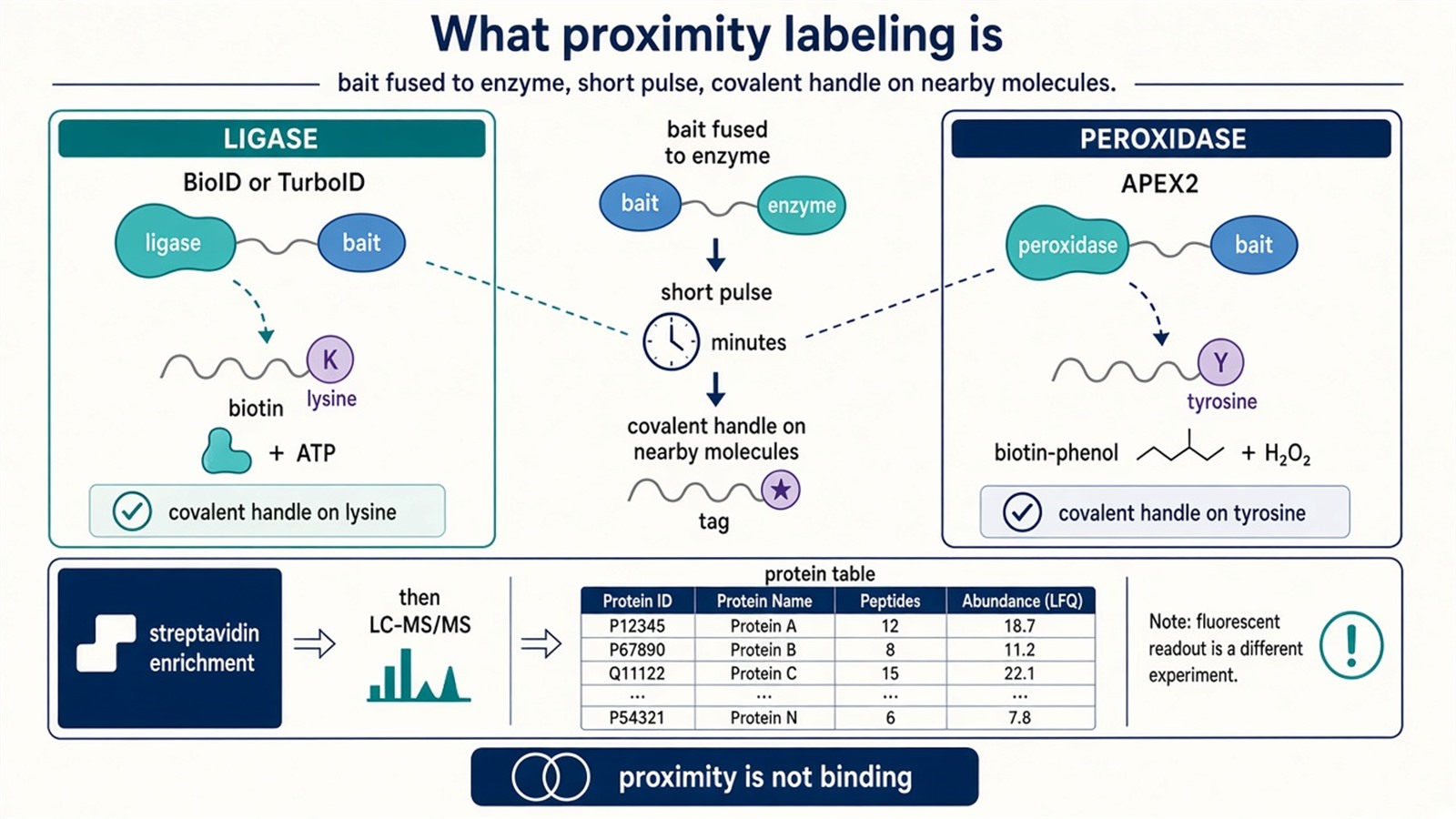
Figure 1. A fused ligase or peroxidase writes a handle on nearby molecules. The handle is usually biotin. Proximity is not binding. Fluorescent readouts are a different experiment.
Choose the enzyme class before the first transfection. A one-minute APEX2 pulse is not a shorter BioID run.
The Labeling Experiment Has Two Wet Moves, Then Lysis
The original two-step skeleton remains. The no-lysis claim does not.
The first move is to build a fusion of the enzyme to a bait or a localization sequence, and to build the localization-matched enzyme-only arm at the same time. Expression is checked before the pulse. Overexpression biotinylates by crowding.
The second move is to start the reaction under a written condition: biotin for a ligase, biotin-phenol plus H₂O₂ for APEX2. Time and dose are a window, not a recipe that maintains native interactions.
After those two moves, labeled molecules are enriched and, for a protein table, searched by LC-MS/MS. That enrichment is a third wet block. It uses lysis. It is not optional purification that can be skipped to keep complexes intact. For how the streptavidin file is named as a proteome, Proximity Labeling Mass Spectrometry provides a complementary MS page.
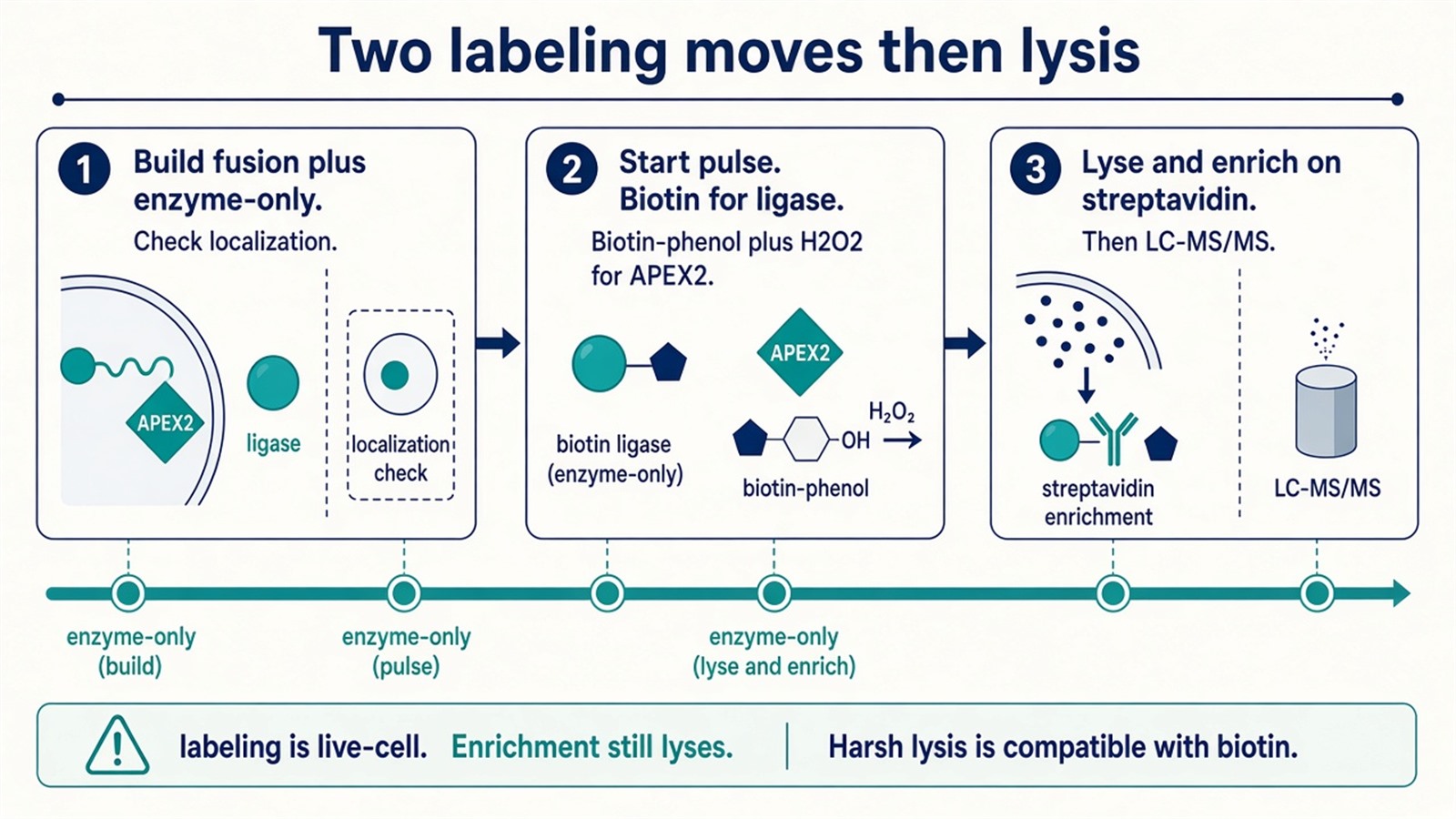
Figure 2. Fusion plus enzyme-only, then the pulse. Streptavidin enrichment still lyses the cell. Harsh lysis is compatible with biotin, not proof that native interactions were kept.
What Background and Enzyme Choice Actually Mean
Non-specific biotinylation is expected. It is not background noise that is removed by making the enzyme more specific, by optimizing the reaction, or by adding a multidimensional analysis slogan. Enzyme-only, and where needed a no-substrate arm, estimates it. Subtracting every control identification deletes real neighbors that leak into the enzyme-only digest.
Different enzymes have different catalytic rates and different substrate needs. That is why the enzyme is chosen before transfection. It is not a menu that becomes reliable and versatile for dynamic protein networks once the enzymes are optimized.
Cancer-network, therapeutic-target, precision-medicine, pathogen-host, and vaccine sentences sit outside the labeling event. A biotinylated neighborhood in a cancer cell line does not identify a disease-associated molecule or a drug target. A host-cell neighborhood next to a viral protein does not advance a vaccine.
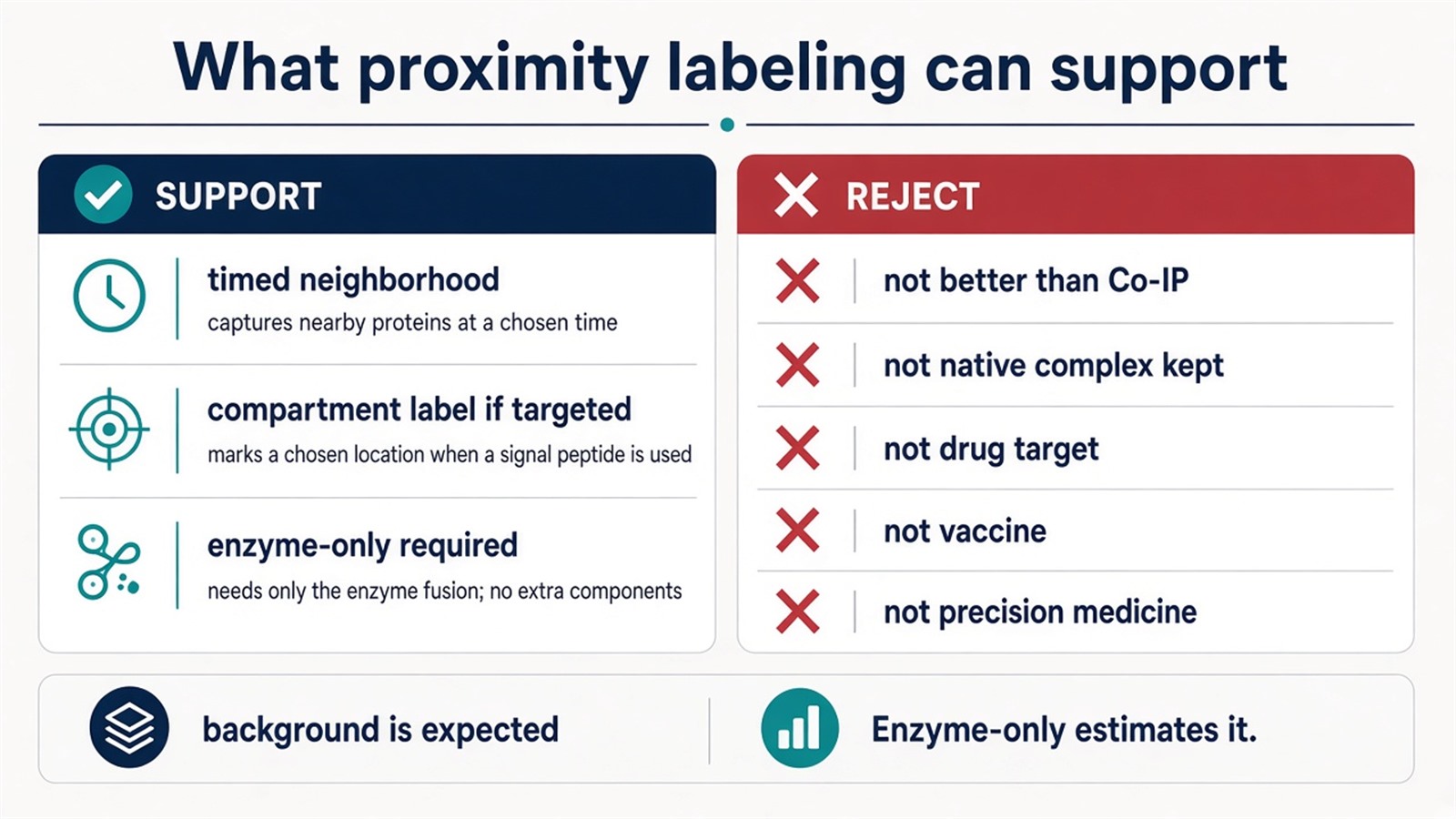
Figure 3. Supported: a timed neighborhood or compartment label. Not granted by live-cell tagging: native complexes, superior sensitivity versus Co-IP, or a translational target.
Experimental Limits
Proximity labeling reduces a living cell to what a fused enzyme, a written pulse, a recovery handle, and the chosen readout can report. Diagnostic, drug-development, or vaccine language sits outside ordinary research reporting unless a separately validated assay is in place.
Project Planning and Service Scope
A usable proximity-labeling plan names the enzyme class, the enzyme-only arm, the pulse, and the claim that will be allowed, before the first transfection. MtoZ Biolabs scopes biotin proximity labeling and proximity-labeling MS with Orbitrap-class LC-MS/MS. Interpretability still follows those arms, not a live-cell-native slogan.
Once the next sentence is the streptavidin table rather than the labeling event alone, the project is proximity-labeling MS. Researchers who need that table can review the MtoZ Biolabs Proximity Labeling Mass Spectrometry Service for project-specific sample evaluation, feasibility assessment, and workflow planning.
Frequently Asked Questions
1. What does proximity labeling report?
Molecules covalently tagged near a fused ligase or peroxidase during a written pulse. It does not report a binding event.
2. Is proximity labeling more sensitive than Co-IP or colocalization?
No. It answers a different question. Co-IP still reports a wash-stable pellet. Colocalization still reports overlapping fluorescence.
3. Does live-cell labeling avoid lysis?
Labeling can be done without fixation. Enrichment still lyses the cell. Harsh lysis is often used on purpose.
4. How are BioID, TurboID, and APEX2 different?
BioID and TurboID are ligases that mark lysines. APEX2 is a peroxidase that marks tyrosines and needs H₂O₂. The windows differ.
5. What control is required?
A localization-matched enzyme-only fusion, and where needed a no-substrate arm. Empty vector without enzyme is not that control.
Reference
- Roux K.J., Kim D.I., Raida M., Burke B. (2012). A promiscuous biotin ligase fusion protein identifies proximal and interacting proteins in mammalian cells. J. Cell Biol., 196, 801-810. https://doi.org/10.1083/jcb.201112098
- Branon T.C., Bosch J.A., Sanchez A.D., et al. (2018). Efficient proximity labeling in living cells and organisms with TurboID. Nat. Biotechnol., 36, 880-887. https://doi.org/10.1038/nbt.4201
- Rhee H.W., Zou P., Udeshi N.D., et al. (2013). Proteomic mapping of mitochondria in living cells via spatially restricted enzymatic tagging. Science, 339, 1328-1331. https://doi.org/10.1126/science.1230593
- Lam S.S., Martell J.D., Kamer K.J., et al. (2015). Directed evolution of APEX2 for electron microscopy and proximity labeling. Nat. Methods, 12, 51-54. https://doi.org/10.1038/nmeth.3179
- Gingras A.C., Abe K.T., Raught B. (2019). Getting to know the neighborhood: using proximity-dependent biotinylation to characterize protein complexes and map organelles. Curr. Opin. Chem. Biol., 48, 44-54. https://doi.org/10.1016/j.cbpa.2018.10.017
