



BioID and TurboID are biotin ligases fused to a bait or a localization sequence. In living cells they covalently attach biotin to nearby lysines. Streptavidin then recovers those proteins for liquid chromatography–tandem mass spectrometry (LC-MS/MS). The table is a neighborhood or a compartment proteome. It is not a mapped interaction network, a disease pathway, or a drug-target assay. Proteins that sit close to the ligase can be labeled whether or not they bind the cargo. TurboID is a faster-evolved ligase, not an enhanced-performance replacement that keeps BioID’s background.
Labeling happens before lysis. Enrichment does not. Both methods still lyse the cell and bind a streptavidin bead. BioID does not avoid cell lysis or protein purification. A ligase-only arm, matched for localization, is the control. An empty vector without enzyme, or a “known non-interacting protein,” does not estimate ligase background.
Researchers who already have a BirA* or TurboID fusion and need a streptavidin table can also review the MtoZ Biolabs Biotin Proximity Labeling Service for project-specific feasibility and analysis planning.
What BioID and TurboID Share
BioID uses the promiscuous BirA* mutant. TurboID was evolved from that lineage and labels in about ten minutes at 37 °C, whereas BioID typically needs many hours. Both mark lysines. Both feed the same streptavidin–MS path. For the family that also includes APEX2, Proximity Labeling Mass Spectrometry provides a complementary ligase-versus-peroxidase overview.
Neurodegenerative, cancer, immune, and therapeutic-target sentences are later overlays. Labeling a live-cell neighborhood does not identify a drug target, measure drug–protein binding, or assess efficacy and specificity of a compound.
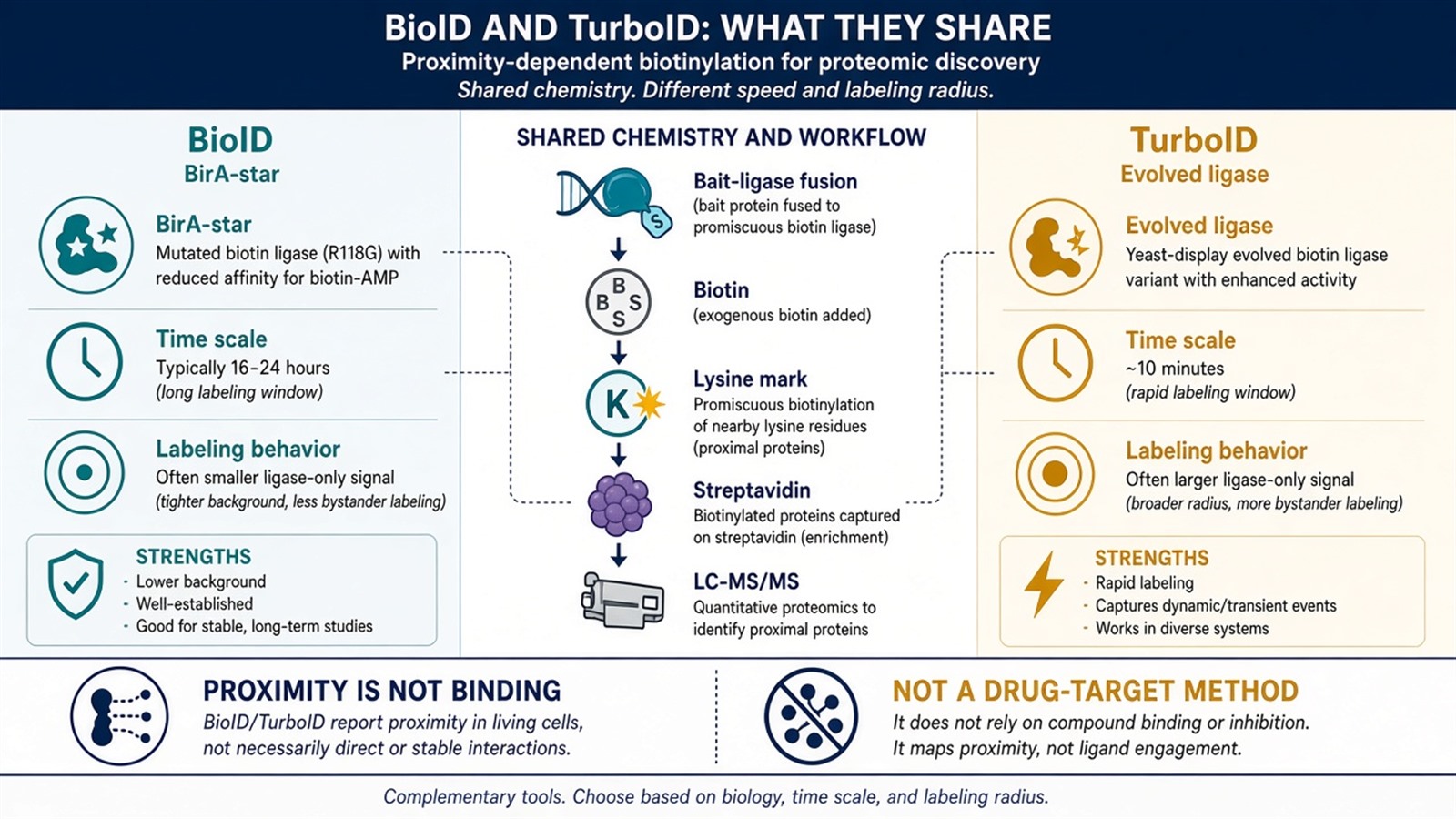
Figure 1. Shared chemistry: bait–ligase, biotin, lysine, streptavidin, LC-MS/MS. Different window: hours for BioID, about ten minutes for TurboID. Proximity is not interaction.
Choose the ligase before the first transfection. A ten-minute TurboID pulse is not a shorter BioID run on the same construct.
When Each Ligase Is the Better First Choice
These advantages hold only with the condition in the same sentence.
BioID is useful for a long, steady biotin window when a slow label is acceptable and a smaller ligase-only background is wanted. High specificity is not a property of BirA*. Versatility is the fact that many fusions can be built. Steady-state network language is still a neighborhood integrated over hours.
TurboID is useful when the next contrast is a short biotin pulse. Ten minutes can raise temporal resolution relative to overnight BioID. It does not make the method ideal for every rapidly changing interaction, and it does not automatically detect transient binders that traditional methods miss. Higher activity often increases enzyme-only biotinylation. For the low-copy neighborhood use of that short pulse, How Can TurboID-Based Proximity Labeling Enable the Study of Low-Abundance Protein Interactions? provides a complementary TurboID page.
TurboID can retain activity at biotin doses and temperatures used in some organisms. That is not proof of high efficiency at low temperature and low biotin with minimal physiological interference. Comparative side-by-side work has shown stronger TurboID labeling and a larger ligase-only proteome than BioID on the same bait. miniTurbo is smaller and less stable. It can reduce some background and can also lose activity in a long culture. It is a third ligase, not a default upgrade. For a one-minute tyrosine pulse that needs hydrogen peroxide, APEX Proximity Labeling provides a complementary peroxidase option.
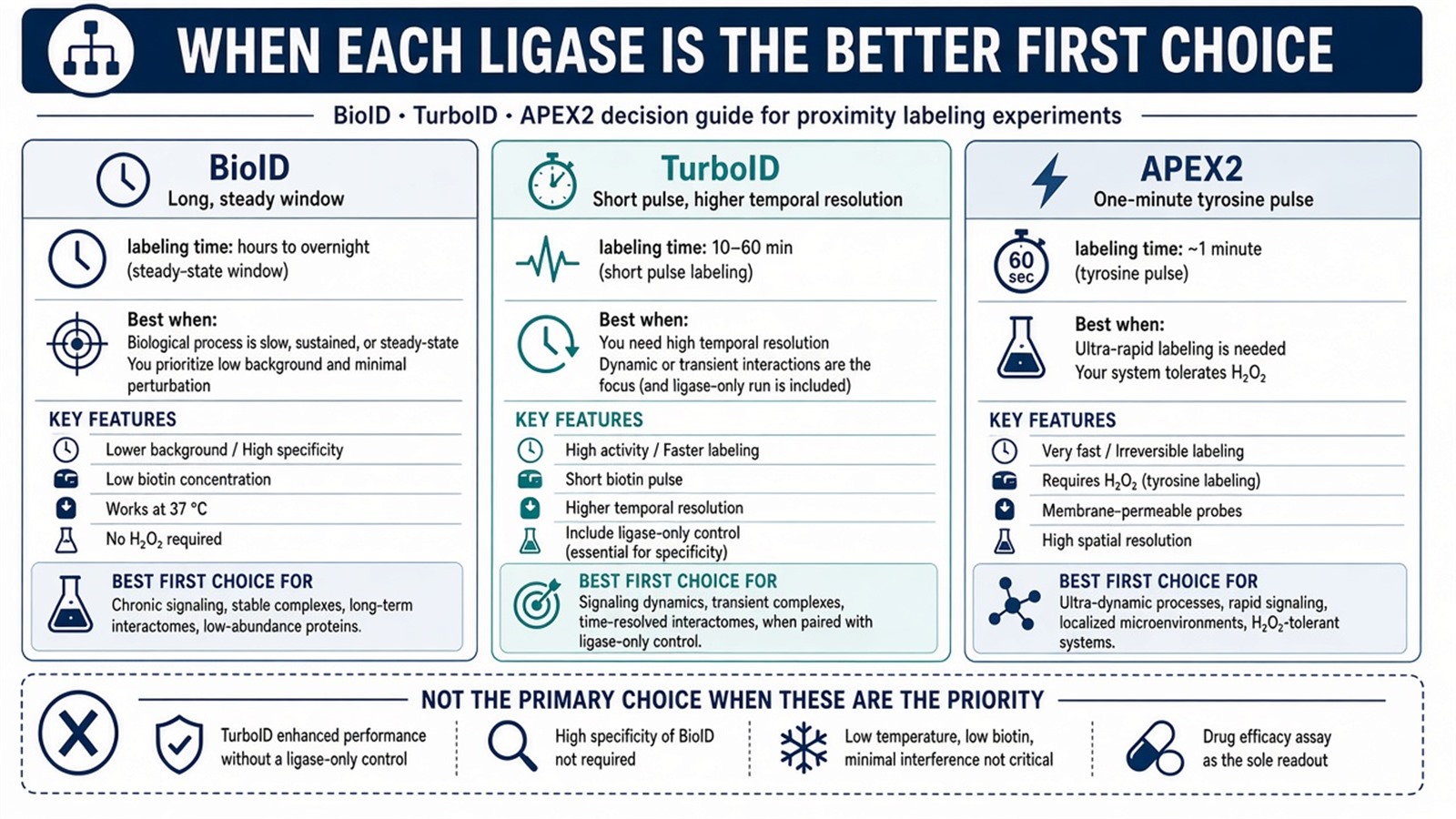
Figure 2. BioID: hours, often lower ligase-only signal. TurboID: minutes, often higher ligase-only signal. APEX2 is a different enzyme class.
Experimental Factors That Decide the Table
Expression of the fusion is a localization problem first. Too much ligase biotinylates by crowding. Too little ligase yields few biotinylated peptides. Promoter choice is a dose control, not a switch between physiological and non-physiological interactions. The table reports who was near the enzyme, not whether the contact was physiological.
Non-specific biotinylation is expected. The matched ligase-only arm, and where needed a no-biotin arm, estimates it. Empty-vector cells lack the enzyme and cannot stand in for ligase-only. A protein thought not to interact with the bait is not a BioID control unless it is itself a localization-matched ligase fusion.
After the pulse, streptavidin enrichment usually proceeds by on-bead digestion or a denaturing release. Endogenous biotinylated carboxylases appear in both arms. They are expected rows, not proof that the bait neighborhood failed. For how a streptavidin file is designed as a proteome in the peroxidase class, APEX Proteomics provides a complementary reading order that also applies to ligase-only scoring.
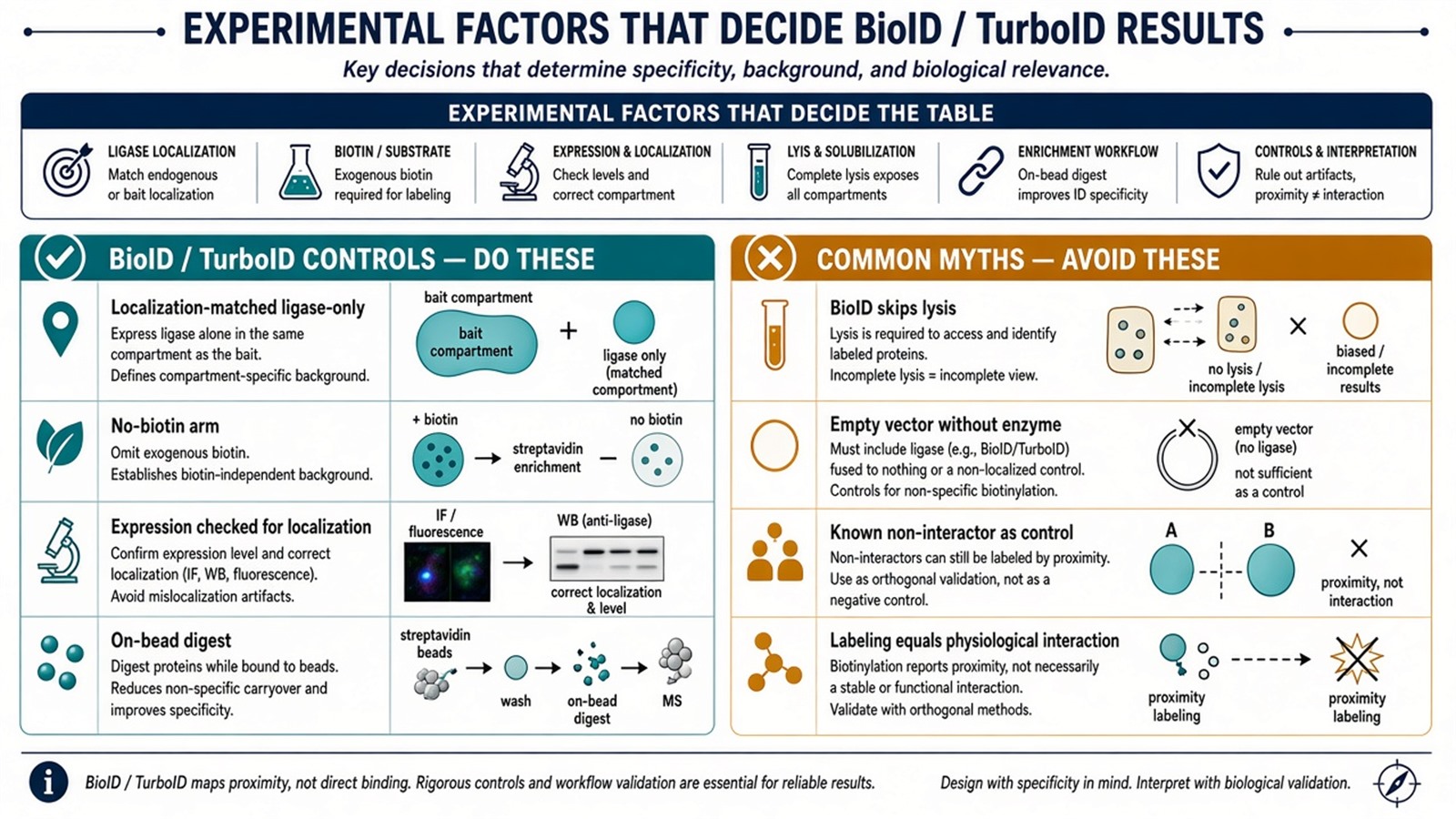
Figure 3. Expression is checked for localization. Ligase-only travels through streptavidin and the search. Empty vector without enzyme does not replace that arm.
Experimental Limits
BioID and TurboID reduce a living cell to what a biotin ligase fusion, a biotin pulse, streptavidin, and the search engine can report. Diagnostic or drug-development language sits outside ordinary research reporting unless a separately validated assay framework is in place.
Project Planning and Service Scope
A usable ligase plan names BioID or TurboID, the ligase-only arm, the biotin window, and the claim that will be allowed, before the first transfection. MtoZ Biolabs scopes biotin proximity labeling with Orbitrap-class LC-MS/MS. Interpretability still follows those arms, not a faster-enzyme slogan.
Once the project may need APEX2 as well as a ligase, enzyme choice can be scoped as proximity-labeling MS. Researchers who need ligase-or-peroxidase matching can review the MtoZ Biolabs Proximity Labeling Mass Spectrometry Service for project-specific sample evaluation, feasibility assessment, and workflow planning.
Frequently Asked Questions
1. What is the difference between BioID and TurboID?
Both biotinylate nearby lysines. BioID uses a long biotin window. TurboID uses about ten minutes and often a larger ligase-only background.
2. Does BioID avoid cell lysis?
No. Labeling is in the cell. Streptavidin enrichment still requires lysis.
3. Is TurboID more specific because it is faster?
No. Speed is the window. Specificity is the ligase-only comparison.
4. Can these methods identify drug targets or drug–protein binding?
Not by themselves. They report a biotinylated neighborhood, not compound engagement.
5. What control should be run?
A localization-matched ligase-only fusion, and where needed a no-biotin arm. Empty vector without enzyme is not that control.
Reference
- Roux K.J., Kim D.I., Raida M., Burke B. (2012). A promiscuous biotin ligase fusion protein identifies proximal and interacting proteins in mammalian cells. J. Cell Biol., 196, 801-810. https://doi.org/10.1083/jcb.201112098
- Branon T.C., Bosch J.A., Sanchez A.D., et al. (2018). Efficient proximity labeling in living cells and organisms with TurboID. Nat. Biotechnol., 36, 880-887. https://doi.org/10.1038/nbt.4201
- Kim D.I., Jensen S.C., Noble K.A., et al. (2016). An improved smaller biotin ligase for BioID proximity labeling. Mol. Biol. Cell, 27, 1188-1196. https://doi.org/10.1091/mbc.E15-12-0844
- May D.G., Scott K.L., Campos A.R., Roux K.J. (2020). Comparative application of BioID and TurboID for protein-proximity biotinylation. Cells, 9, 1070. https://doi.org/10.3390/cells9051070
- Gingras A.C., Abe K.T., Raught B. (2019). Getting to know the neighborhood: using proximity-dependent biotinylation to characterize protein complexes and map organelles. Curr. Opin. Chem. Biol., 48, 44-54. https://doi.org/10.1016/j.cbpa.2018.10.017
