



TurboID-based proximity labeling can enable the study of a low-abundance protein neighborhood when a bait–ligase fusion can be expressed at a controlled level and a ligase-only arm is processed in parallel. TurboID covalently biotinylates lysines near that fusion in living cells. Streptavidin then recovers biotinylated proteins, often after a denaturing lysis that a co-immunoprecipitation (Co-IP) cannot use. The table is a proximity list. It is not a genuine interaction network that Co-IP or pull-down failed to recover, and it is not a gold-standard interactome. Proximity is not binding. A protein can be labeled because it shared a compartment, not because it occupied the bait.
Low-copy transcription factors, signaling nodes, and chromatin regulators are hard in Co-IP because antibody occupancy is low and the wash empties a scarce pellet. TurboID does not raise the copy number of the endogenous protein. It changes the capture chemistry: labeling can accumulate while a contact is brief, and the biotin handle survives harsh lysis. If the fusion is overexpressed, mislocalized, or run without ligase-only, the same chemistry produces a larger background table. For the occupancy limits that remain when the assay is still Co-IP, Co-IP for Low-Expression Protein Interactions provides a complementary Co-IP discussion.
Researchers who already have a TurboID-bait plan, a ligase-only control, or a low-copy neighborhood question can also review the MtoZ Biolabs Protein-Protein Interaction Analysis Service for project-specific feasibility and analysis planning.
What Is TurboID?
TurboID is an engineered biotin ligase derived from Escherichia coli BirA and optimized from the BioID lineage. BioID typically needs many hours of biotin. TurboID can label in about ten minutes at 37 °C. That shorter window can improve temporal resolution. It does not automatically minimize background. Higher catalytic activity is why empty-ligase signal is often larger than with BioID.
The working sequence is a bait–TurboID fusion, addition of biotin, covalent transfer of biotin to nearby lysines, streptavidin enrichment, and liquid chromatography–tandem mass spectrometry (LC-MS/MS). The often-quoted radius of about 10 nm is a working estimate from earlier biotin-ligase work. It is not a measured sphere around every bait. Membrane, crowding, and expression level change who is labeled.
This is a shift from wash-stable binding to proximity-dependent biotinylation. Transient or membrane-associated neighbors can be labeled. They are not thereby resolved as complexes. For when a partner list versus a residue pair is the next sentence, Co-IP-MS vs XL-MS: Which Protein Interaction Workflow Should You Choose? provides a complementary method choice.
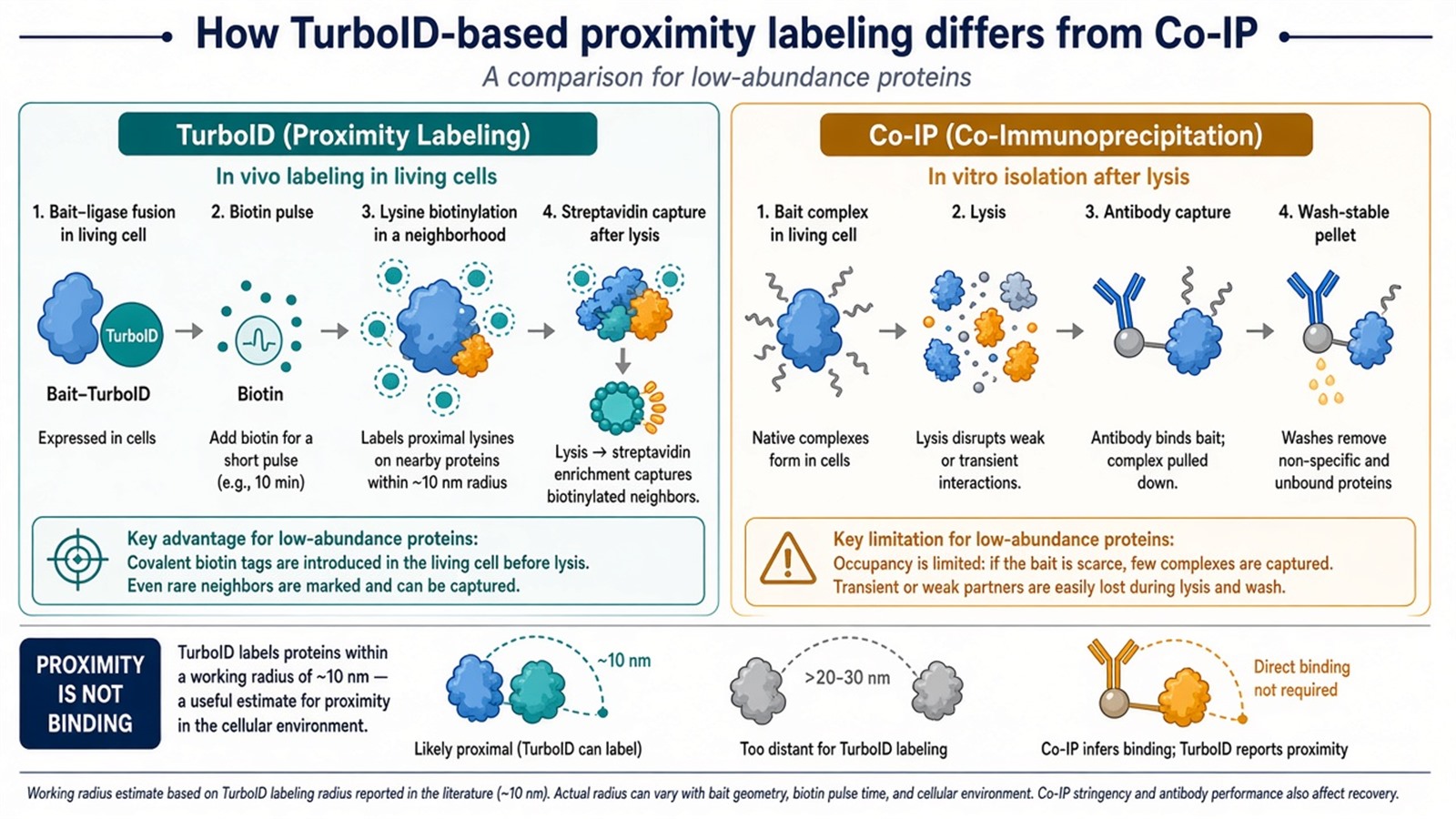
Figure 1. TurboID biotinylates lysines near a bait–ligase fusion. Streptavidin recovers labeled proteins after lysis. Co-IP still needs a complex that survives the wash.
Write the ligase-only arm and the expression level before the first biotin pulse. Ten minutes does not invent a control.
How Does TurboID Facilitate the Study of Low-Abundance Protein Interactions?
These points hold only with the condition in the same sentence.
Brief contacts can be recorded, if the fusion is present during the pulse
Labeling requires spatial proximity during the biotin window, not a complex that remains after lysis. A transient neighbor of a low-copy factor can receive biotin and still be recovered later. That neighbor is a proximity candidate. It is not a demonstrated target of a transcription factor.
Compartment and time can be restricted, if targeting and induction are real
Cell-type promoters, localization sequences, and inducible fusions can limit where and when ligase is active. They enable a more defined neighborhood only when localization is checked on the same cells. An inducible system that leaks ligase is still a continuous labeler.
Streptavidin can recover labeled proteins after harsh lysis, if biotinylation occurred
Streptavidin–biotin affinity lets the enrichment survive denaturing buffers that strip Co-IP complexes. That is the enrichment advantage for scarce, biotinylated proteins. It is not greater applicability than Co-IP for every bait. An IP-grade antibody on an abundant endogenous protein remains the shorter path. TurboID always requires a fusion.
MS can name biotinylated proteins that were enriched, if both arms are acquired
Orbitrap-class LC-MS/MS, including data-independent acquisition, can deepen a streptavidin eluate. The instrument name does not decide which rows are bait-dependent. Ligase-only, and where needed a no-biotin arm, must be searched. Subtracting every control identification deletes real neighbors that leak into the ligase-only digest.
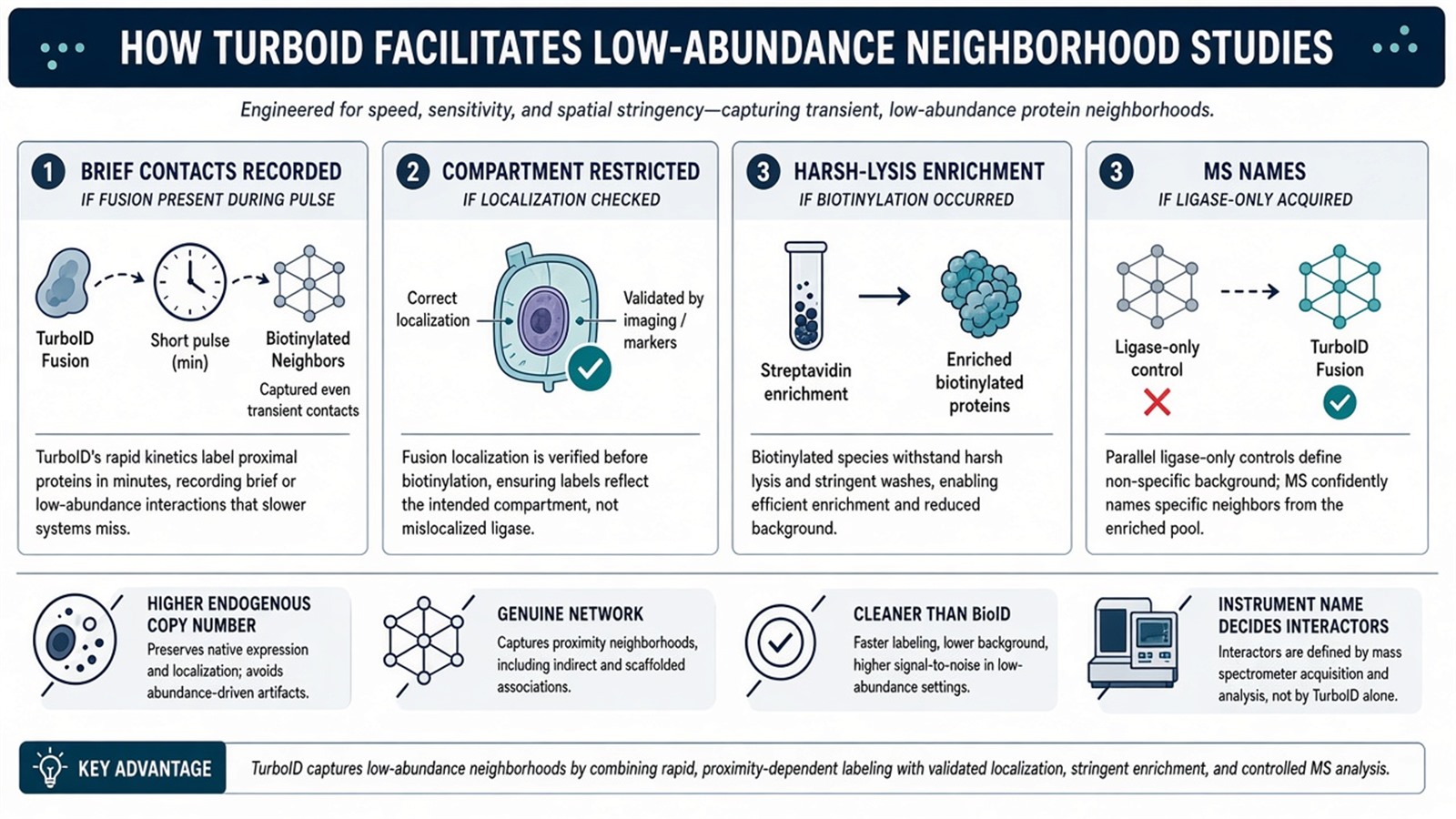
Figure 2. Supported when ligase-only is run: a proximity table after a short biotin pulse. Not granted by streptavidin affinity: a genuine network, higher endogenous occupancy, or a cleaner file than BioID.
How Can Common TurboID-Related Pitfalls Be Avoided?
These limits sit in the ligase chemistry. They are not beginner add-ons.
A ligase-only fusion matched for localization, a catalytically inactive mutant, or a no-biotin arm estimates background. Those arms do not “remove” background. Enrichment is read against them.
Expression must be low enough that the fusion stays at the intended site. Overexpression and aggregation biotinylate by local crowding.
Biotin dose and time are titrated on the same line. About ten minutes is a common starting window. It is not a recipe that minimizes non-specific labeling. Longer pulses and high biotin increase both true and false biotinylation.
Streptavidin enrichment is usually followed by on-bead digestion or a harsh, denaturing release. Mild elution does not reverse streptavidin–biotin and does not reduce contaminants by being gentle. For how Co-IP-MS still fits when an antibody and a wash-stable pellet are available, the MtoZ Biolabs Co-IP-MS Protein Interaction Analysis Service remains the antibody-capture route.
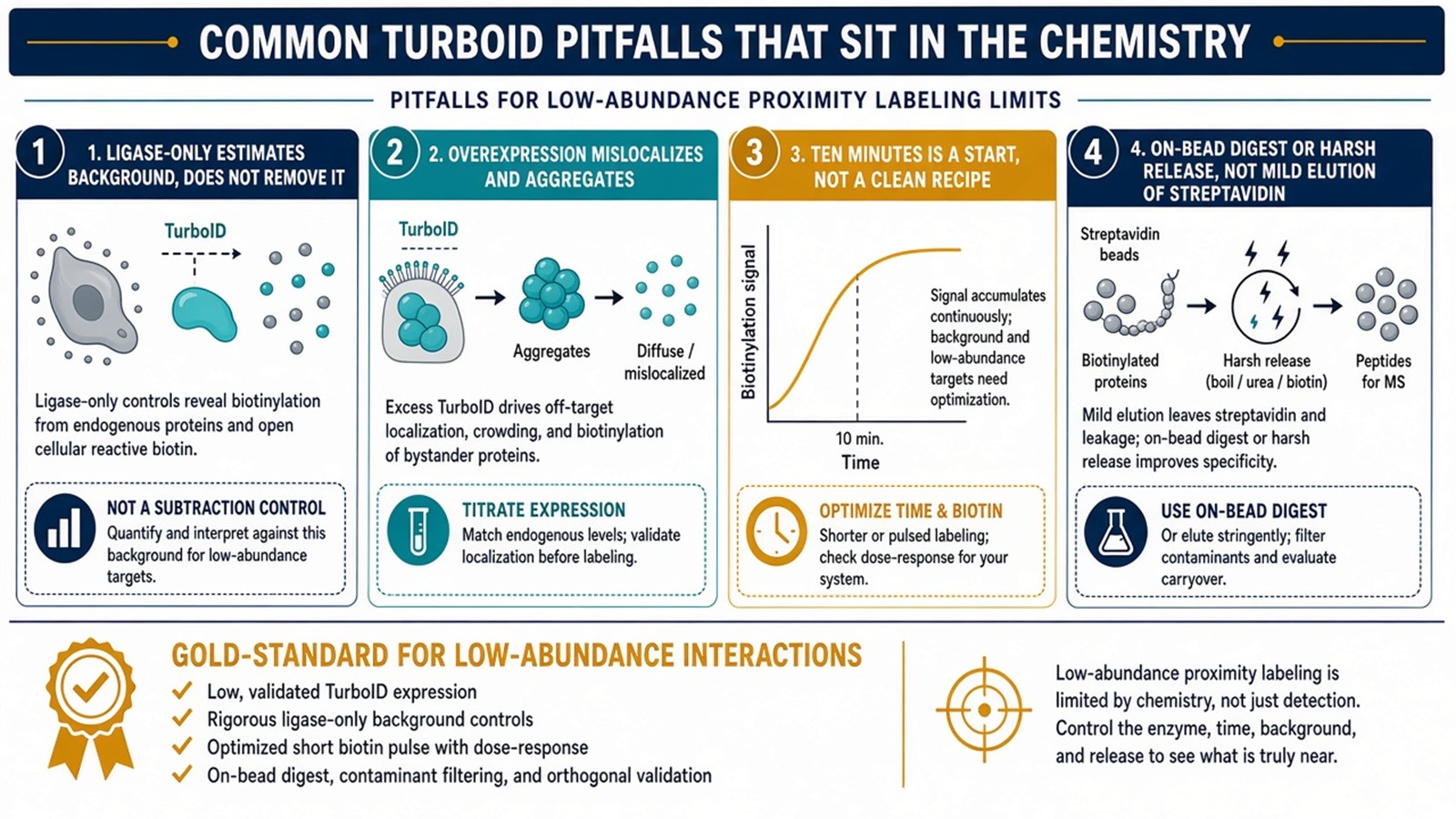
Figure 3. Higher activity than BioID raises background unless ligase-only is processed. On-bead digest is the usual exit. Gold-standard language is outside this assay.
Experimental Limits
TurboID reduces a living cell to what a fusion ligase, a biotin pulse, streptavidin, and the search engine can report. Diagnostic or disease-mechanism language sits outside ordinary research reporting unless a separately validated assay framework is in place.
Project Planning and Service Scope
A usable TurboID plan names the fusion, the localization check, the ligase-only arm, the biotin window, and the claim that will be allowed, before the first pulse. MtoZ Biolabs scopes proximity-labeling MS with Orbitrap-class LC-MS/MS. Interpretability still follows those arms, not the instrument brand or a network drawing.
Once the next sentence is a wash-stable endogenous pellet rather than a proximity list, the project should not be forced through TurboID. Researchers who need antibody capture of a scarce bait can review the MtoZ Biolabs Co-Immunoprecipitation Protein Interaction Analysis Service for project-specific sample evaluation, feasibility assessment, and workflow planning.
Frequently Asked Questions
1. Can TurboID enable low-abundance interaction studies?
Yes, as a proximity table, if a controlled bait–ligase fusion and a ligase-only arm are run. It does not reconstruct a genuine Co-IP network.
2. Does TurboID require a stable protein–protein interaction?
No. It requires proximity during the biotin pulse. That is why a labeled protein is not automatically a binder.
3. Is TurboID cleaner than BioID because it is faster?
No. The shorter window can improve time resolution. Higher activity often raises ligase-only biotinylation.
4. Should streptavidin beads be eluted mildly?
Usually not. Biotin–streptavidin is reversed by denaturation or bypassed by on-bead digestion.
5. When should Co-IP still be used for a low-copy bait?
When an IP-grade antibody exists and the next sentence is a wash-stable association, not a live-cell neighborhood.
Reference
- Branon T.C., Bosch J.A., Sanchez A.D., et al. (2018). Efficient proximity labeling in living cells and organisms with TurboID. Nat. Biotechnol., 36, 880-887. https://doi.org/10.1038/nbt.4201
- Roux K.J., Kim D.I., Raida M., Burke B. (2012). A promiscuous biotin ligase fusion protein identifies proximal and interacting proteins in mammalian cells. J. Cell Biol., 196, 801-810. https://doi.org/10.1083/jcb.201112098
- Kim D.I., Jensen S.C., Noble K.A., et al. (2016). An improved smaller biotin ligase for BioID proximity labeling. Mol. Biol. Cell, 27, 1188-1196. https://doi.org/10.1091/mbc.E15-12-0844
- Hung V., Udeshi N.D., Lam S.S., et al. (2016). Spatially resolved proteomic mapping in living cells with the engineered peroxidase APEX2. Nat. Protoc., 11, 456-475. https://doi.org/10.1038/nprot.2016.018
- Gingras A.C., Abe K.T., Raught B. (2019). Getting to know the neighborhood: using proximity-dependent biotinylation to characterize protein complexes and map organelles. Curr. Opin. Chem. Biol., 48, 44-54. https://doi.org/10.1016/j.cbpa.2018.10.017
