Peptide Relative Quantification Service
MtoZ Biolabs provides Peptide Relative Quantification Service for comparative measurement of peptide abundance across biological samples using high-resolution LC-MS/MS workflows.
Label-free and label-based strategies are selected according to sample type, study design, and quantitative objectives to support reliable peptide-level comparison across experimental groups.
- High-resolution LC-MS/MS for comparative peptide abundance analysis
- Flexible label-free and label-based quantification strategies
- Peptide-level fold-change analysis across biological conditions
Overview
Peptide relative quantification is used to compare changes in peptide abundance across biological samples, experimental groups, or time points. Results are typically reported as normalized abundance values, relative ratios, or fold changes, making the approach well suited to comparative studies in which the direction and magnitude of peptide changes are the primary analytical objectives.
MtoZ Biolabs provides LC-MS/MS-based relative quantification workflows for endogenous peptides and protein-derived peptides. For projects requiring concentration-level measurement of predefined peptide targets, an absolute peptide quantification workflow should be selected instead.
Peptide Relative Quantification Service at MtoZ Biolabs
MtoZ Biolabs provides customized peptide relative quantification workflows based on sample characteristics, peptide origin, experimental group structure, sample number, and quantitative objectives.
For endogenous peptide studies, sample preparation is designed to preserve naturally occurring peptide populations. For protein-derived peptide analysis, protein extraction and enzymatic digestion can be incorporated according to project requirements.
1. Label-Free Relative Quantification
Label-free quantification determines peptide abundance from LC-MS/MS signal intensity without introducing additional labeling reagents. It is particularly suitable for studies requiring flexible sample numbers or broader comparative designs.
Depending on project scale and data requirements, appropriate acquisition approaches can be selected. DIA-based acquisition may be considered when quantitative consistency across larger sample sets is a priority.
2. Label-Based Relative Quantification
Label-based workflows enable relative comparison between samples through defined labeling strategies.
(1) TMT-Based Relative Quantification
Tandem Mass Tag labeling enables multiplexed peptide comparison through reporter-ion measurements generated during MS/MS analysis and is well suited to multi-group experimental designs.
(2) SILAC-Based Relative Quantification
SILAC introduces labeled amino acids during cellular growth, allowing corresponding peptide signals to be quantitatively compared by mass spectrometry. This strategy is primarily applicable to compatible cell-based systems.
The quantitative approach is selected according to sample type, group structure, sample availability, and project objectives.
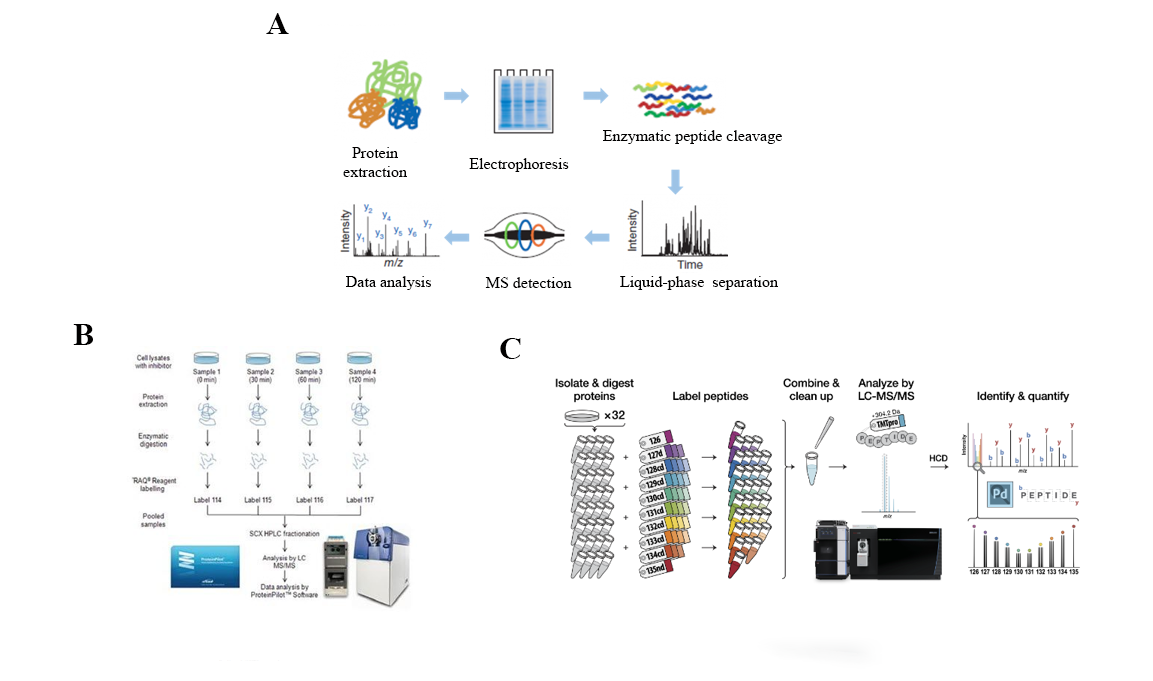
Figure 1. The Experiment Workflow of (A) Label Free, (B) iTRAQ and (C) TMT.
When This Service Is a Good Fit
Peptide relative quantification is appropriate when:
- peptide abundance differences are more important than exact concentrations;
- the same peptide needs to be compared across multiple samples or groups;
- quantitative screening is required before targeted validation;
- biological groups, time points, or experimental conditions need to be compared;
- changes in peptide profiles need to be evaluated at the peptide level.
Projects focused on exact concentration measurement should use absolute quantification, while predefined peptide panels may be better suited to targeted peptide quantification.
Analysis Workflow
1. Project Assessment
Sample type, peptide origin, experimental groups, biological replicates, and quantitative objectives are reviewed.
2. Sample Preparation
Samples are processed using endogenous peptide extraction or protein-derived peptide preparation according to the analytical target.
3. LC-MS/MS Analysis
Prepared samples are analyzed using high-resolution tandem mass spectrometry under project-specific acquisition conditions.
4. Relative Quantification
Peptide abundance signals are extracted, normalized, quality assessed, and compared across samples.
5. Statistical Analysis and Reporting
Quantitative differences are statistically evaluated and summarized in peptide-level tables, figures, and reports.
Applications
1. Treatment and Perturbation Response Studies
Evaluate peptide abundance changes following drug treatment, stimulation, genetic manipulation, environmental exposure, or other experimental interventions.
2. Time-Course and Dynamic Biological Studies
Monitor peptide abundance across multiple time points to characterize dynamic changes associated with differentiation, development, signaling, stress response, or other biological processes.
3. Biomarker Candidate Prioritization
Identify peptides showing reproducible abundance differences between biological groups and prioritize candidates for subsequent targeted validation.
4. Batch and Process Comparability Studies
Compare peptide abundance profiles across experimental batches, processing conditions, or peptide-containing samples to assess consistency and quantitative variation.
Why Choose MtoZ Biolabs?
1. Multi-Strategy Selection
Offering both labeled and label-free quantification modes to flexibly accommodate different experimental needs.
2. High-Sensitivity Analysis
Relying on high-resolution mass spectrometry platforms to achieve precise detection of subtle differences.
3. Reliable Quantitative Results
Standardized workflows ensure data reproducibility and comparability.
4. End-to-End Support
Providing technical assistance throughout the entire process from experimental design to result interpretation.
5. Customized Analytical Solutions
Delivering personalized quantification strategies based on research objectives and sample characteristics.
Deliverables
1. Experimental and Method Details
Study design, sample preparation procedures, LC-MS/MS conditions, and quantitative strategy.
2. Peptide Identification Results
Identified peptide sequences and associated analytical information.
3. Relative Quantification Matrix
Normalized peptide abundance values, relative ratios, or fold-change results across samples and groups.
4. Statistical Analysis Results
Group comparison results, statistical parameters, and quantitative visualizations.
5. Quality Assessment Information
Relevant quality-control metrics and data-processing summaries.
6. Raw and Processed Data
Raw mass spectrometry files, processed quantitative tables, figures, and final analysis report.
FAQ
Q1. What types of samples can be used for peptide relative quantification?
The workflow can support endogenous peptide-containing samples, peptide extracts, protein-derived peptide preparations, and other suitable biological materials. Sample preparation is selected according to peptide origin and project objectives. For more information, please refer to Sample Submission Guidelines for Proteomics.
Q2. How many biological replicates are recommended?
The appropriate number of replicates depends on biological variability, study design, and the statistical comparisons required. Replicate planning should be considered during project design rather than after data acquisition.
Q3. Can relative peptide quantification be used for low-abundance peptides?
Detection depends on peptide abundance, sample complexity, ionization behavior, and analytical conditions. For particularly low-abundance or predefined targets, enrichment or targeted quantification may be considered.
Q4. What information is needed before starting a project?
Sample type, sample number, experimental groups, biological replicates, peptide origin, and the intended comparison should be provided so that an appropriate quantitative workflow can be selected.
Start Your Project with MtoZ Biolabs
A reliable comparative study begins with an appropriate experimental design and quantification strategy.
Contact MtoZ Biolabs with your sample type, group structure, and research objectives to establish a peptide relative quantification workflow aligned with your project.
MtoZ Biolabs, an integrated chromatography and mass spectrometry (MS) services provider.
Related Services
Quantitative Peptidomics Service
Peptide Quantification Service
