



An IP-MS protein list is a mixed observation. It can contain bait-associated candidates, antibody or tag background, abundant carryover, and proteins recovered because they bind beads or persist through incomplete washing. Filtering is therefore a decision process: which identifications remain after control comparison, replicate agreement, and enrichment evidence are applied together. A fold-change cutoff used in isolation does not convert a capture list into a validated interactome.
This article focuses on interpreting and prioritizing proteins in an existing IP-MS dataset. For guidance on experimental controls, biological replicates, and sample grouping, see Co-IP-MS Experimental Design: IgG and Empty-Vector Controls, Replicates and Grouping. Researchers seeking IP-MS services for protein interaction studies can contact MtoZ Biolabs to discuss their research objectives and project requirements through the IP-MS Protein Interactomics Analysis Service. The broader context of protein interaction research is covered in Protein-Protein Interaction Analysis: From Partner Discovery to Interaction Validation.
Why Do IP-MS Results Contain Background Proteins?
Non-Specific Binding
Nonspecific binding arises because lysis, antibody scaffolds, affinity tags, and resins can recover proteins that are not part of the bait complex. Highly abundant proteins, sticky nucleic-acid binders, and proteins that adsorb to surfaces are recurrent sources. Overexpression can increase chance encounters. Gentle washing preserves weak partners and also preserves more background. The presence of background is expected; the design question is whether it can be recognized.
Common Contaminants
Common contaminants include residual antibody chains, keratin, residual serum proteins, and frequent bead binders. Some of these proteins appear in many unrelated captures and should be interpreted with extra caution even when they receive a high identification score. A high peptide count is evidence of detection, not of bait-specific association. Species mismatch, database incompleteness, and shared peptides can also place the same spectrum onto an unintended protein name.
Understanding these sources before ranking candidates prevents two opposite errors: discarding every abundant protein as contamination, and treating every identified name as an interactor. Background is a property of the capture and the sample, not a software setting.
Using Negative Controls and Replicates to Evaluate Background
Control-Based Comparison
Negative-control captures processed in the same batch and format as the bait samples provide the primary background model. IgG, empty-vector, tag-only, or beads-only samples are useful when they match the capture chemistry actually used. Proteins that are similar in bait and control captures are weak candidates for bait-specific enrichment, even if they are confidently identified. Proteins that appear only in bait captures remain hypotheses until replicate and quantitative evidence are considered.
If no matched control was acquired, filtering options narrow. Public contaminant lists can flag frequent artifacts, but they cannot replace a chemistry-matched control from the same lysate and batch. Quantitative comparison is then limited to qualitative caution.
Reproducibility
Independent biological replicates show whether a protein is recurrently associated with the bait capture. A protein seen once at high apparent enrichment is weaker evidence than a moderate enrichment seen across independent preparations. Technical reanalysis of one digest can confirm that a signal is analytically repeatable, but it does not demonstrate biological recurrence.
Missing values need context. A protein absent from one replicate may be a true low-level candidate, a stochastic detection event, or a failed capture in that sample. Inspecting bait recovery in each replicate is essential, because a replicate with poor bait capture is not a valid biological repeat of the interaction experiment.
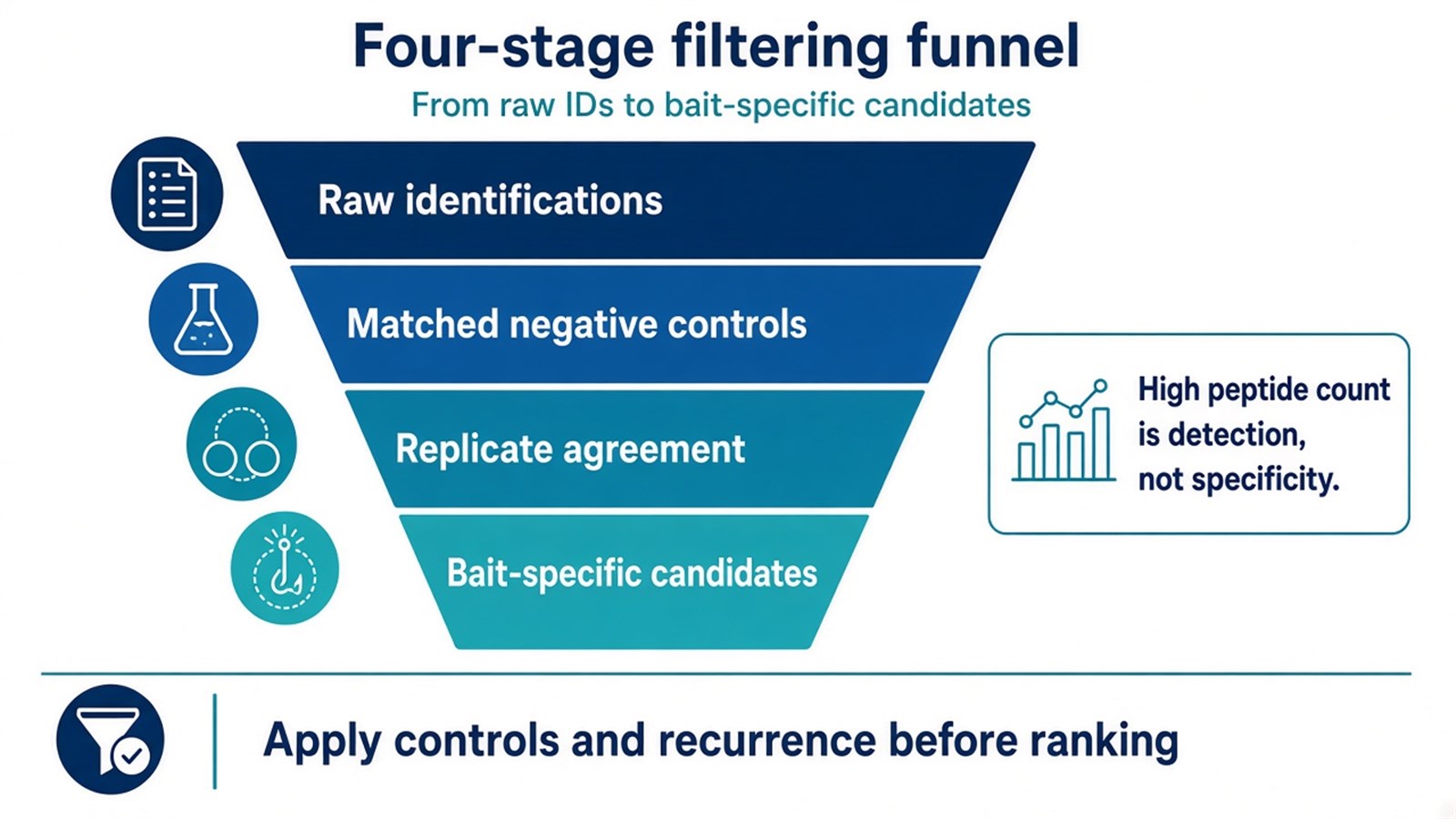
Figure 1. Control comparison and replicate recurrence should be applied before a protein is treated as a bait-specific candidate.
Evaluating Fold Change and Quantitative Evidence
Enrichment Ratios
Relative abundance values, including intensity ratios or fold changes between bait and control captures, help rank proteins that are present in both groups. A larger bait-to-control ratio supports enrichment, provided bait recovery, sample loading, and processing were comparable. In MtoZ LC-MS/MS offerings, identification tables typically include peptide and protein intensity values that can support these comparisons. The ratio is still a relative observation in the captured material, not a cellular stoichiometry.
There is no universal fold-change threshold that separates true interactors from background across antibodies, baits, and sample types. A cutoff copied from another study can hide weak but recurrent partners or retain strong bead binders. Thresholds, when used, should be justified by the observed control distribution in the current experiment and reported as a decision rule rather than a biological law.
Missing Values and Statistical Support
Some of the strongest-looking candidates are detected in bait captures and absent from controls. That pattern can be meaningful, but it can also arise from low control coverage, stochastic sampling, or a search setting that reports presence more readily than quantity. Statistical support is useful when the number of replicates and the missing-value pattern can support it. It is not a substitute for inspecting bait recovery and control quality.
Prioritizing Candidate Protein Interactors
Background Filtering
Use the existing control comparisons and identification evidence to separate candidates into practical categories:
- Likely background: Proteins with similar recovery in bait and control samples, or proteins whose detection is consistent with common contaminants and nonspecific binding.
- Candidates requiring further review: Proteins with apparent bait enrichment but inconsistent detection, substantial missing values, ambiguous protein assignments, or limited supporting evidence.
- Higher-priority candidates: Proteins supported by consistent bait-associated enrichment, reproducible detection, and credible peptide-level evidence.
These categories are intended to organize the evidence, not to establish definitive biological classifications. Common contaminant behavior should prompt closer review rather than automatic exclusion, particularly when other evidence supports a possible bait-associated role. Keep the reasons for retaining or deprioritizing candidates clear and traceable. This makes the resulting list easier to review and helps identify which proteins warrant further investigation.
Candidate Ranking
Rank the remaining candidates by considering enrichment magnitude, consistency across replicates, peptide-level support, and the quality of the control comparison together. Biological plausibility can help determine which candidates deserve attention first, but it should remain a secondary consideration rather than a substitute for experimental evidence. For example, a protein with moderate enrichment, reproducible recovery, and consistent peptide evidence may deserve higher priority than a protein with an extreme ratio in only one sample. A known association with the bait's pathway may provide useful context, but it cannot compensate for weak or contradictory experimental evidence.
The appropriate output is a prioritized list of candidate interactors, accompanied by the evidence supporting each ranking. A binary classification of proteins as true or false interactors overstates what IP-MS filtering can establish. Similarly, database-derived network connections should not be treated as independent validation of the observed capture results.
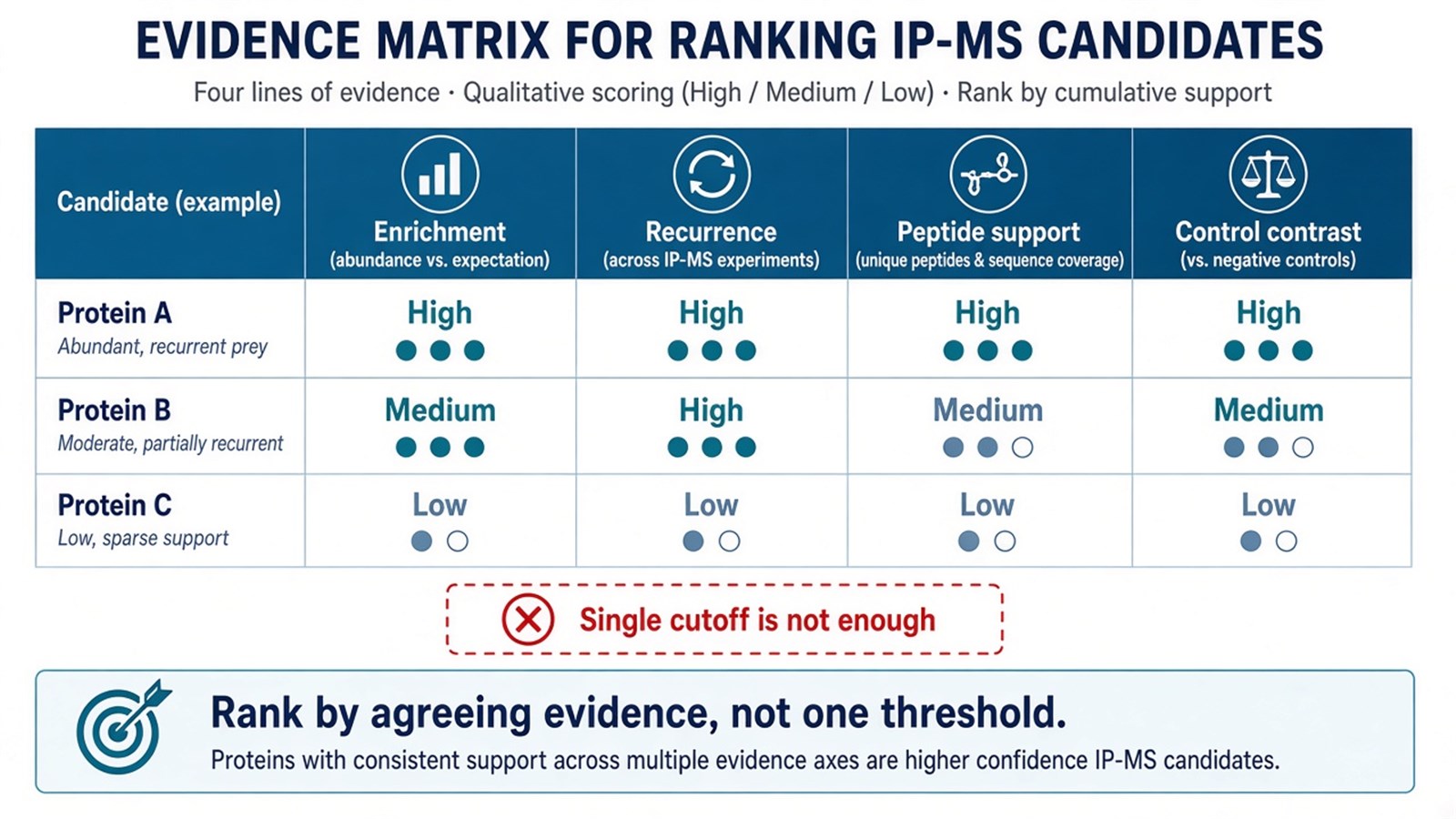
Figure 2. Candidate priority is stronger when enrichment, replicate recurrence, peptide support, and control contrast agree. A single fold-change cutoff is not a complete decision rule.
Interpreting Filtered Interactors and Planning Validation
A candidate that remains after control-aware filtering is supported as being enriched in the bait capture under the tested conditions. This does not establish direct binding, define the complete composition of a protein complex, or demonstrate a functional relationship. Indirectly associated proteins and residual background may still be present.
The next step depends on the question that remains unresolved:
- To assess whether an association is reproducible: Review the existing control and replicate evidence. Reciprocal Co-IP may provide additional evidence of the association.
- To investigate direct binding: A suitable pairwise binding assay can assess whether two proteins interact under defined conditions, provided they can be prepared in appropriate forms.
- To investigate proximity or spatial relationships: Proximity labeling can identify proteins near the bait in a biological context, while XL-MS can provide residue-pair distance restraints within a protein assembly. These methods provide different types of evidence.
- To investigate biological function: Appropriate perturbation experiments may be needed to determine whether a candidate contributes to a biological process or phenotype.
The final report should distinguish three levels of evidence: proteins identified by MS, candidates retained after control-aware filtering, and conclusions that require further validation. This distinction helps researchers prioritize candidates without treating co-enrichment as proof of direct binding or functional significance.
Frequently Asked Questions
1. Can a protein absent from the control but present in one bait replicate be retained?
It can be retained as a low-confidence candidate if bait recovery in that replicate is adequate, but it should not be ranked equal to proteins seen across independent bait captures. Additional replication is usually more informative than lowering a fold-change cutoff.
2. Should antibody heavy and light chains be removed computationally?
They should be recognized and interpreted as capture reagents or fragments rather than as biological interactors. Whether they are hidden in a display table is a reporting choice. Their presence can still indicate antibody load and should not be ignored during quality review.
3. Can fold change be compared across different antibodies or baits?
Only with caution. Capture efficiency, background, and bait abundance differ among antibodies and tags. A ratio that was informative in one system can be misleading in another. Comparisons are stronger within a matched experimental batch.
Conclusion
IP-MS filtering is the process of separating bait-dependent co-enrichment from expected background using matched controls, replicate recurrence, and quantitative contrast together. The filtered list is a prioritized hypothesis set, not a proof of direct binding. Researchers planning protein interaction studies can contact MtoZ Biolabs to discuss their research objectives, sample requirements, and project needs through the IP-MS Protein Interactomics Analysis Service.
