



A small molecule may produce a clear cellular or biochemical effect, yet the protein responsible for that response remains unknown. Small-molecule target identification helps researchers discover candidate proteins, distinguish promising targets from background, and select candidates for further validation. This article compares probe-based enrichment and label-free approaches, explains how to evaluate candidate proteins, and outlines the evidence needed to validate potential targets.
Researchers comparing interaction evidence more broadly can use Protein Interaction Analysis: What It Reveals, Key Methods, and Applications. For project-specific feasibility of probe-based or response-based target identification, the MtoZ Biolabs Small Molecule Drug Targets Identification Service reviews the compound, available probe chemistry, biological material, controls, and the claim the study must support.
From Compound Activity to Candidate Protein Targets
Target identification connects an observed biological response to the proteins potentially responsible for that response. Researchers may begin with a compound that produces a reproducible cellular or biochemical effect, a screening hit that requires further characterization, or a candidate protein whose interaction with a compound needs to be investigated.
The research objective determines the appropriate strategy. When the protein target is unknown, discovery methods help generate a list of candidate proteins for further investigation. When the target is already known, direct binding assays can characterize the interaction between the protein and the compound. These approaches address different stages of drug discovery and can be combined when both target discovery and binding validation are needed.
Biological context also influences experimental design. Intact-cell experiments preserve compound uptake, metabolism, and subcellular compartmentalization, whereas lysate-based experiments provide broader access to proteins but disrupt the native cellular environment. Compound properties matter as well. Covalent compounds, reversible ligands, and compounds with suitable probe-compatible analogs may require different experimental approaches.
Before selecting a strategy, researchers should consider compound activity, solubility, vehicle, binding chemistry, available analogs, and the biological material relevant to the observed phenotype. These factors help determine which target discovery approach is appropriate and how the resulting protein candidates should be interpreted.
Choosing a Strategy for Small-Molecule Target Identification
Probe-Based Enrichment
Probe-based enrichment uses a chemically modified compound to capture associated proteins. Depending on the compound and research objective, a probe may incorporate a reactive group, a photoactivatable group, or an affinity handle that enables protein recovery and subsequent identification by mass spectrometry.
Activity-Based Protein Profiling (ABPP) uses activity-directed probes to label and enrich selected classes of proteins, including enzymes with suitable reactive active sites. Liu et al. (1999) demonstrated this approach for profiling serine hydrolases in complex proteomes. When an appropriate probe is available, the Activity-Based Protein Profiling (ABPP) Service can support probe-based target discovery. Photoaffinity labeling provides another strategy. A photoactivatable group can form a covalent link to nearby molecules after irradiation, helping capture interactions that may otherwise be difficult to preserve during sample processing.
Probe-based experiments generate a list of proteins recovered under defined conditions. This list may contain direct probe-binding proteins, proteins associated through molecular complexes, and nonspecific background proteins. Probe chemistry is therefore a major consideration: chemical modification can alter compound activity, membrane permeability, intracellular distribution, or target selectivity.
Comparing the biological activity of the probe with that of the unmodified compound, together with appropriate competition experiments, helps assess whether the probe remains representative of the original molecule. Probe-based enrichment is most informative when the probe retains relevant compound properties and the experimental controls support the interpretation of recovered proteins.
Label-Free Approaches
Label-free approaches leave the parent compound chemically unmodified. They ask whether treatment changes protein thermal behavior, protease sensitivity, or localized structural accessibility. NSP-MS reports peptide-level proteolysis patterns. Drug Affinity Responsive Target Stability reports compound-associated protection from or sensitivity to proteolysis, as introduced for label-free target identification (Lomenick et al. 2009).
These readouts prioritize proteins that respond to the compound. A response can arise from direct binding, complex remodeling, metabolite effects, or an altered protein state. A true binder may produce no detectable thermal or proteolytic change. Response-based methods are therefore candidate-discovery tools, not a ranked alternative to capture.
When a proteolytic-stability workflow is the intended first measurement, the Drug Affinity Responsive Target Stability Analysis Service can be used to assess compound, material, and control compatibility.
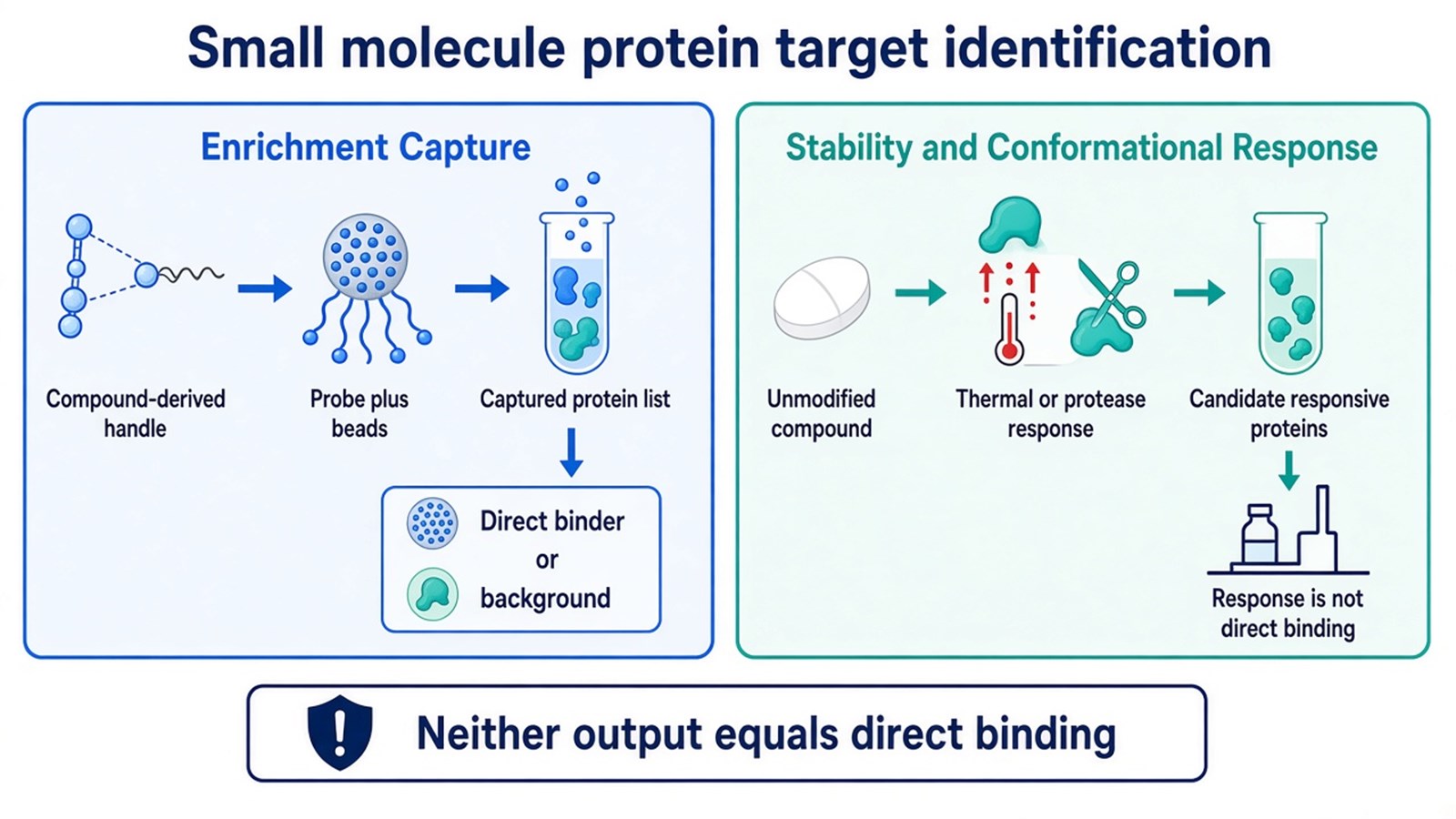
Figure 1. Probe-based enrichment captures proteins associated with a compound-derived handle, while Label-Free Approaches use stability and conformational methods to detect responses to unmodified compounds; neither result alone proves direct binding.
Experimental Design and Controls for Reliable Target Discovery
Experimental controls help distinguish compound-associated candidates from nonspecific recovery and unrelated treatment effects. The appropriate controls depend on the selected method, compound chemistry, and biological material.
For probe-based enrichment, a no-probe control helps identify background associated with the capture process. Beads-only or reporter-only controls can reveal proteins that interact with the capture matrix or reporter group. Competition with excess unmodified compound can help assess whether protein recovery depends on the parent compound. Structurally related inactive analogs may provide additional evidence when their inactivity and relevant physicochemical properties are established.
For DARTS and other applicable label-free workflows, matched vehicle controls and independent biological replicates help distinguish reproducible treatment-associated responses from sample handling effects. Concentration series may provide additional evidence when supported by the assay design. Solubility, aggregation, pH, and residual solvent should also be considered because these factors can alter protein behavior independently of specific binding.
Sample source influences which proteins are available for detection. Tissue samples and mixed cell populations may produce signals affected by cellular composition. Lysate-based experiments can expose proteins that a compound may not reach in intact cells, while intact-cell experiments may be influenced by membrane permeability, metabolism, and intracellular distribution.
Treated and control samples should be processed consistently, with experimental conditions selected to match the compound and biological system. This helps distinguish reproducible candidate signals from background introduced by sample preparation or treatment conditions.
Screening Candidate Protein Targets
Target discovery can produce a substantial list of proteins, but not every detected protein warrants the same level of follow-up. Candidate prioritization should integrate multiple lines of evidence rather than rely on a single fold-change threshold.
For probe-based enrichment, relevant criteria include reproducibility, competition behavior, peptide-level evidence, protein abundance, subcellular localization, and compatibility with the probe chemistry. For DARTS, the direction and consistency of proteolysis changes, protein-level evidence, and agreement across biological replicates can help determine which candidates merit further investigation.
High-abundance proteins, common bead-binding proteins, and proteins detected across unrelated treatments require careful evaluation. Pathway annotation can help organize candidates and identify biological relationships, but pathway membership alone does not establish a direct interaction with the compound.
Results from different discovery approaches may provide complementary evidence. When independent experiments identify the same candidate under appropriate conditions, that agreement can support its prioritization. When the results differ, researchers should examine differences in probe chemistry, compound accessibility, sample context, and assay sensitivity before deciding which candidates to pursue.
The outcome of this stage should be a focused list of proteins supported by reproducible evidence and suitable for further validation. Prioritization helps direct subsequent experiments toward candidates with the strongest combination of experimental support and biological relevance.
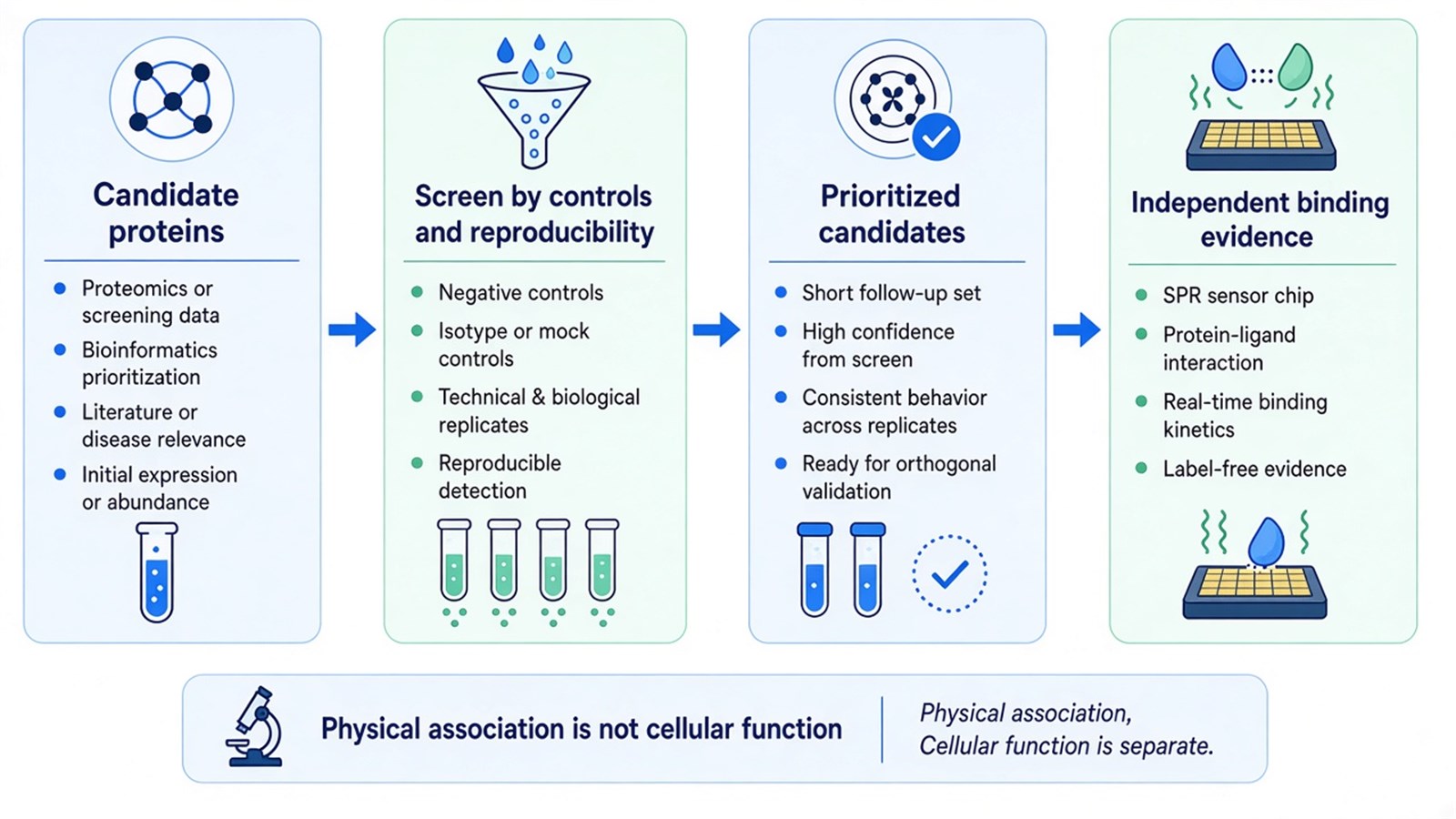
Figure 2. Reproducible, control-aware candidate screening precedes independent binding tests; physical association still remains distinct from cellular function.
Validating Protein Binding and Biological Relevance
After candidate proteins have been prioritized, independent experiments can investigate whether the selected proteins interact directly with the compound and whether those interactions are relevant to the observed biological response.
If an active, purified candidate protein is available, SPR Based Protein Interaction Analysis can characterize concentration-dependent binding and, when the data support suitable kinetic analysis, estimate binding affinity and association or dissociation rate constants. Biolayer interferometry (BLI) and microscale thermophoresis (MST) can also characterize defined protein–compound pairs when their respective assay requirements are met.
These biophysical measurements provide evidence about binding under the tested conditions. They can help compare candidate compounds, investigate structure–activity relationships, and determine whether a proposed protein–compound interaction can be measured directly in vitro.
Cellular target engagement addresses a different question: whether the compound interacts with the candidate protein in the relevant biological environment. Competition experiments using the unmodified compound, appropriately designed mutations, or suitable target-engagement assays can provide additional evidence.
Functional validation can then investigate whether the candidate protein contributes to the observed phenotype. Genetic or biochemical perturbation can help determine whether changing the candidate protein alters the biological response. Combining target discovery, independent binding measurements, cellular target engagement, and functional evidence provides a stronger basis for evaluating a proposed mechanism of action.
Frequently Asked Questions
1. Should unbiased target identification start in intact cells or lysate?
Choose the context required by the phenotype and compound access. Intact cells retain uptake, metabolism, and compartments. Lysates expose proteins more directly and can simplify some variables. If the phenotype may depend on a metabolite or a specific cellular state, intact-cell treatment is often more informative. A paired design can separate access-dependent responses from lysate-accessible candidates when resources permit.
2. Is a clickable, biotinylated, or covalent probe required?
Only if the chosen strategy is enrichment capture. Response-based methods do not require an affinity handle on the parent compound. A probe is useful when it preserves the relevant chemistry and when competition with the unmodified compound can be tested. If modification abolishes activity, a stability or conformational design is usually the more aligned first step.
3. How can direct binders be separated from downstream or complex-associated proteins?
Candidate lists should be interpreted alongside the appropriate controls and the evidence generated by the discovery method. Competition experiments can help evaluate probe-associated candidates, while independent biophysical assays can test selected protein–compound pairs. Cellular target-engagement experiments and functional perturbation can then investigate whether the interaction is relevant to the observed biological phenotype.
Conclusion
Small-molecule target identification is most effective when discovery, candidate prioritization, and validation are treated as connected stages. Probe-based enrichment and label-free approaches provide complementary ways to generate candidate proteins, while independent binding measurements and functional studies help determine which candidates warrant further investigation.
MtoZ Biolabs provides Small Molecule Drug Targets Identification Services to support research into compound–protein interactions. Contact us with your compound information, research objectives, biological material, and any existing probe or preliminary results to discuss a suitable target discovery strategy.
Reference
- Y. Liu, M.P. Patricelli, B.F. Cravatt (1999). Activity-based protein profiling: the serine hydrolases. Proceedings of the National Academy of Sciences of the United States of America, 96, 14694-14699. https://doi.org/10.1073/pnas.96.26.14694
- B. Lomenick, R. Hao, N. Jonai, R.M. Chin, M. Aghajan, S. Warburton, J. Wang, R.P. Wu, F. Gomez, J.A. Loo, J.A. Wohlschlegel, T.M. Vondriska, J. Pelletier, H.R. Herschman, J. Clardy, C.F. Clarke, J. Huang (2009). Target identification using drug affinity responsive target stability. Proceedings of the National Academy of Sciences of the United States of America, 106, 21984-21989. https://doi.org/10.1073/pnas.0910040106
