



The principle of a GST pull-down assay is three binding events in one capture. Glutathione S-transferase (GST) occupies reduced glutathione (GSH) that is covalently presented on agarose or Sepharose. A bait fused to GST is thereby held on the bead. Proteins that remain attached to that bait through a written wash stay on the resin and can be eluted with free GSH, then read by stain, Western blot, or mass spectrometry (MS). GST–GSH exclusivity is handle chemistry. It is not cargo specificity, low background, or an intracellular network. A GST-only arm is part of the principle: without it, proteins that bind GST, the linker, or the resin are scored as partners of the bait.
The assay is in vitro. Purification of a GST fusion and a GST pull-down share the first event. They do not share the question. Purification asks whether the fusion was recovered. Pull-down asks which other proteins were recovered with it. Mapping signaling routes, verifying candidate-drug efficacy, or nominating biomarkers are later claims. They are not consequences of GSH occupancy.
Researchers who already have a GST-bait construct or a GSH-resin plan can also review the MtoZ Biolabs GST Pull Down Assay Service for project-specific feasibility and analysis planning.
The Three Binding Events
GST, typically the Schistosoma japonicum enzyme used in pGEX-class fusions, binds immobilized GSH with affinity sufficient for bead capture. The fusion is held only while that handle remains occupied and folded. A truncated GST stub still occupies GSH and still presents whatever peptide remains.
The bait is not recognized by GSH. It is present because it is fused to GST. N- or C-terminal placement changes which face of the bait is free. That is a fusion decision, not a second principle. For terminus, host, dimers, and GST-binding lysate proteins, GST Fusion Protein Pull-Down Assay provides a complementary fusion-handle discussion.
Prey is not bound by GSH unless it itself is a GST fusion. It remains if a contact with the bait, or a bridge through another subunit, survives detergent, salt, and wash time. Free GSH later competes the handle off the bead and releases the mixture. Release does not sort cargo binders from handle binders.
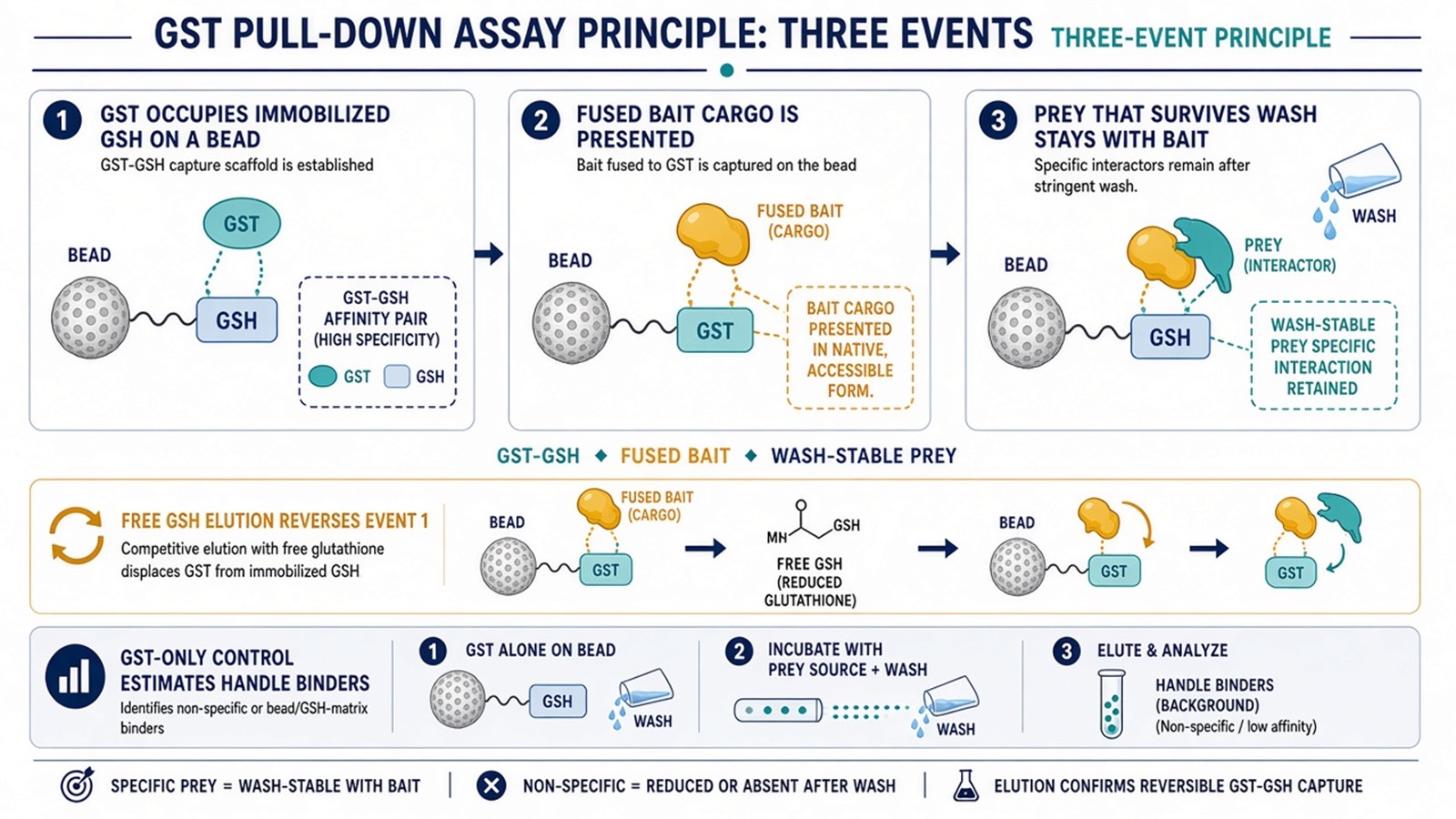
Figure 1. Event 1 is GST–GSH. Event 2 is presentation of the fused bait. Event 3 is wash-stable association with that bait. Only the first event is designed by the resin.
Name the three events before the first blot. A band in the eluate does not say which event produced it.
What the Principle Is Not
GST–GSH does not reconstruct a living cell. A lysate offered to the bead is still a tube reaction. For that in-vitro constraint, In Vitro Pull-Down Assay provides a complementary discussion.
The principle does not verify drug–target binding. An immobilized GST-bait can retain a compound-binding partner only if that partner was in the sample and survived the wash. Cellular engagement is a different measurement.
The principle does not build a protein-interaction network or a diagnostic marker. Those sentences need many baits, orthogonal assays, and a separately validated framework. For the four bench steps after the principle is named, What Is the General Procedure for GST Pull-Down Analysis of Protein–Protein Interactions? provides a complementary procedure. For how to read the blot or the table, How to Interpret the Results of a Pull-Down Experiment provides a complementary interpretation order.
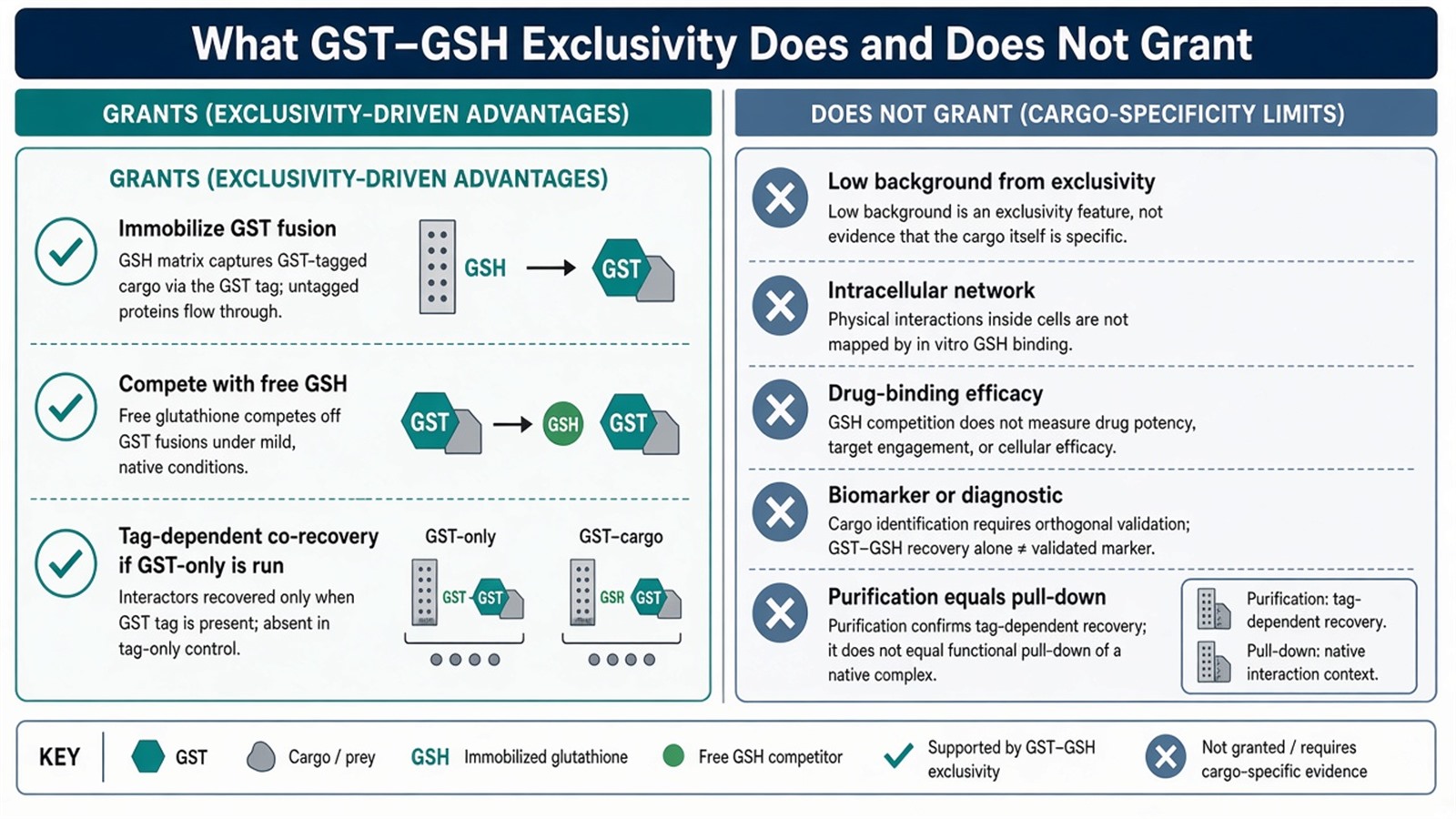
Figure 2. What GSH occupancy supports: immobilization of a GST fusion and competitive elution. What it does not: low background, an interactome, drug efficacy, or a biomarker.
Advantages of GST Pull-Down Assay
These points hold only with the condition in the same sentence.
Handle capture without an antibody, if the fusion is soluble
GST–GSH lets a laboratory immobilize a recombinant bait without an IP-grade antibody. The advantage disappears when the fusion is an inclusion body or a degraded stub.
Competitive elution with free GSH, if both arms use it
Free glutathione reverses event 1 and releases whatever was held by events 2 and 3. That is operationally convenient. It is not gentler proof of a specific prey. SDS elution recovers more protein and more background. GST-only must use the same exit.
A defined empty-handle control, if GST-only is actually run
The exclusive GST–GSH pair makes a matched GST-only protein the correct negative arm. Exclusive chemistry does not, by itself, lower background. Broad application to “intracellular networks” is not an advantage of the principle. The tube remains a tube.
Ease of operation is true only relative to a method that needs a custom antibody. Expression, solubility, and the GST-only arm are still the work.
Considerations for GST Pull-Down Assay
These limits sit inside the three events. They are not beginner errors.
Protein expression and solubility
If event 2 never happens because the cargo did not fold, the bead still holds GST. Changing host or induction can raise full-length product. It does not change the principle.
Non-specific binding
Proteins that bind GST, GSH resin, or the linker occupy the same eluate as true cargo partners. Optimizing the wash is a trade-off. It is not a substitute for GST-only.
Protein degradation
Low temperature and protease inhibitors slow proteolysis. A stub that retains GST still performs event 1. Result accuracy follows whether the intended bait was still fused, not the ice bucket alone.
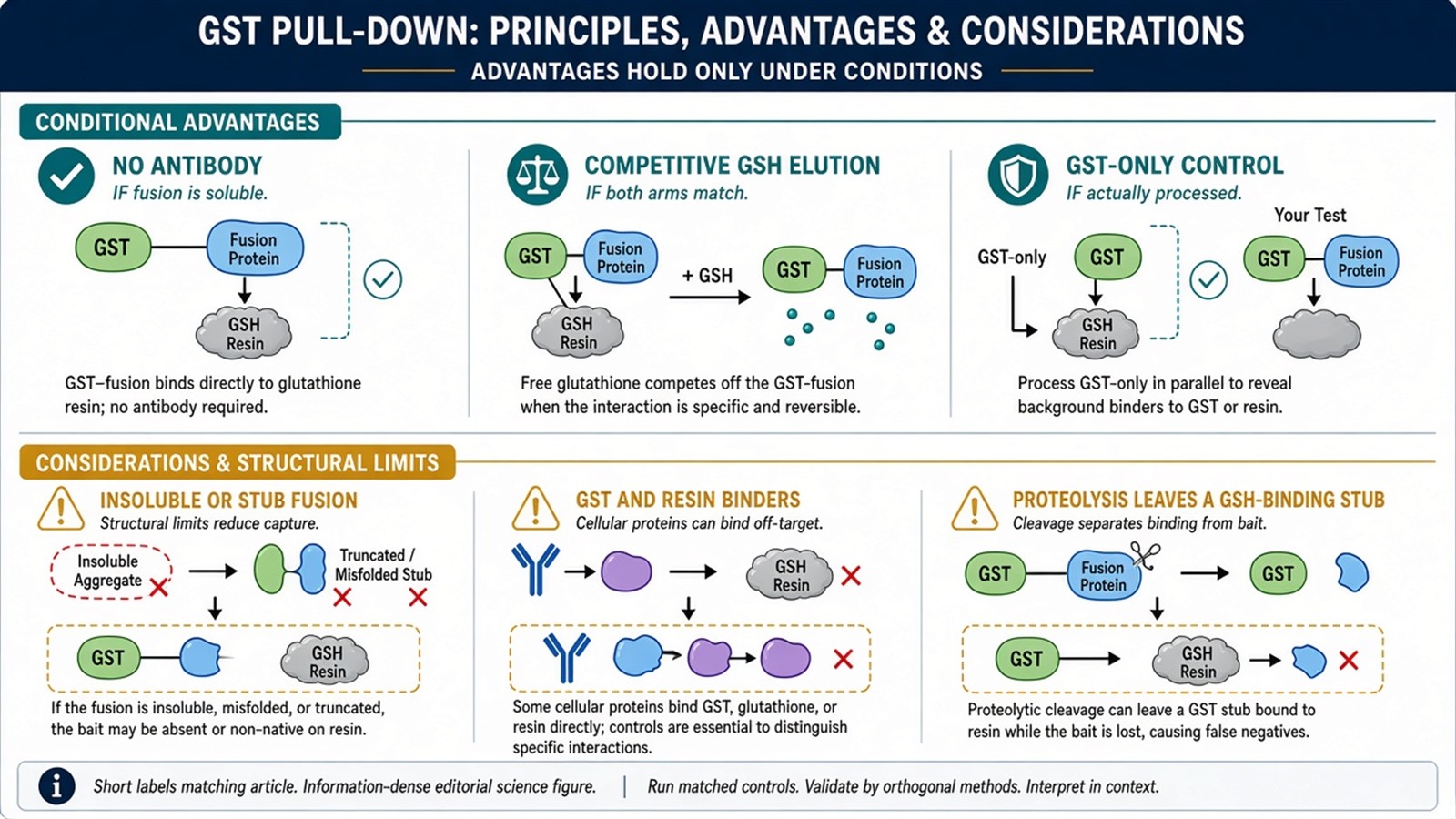
Figure 3. Supported when the fusion is intact and GST-only is processed: handle immobilization and tag-dependent co-recovery. Not granted by GSH exclusivity: low noise, intracellular scope, or a complete prey list.
Experimental Limits
The principle reduces a mixture to what GST, GSH, and the wash can hold. Diagnostic language sits outside ordinary research reporting unless a separately validated assay framework is in place.
Project Planning and Service Scope
A usable principle plan names the three events, the GST-only arm, the elution competitor, and the claim that will be allowed, before the first induction. MtoZ Biolabs scopes GST pull-down with Western or Orbitrap-class LC-MS/MS. Interpretability still follows those events, not the resin brand.
Once the principle is specified and the readout is an open list, the project can be scoped as pull-down MS. Researchers who need identification of a GST pull-down eluate can review the MtoZ Biolabs Pull Down based Protein Analysis Service with Mass Spectrometry for project-specific sample evaluation, feasibility assessment, and workflow planning.
Frequently Asked Questions
1. What is the principle of a GST pull-down assay?
GST occupies immobilized GSH, the fused bait is presented, and proteins that survive the wash are co-recovered. Free GSH reverses the handle and releases the mixture.
2. Does GST–GSH exclusivity mean the result is specific?
No. It means the handle can be captured and competed. Specificity of a prey is the GST-only comparison.
3. Is GST pull-down the same as GST purification?
They share event 1. Purification stops at recovery of the fusion. Pull-down asks about proteins that remained with that fusion.
4. Can this principle map intracellular networks?
No. The assay is in vitro. A network is a later overlay after many baits and orthogonal assays.
5. How does this page differ from the GST fusion and procedure pages?
This page names the three events. The fusion page is terminus, host, and handle artifacts. The procedure page orders the bench steps.
Reference
- Smith D.B., Johnson K.S. (1988). Single-step purification of polypeptides expressed in Escherichia coli as fusions with glutathione S-transferase. Gene, 67, 31-40. https://doi.org/10.1016/0378-1119(88)90005-4
- Vikis H.G., Guan K.L. (2004). Glutathione-S-transferase-fusion based assays for studying protein-protein interactions. Methods Mol. Biol., 261, 175-186. https://doi.org/10.1385/1-59259-762-9:175
- Einarson M.B., Pugacheva E.N., Orlinick J.R. (2007). GST Pull-down. CSH Protoc., 2007, pdb.prot4757. https://doi.org/10.1101/pdb.prot4757
- Harper S., Speicher D.W. (2011). Purification of proteins fused to glutathione S-transferase. Methods Mol. Biol., 681, 259-280. https://doi.org/10.1007/978-1-60761-913-0_14
- Phizicky E.M., Fields S. (1995). Protein-protein interactions: methods for detection and analysis. Microbiol. Rev., 59, 94-123. https://doi.org/10.1128/mr.59.1.94-123.1995
